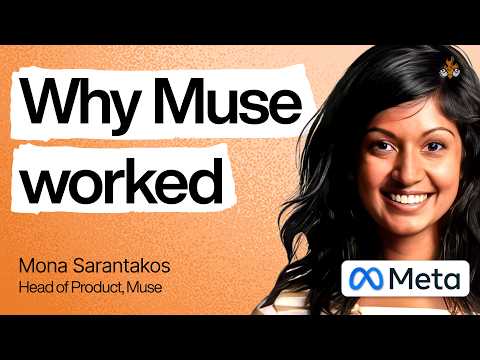




Meta’s Muse: How we launched the most successful consumer product this year | Mona Sarantakos
Why Muse Waited Seven Months to Launch
Although Meta started exploring consumer agents before competitors like Grok Bot, Claude Duet, and Dots, the team took seven months to launch. Having a functional product by spring, they spent the remaining months building custom benchmarks, red-teaming browser security vectors, and dogfooding with alpha testers under the mantra 'trust is a must.' Sarantakos maintains the wait prevented catastrophic trust failures.
How Zuckerberg, Friedman, and Wang Shaped Muse
Instead of formal slide reviews, the Muse team collaborated casually with leadership by passing phone prototypes around small rooms. Nat Friedman drove architecture and the external Sentinel security backstop, Alex Wang aligned the surprisingly agentic Muse Spark model with product needs, and Mark Zuckerberg pushed the team beyond task completion toward long-term user goal alignment, sparking the 'dreaming and study' proactive feature and the goals tab.
Sarantakos on the Unexpected Rise of Shopping
Weekly reviews of internal dogfooders and an external UX research panel kept the team grounded in everyday use cases rather than executive edge cases. While Sarantakos initially predicted personal productivity, health, and finance would dominate—and others bet on home automation—shopping unexpectedly emerged as a top use case, led by engineering manager Christine Awad's heavy testing. This forced the team to build dedicated shopping evaluations.
Using Agent Swarms and Handwritten Prompts for Evals
Because existing Meta AI data consisted of single-turn queries, the Muse team lacked production data for long-running, non-coding multi-turn tasks. They deployed 'agent swarms' to analyze ecosystem conversations, generate synthetic data, and surface specific production failures—such as users getting blocked on a merchant site. These insights feed a tiered evaluation hierarchy covering safety, capabilities, behavior, and use cases, though the team mandates that system prompts and behavioral specs be strictly handwritten by humans.
Word of Mouth and Starter Packs Drive Activation
The biggest hurdle for Muse is convincing users who already have a chatbot why they need an agent and helping them overcome 'first prompt freeze.' Sarantakos identifies peer word-of-mouth—seeing how a relatable friend actually uses Muse—as the number one activation lever. Inside the app, the team built an 'ideas tab' with pre-packaged starter packs that set up cron notifications and dashboards, and they are now implementing tiered onboarding for mainstream users.
Small Roof Team and the Vision for Ambient Agents
Muse started with roughly 10 people and stayed under 100 total—with just four PMs—working closely out of a rooftop 'library' in Menlo Park. Managing non-deterministic agents that handle real-life tasks like airline refunds, medical appointments, and kids' sports creates intense responsibility. Looking ahead, Sarantakos envisions Muse moving beyond a smartphone app into ambient hardware like glasses and charm devices, requiring less 'Tamagotchi' babysitting while helping users achieve financial betterment.