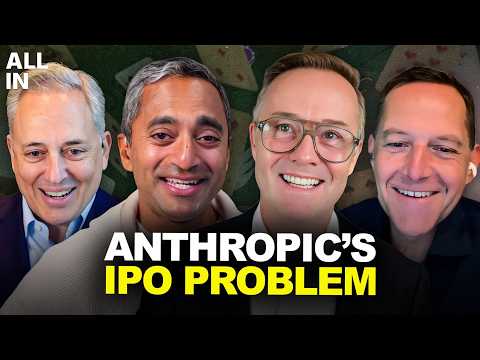
David Sacks contends that Dario Amodei's response to criticism is disingenuous, arguing that Anthropic's aggressive push for specific AI regulations constitutes regulatory capture. He refutes Amodei's claim of balanced messaging, citing past job loss predictions and contrived studies as evidence of fear-mongering designed to influence policy.
Friedberg: The 'Steel Man' of AI Risk
David Friedberg attempts to 'steel man' the argument for AI caution, positing that frontier lab leaders genuinely see profound risks like AI-designed bioweapons, cyberattacks, and societal manipulation. He argues that the inability to 'unobfuscate' model thinking tokens makes independent validation impossible, suggesting open-source models offer more transparency.
Sacks vs. FINRA for AI: A Regulatory Showdown
David Sacks strongly opposes a FINRA-style 'DMV for AI' regulatory body, arguing it would lead to capture, stifle innovation, and cede ground to China. He advocates for an MPAA-like model where the industry self-regulates through open standards and best practices, contrasting it with government-controlled, pre-release testing that would cause significant delays.
Flock Safety was founded nine years ago with the mission to create safer neighborhoods, initially selling basic license plate reading cameras. The technology has since evolved to detect vehicle features beyond just plates. The company now operates in over 6,000 cities, having solved over a million crimes and found over 10,000 missing people, including a recent case of a kidnapped toddler safely recovered within an hour.
Garrett Langley: Data Retention Trade-offs
Langley explains that data retention periods are crucial for efficacy, with 7 days being a reasonable trade-off for solving 90% of crimes, though longer periods (like 30 days or more) are more effective for complex cases like homicides or delayed reports of sexual assault. He emphasizes that cities should have the final say, but Flock sets strong defaults, recently shifting from 30 to 7 days.
Garrett Langley Addresses Vandalism and Communication
Langley expresses dismay over camera vandalism, calling those who incite it 'terrorists' and highlighting the felony charges faced by perpetrators. He admits Flock has faced communication challenges and acknowledges that activists, not terrorists, are ripping down cameras, believing they misunderstand the product's nuances and lack of facial recognition or video recording.
Anthropic is reportedly targeting a $2 trillion IPO, a valuation that would shatter previous records. This aggressive move comes despite potential market share erosion to competitors like OpenAI and Grok, highlighting the company's confidence in its growth trajectory and product offerings, particularly in enterprise solutions and coding assistance.
Infrastructure Bottlenecks: Energy and Data Centers
The exponential growth in AI demand is straining global infrastructure, particularly energy supply and data center capacity. While demand for AI tokens is soaring, the physical constraints of building and powering these facilities present a significant challenge, requiring massive capital investment and innovative solutions.
David Sacks: Zuckerberg's Critique of AI Doomers
Mark Zuckerberg's manifesto critiques AI 'doomers' (like those at Anthropic) for rushing to create a dystopian future they claim to fear, suggesting a contradiction in their approach. Sacks aligns with Zuckerberg's view that extreme concentration of power in AI is problematic and that decentralized outcomes are preferable, drawing parallels to Thomas Sowell's 'Vision of the Anointed' where intellectuals believe they can engineer society benevolently, often with negative consequences.
Rahm Emanuel labels the upcoming summit between Xi and Trump as a 'Summit of Disruption,' arguing that both superpowers are exporting their domestic dysfunction. He contends that China's export is economic dysfunction, crushing other nations' manufacturing, while the US exports political and cultural dysfunction, exacerbating tensions. He criticizes the current US president's style of 'punching down and kissing up' to adversaries, suggesting this approach isolates America and makes it vulnerable.
Emanuel: China's Strategy of Dependency
Rahm Emanuel argues that China's core strategy is to make other nations dependent on its markets and resources while achieving independence for itself. This approach aims to leverage economic power to manipulate and control other countries' sovereignty, creating duplicity in global trade and supply chains. He cites examples like the soybean dispute with the US and the diversification of suppliers for barley to illustrate this point. Emanuel believes this win-win rhetoric is a facade for a zero-sum game where China seeks maximum leverage with minimum vulnerability.
Forming Economic Blocs to Counter China
Emanuel proposes forming economic blocs with allies like Australia, Japan, South Korea, Taiwan, and the EU to collectively withstand China's economic pressure. He argues that 'isolating the isolator' through unified economic action is more effective than unilateral tariffs. This block would then organize research and capacity, particularly in defense, to confront China and its allies (Russia, Iran, North Korea). He criticizes the current administration for isolating America and making it vulnerable.
Google is shifting its strategic focus and capital allocation from developing frontier AI models to building out AI infrastructure, a move that has led to key researchers like Jeff Dean leaving to start new ventures. This pivot is driven by the high returns and lower beta associated with compute infrastructure compared to the high-risk, high-beta model development.
SpaceX's Stellar Quarter Fueled by AI Compute Rentals
SpaceX reported spectacular Q2 earnings with $7.8 billion in revenue, driven significantly by its 'Elon Web Services' renting out AI compute capacity, particularly to Anthropic and Google. This surge in AI revenue, alongside heavy capex investment, positions SpaceX as a major player in the AI infrastructure landscape.
The Starlink business is performing exceptionally well, demonstrating rapid subscriber growth and significant profitability, generating $2.6 billion in adjusted EBIT in the quarter. With 12 million subscribers and growing, it's on a trajectory to potentially generate $40 billion in revenue and $30 billion in free cash flow, making it a trillion-dollar business on its own.
The US Navy successfully used Saronic's autonomous speedboat, the Corsair, for the first time to rescue downed pilots in the Straits of Hormuz, demonstrating a critical advancement in saving lives without risking additional personnel. This operation signifies the Navy's trust in autonomous platforms for high-stakes missions.
Vib Alakar: Autonomy Drives Scale and Efficiency
Removing humans from ships drastically reduces complexity, cost, and build time by eliminating life support systems, crew quarters, and associated infrastructure. This allows for optimized naval architecture, increased speed, range, and payload, enabling mass production of capable vessels like Saronic's Corsair.
Vib Alakar: Vertical Integration and Software
Saronic achieves rapid, lower-cost production through vertical integration and investment in the supply chain, digitizing analog components with software APIs. This approach absorbs the complexity traditionally handled by humans in engine rooms, allowing for more efficient remote operation and democratizing decision-making for deployed assets.
Hedge fund manager Leopold Aschenbrenner's massive AI and chip stock portfolio was margin called and liquidated due to excessive leverage, demonstrating how rapid market downturns can amplify losses catastrophically. Despite earlier 100x returns, a 20% drop in the chip index, amplified by leverage, led to his fund's downfall, with Citadel reportedly buying the assets. This event underscores the inherent risk of leverage, even for brilliant investors.
Friedberg: Energy Abundance and AI Efficiency
The rapid advancements in renewable energy, particularly solar and battery storage, are leading to an abundance of energy with near-zero incremental cost. Simultaneously, AI is poised for significant efficiency gains, potentially cutting token consumption by 50-75%. These factors are largely underestimated in current economic forecasts and represent a major productivity boon.
Palihapitiya: The Looming Electron Deficit
America faces a massive electricity deficit by 2050, projected to be 1.7 terawatt hours short – equivalent to six times California's current energy consumption. This shortfall is expected to worsen with the increasing demand from AI and robotics, underscoring the critical need for expanded energy production and storage solutions.
Bernt Børnich: 1X's Focus on Embodied AGI and Ecosystem Development
1X is dedicated to solving embodied AGI to create an abundance of labor, emphasizing the need to focus on general problems and build a robust robotics ecosystem. Bernt Børnich highlights teleoperation as a key application, allowing humans to remotely control robots like Neo for tasks such as factory presence or managing remote power stations. This approach provides immediate utility and gathers valuable data. This strategy balances current practical applications with the long-term goal of advanced autonomous intelligence.
Bernt Børnich Predicts 'Hard Takeoff' in Robotics
Bernt Børnich predicts a 'hard takeoff' in robotics within a decade, potentially as soon as three years, where robots will become self-sufficient, building other robots, data centers, and even performing mining and refining. He stresses that physical AI is essential for progressing science, as models need to conduct and observe experiments. The rapid acceleration of AI development makes precise timelines challenging, but the shift is imminent. This era will usher in a true abundance of labor and fundamentally transform scientific discovery.
The Threat of Chinese Robotics
The discussion highlights concerns about Chinese robotics companies potentially stealing intellectual property and deploying cheaper, advanced robots that could flood the market. Dr. Fankhauser and others emphasize that while Chinese robots may excel in hardware, they often lack the integrated solutions, autonomy, and cybersecurity trust crucial for sensitive applications, posing a competitive and security risk.
Banning open-source AI models, particularly those from China, would be a catastrophic mistake for the United States. It would stifle innovation, cede the AI race to competitors, and artificially inflate costs for American businesses, putting them at a severe disadvantage globally. American companies must be free to leverage all public domain contributions.
Chamath Palihapitiya: Distillation is a Red Herring
The controversy around 'distillation' is largely a distraction. Companies like Anthropic could easily implement KYC measures to prevent misuse, but doing so would slow their growth. Their push for bans suggests a desire for regulatory protection rather than a genuine concern about distillation, which is a common practice across industries.
David Friedberg: Distillation is Benchmarking, Not Theft
Distillation, in the context of AI, is akin to benchmarking – observing outputs to improve one's own product. It's not IP infringement because it doesn't involve stealing proprietary code or weights. Companies like Google historically used similar methods. The focus should be on the output, not the process, and terms of service are the responsibility of the providers.
Mark Cuban argues that the current AI market is not a traditional bubble like the dot-com era because it lacks widespread public speculation and companies with no revenue. Instead, he believes the current AI investment frenzy primarily risks venture capitalists and funds that are 'going all in,' potentially leading to significant losses for these entities but not necessarily impacting the broader public.
David Sacks: M&A Stagnation and the Need for Public Markets
David Sacks points out that a four-year drought in acquisitions, partly due to regulatory stances on monopolies, has stifled corporate development. He argues that for disruptive AI companies, having the ability to go public via IPOs is crucial. This provides currency for future acquisitions and allows companies to adapt more nimbly than relying solely on cash raises, especially if the cost of capital increases.
Chamath Palihapitiya: The AI-First Workspace Divide
Chamath Palihapitiya observes a significant divide within companies between 'AI-first' employees who embrace the technology and those who don't. He likens this gap to the early days of PCs, where proficiency with office suites created a stark advantage. This literacy gap is becoming a critical factor in productivity and career progression.
Demis Hassabis has proposed a US-led international AI standards body, modeled after FINRA, to be industry-funded and run by independent experts. This voluntary body would assess models for risks like cybersecurity and national security, with the potential for mandatory compliance and development slowdowns if necessary. The proposal has garnered support from key industry figures like Elon Musk, Sam Altman, and Sundar Pichai.
Palihapitiya: Avoiding Regulatory Capture
Chamath Palihapitiya stresses the importance of quickly establishing rules to avoid regulatory capture, where powerful actors use their capital to influence legislation. He believes that while federal oversight and the DOJ will still play roles, an SRO can prevent a few large companies from 'pulling the ladder up' and stifling competition from startups and open-source initiatives. He views Demis Hassabis' proposal as a sensible step forward.
Sacks: Anthropic's Regulatory Strategy
David Sacks criticizes Anthropic's strategy of encouraging states to implement increasingly strict AI regulations, calling it a form of 'regulatory capture.' He argues this approach, detailed in a Politico article, creates a fragmented regulatory landscape that disadvantages startups and open-source projects, and that concessions to government will only lead to further demands, urging companies to 'grow a spine' and fight for a clear line, like the proposed SRO.
Pat Gelsinger argues that Intel's decline began when the company shifted from being run by deeply technical leaders to business-focused executives. He believes this led to critical strategic errors, such as passing on the iPhone chip and neglecting factory expansion and advanced manufacturing technologies like EUV machines, which were only justifiable from a technologist's perspective.
TSMC's Foundry Model: The Industry's New Standard
Gelsinger explains that TSMC's vision to become a dedicated foundry, manufacturing chips for any designer, fundamentally changed the semiconductor industry. Unlike Intel's integrated design and manufacturing (IDM) model, TSMC's open approach, supported by standardized design tools and massive investment, allowed for broad innovation and scale, eventually surpassing Intel significantly.
Geopolitical Risk: Taiwan's Critical Role and Energy Vulnerability
The conversation underscores the extreme geopolitical risk associated with Taiwan's dominance in chip manufacturing. Gelsinger points out Taiwan's limited energy reserves, suggesting a blockade could cripple global chip production within weeks, with devastating economic consequences. This highlights the urgent need for resilient, diversified supply chains.
ElevenLabs experienced an unprecedented revenue ramp, reaching $100 million ARR in 20 months, then $200 million in 10 months, and $300 million in 5 months, culminating in $600 million ARR by the end of the last year. This growth is attributed to the release of their human-sounding text-to-speech model in early 2023.
The AI-Powered Lean Organization: No PMs Needed
ElevenLabs operates without traditional Product Managers (PMs), a strategic decision made from inception. They embed engineers across all departments, including talent and legal, to foster automation and ensure quality control. This structure allows for rapid iteration and empowers individuals to handle multiple functions, fundamentally changing how software is built and managed.
Jason: The Pedal Revolutionizes LLM Interaction
The introduction of a physical pedal for interacting with Large Language Models (LLMs) has transformed the prompting experience. By allowing users to speak continuously without the fatigue of typing, it enables longer, more natural 'streams of consciousness' prompts, which LLMs handle exceptionally well, leading to significantly better outputs and a more fluid interaction.
SpaceX's recent IPO was a textbook example of a successful market debut, raising $75 billion at a $1.75 trillion valuation and trading up 25% on $35 billion in forward revenue, demonstrating a viable model for future mega-cap tech offerings. This success provides a crucial blueprint for OpenAI and Anthropic.
OpenAI vs. Anthropic: The IPO Race and Revenue Trajectories
While Anthropic is rumored to be ahead in revenue trajectory, OpenAI is regaining momentum with new models and a potential $70 billion revenue run rate, positioning both for trillion-dollar valuations. OpenAI faces corporate restructuring complexities, potentially delaying its IPO slightly compared to Anthropic.
The Unprecedented Scale of AI Revenue Growth
The potential for AI companies to add $200 billion in incremental revenue in a single year, growing from $100 billion to $300 billion, is historically unprecedented. This scale of growth, driven by the vast TAM of intelligence, suggests a fundamental shift in economic paradigms.
Chamath Palihapitiya: The Unprecedented AI Buildout
The current buildout of AI infrastructure is unlike anything seen before, requiring immense capital, time, and human intellect. Data centers are growing to the size of football fields, consuming power comparable to midsize cities, and are being constructed globally, indicating a massive, insatiable demand for AI hardware and capacity.
Jason Calacanis: The Rise of AI Reasoning and Intent
AI models are evolving from simply processing prompts to understanding user intent and strategizing, as seen with models like Fable and GLM 52. This leap in reasoning allows AI to offer better solutions and abstract complex tasks, fundamentally changing how humans interact with and leverage AI.
Andrew Feldman: Breaking Moore's Law for Inference
Cerebras has effectively broken Moore's Law for AI inference, achieving performance gains significantly exceeding the traditional 18-month doubling. This is due to a novel architecture optimized for the computational demands of AI reasoning, offering a new trajectory for hardware performance that outpaces older architectures like GPUs.
Alex Karp's CNBC appearance, framed by some as a 'crashout,' was actually a defense of 'sovereign AI,' arguing that enterprises and governments must retain control over their data, models, and compute to protect their intellectual property and strategic advantages. He criticized frontier models for risking the transfer of valuable IP.
The Economics of Open Source vs. Proprietary AI
Using open-source models, especially when wrapped with an agnostic control plane like 8090's software factory, can be dramatically cheaper (up to 16.4x) than proprietary models, even if slightly slower. This cost-effectiveness, combined with data control, makes open-source a compelling alternative for enterprises.
Nvidia's Strategic Pivot to Open Source AI
Nvidia, after initially downplaying its open-source AI models like Neotron, is now aggressively promoting them. This shift appears to be a strategic response to competitors like OpenAI and Anthropic developing their own chips, and to the broader ecosystem's need for competitive model options. Nvidia aims to 'own the whole stack' by offering both hardware and competitive open-source models, potentially disrupting the current AI landscape.
Partisanship is the overwhelming force driving US elections, making outcomes in most states highly predictable. This phenomenon, rather than widespread fraud, explains election results and the perceived 'blue shifts' in vote counts. The system's complexity and slow counting in places like California create an appearance of impropriety, but the underlying partisan alignment is the primary driver.
The Knicks' Playoff Resilience: Systemic Improvement
The New York Knicks' playoff success is attributed to spontaneous improvements in both defense and offense, particularly under coach Mike Brown and with Karl-Anthony Towns's evolving role. Their consistent playoff experience over the past four years has built resilience, enabling them to overcome deficits and demonstrate a level of dominance that makes them a formidable opponent for any team.
Nate Silver argues that Democrats have won recent elections primarily due to external factors like the pandemic or a weak Republican opponent, rather than effective strategy. He points out that Biden's approval among independents is significantly lower than Obama's, suggesting a failure to bridge divides. Silver believes candidates like Kamala Harris and Gavin Newsom, by defending the status quo, are employing a failing strategy that doesn't resonate with the need for change.
Socialist-endorsed candidates, supported by figures like Eric Adams, have achieved a significant sweep in New York City's Democratic congressional primaries. This includes victories in districts like the 10th and 13th, signaling a potential shift in the Democratic Party's base and a challenge to its establishment wing. The candidates' platforms often include radical proposals such as abolishing the Senate, the carceral state, and ICE, reflecting a post-American ideology.
Travis Kalanick: Truth and Justice as Societal Immune System
Travis Kalanick proposes that 'truth and justice' function as society's immune system. When this system is suppressed, whether through the erosion of truth in media or the lack of consequences for crimes, societal ills flare up. He uses the COVID-19 pandemic and the Fauci case as examples of how a lack of truth and justice can lead to prolonged suffering and distrust, suggesting that monitoring the trajectory of truth and justice is key to understanding a society's health.
Chamath Palihapitiya: The Case for Age-Gated Social Media
Chamath Palihapitiya argues that restricting social media access for individuals under 16 is crucial for preventing early addiction to 'digital drugs.' He believes this measure, if adopted by countries like Canada, the UK, and the US, could lead to a less radicalized youth and greater political stability in the long run. This approach, he suggests, fosters healthier information consumption habits, akin to a balanced diet for long-term well-being.
Ryan Cohen: From Chewy's Success to GameStop's Challenge
Ryan Cohen's entrepreneurial journey began with Chewy, where he focused on operational efficiency and a superior consumer experience, principles he initially attempted to apply to GameStop. However, he learned that a direct playbook transfer was flawed, necessitating a pivot to a strategy more suited to GameStop's unique retail environment and market position.
Ryan Cohen: The Vision for eBay Acquisition
Ryan Cohen believes eBay is undervalued and possesses massive potential, citing its poor execution, slow growth, and strained seller relationships as key areas for improvement. His proposed $56 billion acquisition plan centers on a three-part vision: drastic cost reduction, expansion of live commerce, and the creation of a digital marketplace for in-game collectibles, aiming to revitalize the platform.
Friedberg: The Rise of the 'Politburo' and Erosion of Liberty
A new political class, akin to a 'politburo,' is forming in the United States, seeking to control the economy, education, and media. This group, characterized by figures like Elizabeth Warren and Bernie Sanders, masquerades as virtuous while aiming to seize the means of production and dictate individual freedoms, ultimately leading to a loss of liberty and economic mobility for citizens. This trend is exemplified by policies that erode private property rights, such as the new tax law in Illinois.
SpaceX's Record IPO and Cursor Acquisition
SpaceX achieved a record-breaking IPO, raising $85 billion and reaching a market cap over $2 trillion, briefly surpassing Amazon and Microsoft. Concurrently, SpaceX exercised its option to acquire Cursor, a coding agent that initially used Anthropic's Claude. This strategic move, valuing Cursor at 15 times its $4 billion revenue, integrates AI capabilities and strengthens SpaceX's position in the market, demonstrating exceptional business acumen.
Sacks: Elon Musk's Trillionaire Status is Paper Wealth
Elon Musk's designation as the world's first trillionaire is a reflection of the market's increased valuation of his SpaceX shares, not an increase in his personal liquid assets. He holds the same amount of wealth as before the IPO, bound by a one-year lockup period. This 'paper wealth' underscores the distinction between owning productive assets and having readily available cash, emphasizing that his wealth is tied to the future potential of the companies he builds.
Chamath: Anthropic's Fable 5 and the Specter of Censorship
Anthropic's new Fable 5 model, while powerful, introduces significant risks of censorship and business disruption due to its data retention policies and the potential for arbitrary downgrading of capabilities. This necessitates a new approach to AI governance focused on control and diversity of options.
Jason Calacanis: Anthropic's Regulatory Capture Strategy
Anthropic's actions, including mandatory surveillance and model downgrading, coupled with calls for new regulatory bodies, suggest a sophisticated campaign for regulatory capture. This strategy aims to stifle competition, particularly from open-source models, and consolidate power.
Chamath: The Capital Challenge of Building Open-Source AI Infrastructure
Building the necessary data center infrastructure for large-scale open-source AI development requires immense capital, with costs escalating dramatically. This financial barrier makes it challenging for the US to compete with nations that may not face similar constraints.
Eco R1 Capital employs a contrarian strategy in biotech investing, focusing on companies that are unfollowed, unloved, and misunderstood. This approach aims to identify undervalued opportunities that the broader market overlooks. The current environment presents a unique moment for such companies, suggesting potential for significant returns by investing against the prevailing sentiment. The conclusion is that overlooked biotech firms represent a fertile ground for alpha generation.
Oleg Nodelman pitches Aktis Oncology (AKTS), a biotech company focused on radiopharmaceuticals for cancer treatment. He details their platform's ability to deliver targeted radioactive payloads with minimal collateral damage, likening it to 'autonomous assassination.' Nodelman highlights the company's strong cash position, de-risking strategies like targeting known valid targets (Nectin 4, B7H3), and the significant interest from major pharmaceutical companies, suggesting a substantial valuation potential if programs succeed.
Oleg Nodelman: Aktis Oncology's Biotech Potential
Oleg Nodelman pitches Aktis Oncology, a biotech company aiming to develop novel therapeutics for solid tumors. While acknowledging the potential for significant, platform-level outcomes, he also notes the inherent risks in biotech, including regulatory hurdles, competition from new modalities, and potential intellectual property issues, particularly concerning China. The company's success hinges on demonstrating a broadly applicable mechanism for drug targeting.
Senator Fetterman emphasizes that bipartisanship is crucial for governing, especially in the current polarized climate. He believes that finding common ground is not just ideal but necessary for the nation's progress, and that Pennsylvania serves as a model for this approach. He asserts that country must come before party.
McCormick: Pennsylvania as a Microcosm
Senator McCormick views Pennsylvania as a microcosm of the nation, where building a coalition across urban and rural divides is key to electoral success. He notes that voters expect collaboration, and that the state's diverse demographics necessitate finding common ground, which he believes is essential for addressing consequential issues.
Fetterman: The Filibuster as a Safeguard
Senator Fetterman now defends the filibuster, admitting his previous stance was wrong. He argues it forces senators to work together and protects minority rights, viewing its elimination as a dangerous step towards the House's hyper-partisanship. He considers defending the filibuster a hill he would die on.
Palo Alto Networks tested an AI model, Mythos, for six weeks and discovered vulnerabilities that would have typically taken five to seven years to find. This demonstrates AI's profound capability to rapidly assess codebases for security flaws, far exceeding human capacity and speed.
The Demise of Analytical SaaS
Arora argues that analytical SaaS companies are finished because AI can now perform data analysis directly. Businesses will no longer need to buy separate software modules to analyze their data; instead, they can run AI models against their consolidated data, drastically reducing costs and complexity.
AI as a Utility: The Future of Models
Arora predicts that AI models will become a utility, allowing users to purchase intelligence on demand for specific tasks at varying IQ levels and price points. The real profit pools will not be in the models themselves, but in the applications built on top of them that solve specific business problems.