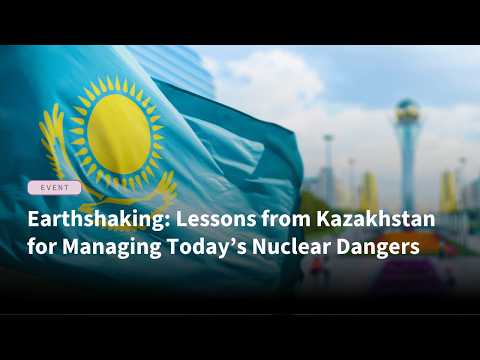
Ambassador Magzhan Ilyassov emphasizes that the Nevada-Semipalatinsk movement, a powerful grassroots initiative, was instrumental in pushing Kazakhstani politicians to make the decision to close the Semipalatinsk Test Site. He argues that this public engagement is critically lacking today, despite the tense geopolitical situation and erosion of international legislation, leaving nuclear threats largely unaddressed by the general public. The movement's ability to force nuclear disarmament onto the political agenda serves as a forgotten but vital lesson for contemporary advocacy.
Kazakhstan's Nuclear Legacy
Kazakhstan, upon gaining independence, made the monumental decision to close the Semipalatinsk nuclear test site and voluntarily relinquish its inherited Soviet-era nuclear arsenal. This included transferring weapons and delivery systems to Russia and securing highly enriched uranium, demonstrating a commitment to non-proliferation and international cooperation.
Project Sapphire: A Model of Cooperation
The 1994 Project Sapphire operation, where the U.S. and Kazakhstan collaborated to remove nearly 600 kg of highly enriched uranium, exemplifies successful international cooperation in securing dangerous nuclear materials. This operation, requiring trust, discretion, and technical expertise, highlights how shared responsibility can overcome complex security challenges.
The Panel Debates the Erosion of Nuclear Deterrence Credibility and Public Awareness
Ambassador Magzhan Ilyassov argues that the popular phrase 'no winners in a nuclear war' needs to be brought back into public focus, as the deterrence concept loses credibility with more countries acquiring nuclear weapons. David E. Hoffman expresses pessimism, citing North Korea's and China's nuclear buildup, while Corey Hinderstein agrees that the global consensus against nuclear war is eroding, with increasing conversations about 'limited' nuclear war. Hinderstein stresses the importance of desiloing the conversation, presenting nuclear weapons as a societal, economic, and stability trade-off, rather than just a nuclear one, to shift public sentiment. The panel concludes that the taboo against nuclear use is breaking, making public re-engagement on the true costs of proliferation more urgent than ever.
Nevada's Nuclear Testing History and Its Human Cost
Congresswoman Titus detailed the history of nuclear testing at the Nevada Test Site, which hosted over 900 tests, including atmospheric tests that exposed soldiers, workers, and nearby communities to radiation. She highlighted the ongoing struggle for veterans to receive recognition and benefits for radiation-related illnesses, advocating for legislation like the Presume Act to address these historical injustices.
The Peril of Resuming Nuclear Testing
Congresswoman Titus strongly criticized the Trump administration's call to resume nuclear testing, citing its potential to reignite an arms race with China and Russia, proliferate nuclear weapons, and undermine U.S. leadership in non-proliferation. She emphasized that subcritical testing technologies already allow for weapon safety assessments without full-scale explosions, rendering new testing unnecessary and dangerous.
Panelists Discuss the Challenge of Trilateral Arms Control with China and Russia
Andrew Weber warns that the world is 'sleepwalking towards a nuclear war,' emphasizing the growing threat of 'limited' tactical nuclear weapons, which are becoming normalized. He advocates for raising this issue in international arms control discussions with both Russia and China, noting Russia's vast tactical nuclear arsenal and China's current lack thereof. Weber suggests a practical step could be discussing with China how to keep tactical nuclear weapons out of the Indo-Pacific region. Corey Hinderstein adds that technical verification approaches are crucial to enable future political commitments, and that the 'three-body problem' of trilateral arms control is a complex challenge requiring innovative solutions. The panel concludes that addressing the proliferation of tactical nuclear weapons and establishing verifiable commitments with all major nuclear powers is paramount to preventing catastrophic conflict.
Lessons from the Past for Present Dangers
Congressman Foster, a physicist, emphasized that the successes of the 1990s in nuclear threat reduction were achieved through cooperation and political will, contrasting this with the current environment of geopolitical rivalry and treaty erosion. He warned that the chances of miscalculation are higher now than during the Cold War, stressing the need for dialogue and evidence-based policies.
Foster: The Physicist's Duty
As the sole PhD physicist in Congress, Bill Foster feels a profound responsibility to advocate for global nuclear security and the peaceful harnessing of atomic power, emphasizing the need for careful stewardship of nuclear capabilities.
Kazakhstan's Legacy of Non-Proliferation
Kazakhstan's decision to close the Semipalatinsk nuclear test site and relinquish its inherited nuclear arsenal, supported by the US, demonstrates a sustained commitment to non-proliferation and international cooperation, serving as a model for global security.
Weber: The Dangers of Resuming Nuclear Testing
Resuming nuclear testing would be a self-defeating and dangerous move, undermining US advantages, risking a cascade of testing by other nations, and potentially sleepwalking into a new era of nuclear competition defined by suspicion and secrecy.
Foster: AI and the Fissile Material Control Point
The advent of AI significantly lowers the barrier to nuclear weapon design, making fissile material itself the primary control point against proliferation and nuclear terrorism, as AI can now simulate weapon designs with relative ease.
Holgate: Kazakhstan's Choice of Security Through Diplomacy
Kazakhstan's decision to relinquish nuclear weapons was a bold, courageous choice for security through diplomacy and international cooperation, recognizing that these weapons were a source of weakness rather than strength.
Weber: The Need for 'Crazy' Solutions
Given the current geopolitical climate, we must consider 'crazy' ideas that were once deemed unnecessary, like the Nunn-Lugar Cooperative Threat Reduction Program, as potential solutions to tomorrow's WMD challenges, requiring readiness to act when opportunities arise.
Shifting Arms Control Focus
The current approach to arms control, which relies heavily on numerical limits, is mathematically flawed and unlikely to achieve security. A more effective strategy would focus on assessing and controlling capabilities rather than fixating on specific numbers. This shift is necessary because the math simply doesn't work with current models, leaving the US in a position where it cannot counter all threats simultaneously. The focus should be on desired consequences, not just the numbers that define them.