Has empire shaped today's world? | Doha Debates
Nigel Biggar Cites Indigenous Buy-In
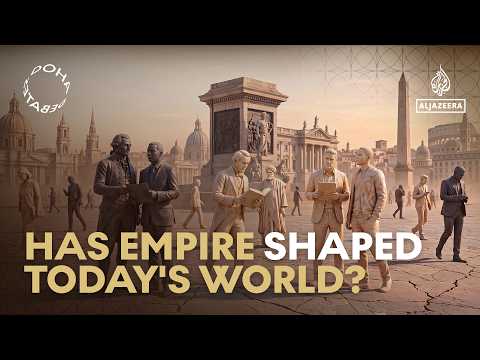
Nigel Biggar argues the British Empire in India and Africa depended on indigenous participation, noting that in 1900 just 164,000 Britons ruled 300 million Indians and East Africa had one colonial official per 20,000 Africans. Gurminder K Bhambra counters that Britain imposed income tax on Indians without democratic representation, while Ian Almond describes British rule as strategic divide-and-rule.
East India Company Taxes and Bengal Famines
Gurminder K Bhambra explains that after the 1757 Battle of Plassey, the East India Company gained tax rights over 30 million people in Bengal, Bihar, and Orissa and sent the revenue to England rather than funding famine relief like the Mughal emperors had. She states the resulting 1770 Bengal famine killed one-third of the population while the Company increased tax collection by forcing survivors to pay the taxes of the dead. Nigel Biggar concedes the Company taxed when it should not have, but argues famines existed in pre-British India.
Disputing Slave Trade Numbers and Chattel Status
Nigel Biggar argues slavery was practiced globally until the early 1800s, citing estimates that Europeans transported 12.5 million Africans across the Atlantic while Arabs transported 17 million Africans. Gurminder K Bhambra disputes both the numbers and the equivalence, stating the author of those figures admits 17 million over 12 centuries is a vast overestimate and 12.5 million over three to four centuries is an underestimate. She stresses that European slavery uniquely commodified human beings as collateral for loans and mortgages alongside Enlightenment emancipation rhetoric.
British Abolition, Wokeness, and Reparations
Inaya Folarin Iman argues that Britain's expenditure of a significant portion of its GDP to compensate slave owners and expedite abolition was a moral victory, even if aligned with economic shifts. Mohamed Hassan asks why moral action then is praised while reparations today are labeled woke, a point Gurminder K Bhambra and Ian Almond endorse. Iman replies that she supports targeted reparations for specific events like the Holocaust or the Mau Mau rebellion, but argues trillion-pound slave-trade reparations would bankrupt British society.
Nigel Biggar's Balance Sheet vs Recolonization
Nigel Biggar outlines a moral balance sheet for the British Empire: debits include inadvertent disease in North America and Australia, unjust land seizures, racism, and disproportionate violence, while credits include abolishing slavery, ending Indian famine around 1900, Royal Navy trade protection enabling firms like Tata, liberal institutions, and standing alone against Nazi Germany from May 1940 to June 1941. Gurminder K Bhambra rejects the credit-and-debit framing, noting that after defeating Japan in 1945, Britain used the Indian Army to help France and the Netherlands violently recolonize Indonesia, Malaya, and Vietnam.
Development Aid Over Reparations and Final Lessons
Speaking as a UK legislator, Nigel Biggar rejects formal apologies and reparations because no living person is guilty of historic slavery and multiple regions participated in slave trading, advocating instead for regret and development aid to address present injustices. In closing reflections, Inaya Folarin Iman warns against treating Western history as an unforgivable original sin, while Gurminder K Bhambra insists rigorous scholarship on contested histories is needed to stop reproducing past inequalities. Biggar concludes unequal power is permanent and must be used well, while Ian Almond argues empire's supply chains of suffering never ended.