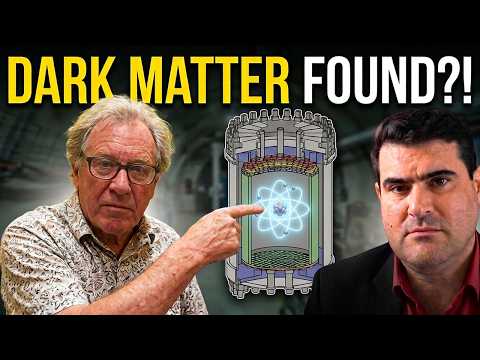
The Lux Zeppelin (LZ) experiment, located deep underground, is the latest in a 40-year lineage of experiments designed to directly detect dark matter particles. Its primary goal is to test various models of dark matter, including the long-standing WIMP hypothesis, by searching for faint interactions within a massive detector.
Brian Keating: The Universe's Composition
The universe is composed of approximately 70% dark energy, 25% dark matter, and less than 5% conventional baryonic matter (the stuff we are made of). While dark matter's gravitational influence is well-observed, its fundamental nature remains unknown, posing a significant challenge to physics.
Rick Gateskill: The WIMP Hypothesis and Its Evolution
The WIMP (Weakly Interacting Massive Particle) hypothesis, nearly 50 years old, posits that dark matter particles interact with ordinary matter via weak forces, similar to those described by the Standard Model. While elegant, the search for WIMPs has been constrained by assumptions about interaction types, leading to the exploration of broader interaction models.
Dark Matter Models and Experimental Reach
The search for dark matter spans an enormous range of possible interaction cross-sections, driven by theoretical models involving exchanged particles with varying masses. The sensitivity of detectors has improved by eight orders of magnitude over 40 years, effectively 'beating Moore's Law' in terms of progress. This vast improvement is necessary because theoretical models can predict interaction probabilities that vary wildly, requiring detectors to probe extremely low interaction rates.
The Cold Dark Matter Model's Resilience
The standard Cold Dark Matter (CDM) model has remarkably survived decades of scrutiny and continues to make predictions that align with new measurements. Its persistence is attributed to its ability to explain a wide range of cosmological observations, making the identification of its constituent particle a critical goal for understanding fundamental physics and the universe's composition, which currently remains largely unknown (95% dark matter and dark energy).
The Xenon Detector's Unique Design
The LZ experiment utilizes seven tons of liquid xenon, a rare noble gas, within a repurposed gold mine to achieve extreme purity and low radioactivity. This setup allows for the detection of faint signals from dark matter interactions by measuring both primary scintillation light (S1) and secondary light from drifting electrons (S2). The combination of these signals provides spatial information and helps characterize the interaction type, distinguishing potential dark matter events from background radiation.
The Challenge of Backgrounds and Signal Characterization
Identifying a true dark matter signal amidst pervasive background noise is a primary challenge. Mundane backgrounds, such as radioactive isotopes like radon and krypton dissolved in the xenon, can mimic dark matter interactions. The ratio of S2 to S1 light signals is a critical tool for discriminating between nuclear recoils (expected from dark matter) and electron recoils (typical of background radiation), allowing scientists to filter out unwanted events.
LZ's Low-Energy Search and Background Challenges
The LZ experiment is capable of searching for dark matter events at extremely low energies, down to a few keV for nuclear recoils and electron equivalents. However, quantifying the chance of conventional interactions mimicking a dark matter signal in this low-energy regime is a significant challenge. Despite running for 220 live days, LZ has not observed a statistically significant excess of nuclear recoil events consistent with WIMP dark matter in this low-energy range, establishing it as world-leading in 'seeing nothing' in this mass range.
Inelastic Scattering and High-Mass Dark Matter
Inelastic scattering models, where dark matter particles interact by transitioning between closely spaced energy states (e.g., a few hundred keV separation), offer a potential explanation for why simpler WIMP models haven't yielded results. Such interactions could be consistent with higher-mass dark matter particles (around 1.1 TeV) and might be challenging to detect at colliders like the LHC, making direct detection experiments like LZ crucial for probing these scenarios.
Rick: The LZ Detector's Shielding
The LZ detector is meticulously designed to be the quietest place on Earth, employing multi-layered shielding and specific materials like gadolinium to detect neutrons and minimize background noise, ensuring that any detected events are not produced by conventional means. This includes an outer detector specifically designed to catch neutrons attempting to enter or exit the main detector.
Rick: The Single Event and Statistical Significance
After 220 days of data collection, the LZ experiment found one event that lies close to the nuclear recoil band. While initially appearing as a 3.4 sigma local excess, rigorous statistical analysis, including accounting for 'look-elsewhere' effects and potential background fluctuations like multi-scatter single ionization (MSSI), reduces the global significance to 2.6 sigma, equivalent to a 1 in 200 chance of being a background event. This means it's not yet a definitive discovery.
The Neutrino Fog
The LZ detector has accumulated around 20 neutrino events from the 8-boron component of solar neutrinos. These neutrinos, scattering off xenon, create a background 'fog' that can obscure potential dark matter signals, especially at lower energies. As detectors scale up and run for longer, atmospheric and supernova neutrinos will also contribute to this background, necessitating precise statistical analysis to distinguish them from dark matter.
MOND vs. Cold Dark Matter
MOND (Modified Newtonian Dynamics) was designed to explain galaxy rotation curves without dark matter, and it performs well in that specific regime. However, cold dark matter has proven remarkably successful across a vast range of cosmological scales and evolutionary histories. Recent Gaia data showing a 'dip' in stellar kinematics is challenging for both paradigms, but MOND faces broader challenges in explaining cosmological structure formation compared to the well-established cold dark matter model.
Directionality and Cleaning the Fog
While the neutrino fog is a challenge, directional detection could help distinguish dark matter signals from neutrinos. Dark matter's galactic motion creates a directional skew in recoils, unlike the isotropic neutrino background. Although liquid xenon detectors like LZ currently lack this directional capability, research into alternative targets and gas-based detectors shows promise for future experiments to overcome this limitation.