Director Breaks Down His Own Movie Scene by Scene
The Babylonian Exile: A Bridge to Gentile Salvation
The Babylonian exile is a pivotal moment in biblical history, marking a shift from a purely Jewish narrative to one that includes Gentiles in God's plan for salvation. The use of Aramaic in parts of Daniel, the language of the Gentiles, and Daniel's vision of the 'Son of Man' (Bar Anash) are crucial links that Jesus later referenced, signifying a broader path to salvation through Christ.
The Paradox of the Cross and Christ's Supremacy
The ultimate paradox of Christianity is the Creator of the universe dying on a wooden cross, a symbol of sin and separation from God. This act of humility and grace, coupled with Christ's dying words, 'Father, forgive them,' demonstrates a level of purity and otherworldliness unmatched in history, highlighting His supremacy over all beings and kingdoms.
Authenticity and Audience Reception
Making Christian films authentically to the text can serve both believers and non-believers by providing unmediated access to scripture, similar to how 'The Odyssey' might inspire readers to engage with the original text. For Christians, accuracy is paramount to avoid theological questions, while for non-Christians, a less explicitly Christian approach, like 'Lord of the Rings,' might be more effective in planting spiritual seeds.
The Power of Names and Identity
Kooman emphasizes the profound significance of names in the biblical narrative, illustrating how they are tied to identity and destiny. He explains that Nebuchadnezzar renaming Daniel to Belshazzar, meaning 'Baal is my judge,' was a deliberate act to undermine Daniel's identity and allegiance to 'the Most High.' This artistic choice in the film highlights the gospel's message of new identity in Christ, where believers are given a new name and become a new creation. The director connects this to the biblical accounts of Abram becoming Abraham and Sarai becoming Sarah, showing how name changes signify divine elevation and purpose.
The Nuance of Prophecy and Discernment
The discussion delves into the nature of prophecy and the critical skill of discernment, particularly in the context of Nebuchadnezzar's dream and Daniel's interpretation. Kooman shares a personal anecdote about experiencing prophecy, emphasizing that true prophecy reveals the secrets of the heart, leading to humility and recognition of God's power, not self-aggrandizement. He contrasts this with counterfeit prophecy and highlights Daniel's humility in attributing all knowledge to God. This leads to an exploration of Nebuchadnezzar's allure to Daniel's gift, representing a fascination with power rather than the divine source.
Filming Miracles: The Wind and the Rock
During the filming of Daniel's interpretation of Nebuchadnezzar's dream, an intense wind swept across the set precisely as the actor playing Daniel quoted scripture about a 'rock cut out not by human hands.' This event, witnessed by over a hundred crew members, was interpreted by the director as a divine confirmation of the word of God, highlighting the active nature of scripture.
Divine Location Scouting: The Fiery Furnace
The search for a suitable location for the fiery furnace scene proved difficult until the crew prayed for divine guidance. An hour later, a 'god ray' beamed onto a specific, previously unnoticed spot near the Jerusalem set, which was then identified as the perfect location for the furnace. This event led a crew member to express belief, reinforcing the idea that God actively participates in the filmmaking.
Daniel's Vulnerability and Susanna's Role
Addressing the challenge of Daniel's seemingly unwavering character, Kooman introduces Susanna (from apocryphal texts) as a character who draws out Daniel's vulnerability. In a key scene, Daniel admits uncertainty about facing the impending decree, prompting Susanna to challenge his fears. This interaction leads to Daniel's prayer, where he confesses sin and weakness, highlighting that even biblical heroes experience vulnerability and rely on God, a message intended to encourage viewers.
The Scholarly Debate on Daniel's Authorship
The interviewer raises a significant challenge regarding the Book of Daniel, presenting the critical scholarly view that it's a second-century text written during the Maccabean revolt, implying false prophecy and questioning its reliability, especially since Jesus quoted it. This perspective suggests the book was a historical narrative disguised as prophecy. The interviewer states that critical scholars have 'won out' in this debate.
Daniel Kooman: The Core of the Story
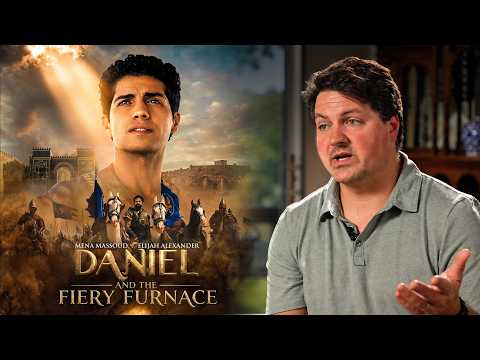
The film 'Daniel and the Fiery Furnace' focuses on the Babylonian exile and culminates in the fiery furnace event, aiming to balance epic visual scope with intimate character development. The narrative's entry point is the origin of the Babylonian exile, starting in Jerusalem but quickly moving to Babylon, with the fiery furnace as the story's climax. This approach was chosen to tell a contained story within the larger narrative possibilities of the Book of Daniel. The final sentence emphasizes that this scope was carefully selected to tell a compelling story within the film's constraints.