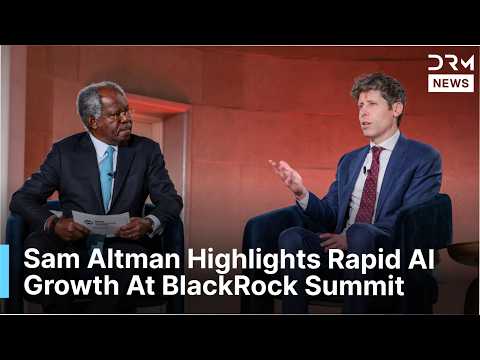
FULL INTERVIEW: OpenAI CEO Sam Altman Speaks on AI Scaling and Infrastructure Need | DRM News | AI1F
Altman on AGI Timelines and Cognitive Capacity
Sam Altman suggests that defining Artificial General Intelligence (AGI) is complex, with varying interpretations of its arrival. He posits two key thresholds: one, when global cognitive capacity in data centers surpasses that outside (potentially by late 2028), and two, when leaders in major fields cannot perform their jobs without heavy AI reliance. The latter, he believes, is not far off, transforming roles into AI supervision.
OpenAI's $110B Funding for Infrastructure Scale
OpenAI has secured $110 billion in funding, significantly larger than any previous public offering, to address the extreme infrastructure costs of AI. Sam Altman emphasizes that compute is revenue and that the business model relies on selling tokens. The company's principle of abundance aims to flood the world with intelligence, requiring massive upfront investment in infrastructure to avoid capacity constraints.
Altman on AI Chip Development: Inference Focus
OpenAI is developing an inference-only chip aimed at being the cheapest and most efficient per watt, addressing future agent demand. Sam Altman distinguishes between training chips (massive processing for model creation) and inference chips (efficient execution of trained models). He expects the first chips to be deployed at scale by year-end, with initial units available in months.
Altman: AI as a Fundamental Scientific Principle
Sam Altman likens the discovery of deep learning to uncovering a fundamental property of physics, suggesting that AI's core principles will become widely understood, much like the transistor. While operational knowledge and infrastructure will offer competitive advantages, the underlying science will be accessible. He notes the US leads in frontier models, while China leads in cheaper inference and open-source, with the US currently leading overall.
Altman: Democratic vs. Autocratic AI Development
Sam Altman argues that decisions about transformative technologies like AI should belong to society through democratic processes, not just the companies developing them. He believes AI's potential to reshape economies and geopolitics necessitates public input, learning from the internet's societal impact. Companies like OpenAI are becoming critical infrastructure providers, but societal consensus must guide the rules and limitations.
Altman: Managing Abundance vs. Scarcity
Sam Altman suggests that society, structured for millennia to manage scarcity, is ill-equipped for the coming era of abundance driven by AI. This shift challenges traditional capitalism, labor-capital dynamics, and economic metrics like GDP, which may decline even as quality of life improves. He anticipates painful but necessary adjustments and debates to redefine systems for this new prosperity.