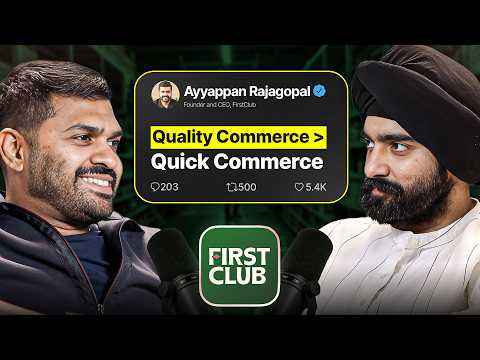
Ayyappan Rajagopal: Quality Over Speed is the Core Thesis
FirstClub's fundamental business strategy is a contrarian bet on quality over speed, challenging the prevailing quick commerce model. While competitors focus on 10-minute deliveries, FirstClub believes consumers prioritize quality and are willing to wait slightly longer (15-30 minutes) for it. This focus is reflected in their significantly higher average order value (₹1200+) compared to industry norms, indicating a customer base that values product integrity.
Making Quality Affordable: The Supply Chain Advantage
Contrary to the belief that quality must be expensive, FirstClub leverages supply chain integration to make high-quality products affordable. By controlling the value chain from sourcing to delivery and working with a curated set of brands, they reduce logistics and inventory costs. This efficiency allows them to offer better quality products at comparable or marginally higher prices than competitors, directly challenging the economic model of quick commerce platforms that rely on high margins from lower-priced goods.
Private Label: Filling Quality White Spaces
FirstClub's private label strategy is not about maximizing margins but about filling 'white spaces' with high-quality products that are either unavailable or of lower quality in the mainstream market. Examples include offering premium cashews at accessible prices and launching chocolates made with 100% couverture chocolate, not cocoa mass and palm oil, at competitive price points. This approach involves working with manufacturers to ensure quality standards are met and then making these superior products affordable for consumers. This strategy aims to redefine consumer expectations for quality within specific categories.
Vimarsh Razdan: The Foundation of UnderNeat's Success
Vimarsh Razdan emphasizes that UnderNeat's rapid success is built on years of hard work and experience, not overnight luck. His background in fashion manufacturing and previous entrepreneurial ventures provided a strong foundation for understanding business operations, supply chains, and customer needs, which he applied to building a large-scale company.
UnderNeat's Customer-Centric Product Strategy
UnderNeat prioritizes customer feedback above all else, using it to drive product development (NPD) and go-to-market (GTM) strategies. They actively listen to customer needs, iterate on products, and even discontinue those that don't meet satisfaction, ensuring a strong product-market fit and customer loyalty. This approach has led to a focused product line with high repeat rates.
The Celebrity Co-Founder Dynamic
Vimarsh Razdan discusses the dual nature of having a celebrity co-founder, like Kusha Kapila for UnderNeat. He acknowledges the significant advantage in brand visibility and customer acquisition that such a partnership brings. However, he also points out the inherent challenges, suggesting that managing the celebrity aspect requires careful strategy to ensure it complements, rather than overshadows, the core business operations and brand identity. This balance is key to leveraging the celebrity's influence effectively.
Vimarsh Razdan's journey to co-founding UnderNeat is built on over a decade and a half of experience in the apparel industry, including scaling a division to 500 crores and previously launching brands in India. This extensive background provided him with the foundational knowledge in sourcing, manufacturing, and business operations necessary to tackle the D2C market, despite a prior entrepreneurial venture facing setbacks.
Navigating Supply Chains and Market Size for Founders
For apparel founders, a robust supply chain is paramount, not just for production but for fulfilling demand when it arises. While initial supplier sourcing might seem manageable, the true challenge lies in identifying products with a significant delta over competitors and building repeat business. Founders should focus on niche markets where larger players aren't investing, scale that niche, and then consider competing directly.
The Long Game: CAC, Repeats, and Trust
Focusing solely on short-term Customer Acquisition Cost (CAC) gains is a flawed strategy for long-term business building. While working with creators initially lowers CAC, the real sustainability comes from repeat purchases and organic customer trust. Businesses should prioritize building this long-term value, even if it means absorbing higher initial CAC, as advertising costs are bound to increase.
Crane Venture Partners is launching a $150 million fund focused on early-stage AI and deep tech in the APAC region, particularly India. They aim to back founders with a long-term vision and a first-principles approach, avoiding those overly focused on the fundraising game. The fund seeks to support companies that can define a generation and endure for decades.
The Ideal Founder Persona
The ideal founder possesses a combination of philosophical depth, strategic thinking, and hands-on building capability. They are driven by a mission they might not fully articulate but is evident in their long-term commitment, akin to building a life's work. Crane Venture Partners values founders who are comfortable investing in ideas without immediate market momentum, focusing instead on the product and its potential.
India's Manufacturing & Deep Tech Ascent
India's manufacturing sector, particularly with the increasing assembly of products like iPhones, is becoming a fertile ground for deep tech innovation. Leveraging strengths in chemical engineering and materials, coupled with improving financial profiles, Indian companies are poised for significant growth, especially when integrating software and robotics to overcome manual limitations.
BLS International originated from a simple observation by the founder, Shikhar Aggarwal's father, about long queues at embassies for visa applications. This led to an initial outsourcing model for Schengen embassies in Delhi, which, despite early profitability challenges, laid the groundwork for expansion into global government services.
Diversification Beyond Visas
BLS International has strategically diversified beyond visa processing by acquiring companies like Citizenship Invest and IDATA, and by expanding into e-governance and banking services in India. This expansion leverages their existing network and technology to become a comprehensive global citizen service provider.
Technology as the Backbone
Despite its massive physical footprint, BLS International is fundamentally a technology-first company. AI-enabled software, queue management systems, biometric solutions, and robust data security are critical for managing operations across 70 countries and ensuring compliance with global regulations.
Moxie Beauty achieved rapid growth, exceeding initial projections significantly. The brand launched with seven products focused on frizzy and wavy hair, later expanding into damage repair and anti-dandruff ranges. Distribution strategy evolved from website and Amazon to Q-commerce, Nika, and D2C, with Q-commerce now being the largest channel, demonstrating a dynamic approach to reaching consumers.
Innovation Beyond Marketing: The R&D Edge
Moxie Beauty's success is rooted in significant investment in research and development, creating genuinely innovative products rather than relying solely on brand narrative. Khanna emphasizes that category creation requires deep scientific understanding and product efficacy, which drives customer loyalty and repeat purchases. This focus on R&D, even without a prior formulation background, has been key to standing out in a crowded market.
Scaling Innovation: Maintaining Product DNA
Despite significant company growth, Moxie Beauty remains committed to its product innovation DNA. New categories are only explored if there's a deep, underserved problem to solve, not just for expansion. This principle guided the development of their anti-dandruff range, initially not on the roadmap but added due to a persistent personal need. The company is investing in in-house technical talent and expanding its lab facilities to support this continued focus on genuine innovation, ensuring product development remains a core strength.
Lifelong Online has achieved over
₹1,000 crore in revenue, offering more than 500 products across home, kitchen, health, and fitness categories to nearly 3 crore customers nationwide. The brand operates across multiple channels, including online marketplaces, quick commerce, and large format retail stores, catering to an aspirational Indian consumer base in Tier 1, 2, and 3 cities.
The Indian Consumer DNA: Value Over Premium
The Indian consumer is inherently value-conscious, seeking maximum value for their money regardless of income bracket. This 'value DNA' drives purchasing decisions, especially for home goods, where price and perceived value lower the barrier to entry for new categories and foster repeat purchases, enabling large revenue businesses.
From Kitchen to Fitness: Category Expansion
Lifelong initially focused on kitchen appliances due to co-founder Atul's expertise but quickly expanded into home and fitness categories. This expansion was driven by observing clear market trends indicating a desire for fitness and home improvement, coupled with high entry barriers in existing premium markets, which Lifelong aimed to simplify.
Fixderma was founded in 2010 with the core idea of creating 'cosmeceutical' products, bridging the gap between pharmaceutical-grade efficacy and cosmetic appeal. The initial strategy involved exclusive distribution for foreign brands in India, but a realization of market gaps led to the development of their own brand, focusing on dermatologist recommendations and controlled manufacturing.
Shaily Mehrotra: Product Innovation vs. Marketing
Unlike many modern D2C brands that prioritize marketing and storytelling, Fixderma's success hinges on product innovation and efficacy. While ingredients like niacinamide and glycolic acid are not new, their effective formulation and the brand's clinical approach, endorsed by dermatologists, create a strong differentiator. This product-first philosophy is essential for long-term brand building.
Shaily Mehrotra: The Indian Customer
The Indian consumer is becoming more aware and ingredient-conscious, moving beyond superficial marketing. While some experimentation with new brands occurs, Fixderma experiences strong retention due to its clinical approach and dermatologist recommendations, particularly with its premium range. The brand's straightforward, problem-solution packaging resonates with customers seeking genuine results.
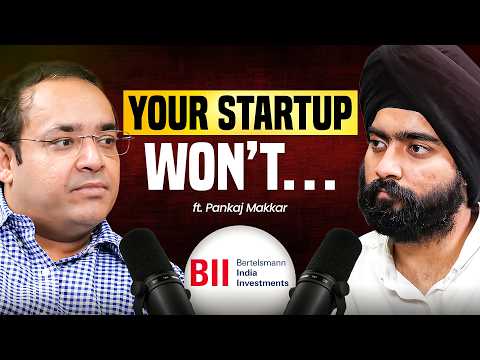
Pankaj Makkar's journey into venture capital began early, influenced by his CA background and a desire for business building. He joined Bertelsmann, a 200-year-old conglomerate with diverse global businesses, which provided a unique foundation for his investment career.
s2: Contrarian Series B/C Strategy in India
Bertelsmann India Investments adopted a contrarian strategy by focusing on Series B and C funding rounds, a less competitive and more complex stage than seed or Series A. This approach was based on the belief that by analytically assessing risk reduction from Series A to B, they could price assets higher and still achieve target portfolio returns.
s2: The Math of VC Portfolio Construction
Achieving a 4x return for Limited Partners (LPs) requires careful portfolio construction. Makkar explains that if 30% of capital goes to zero, the remaining 70% must yield 6-7x returns. This necessitates entry valuations that can provide a 10-12x return on the initial check to achieve the blended 4x goal.
India is experiencing a significant travel boom, with a generational shift towards prioritizing experiences over possessions. This surge is evidenced by increased air travel, rapid passport issuance, and a growing market size, transforming India's position globally from 19th to 11th in outbound travel pre-COVID, with expectations of further growth.
Scapia's Integrated Travel Ecosystem
Scapia offers a holistic travel platform that combines a co-branded credit card with a comprehensive booking marketplace for flights, stays, buses, and trains, alongside experiences and a curated e-commerce store for travel gear. The goal is to provide customers with a delightful and valuable end-to-end travel solution.
Customer Acquisition: Delight and Value
Scapia stands out in the crowded credit card market by focusing on two key pillars: customer delight through superior design, unboxing experience, and app usability, and tangible value via zero forex charges, lounge access, airport privileges, and redeemable coins. This dual approach addresses both the irrational (delight) and rational (value) aspects of customer decision-making.
Healthcare systems globally are fundamentally broken due to high delivery costs, leading to patient dissatisfaction and systemic issues like long wait times or high premiums. This is not just a technology or operational problem, but a core model issue.
SuperOS: The AI Engine
SuperOS is an agentic operating system designed from the ground up for hospitals, managing everything from OPD slots and diagnostics to inventory and patient monitoring, enabling zero wait times and efficient operations.
The 'Tesla for Healthcare' Full-Stack Approach
Superhealth adopts a full-stack approach, akin to Tesla, by building and operating the hospital, developing the technology (SuperOS), and managing all aspects of care, which is crucial for achieving significant improvements.
Manu Awasthy simplifies wealth management as the process of managing surpluses to generate returns, regardless of the amount. He emphasizes that time horizon and risk tolerance are the two most important factors, whether investing 500 rupees or 5,000 crores. Thus, wealth management is fundamentally about putting money to work and earning a return, tailored to individual circumstances.
India's Rapid Economic Growth
India's economy is experiencing rapid growth, fostering a strong entrepreneurial spirit and increased belief in the ecosystem, according to Manu Awasthy. This growth is not limited to founders but extends across the spectrum through ESOPs and better employment opportunities. As a result, wealth creation is happening organically and uniformly in Tier 2 and Tier 3 cities, indicating a broad-based economic expansion.
Traditional vs. New Wealth Tech
Awasthy contrasts the traditional wealth management model, characterized by relationship managers and physical interactions, with the new wealth tech model. He argues that the traditional approach is rudimentary and struggles to scale, especially with the increasing complexity of wealth management for high-net-worth individuals. Therefore, technology is essential to enhance decision-making and product accessibility.
Geetansh Bamania positions renting as a flexible alternative to EMIs, especially for young professionals. He argues that renting provides the benefits of ownership (like access to furniture and appliances) without the long-term financial commitment and burden of EMIs, offering free maintenance and relocation. Thus, renting becomes a compelling option for those prioritizing flexibility and financial agility in their early careers.
Demand & Supply: Bamania's Early Challenges
Geetansh Bamania explains that RentoMojo faced the challenge of simultaneously building both demand and supply for furniture rentals. Unlike models like Uber, where a supply of taxi drivers already existed, RentoMojo had to educate consumers about the benefits of renting and create a network of suppliers. Therefore, the company had to solve both sides of the equation to achieve scalability.
Customer Insights: Bamania on Preferences
Geetansh Bamania shares that customers generally want lower prices, faster delivery, and more choices. However, he notes that RentoMojo faces constraints in offering excessive choices due to the need for product rotation and occupancy optimization. Therefore, the company focuses on providing a curated selection of popular, versatile products that appeal to a broad customer base.
Manas Gupta: Quick Commerce as a Digital Kirana with Data Power
Manas Gupta defines quick commerce as a 'kirana store with a digital footprint,' offering consumers immediate convenience while providing brands with a rich digital trail of shopper behavior. He highlights how this data, exemplified by 40% of sleep supplement sales in Delhi occurring in just 10% of dark stores, is a 'gold mine' for brands to decode demand patterns and inform both online and offline strategies. Ultimately, this data-driven approach, combined with high customer retention rates (70%+ compared to 25-30% for next-day delivery), signaled a 'holy grail' for the quick commerce model.
GobbleCube's Mission: Actionable Growth for Brands
Manas Gupta explains that GobbleCube serves as a platform for brands to achieve profitable growth on quick commerce channels by focusing on key metrics like offtake growth, category share, and marketing ROI. He recounts an anecdote where a Blinkit executive challenged them to provide 'the so what' of data, leading GobbleCube to build features geared towards answering specific growth problems rather than just presenting dashboards. Ultimately, this problem-solving philosophy has enabled GobbleCube to onboard nearly 300 brands in less than a year, demonstrating strong product-market fit.
Quick Commerce Levels the Distribution Playing Field
Manas Gupta asserts that quick commerce has democratized distribution, creating a level playing field where new-age brands can compete directly with entrenched FMCG giants. He notes that the limited storage capacity of dark stores forces brands to be strategic about inventory management and distribution. This environment, coupled with low brand loyalty in immediate-need scenarios, allows agile new brands to gain market share rapidly, as evidenced by their accelerated journey to the 100 crore revenue mark compared to older D2C brands. Ultimately, quick commerce rewards smart, consistent availability over traditional distribution dominance.
Aditya Agarwal: Embracing the 'Minus One to Zero' Startup Phase
Aditya Agarwal defines the 'minus one to zero' phase as a crucial period for founders to explore ideas and gain conviction before launching a startup, emphasizing the need for a talent-dense environment like South Park Commons for inspiration and validation. He notes that SPC India has successfully validated its hypotheses regarding founders' openness to this exploratory phase, the deep technical talent available, and the high ambition levels among Indian entrepreneurs, exceeding initial expectations. Ultimately, this phase is presented as essential for fostering groundbreaking ventures.
Prateek & Aditya: AI Native Founders Blend Freshness with Depth
Prateek Mehta and Aditya Agarwal clarify that being 'AI native' isn't about age but about a founder's willingness to discard past assumptions and apply current technology with fresh eyes. They contend that while younger founders often naturally possess this trait, experienced operators can also be AI native if they commit to deep problem-solving without baggage. The true magic, they conclude, lies in the convergence of this fresh perspective with profound depth, irrespective of a founder's background.
Aditya Agarwal: Depth and Ambition are Non-Negotiable for Founders
Aditya Agarwal asserts that every great founder must possess non-negotiable depth in their chosen area, becoming a world expert by continuously digging into successive layers of a problem. He also stresses the importance of ambition, noting that the best founders consistently scale their goals, transforming initial successes into exponentially larger aspirations. Ultimately, he argues that founders should embrace their ambition without ego, aiming to change the world.
Manav Garg: India's AI Ecosystem is Nascent but Globally Competitive
Manav Garg asserts that India's AI ecosystem is at the beginning of a significant wave, showcasing a cohort of 10-20 companies, including Emergent (AI coding platform) and Composio (LLM integration), that are already proving global potential. He highlights successes in diverse sectors like healthcare and market research, indicating a promising, albeit early, stage for Indian AI innovation. Ultimately, these early wins challenge the perception that AI leadership is solely confined to the US and China.
Founder Traits for AI Success: Hard Problems, AI Expertise, and Distribution
Manav Garg identifies three crucial traits for successful AI founders: solving a hard technical problem, having an AI researcher or engineer on the team, and prioritizing distribution from the outset. He illustrates this with Emergent, which focused on production-ready applications, securing a large seed investment due to its vision and deep AI expertise. Ultimately, this framework shifts the focus from traditional business models to deep technical innovation and strategic market entry.
The AI Era Belongs to 'Young Minds' with Imagination
Manav Garg argues that the AI era favors 'young minds' – individuals with imagination who can reimagine workflows rather than merely automating existing ones. He notes a significant demographic shift in startup applications, with over 60% of Together Fund's plans coming from founders aged 20-30, a stark contrast to the previous SaaS era. Ultimately, this redefines the ideal founder profile, prioritizing creativity and a fresh perspective over traditional experience.