The core of the 'Reverse Information Paradox' is that using AI incurs a dual cost: direct financial expenditure for tokens and subscriptions, and a far more significant, often hidden, cost of surrendering proprietary company knowledge. This knowledge, embedded in prompts, corrections, and evaluations, becomes the training data for AI models, effectively allowing providers to profit from the user's own intellectual capital.
Lucas Montana: The Future Engineer's Skillset
The market is rapidly evolving beyond engineers who simply know how to use AI tools. The new demand is for professionals who understand and can implement advanced concepts like private evaluations, AI orchestration gateways, and the strategic retention of learned intelligence. This signifies a move towards engineers who build and own the AI infrastructure, rather than just consuming it.
The initial question about Annual Recurring Revenue (ARR) needed to leave a stable job is complex. While ARR is a key metric, it's not the sole determinant for leaving employment. The speaker's decision is influenced by factors beyond just revenue, such as personal energy efficiency and strategic growth potential.
Cash Efficiency: The Core Metric
The most intelligent financial strategy is 'cash efficiency,' which measures the revenue or value generated per unit of investment (like time). For personal finance, this means evaluating if the salary and benefits from a job justify the invested time and mental energy. High cash efficiency in a current role might make leaving less appealing, even with a side project's revenue.
The Importance of Delegation
True entrepreneurial success, especially when aiming for an exit or significant growth, hinges on the ability to delegate effectively. Relying solely on one person (the 'bus factor' of one) is unsustainable and prevents taking breaks or scaling. Identifying and empowering the right team members is key to avoiding the trap of simply selling one's own hours.
EBITDA: The Real Profit Metric
When evaluating the financial viability of leaving CLT, focus on EBITDA (Earnings Before Interest, Taxes, Depreciation, and Amortization) rather than just revenue. This metric reflects true profitability after operational costs but before major deductions like taxes, providing a more accurate picture of distributable profit for reinvestment or personal withdrawal.
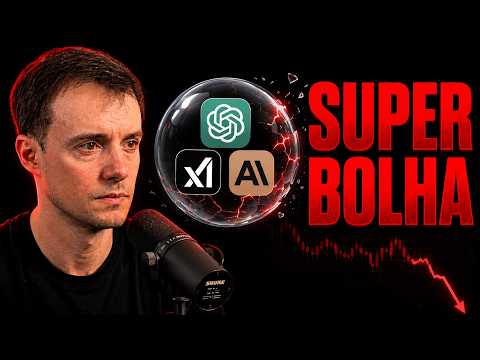
Financial experts, including Michael Burry and major Chinese hedge funds, are sounding the alarm about a potential AI bubble. They cite unsustainable valuations and a lack of long-term profitability, suggesting that the current AI investment frenzy might be overheated.
Grok 4.5: The Cost-Effective Contender
The new Grok 4.5 model, trained on extensive data from X (formerly Twitter), is presented as a powerful yet significantly cheaper alternative to top-tier models like GPT-4.8. Its performance is comparable to higher-end models but at a fraction of the cost, making advanced AI more accessible.
The Unsustainable CAPEX of AI
The massive capital expenditure (CAPEX) on data centers by Big Tech companies is becoming unsustainable. With billions invested, the revenue generated from AI models is disproportionately small, creating a financial imbalance that threatens the long-term viability of current AI development strategies.
SpaceX's Strategic Position
SpaceX, under Elon Musk, is strategically positioned to capitalize on the AI market's evolving landscape. With its own data centers and a cost-efficient AI model (Grok 4.5), the company is well-equipped to offer competitive AI services and potentially weather the economic pressures affecting other tech giants.
A competition between a human worker and a humanoid robot for organizing packages in a distribution center highlighted that while humans might be more skilled and energy-efficient in the short term, robots can operate continuously, raising questions about long-term employment and economic models.
The Counter-Intuitive Economics of AI in Programming
Despite AI's increasing capabilities, the speaker argues that human programmers are becoming 'cheaper' not because they are less efficient, but because the tools that make them efficient (like AI) are becoming more accessible, driving down the perceived value of individual human labor. This leads to a scenario where AI's long-term cost-effectiveness is questionable due to maintenance, energy, and resource scarcity issues.
Lucas Montano: The Problem of Repetitive Explanations
Developers frequently have to repeat the same explanations and instructions to AI assistants, such as project setup details (PNPM, Postgress schema) or coding standards (writing tests before resource changes, handling Prisma migrations). This repetition highlights a need for AI agents that can retain context and learn from past interactions, rather than requiring constant re-initialization.
Hermes Agent's Learning Loop Explained
The Hermes Agent implements a 'learning loop' with auto-generated skills, featuring persistent memory across three layers: session memory, persistent memory, and skill memory. This system aims to overcome the limitations of stateless AI interactions by allowing agents to learn, adapt, and retain information over time, similar to how human developers manually curate knowledge bases.
Open Source vs. Proprietary AI Agents
While proprietary solutions like Anthropic's 'Dreaming in Claude' offer advanced features, open-source alternatives like Hermes Agent provide crucial flexibility. Users can self-host Hermes on their own VPS, avoiding vendor lock-in and allowing integration with various LLMs (GPT, Claude, Gemini), unlike closed systems that tie users to a single provider.
The speaker predicts that within 5 years, the ability to type code quickly or use specific IDE features will become largely irrelevant. The core skill will shift from manual code generation to managing multiple abstractions and directing AI agents. This is because the bottleneck in development has always been conceptualization and abstraction management, not typing speed. The speaker emphasizes that AI will not steal jobs but will change the nature of the job itself, focusing on higher-level problem-solving.
The Rise of Context Switching
In the coming years, companies will increasingly value 'context switching' – the ability to fluidly move between different tasks, bugs, and feature requests without losing productivity. This is directly tied to efficient AI agent management, where developers will need to spawn multiple agents, manage their workflows, and integrate their outputs seamlessly. Traditional IDE navigation skills will become less important than the ability to manage complex, multi-agent development environments.
AI as a Catalyst for Evolution
The speaker argues that AI is not just an 'auto-complete' but a complex system that has fundamentally changed how we work, citing examples like Akita and Linus Torvalds using AI tools for development. Denying this evolution or clinging to outdated views from years ago is a disservice to professional growth. The future programmer will be one who embraces and effectively leverages these advanced AI capabilities.