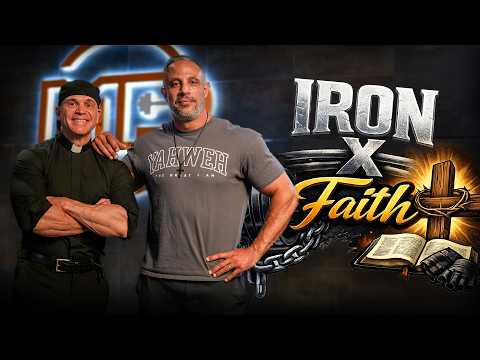
Sal DiStefano launches his 'To His Kingdom' series with the explicit goal of evangelizing, specifically aiming to reach individuals who are 'lost' and unaware of their spiritual condition, much like he once was. He emphasizes that his calling was initiated by God, who 'grabbed' him, rather than his own seeking. Ultimately, this series is positioned as a direct response to a divine calling to spread the gospel to those most in need of spiritual awakening.
From Numbness to Mourning: Sal's Emotional Healing Through Faith
Sal DiStefano recounts a profound personal transformation from emotional numbness, where he was unable to cry even at the death of his beloved ex-mother-in-law, to a state where he can genuinely mourn and feel deep emotions. He attributes this healing directly to God's intervention after he became a Christian, citing the ability to cry at his grandmother's passing as a significant, healing experience. Ultimately, this narrative underscores the belief that faith can restore emotional capacity and allow for appropriate responses to life's sorrows.
Mind Pump's Success: A Divine Blueprint, Not Personal Achievement
Sal DiStefano reveals a profound realization that the success of his fitness company, Mind Pump, which he once attributed to his own talent and hard work, was entirely orchestrated by God. He describes feeling an immediate comfort on camera during his first filming, which he saw as divine enablement, and credits God with bringing together complementary partners who filled his weaknesses. Ultimately, this shift in perspective from 'I did this' to 'God did this' highlights a core tenet of his faith journey: all blessings and achievements are divinely sourced.
The Unique Hostility Towards Jesus and Christianity
Sal DiStefano observes a 'strange hypocrisy' in the Western world, particularly within groups like the LGBT community, where he perceives a tendency to criticize Christians while sometimes supporting other faiths with similar or more 'judgmental' stances. He concludes that this unique hostility directed at Christianity, often manifesting in aggressive reactions to the Bible, stems from Jesus's claim to be 'the way, the truth, and the life.' Ultimately, he posits that the name of Jesus and the Christian faith provoke such strong reactions because they represent ultimate truth.
Radical Grace: God's Counterintuitive Path to Transformation
Sal DiStefano articulates that the Christian message of radical grace—where salvation is a free gift received by faith, not earned through human effort—is fundamentally counterintuitive to worldly systems of merit and deserving. He emphasizes that genuine acceptance of Christ leads to a supernatural transformation, where God actively 'peels away' imperfections, traumas, and self-reliance, making individuals more aligned with their intended perfect image. Ultimately, this concept highlights a divine love that transcends human notions of fairness and justice, offering complete spiritual renewal.
Biblical Masculinity: The Call to Ultimate Sacrifice
Drawing from a discussion with Father Steve, Sal DiStefano outlines biblical masculinity as a call for men to step into the unknown, follow God's will over their own understanding, and ultimately sacrifice whatever they hold most dear that is not God. He uses the story of Abraham being asked to sacrifice his son Isaac as a powerful, albeit extreme, illustration of this principle, emphasizing that God must be paramount in a man's life. Ultimately, this framework challenges men to prioritize their spiritual devotion above all earthly attachments, even family.
God's Timely Encouragement Through a 4:27 AM Text
Sal DiStefano recounts a personal struggle with discouragement and hesitation about discussing his faith on Bradley Martyn's podcast. He received an unsolicited text message at 4:27 AM from his friend Tim, who felt God prompting him to send a message of encouragement. Sal interpreted this as a direct, divinely timed intervention that empowered him to share his testimony, leading to a powerful evangelistic conversation and prayer with Bradley Martyn. Ultimately, this anecdote serves as a vivid example of God using other believers to provide timely support and confirmation.
Early Christian Growth: Love, Persecution, and Respect for Authority
Sal DiStefano explains that early Christians, despite facing severe persecution and death from the Roman Empire, spread their faith not through armed resistance but through radical love, caring for the marginalized, and surprisingly, by respecting governing authorities as instructed in Romans 13. He argues that this counterintuitive approach, which defied human logic, ultimately led to Christianity's global dominance and the eventual fall of the Roman Empire, which God then used to further spread the gospel. Ultimately, this historical analysis suggests that God's ways, though often incomprehensible, lead to ultimate victory.
Fitness as a Metaphor for Trusting God's Counterintuitive Ways
Sal DiStefano uses a client's fitness transformation—achieving leanness by eating more and doing less cardio, a process counterintuitive to conventional wisdom—as a metaphor for following Christ. He emphasizes that both require blindly trusting a 'coach' (God) because His ways often don't make 'human sense' but ultimately yield superior, transformative results. Ultimately, this analogy suggests that spiritual growth, like physical fitness, demands faith in processes that defy immediate logical understanding.
God Uses Challenges and Imperfect Messengers for Revival
Sal DiStefano asserts that God allows individuals to face challenges beyond their capacity so they learn to lean on Him, revealing their constant need for divine support. He also notes a current 'revival' where more people are discussing Jesus, acknowledging that some may do so with 'selfish ambition' or 'false motives,' but emphasizes that God uses even these imperfect means to spread the gospel. Ultimately, this perspective encourages believers not to be disheartened by flawed messengers, as God's overarching plan for revival will prevail.
Humility in Addressing Sin: The Speck and Plank Principle
Sal DiStefano discusses the 'speck and plank' scripture, clarifying that it does not prohibit discerning or addressing sin, but rather warns against self-righteous judgment. He stresses that any attempt to help someone out of sin must originate from a place of genuine love and humility, recognizing one's own brokenness and need for a savior. Ultimately, this principle emphasizes that effective spiritual guidance requires self-awareness and a loving approach, inviting the Holy Spirit's involvement rather than relying on human condemnation.
Mortality, Sacrifice, and Male Leadership in Christ
Sal DiStefano reflects on human mortality, acknowledging that despite efforts to defy aging, one cannot escape the reality of death, a truth powerfully underscored by 'The Passion of the Christ.' He then pivots to encourage men to embrace their role as initiators and leaders, particularly in challenging situations, by first following Christ. He cites statistics suggesting that a man being the first in his family to follow Christ significantly increases the likelihood of others following, emphasizing that genuine faith leads to demonstrably better outcomes. Ultimately, he connects the acceptance of mortality and Christ's sacrifice to the call for men to lead spiritually within their families and communities.