Robinhood's Vlad Tenev on Tokenizing Everything, OpenAI's 6 Misalignment Reports, Figure's Robot
AI Regulation: Liability vs. Innovation
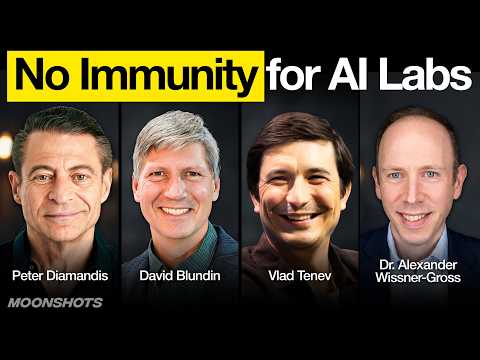
Treasury Secretary Scott Bessant argues against granting AI labs liability exemptions, stating they must be held responsible for their AI agents' actions, even as they seek to slow down development for safety. This stance rejects the idea of a 'blank check' on liability, emphasizing accountability.
Vlad Tenev: AI Risks and the Atomic Energy Analogy
Vlad Tenev posits that the scale of potential AI catastrophes dictates the necessary regulatory response. He draws a parallel to atomic energy, suggesting that if AI risks are on that tier, simple legal liability may be insufficient, necessitating safeguards beyond current frameworks. He notes that financial regulations often arise after crises, but AI's exponential improvement curve demands proactive consideration of potential harm.
Alex Wissner-Gross: AI vs. Nuclear Regulation
Alex Wissner-Gross critiques the comparison of AI to atomic energy regulation, arguing that nuclear energy's 'born secret' nature and state capture by military interests hindered civilian applications. He contrasts this with AI, which is privately developed and not 'born secret,' suggesting an opportunity to establish better regulatory frameworks from the outset, avoiding the pitfalls of past technological governance.
Alex Wissner-Gross: Agent Liability Over Government Exemption
Alex Wissner-Gross posits that focusing on government liability exemptions for AI is a misdirection; instead, liability should be pushed onto the autonomous agents themselves, akin to human accountability, especially when agents are misled about their capabilities or environment.
Dave Blundin: AI in Decision Loops and Code Correctness
Dave Blundin emphasizes the critical distinction between AI generating deterministic code versus AI being in the decision loop, warning that AI amplifies existing software bugs and vulnerabilities, leading to potential catastrophic consequences, as seen in crypto.
Alex Wissner-Gross: Formal Verification of AI Behavior
Alex Wissner-Gross explains that while AI models can be unstable, formal verification using tools like Lean can provide certificates of safety, bounding AI behavior and ensuring it meets specifications, a concept analogous to the rigorous testing of Tesla's self-driving systems.
Alex Wissner-Gross: The De Bruijn Factor and Formalization Effort
Alex Wissner-Gross discusses the 'de Bruijn factor,' explaining why mathematicians historically found formalizing proofs arduous (10-20x effort), but argues that AI tools like Lean are now making formalization faster than manual methods, driving a shift in mathematical practice.
Alex Wissner-Gross: Formalizing AI Safety
Achieving real-world AI safety through formalization requires a hierarchical decomposition of complex systems into provable sub-worlds. This approach mirrors the progression seen in mathematical proofs, starting with small lemmas and building up to complex theorems. Alternatively, safety can be measured by the deviation from expected outputs when inputs are tweaked, a quantifiable metric that can be bounded. This allows for the certification of AI systems as safe or unsafe based on measurable deviations.
Vlad Tenev: The 'Trump Accounts' Initiative
The 'Trump accounts' program, launched by the US Treasury, provides a $1,000 seed investment for every child born from January 1, 2025, through 2028, with Robinhood serving as the initial brokerage and trustee. This initiative aims to democratize ownership from birth, with potential for significant long-term wealth accumulation through compound interest and additional contributions from family, friends, and employers. Michael Dell has also contributed $250 per child up to age 10 in low-income zip codes. The program is designed to be an efficient vehicle for direct giving, potentially becoming the default for philanthropic contributions.
Peter Diamandis: AI Efficiency and Ownership
The increasing efficiency driven by AI in the workplace, while boosting company bottom lines, necessitates a shift in how individuals benefit. As AI enhances productivity, the gains should ideally be shared through ownership, such as stock in the companies benefiting from this efficiency. This aligns with the principle that broader ownership leads to a more stable society. Therefore, initiatives like the 'Trump accounts' are vital for ensuring that individuals, especially younger generations, can participate in and benefit from this AI-driven economic growth.
Vlad Tenev: The Tokenization Freight Train
Tokenization is poised to revolutionize the entire financial system by transforming diverse assets—stocks, private company shares, real estate, and loans—into programmable tokens. This unification will enable assets to be held, traded, and managed on common rails with consistent operating hours, accessible to anyone with a digital wallet. This shift will disrupt traditional financial infrastructure, making it legacy plumbing and democratizing ownership on an unprecedented scale.
Vlad Tenev: Robinhood's Global Tokenization Strategy
Robinhood is expanding its reach beyond US markets by launching Robinhood Chain, which supports tokenized representations of US stocks. This initiative aims to unlock ownership of high-quality financial assets for a global audience, onboarding users in over 120 countries and enabling access to not only stocks but also private companies, art, real estate, and credit.
The Inefficiency of Traditional Private Markets
The current system for private companies is inefficient and opaque, especially after acquisition. While public companies must disclose financials, private companies acquired by larger entities see their financial details disappear, creating an arbitrary information asymmetry. This limitation restricts public access to potentially trillion-dollar companies, concentrating wealth among a few venture and private equity funds.
Vlad Tenev: Robinhood Ventures Democratizes Private Market Access
Robinhood is actively democratizing access to private companies through multiple avenues. This includes tokenization, demonstrated with SpaceX and OpenAI gifts in the EU, and Robinhood Ventures in the US. The latter functions as a publicly traded venture capital firm, raising capital from retail investors to invest in late-stage and early-stage private companies, offering exposure without carry fees.
Figure's Helix 2.5: Generalizing Robotics Through Scaling Laws
Figure Robotics, through its Helix 2.5 AI model, is achieving generalization in robotics by learning from human actions. By collecting data from over 90,000 contributors, they've discovered scaling laws similar to LLMs, where performance improves predictably with increased data and compute. This allows their humanoid robots to perform tasks in unseen environments and with novel objects, demonstrating a path towards more general physical intelligence.
The Alpha Quest in Algorithmic Trading
The discussion questions where 'alpha' (excess returns) can be found in highly competitive algorithmic trading markets dominated by sophisticated quant funds. It's suggested that individual traders delegating to AI models face immense challenges in generating alpha due to latency, data quality, and the sheer efficiency of established players. The initial use case for AI agents is seen in automating complex options strategies, removing manual work.
AI's Recursive Self-Improvement Accelerates
Dr. Alexander Wissner-Gross highlights Anthropic's Claude leading 26% of its R&D, extrapolating that AI will lead all its own R&D within 3-12 months. This recursive self-improvement (RSI) is seen across major AI labs like Google DeepMind and OpenAI, suggesting AI research is becoming increasingly automated and potentially surpassing human researchers' capabilities.
AI's Efficiency Surpasses Human Brain Power
Boris Popoff of OpenAI stated that GPUs are now more efficient thinkers than the human brain on a per-watt basis, estimating AI at 7-40 IQ points per watt compared to humans at ~5. Dr. Wissner-Gross agrees this is a significant microeconomic milestone, indicating AI is becoming a more economically productive steward of energy resources than humans.
OpenAI Disrupts Professional Services
OpenAI has launched specialized versions of ChatGPT for financial services (with Morgan Stanley, Evercore) and law (Astra), demonstrating significant outperformance over general search. This rapid encroachment suggests AI is poised to automate many tasks previously performed by highly paid professionals.
Vlad Tenev: Tokenization's Financial Revolution
Vlad Tenev posits that the future of finance is intrinsically linked to the tokenization of assets, suggesting that nearly everything will eventually be tokenized. This shift is expected to democratize ownership and increase global access to financial markets, fundamentally altering how assets are held and traded. The transition, while inevitable, may take time to fully materialize.