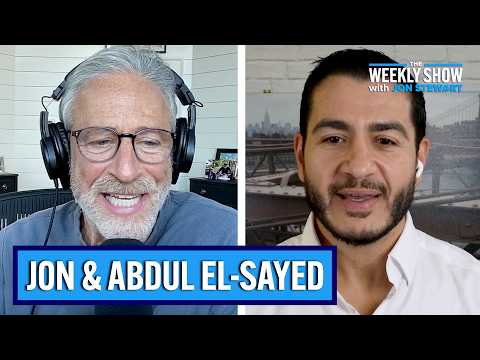
The Weekly Show with Jon Stewart's Abdul El-Sayed’s Progressive Policy Prescription | The Weekly Show with Jon Stewart: skim's analysis identifies 11 key moments, with 3 potential conflicts of interest flagged. Michigan Democratic Senate nominee Dr.
Category: Politics. Format: Interview. YouTube video analyzed by skim.
skim AI Analysis
Credibility assessment: Candid Political Interview. Abdul El-Sayed provides firsthand accounts of his public health tenure and campaign finances, while Jon Stewart cites specific legislative history like the 2010 Zadroga Act. However, campaign spending totals, polling claims, and descriptions of opponent ads rely on self-reported candidate assertions without independent documentation.
Bias assessment: Progressive Populist Advocacy. The episode serves as a sympathetic platform for Democratic candidate Abdul El-Sayed. Both Jon Stewart and El-Sayed express sharp disdain for Republican opponent Mike Rogers and Donald Trump, framing the race around corporate corruption and progressive economic remedies.
Originality: 82% — Substantive Long-Form Dialogue. Rather than repeating standard cable news talking points, the conversation explores the intersection of public health, immigrant identity, and coalition friction in Michigan, pushed along by Jon Stewart's pointed questions on voter skepticism.
Depth: 79% — Systemic Policy Focus. The discussion connects local voter anxieties about care costs and artificial intelligence to macro-level structures like Citizens United, foreign military aid allocations, and municipal school funding deficits.
Key Points (11)
1. El-Sayed Compares Campaigning to Medical Care
Timestamp: 00:02:08 to 00:08:15
Abdul El-Sayed reflects on the final two weeks of his 18-month Senate campaign, noting that his family's emigration from Egypt makes him grateful to participate in American democracy. He compares political campaigning to medicine and civic chiropractics, where intimate home visits and open town halls unlock collective pain that voters thought they carried alone. He concludes that politics works best when candidates listen to people's worst struggles and work together to solve them.
Significance (Medium): Framing a Senate campaign as clinical empathy allows El-Sayed to position himself as a healer rather than a partisan combatant.
Sources in support: Abdul El-Sayed (Michigan Democratic Senate Candidate and Physician), Jon Stewart (Host of The Weekly Show)
2. Care Costs and AI Dread Dominate Town Halls
Timestamp: 00:08:16 to 00:13:35
Abdul El-Sayed identifies three primary anxieties raised by Michiganders at town halls: health care, child and senior care, and dread over artificial intelligence. He shares an account of a woman whose insurance paid only $395 for an emergency appendectomy, alongside parents worried that $60,000 in college debt will not protect their children from AI job displacement. He explains that refusing corporate donations lets him translate these voter concerns directly into policy prescriptions without pleasing wealthy donors.
Significance (High): Highlighting underinsured emergencies and AI job fears grounds progressive economic policy in immediate household anxieties.
Sources in support: Abdul El-Sayed (Michigan Democratic Senate Candidate and Physician), Jon Stewart (Host of The Weekly Show)
3. Why El-Sayed Left Clinical Medicine for Policy
Timestamp: 00:15:08 to 00:20:22
When Jon Stewart asks why he pivoted from clinical medicine, Abdul El-Sayed explains that seeing a 10-year life expectancy gap just 15 minutes from his childhood home convinced him to work on the system rather than in it. He cites his tenure leading Detroit and Wayne County health departments, where he says his team provided children's glasses, curbed school lead exposure, and initiated a program to eliminate up to $700 million in medical debt. He also recalls how Bill Clinton and Barack Obama's 2004 convention speech showed him that a Muslim American with an 11-letter first name could run for office.
Significance (High): Pointing to municipal debt relief and lead abatement gives El-Sayed concrete executive credentials to counter critics who label him a purely ideological candidate.
Sources in support: Abdul El-Sayed (Michigan Democratic Senate Candidate and Physician), Jon Stewart (Host of The Weekly Show)
4. Immigrant Roots and Systemic American Poverty
Timestamp: 00:20:24 to 00:28:13
Abdul El-Sayed describes how summers in Alexandria, Egypt, with his illiterate grandmother taught him that intelligence and hard work mean little without opportunity. He notes that his father was shocked to find severe poverty near Detroit's Eastern Market, where some communities have a $14,000 median annual income. Both Jon Stewart and El-Sayed conclude that American poverty is a deliberate policy choice in an economy designed to help billionaires make a second billion while cutting health care and underfunding schools.
Significance (Medium): Linking third-world deprivation to Detroit neighborhoods challenges American exceptionalism and frames domestic poverty as a legislative choice.
Sources in support: Abdul El-Sayed (Michigan Democratic Senate Candidate and Physician), Jon Stewart (Host of The Weekly Show)
5. El-Sayed Addresses $70M Primary Spend and Gaza
Timestamp: 00:28:13 to 00:37:39
Responding to Jon Stewart's questions about his support in Detroit, Abdul El-Sayed says he was outspent 11-to-1 with a record $70 million in primary attack ads, yet still won 40% of the Black vote. He acknowledges friction between some Arab store owners and Black residents in Detroit, as well as tensions over the 2024 Uncommitted movement protesting the Biden administration's Gaza policy. He defends backing Uncommitted in the primary before immediately endorsing Kamala Harris in the general election, connecting a $2.8 billion U.S. bomb authorization to Detroit public schools' $1.8 billion infrastructure deficit.
Significance (High): Tying $2.8 billion in foreign bomb authorizations directly to Detroit's $1.8 billion school repair backlog turns a divisive foreign policy stance into a local pocketbook argument.
Sources in support: Abdul El-Sayed (Michigan Democratic Senate Candidate and Physician)
Neutral sources: Jon Stewart (Host of The Weekly Show)
6. Jon Stewart Condemns Mike Rogers Over 9/11 Bill
Timestamp: 00:39:40 to 00:47:41
Jon Stewart expresses deep disdain for Republican Senate nominee Mike Rogers, recalling how Rogers opposed the 2010 Zadroga Act providing health care for 9/11 first responders by dismissing it as a New York problem. Abdul El-Sayed agrees, arguing that Rogers lacks moral accountability and uses attacks on El-Sayed's Muslim background to distract voters from Donald Trump's war and Canadian tariff policies. El-Sayed claims the tariff dispute costs Michigan households an average of $5,600 and notes Rogers voted four times against prescription drug reimportation.
Significance (High): Stewart's firsthand account of lobbying against Rogers on 9/11 responder health care undercuts the Republican candidate's patriotic branding.
Sources in support: Jon Stewart (Host of The Weekly Show), Abdul El-Sayed (Michigan Democratic Senate Candidate and Physician)
7. Pitching Ideological Consistency to Skeptics
Timestamp: 00:47:41 to 00:56:00
Jon Stewart presses Abdul El-Sayed on whether his biggest hurdle is overcoming anti-Muslim bias or reassuring Black and Jewish Democrats skeptical of his past statements. El-Sayed responds that voters ask both what a politician fights for and how they know the politician will actually fight for it. Recounting a tense town hall with skeptical Jewish Michiganders, he argues that being direct about his disagreements on Israel proves he will not cave when defending reproductive rights, democracy, and economic relief.
Significance (Medium): Refusing to pander to skeptical voters is a high-risk strategy that bets candor on Gaza will build broader trust on domestic issues.
Sources in support: Abdul El-Sayed (Michigan Democratic Senate Candidate and Physician)
Neutral sources: Jon Stewart (Host of The Weekly Show)
8. Media Gotcha Questions vs. Voter Priorities
Timestamp: 00:57:26 to 01:02:48
Jon Stewart notes that online coverage of Abdul El-Sayed focuses heavily on demands to disavow Hasan Piker or the Muslim Brotherhood, including a viral town hall exchange with a Josh Hawley operative named Tommy. El-Sayed says press gaggles after his town halls show a total disconnect from voters, who ask substantive questions about AI, health care, and bipartisan cooperation while reporters hunt for viral clips. He adds that even some Trump voters have thanked him for redirecting gotcha questions back to grocery and healthcare costs.
Significance (Medium): Exposing the gap between press gaggle questions and town hall concerns illustrates why public trust in political journalism continues to erode.
Sources in support: Abdul El-Sayed (Michigan Democratic Senate Candidate and Physician), Jon Stewart (Host of The Weekly Show)
9. Stewart and El-Sayed Debate Campaign Finance Reform
Timestamp: 01:02:48 to 01:10:06
Jon Stewart argues that Supreme Court rulings on campaign finance, executive power, and corruption have left democracy vulnerable, proposing a constitutional amendment to cap election spending, shorten campaign seasons, and ban partisan gerrymandering. Abdul El-Sayed suggests triggering equal public funding whenever a super PAC spends money, though Stewart counters that matching billions in spending is untenable without hard limits. El-Sayed agrees to back an amendment, noting that total primary and general election spending against him will reach upwards of $300 million while former rival Haley Stevens now campaigns for unity.
Significance (High): Debating public matching funds versus a constitutional amendment highlights the structural difficulty of curbing billionaire influence under current Supreme Court precedent.
Sources in support: Jon Stewart (Host of The Weekly Show), Abdul El-Sayed (Michigan Democratic Senate Candidate and Physician)
10. Producers Analyze Attack Ads and Voter Mood
Timestamp: 01:11:22 to 01:19:35
In the post-interview discussion, Jon Stewart and producers Gillian Spear and Brittany Mehmedovic examine how national media fixates on viral conflict while racist dog whistles and attack ads target candidates on the ground. Stewart recalls fearing that deceptive ads would sink Mikie Sherrill in New Jersey before her blowout win, and cites an extreme Texas attack ad targeting James Talarico. Spear shares an anecdote from a Midwestern diner where an older man stated he could no longer vote Republican because nobody in the party stands up to Donald Trump.
Significance (Low): Contrasting extreme television attack ads with quiet voter defections underscores the unpredictability of the midterm electorate.
Sources in support: Jon Stewart (Host of The Weekly Show), Gillian Spear (Producer of The Weekly Show), Brittany Mehmedovic (Producer of The Weekly Show)
11. AI Jingles and the Dread of Election Night
Timestamp: 01:19:36 to 01:27:47
Answering listener questions, Jon Stewart reacts with mock shame after dancing to an AI-generated intro jingle and jokes about Taco Bell's non-interactive drive-thru AI. Turning to a question about fake polls and election night disappointment, Stewart and Gillian Spear describe the destabilizing shock of realizing fellow Americans actively want dystopian policies like mass immigrant roundups. Stewart concludes that Donald Trump uses phrases like fake news to warp reality, urging listeners to recognize the urgency of the moment and vote.
Significance (Medium): Stewart articulates the psychological toll on voters who view recent election outcomes not as policy disputes, but as a rejection of shared democratic norms.
Sources in support: Jon Stewart (Host of The Weekly Show), Gillian Spear (Producer of The Weekly Show), Brittany Mehmedovic (Producer of The Weekly Show)
This analysis was generated by skim (skim.plus), an AI-powered content analysis platform by Credible AI. Scores and classifications represent the platform's AI-generated assessment and should be considered alongside other sources.