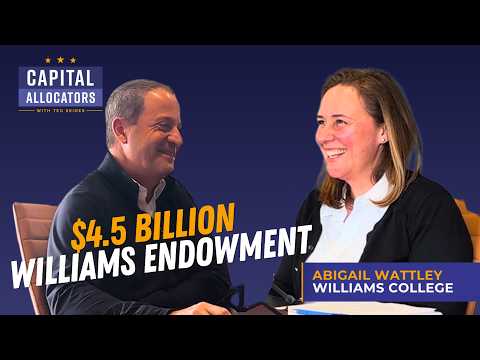
Abigail Wattley – Inside the $4.5B Williams Endowment | Capital Allocators EP.507
Capital Allocators with Ted Seides
Summary
Abigail Wattley, Chief Investment Officer of Williams College, traces her nearly twenty-year journey from joining founding CIO Collette Chilton as an analyst in 2007 to leading the $4.5 billion endowment. She explains how she learned technical asset classes like fixed income and oil and gas from scratch before taking over hedge funds, which still represent a 27% target allocation. Because the endowment funds nearly 60% of the college's operating budget and supports a loan-free financial aid program, the 11-person office targets a 5% real return while holding only 1% to 2% in cash, tracking every cash flow weekly alongside $150 million in credit lines.
Combining her institutional memory with outside Managing Directors Julia and Paul allowed the team to re-underwrite legacy managers, expand into biotech, pivot real assets from fossil fuel extraction to renewable infrastructure, and adopt LLMs for diligence. Looking ahead to her three-year anniversary on July 1st, Wattley is finalizing asset allocation updates while weighing private market commitment pacing and capacity limits for her seven-person investment team.
How time-sensitive the topic is: Evergreen
By the numbers
4.5 billion dollars: Current assets under management at the Williams College endowment, up from $1.3 billion in 2007. (Mentioned at 3:19)
5%: Target annual real return and annual spending draw required from the Williams College endowment. (Mentioned at 12:21)
60%: Approximate share of Williams College's operating budget supported by the endowment. (Mentioned at 12:32)
350 line items: Number of distinct line items in the Williams portfolio whose manager data is automatically downloaded. (Mentioned at 20:35)
27%: Current aggregate target allocation to long-short equity and absolute return hedge funds, down from 40% historically. (Mentioned at 23:06)
150 million dollars: Backup lines of credit maintained by the Williams Investment Office for belt-and-suspenders liquidity. (Mentioned at 30:59)
1 to 2%: Portion of the Williams endowment portfolio held in cash so assets remain fully invested. (Mentioned at 31:13)
1%: Current portfolio allocation to investment grade fixed income for rainy-day liquidity, down from 10% historically. (Mentioned at 33:19)
150 students: Number of Williams students who have participated in the office's analyst, internship, or winter study programs since 2010. (Mentioned at 41:02)
7 investment professionals: Size of the investment team covering global markets within the 11-person Williams Investment Office. (Mentioned at 43:21)
Questions this video answers
How much of Williams College's operating budget is funded by its endowment?
The $4.5 billion Williams College endowment supports nearly 60% of the college's annual operating budget, including a financial aid program with no student loans. Because the college relies so heavily on this annual draw, the investment office prioritizes earning a 5% real return while strictly managing liquidity and volatility.
Abigail Wattley, 10:11 to 14:19
From this keypoint: Funding 60% of the Williams Budget
Why does the Williams College endowment still allocate 27% of its portfolio to hedge funds?
Abigail Wattley explains that long-short equity and absolute return hedge funds help the endowment earn its target return while controlling volatility and providing liquidity for its 5% annual spending draw. Evaluated strictly net of fees, the 27% allocation allows the portfolio to weather market cycles without forced selling.
Abigail Wattley, 22:45 to 25:40
From this keypoint: Why Hedge Funds Remain 27% of the Portfolio
How does the Williams Investment Office manage liquidity while holding only 1% to 2% in cash?
To keep the endowment nearly fully invested with just 1% to 2% cash, the 11-person office reviews every cash inflow and outflow during weekly team meetings and maintains a rolling 12-month forecast by asset class. As a backup, the office also holds $150 million in lines of credit.
Abigail Wattley, 25:40 to 31:46
From this keypoint: Private Market Pacing and Weekly Liquidity Math
How has the Williams endowment adjusted to slower private equity and venture capital distributions?
Rather than abandoning private markets, Williams models commitment pacing over three-year rolling windows and treats annual budgets as guidelines rather than quotas to fill. Recognizing that top venture-backed companies stay private longer, the office raised its target allocation to buyouts and venture over recent years while waiting patiently for compounding returns.
Abigail Wattley, 25:40 to 31:46
From this keypoint: Private Market Pacing and Weekly Liquidity Math
What changed when Abigail Wattley succeeded Collette Chilton as CIO of Williams College?
Wattley's internal promotion preserved the endowment's core strategy and long-standing manager relationships without wasting time repointing the ship. At the same time, bringing in outside Managing Directors Julia and Paul prompted a full re-underwriting of legacy managers, expanded investments into biotech, and modernized portfolio look-through technology.
Abigail Wattley, 14:19 to 22:45
From this keypoint: Internal Succession Meets Outside Perspectives
How does the Williams College endowment approach fossil fuels, real assets, and fixed income today?
Williams eliminated investment grade bonds in 2019 before bringing back a small 1% rainy-day allocation about a year ago once interest rates rose off zero. In real assets, the endowment no longer invests in funds dedicated to oil and gas extraction, shifting its focus toward power and renewable infrastructure.
Abigail Wattley, 31:46 to 34:20
From this keypoint: Cutting Bonds to 1% and Exiting Fossil Fuels
How is the Williams College investment team using artificial intelligence and LLMs?
Every member of the team participates in internal AI working groups established during their annual summer retreat to experiment without overcommitting to rapidly changing tools. Current use cases include using LLMs to get up to speed on sector risks like private credit, identifying off-sheet references in their network, and practicing for interviews.
Abigail Wattley, 45:07 to 50:42
From this keypoint: Using LLMs for Diligence and Capacity Tradeoffs
Why doesn't the Williams College endowment do co-investments, direct investments, or secondaries?
With only seven investment professionals covering the global market across a $4.5 billion portfolio, the team currently lacks the bandwidth and specialized underwriting skill set required for direct deals, co-investments, or active secondary market transactions. Wattley notes that building those capabilities remains an open question as the endowment scales.
Abigail Wattley, 45:07 to 50:42
From this keypoint: Using LLMs for Diligence and Capacity Tradeoffs
How does Williams College train undergraduate students in institutional investing?
Since starting its dedicated analyst program in 2010, the investment office has trained over 150 students across three tracks: full-time analysts, summer internships, and an on-campus winter study course. About half of those alumni still work in asset management across LP and GP firms, providing Williams with a broad industry network.
Abigail Wattley, 38:50 to 45:07
From this keypoint: Snowplow Leadership and the 150-Alum Pipeline
Credible AI™ signals
Confidence: Direct Institutional Insight. Abigail Wattley provides first-hand operational details from her nearly two decades inside the Williams College Investment Office. While her self-reported portfolio allocations, team structure, and historical processes are highly credible, performance claims remain unverified by independent audit data in the conversation.
Bias: Endowment Model Loyalist. The conversation naturally favors the long-term institutional endowment model, active manager selection, and Williams College's internal culture. Host Ted Seides conducts a collegial interview that explores Wattley's decisions without aggressively challenging fee structures or alternative passive approaches.
Originality (78%): Rare Internal Succession View. Internal promotions from entry-level analyst to Chief Investment Officer are uncommon in institutional asset management. Wattley's candid reflections on inheriting a portfolio she helped build, re-underwriting her own past picks with outside hires, and using LLMs for interview prep offer fresh practitioner insights.
Depth (76%): Practical Portfolio Mechanics. The discussion moves beyond high-level platitudes to examine concrete portfolio mechanics, including a 27% hedge fund allocation, weekly liquidity tracking against a 5% spend rate, commitment pacing models, and the transition away from fossil fuel extraction toward power infrastructure.
Key points (11)
Short (19 min): key points 1, 3, 6 and 10
Medium (33 min): key points 1, 3, 4, 5, 6, 7 and 10
Relaxed (54 min): all 11 key points
1. Abigail Wattley's Path to the Williams Office
Timestamp: 00:00:18 to 00:03:33 (3 min)
Speaker: Abigail Wattley
Abigail Wattley explains how a college tutorial with Williams President Morty Shapiro sparked her interest in higher education finance, leading her to Cambridge Associates in 2005. Assigned to the Williams account just as founding CIO Collette Chilton was hired, Wattley joined the new investment office in spring 2007 and helped grow assets from $1.3 billion to $4.5 billion. Her early experience spanned from stuffing FedEx envelopes to executing a $400 million transition and establishing the policy portfolio.
Impact: Medium. Why it matters: Illustrates how ground-floor operational exposure at a newly formed endowment builds comprehensive institutional knowledge across both back-office mechanics and high-level policy.
“I think when we first started, it was 1.3 billion. Today, we're about 4.5 billion in assets. And we've just accrued a lot of knowledge over time about what works for the portfolio.”
In the video: Abigail Wattley, at 3:14
Neutral: Ted
2. Mastering Fixed Income and Real Assets
Timestamp: 00:03:33 to 00:10:11 (7 min)
Speaker: Abigail Wattley
Returning from business school in 2010, Wattley wrote her own job description to manage people, report to Collette Chilton, and own asset classes. She inherited investment grade fixed income and real assets, the two technical areas other managing directors gave up, and trained at a PIMCO bond boot camp with Bill Gross and an oil and gas course at SMU. She learned that allocators get paid for making money rather than finding obscure ideas, while Collette Chilton guarded the portfolio by spotting key issues during final diligence.
Impact: Medium. Why it matters: Demonstrates how junior allocators can build deep domain competence in unglamorous asset classes while relying on senior leadership as a safety net during final manager selection.
“And in this business, we don't get points for difficulty. We get points for making money, right? And so, you don't necessarily have to always go find the least discovered idea.”
In the video: Abigail Wattley, at 8:02
Neutral: Ted
3. Funding 60% of the Williams Budget
Timestamp: 00:10:11 to 00:14:19 (4 min)
Speaker: Abigail Wattley
After expanding into hedge funds, which once represented 40% of the portfolio, Wattley notes that Williams' core investment blocks have remained remarkably consistent. The endowment's central mandate is earning a 5% real return with appropriate risk and liquidity to fund nearly 60% of the college's operating budget. To win access with top fund managers, the office highlights Williams' loan-free financial aid mission, its nimble $4.5 billion size, and a prepared team.
Impact: High. Why it matters: Anchors the endowment's entire asset allocation and liquidity framework to a concrete institutional dependency: funding nearly 60% of the college's annual operations.
“You know, our job is to earn a 5% real return, to make sure that we're doing that with the appropriate level of risk that we're taking, and ensuring that we have sufficient liquidity because we support nearly 60% of the operating budget for the college.”
In the video: Abigail Wattley, at 12:21
Neutral: Ted
4. Internal Succession Meets Outside Perspectives
Timestamp: 00:14:19 to 00:22:45 (8 min)
Speaker: Abigail Wattley
Leading up to Collette Chilton's June 30th retirement, Chilton and Wattley spent a week in California handing off private manager relationships. Wattley argues that promoting an internal CIO prevented wasted time repointing the ship and preserved core relationships. Simultaneously, bringing in outside Managing Directors Julia and Paul injected fresh expertise in biotech, prompted a full re-underwriting of legacy managers, and automated data downloads across 350 portfolio line items.
Impact: High. Why it matters: Shows how an internal CIO succession can avoid strategic whiplash while still combating institutional complacency by empowering external senior hires to challenge legacy holdings.
“Well, that has been really interesting, right? We have really re-underwritten the entire portfolio because you have to when you have new people coming on board and taking over responsibility for asset classes.”
In the video: Abigail Wattley, at 21:06
Neutral: Ted
5. Why Hedge Funds Remain 27% of the Portfolio
Timestamp: 00:22:45 to 00:25:40 (3 min)
Speaker: Abigail Wattley
Although down from a historical 40% share, hedge funds across long-short equity and absolute return still represent a 27% target allocation in the Williams book, according to Abigail Wattley. She defends the allocation because hedge funds help meet return targets while dampening volatility and preserving liquidity for the 5% annual draw. Evaluated strictly net of fees, the strategy benefits from non-zero interest rates, market volatility, and enduring manager talent.
Impact: High. Why it matters: Provides a clear structural defense for a heavy hedge fund allocation at a time when many institutional peers have reduced exposure in favor of private equity or passive indexing.
“Um so, I think today our target allocation across our long short and absolute return portfolio was 27% in aggregate. So, so we're a believer. Would be my first comment.”
In the video: Abigail Wattley, at 23:00
Neutral: Ted
6. Private Market Pacing and Weekly Liquidity Math
Timestamp: 00:25:40 to 00:31:46 (6 min)
Speaker: Abigail Wattley
Addressing slower private market distributions, Wattley says the team uses 3-year rolling commitment models as guidelines rather than rigid quotas, refusing to deploy a $150 million budget if opportunities fall short. Because companies stay private longer, Williams increased its buyout and venture targets over recent years. To stay fully invested with only 1% to 2% cash, the 11-person office reviews every cash flow weekly, forecasts 12 months ahead, and keeps $150 million in credit lines.
Impact: High. Why it matters: Details the exact operational discipline required to run a nearly fully invested endowment with minimal cash drag while navigating extended private market lockups.
“We also maintain $150 million worth of lines of credit for the investment office so that if we These are really belt and suspenders, but if we needed it, we would have kind of a backup source of liquidity.”
In the video: Abigail Wattley, at 30:58
Neutral: Ted
7. Cutting Bonds to 1% and Exiting Fossil Fuels
Timestamp: 00:31:46 to 00:34:20 (3 min)
Speaker: Abigail Wattley
Recalling her panic during the August 2011 US credit downgrade, Wattley explains how investment grade fixed income dropped from 10% of the portfolio to zero in 2019 when rates had a higher probability of rising than falling. Williams reintroduced a modest 1% rainy-day bond position about a year ago after rates rose off zero. Meanwhile, the office no longer invests in funds dedicated to oil and gas extraction, pivoting its real assets book toward power and renewable infrastructure.
Impact: Medium. Why it matters: Highlights how shifting interest rate regimes and institutional climate priorities have reshaped two traditional endowment asset classes over the past fifteen years.
“And then real assets, similarly to your question, we no longer do funds dedicated to the extraction of oil and gas. And so what does it mean to manage a real assets portfolio in that context has really had to change and evolve”
In the video: Abigail Wattley, at 33:32
Neutral: Ted
8. Nate Sleeper's Advice on Moving Faster as CIO
Timestamp: 00:34:20 to 00:38:50 (5 min)
Speaker: Abigail Wattley
Comparing stepping into the CIO role to becoming a parent, Wattley describes the initial exhaustion of owning every small and large decision. Wrestling with the tension between honoring Williams' track record and making her own mark, she asked Investment Committee Chair Nate Sleeper to warn her if she moved too fast. Sleeper predicted she would instead wish she had acted sooner after three years, which Wattley confirms regarding technology adoption and portfolio adjustments.
Impact: Medium. Why it matters: Captures the psychological hurdle faced by internal successors who must overcome deference to their predecessor's portfolio to execute timely changes.
“And he said, I I don't think that's going to be the case, and more likely than not, you're going to look back at kind of where you are after 3 years and say, gosh, I wish I had done some of these things sooner.”
In the video: Abigail Wattley, at 37:26
Neutral: Ted
9. Snowplow Leadership and the 150-Alum Pipeline
Timestamp: 00:38:50 to 00:45:07 (6 min)
Speaker: Abigail Wattley
Wattley views her leadership role for the 7-person investment team like a snowplow clearing streets early so her staff can run fast down new avenues. Since launching its dedicated analyst program in 2010 alongside a winter study class and summer internships, the office has trained over 150 Williams students. Roughly 50% of those alumni remain in asset management across LP and GP roles, creating a cooperative industry network that helps the small team cover global markets.
Impact: Medium. Why it matters: Shows how an undergraduate college endowment can turn student training programs into a long-term proprietary sourcing and peer-intelligence network across the investment industry.
“We now have over 150 students that have participated between one of our three programs, which is amazing. And so, we like to say we eat our own cooking.”
In the video: Abigail Wattley, at 41:01
Neutral: Ted
10. Using LLMs for Diligence and Capacity Tradeoffs
Timestamp: 00:45:07 to 00:50:42 (6 min)
Speaker: Abigail Wattley
To adopt AI without overcommitting to rapidly changing tools, Wattley placed every team member on AI working groups during their two-day summer goal-setting retreat. The team uses LLMs to speed up sector diligence such as private credit risks, identify off-sheet manager references, and even simulate Ted Seides' interviewing style using past podcast transcripts. Conversely, having only seven investment professionals means Williams avoids resource-heavy co-investments, direct underwriting, and secondary market transactions.
Impact: High. Why it matters: Contrasts practical, low-cost AI adoption in manager diligence with the hard structural limits a seven-person investment team faces regarding direct investments and secondaries.
“For example, we don't do co-invest, we don't underwrite direct investments. Um we just don't have the skill set. We're at 4 and 1/2 billion. We're probably still at a scale where that's okay, but at some point in time like that may be a muscle that we need to build.”
In the video: Abigail Wattley, at 49:55
Neutral: Ted
11. Defining Success Through Compounding Hard Work
Timestamp: 00:50:42 to 00:54:44 (4 min)
Speaker: Abigail Wattley
Wattley defines long-term success simply as generating strong investment performance to support Williams College's mission. Rather than searching for a magic-bullet asset class, she focuses on daily execution, thorough team debate, and double-checking work. In closing questions with Ted, she shares how practicing Suzuki violin with her two young children teaches discipline and problem-solving, and cites a desk quote about kindness and appreciating her colleagues' humanity.
Impact: Low. Why it matters: Grounds the endowment's long-term ambitions in consistent daily process execution and a supportive workplace culture rather than heroic market calls.
“There isn't going to be some magic bullet or asset class or manager that we're going to come across that's going to be the answer to it all. It's just going to be that that compounding of great work.”
In the video: Abigail Wattley, at 52:15
Neutral: Ted
Conflicts of interest (1)
Institutional Promotion by Williams CIO
Professional conflict, Low severity
Abigail Wattley serves as Chief Investment Officer of Williams College and is an alumna of the institution.
Sources: Abigail Wattley, Williams College
Significance: Wattley has a professional incentive to portray Williams College's governance, investment performance, and workplace culture favorably to attract top fund managers and talent.
Key sources
Ted: Host, Capital Allocators
Abigail Wattley: Chief Investment Officer, Williams College
Who's in this
Williams College
Collette Chilton
Cambridge Associates
Morty Shapiro
PIMCO
Bill Gross
SMU
Julia
Paul
Intralinks
Nate Sleeper
Also mentioned
California (First mentioned at 5:55)
Texas (First mentioned at 6:14)
FedEx (First mentioned at 2:44)
New England (First mentioned at 6:09)
US (First mentioned at 32:08)
Suzuki (First mentioned at 52:46)
Red Sox (First mentioned at 53:08)
This analysis was generated by skim (skim.plus), an AI-powered content analysis platform by Credible AI. Scores and classifications represent the platform's AI-generated assessment and should be considered alongside other sources.