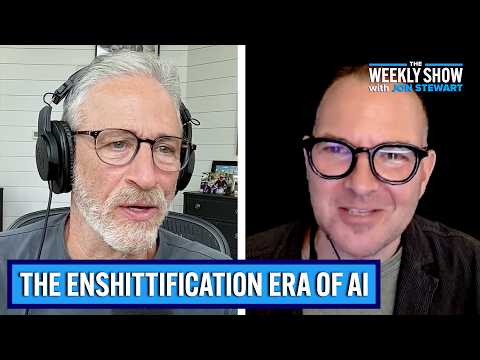
The Weekly Show with Jon Stewart's AI and the Enshittification Era w/ Cory Doctorow | The Weekly Show with Jon Stewart: skim's analysis identifies 13 key moments, with 3 potential conflicts of interest flagged. Cory Doctorow joins Jon Stewart to argue that artificial intelligence is a massive financial bubble driven by corporate hype rather than a sentient threat.
Category: Tech. Format: Interview. YouTube video analyzed by skim.
skim AI Analysis
Credibility assessment: Sourced Tech Critique. Cory Doctorow grounds his economic and technological critique in academic studies, reports from the Roosevelt Institute and Groundwork Collaborative, and his own congressional testimony. However, some claims about leaked OpenAI balance sheets and SpaceX index fund maneuvers rely on secondary commentary and estimates.
Bias assessment: Pro-Labor Anti-Monopoly. The conversation strongly favors labor unions, antitrust enforcement, and progressive economic regulation while portraying tech executives and billionaires as solipsistic monopolists. Both Jon Stewart and Cory Doctorow critique both major political parties from a pro-worker, anti-corporate perspective.
Originality: 85% — Sharp Conceptual Framing. Cory Doctorow introduces memorable frameworks like 'criti-hype,' 'centaur versus reverse centaur' automation, and 'accountability sinks' to reframe standard debates about artificial intelligence. The analysis moves past generic doomerism to examine unit economics and labor power.
Depth: 84% — Deep Structural Analysis. Rather than accepting AI marketing claims at face value, the discussion dissects capital expenditure versus operating expense, inference costs, algorithmic wage discrimination, and historical antitrust precedent. It connects technological deployment directly to corporate consolidation and privacy law.
Key Points (13)
1. Cory Doctorow on Criti-Hype and Social Media
Timestamp: 00:04:37 to 00:10:39
Citing scholar Lee Vinsel, Cory Doctorow argues that critics who repeat tech executives' claims about brainwashing algorithms are engaging in 'criti-hype' that helps companies sell ads. He contends people stay on platforms like Facebook not due to mind control, but because collective action problems make coordinating a departure with friends difficult. Thus, blaming algorithms for human behavior gives tech leaders undeserved credit while ignoring high switching costs.
Significance (High): Reframes social media dominance as a structural lock-in problem rather than psychological manipulation, shifting regulatory focus toward interoperability.
Sources in support: Cory Doctorow (Author of The Reverse Centaur's Guide to Life After AI and EFF Activist)
Neutral sources: Jon Stewart (Host of The Weekly Show)
2. Unsustainable Capital Spending in the AI Sector
Timestamp: 00:10:56 to 00:15:14
Cory Doctorow states that the AI industry generates roughly $50 billion in annual revenue against $700 billion in initial capital expenditure and another $1 trillion added in the last year. Because data centers and GPUs must be replaced every two to five years, companies face massive recurring expenses that require displacing vast amounts of human wages to ever become profitable. He concludes that Sam Altman is running the biggest money-losing venture in human history on the promise that bosses will share wage savings with OpenAI.
Significance (High): Exposes the massive gap between AI infrastructure spending and actual subscription revenue, signaling severe financial fragility across the tech sector.
Sources in support: Cory Doctorow (Author of The Reverse Centaur's Guide to Life After AI and EFF Activist), Jon Stewart (Host of The Weekly Show)
3. Inverted Unit Economics of AI Inference
Timestamp: 00:17:01 to 00:23:34
Unlike the early web where every new customer improved profitability, Cory Doctorow explains that AI suffers from negative unit economics because every user query incurs costly inference computing expenses. Citing researcher Ed Zitron's review of leaked OpenAI financials, Doctorow suggests OpenAI masks subsidized inference losses by categorizing them under a Coca-Cola-sized marketing budget. Consequently, each new AI generation and active customer causes AI providers to lose more money.
Significance (High): Dismantles the common comparison between the dot-com boom and AI by showing that increased AI usage actively deepens operating losses.
Sources in support: Cory Doctorow (Author of The Reverse Centaur's Guide to Life After AI and EFF Activist), Jon Stewart (Host of The Weekly Show)
4. SpaceX Index Rules and Tech Growth Stories
Timestamp: 00:23:34 to 00:29:59
Cory Doctorow claims Elon Musk folded his money-losing Grok AI venture into SpaceX and secured Nasdaq exemptions to enter the Nasdaq 100 immediately without standard insider lockouts, forcing index funds and pensions to buy shares from early billionaire backers. He further argues that tech giants with saturated markets invent fictional growth sectors like Web3, the metaverse, and AI to satisfy Wall Street's demand for rising price-to-earnings ratios. While AI has real utility for tasks like local typo checking, its valuation relies on manufactured hype.
Significance (High): Illustrates how retail retirement funds can become exit liquidity for Silicon Valley insiders when unprofitable tech ventures merge into index-listed firms.
Sources in support: Cory Doctorow (Author of The Reverse Centaur's Guide to Life After AI and EFF Activist), Jon Stewart (Host of The Weekly Show)
5. Why Credulous Bosses Replace Skilled Workers
Timestamp: 00:30:00 to 00:34:05
Cory Doctorow argues that AI is only useful when operated by domain experts who have the discernment to reject its frequent bad advice. However, he warns that AI is still a job-killing technology because salesmen can convince ego-driven executives to fire skilled workers who push back on bad ideas and replace them with flattering, compliant chatbots. Bosses willingly trade away produceable quality just to avoid confronting employees who actually know how the work is done.
Significance (High): Clarifies that workers face displacement not because AI outperforms them, but because management prefers sycophantic software over autonomous staff.
Sources in support: Cory Doctorow (Author of The Reverse Centaur's Guide to Life After AI and EFF Activist), Jon Stewart (Host of The Weekly Show)
6. Centaurs vs. Reverse Centaurs in Automation
Timestamp: 00:35:41 to 00:43:37
Drawing on automation theory, Cory Doctorow contrasts a 'centaur,' where a human head directs a tireless machine body to improve quality, with a 'reverse centaur,' where a machine directs a human body at the limit of endurance to maximize throughput. He cites automated Amazon warehouses having triple the sector's injury rate as proof of reverse centaur design, and warns that firing workers for chatbots incinerates institutional process knowledge. He concludes that if the AI bubble bursts and triggers government austerity, the resulting economic pain will drive voters toward fascism.
Significance (High): Connects workplace automation design and potential tech-bubble austerity directly to physical worker injury, lost institutional memory, and political extremism.
Sources in support: Cory Doctorow (Author of The Reverse Centaur's Guide to Life After AI and EFF Activist), Jon Stewart (Host of The Weekly Show)
7. Reviving Antitrust Enforcement Against Tech Giants
Timestamp: 00:43:38 to 00:50:42
Responding to Jon Stewart's comparison between the AOL-Time Warner crash and today's tech giants, Cory Doctorow argues that modern monopolies are not invincible forces of nature. He notes that early twentieth-century trustbusters shattered rapacious empires like John D. Rockefeller's without modern communication tools, whereas today's monopolies arose because regulators stopped enforcing antitrust laws 40 years ago. Both speakers agree that failing to reform monopolistic capitalism creates the social unrest that enables authoritarian demagogues.
Significance (Medium): Demystifies corporate consolidation as a reversible policy choice from the last four decades rather than an inevitable law of economics.
Sources in support: Cory Doctorow (Author of The Reverse Centaur's Guide to Life After AI and EFF Activist), Jon Stewart (Host of The Weekly Show)
8. Why Billionaires and Banks Fund the AI Bubble
Timestamp: 00:50:42 to 00:56:29
Jon Stewart asks how elite investors and banks fall for the AI bubble, and Cory Doctorow attributes it to a toxic mix of solipsistic billionaires surrounded by sycophants and cynical opportunists who know they can profit from the hype. Doctorow argues that four decades of runaway corporate mergers created cartels powerful enough to achieve regulatory capture over the state. Consequently, myths about efficient free markets blind institutions to financial crashes just as they did in 2007.
Significance (Medium): Explains institutional buy-in to unprofitable tech bubbles through the lens of billionaire insulation, cynical marketing, and regulatory capture.
Sources in support: Cory Doctorow (Author of The Reverse Centaur's Guide to Life After AI and EFF Activist), Jon Stewart (Host of The Weekly Show)
9. Algorithmic Wage Discrimination and Accountability
Timestamp: 00:56:30 to 01:04:45
Cory Doctorow explains that AI excels at multivariate statistical analysis, which corporations use for surveillance pricing and algorithmic wage discrimination. He cites Uber lowering pay offers for less picky drivers and nursing apps buying credit card debt data from brokers to offer lower wages to desperate travel nurses. Furthermore, in high-wage fields like radiology, AI is pitched to cut nine of ten doctors and use the remaining overworked human as an 'accountability sink' to take the blame when patients die.
Significance (High): Reveals how behavioral data brokers and AI algorithms actively depress wages for gig workers and nurses while shifting legal liability onto remaining staff.
Sources in support: Cory Doctorow (Author of The Reverse Centaur's Guide to Life After AI and EFF Activist), Jon Stewart (Host of The Weekly Show)
10. Jon Stewart on Fast-Food AI and Labor Power
Timestamp: 01:04:45 to 01:11:18
Jon Stewart shares an anecdote about a local drive-thru replacing human order-takers with an AI voice bot that failed to handle a simple vegetarian substitution, forcing an employee to intervene anyway. Cory Doctorow notes that while 1990s workers demanded web access, today's CEOs threaten to fire employees who refuse to use AI tools that degrade service quality. Moving forward, Doctorow argues that gutting the National Labor Relations Board will not stop labor activism because unions originally won rights through disruptive strikes before labor laws existed.
Significance (Medium): Highlights consumer and worker backlash against forced, low-quality AI rollouts and underscores historical labor militancy as a counterweight.
Sources in support: Jon Stewart (Host of The Weekly Show), Cory Doctorow (Author of The Reverse Centaur's Guide to Life After AI and EFF Activist)
11. The 1988 Privacy Law Gap and Civic Action
Timestamp: 01:11:18 to 01:19:18
Cory Doctorow recounts testifying at the Consumer Financial Protection Bureau alongside AARP and Pentagon witnesses who revealed that data brokers sell ad targeting lists of dementia patients and military personnel with gambling addictions. He points out that Congress has not passed a federal consumer privacy law since the 1988 VHS rental law, leaving commercial surveillance legal and profitable. To fix this, he urges viewers to reject individual consumer boycotts in favor of joining unions, local political boards, and digital rights groups.
Significance (High): Traces predatory ad targeting, algorithmic price gouging, and deepfakes to a 38-year legislative vacuum on federal consumer privacy.
Sources in support: Cory Doctorow (Author of The Reverse Centaur's Guide to Life After AI and EFF Activist), Jon Stewart (Host of The Weekly Show)
12. Post-Interview Debrief and Democratic Infighting
Timestamp: 01:19:21 to 01:29:18
After Cory Doctorow departs, Jon Stewart and producers Gillian Spear and Brittany Mehmedovic reflect on how strong labor protections offer a realistic alternative to tech fatalism. Answering a listener question with 107 days until the midterms, Stewart criticizes Democratic Party leadership for lacking funds, vision, and a unified message between figures like Chuck Schumer and Mamdani. Gillian Spear adds that Trump's unpopularity has shielded entrenched Democratic leaders from confronting why their own status-quo policies are unpopular.
Significance (Medium): Connects the economic grievances discussed in the interview to the Democratic Party's internal divisions and lack of a midterm platform.
Sources in support: Jon Stewart (Host of The Weekly Show), Gillian Spear (Producer of The Weekly Show), Brittany Mehmedovic (Producer of The Weekly Show)
13. Fox News, Trump's Roast, and Punch vs. Jimothy
Timestamp: 01:29:25 to 01:37:45
Answering why Greg Gutfeld did not receive a cabinet post, Jon Stewart argues that Fox News already functions as the administration's Department of Communications and Marketing. Stewart also defends the comedy writers behind Donald Trump's White House Correspondents' Dinner speech, explaining that Trump ruined serviceable roast premises by rambling for minutes before delivering the punchlines. The hosts close by debating internet animals Punch and Jimothy the raccoon.
Significance (Low): Offers a comedian's technical breakdown of why Donald Trump's roast delivery failed despite professionally written joke structures.
Sources in support: Jon Stewart (Host of The Weekly Show), Gillian Spear (Producer of The Weekly Show), Brittany Mehmedovic (Producer of The Weekly Show)
This analysis was generated by skim (skim.plus), an AI-powered content analysis platform by Credible AI. Scores and classifications represent the platform's AI-generated assessment and should be considered alongside other sources.