Credible AI™ signals
Confidence: Generally Credible. The speakers share practical experiences and insights into AI adoption within investment offices. While personal anecdotes are present, the discussion focuses on real-world applications and challenges, supported by examples from different organizational sizes. The use of enterprise-level AI tools and internal governance discussions adds to the credibility.
Bias: Slightly Pro-AI. The video predominantly highlights the benefits and potential of AI in investment management, with a focus on practical applications and efficiency gains. While challenges and limitations are mentioned, the overall tone leans towards advocating for AI adoption.
Originality (65%): Moderately Original. The video presents a panel discussion with multiple Chief Investment Officers (CIOs) sharing their experiences with AI. While the topic of AI in finance is common, the specific use cases, tools, and challenges discussed by different types of organizations (family office to large pension funds) offer a moderately original perspective.
Depth (76%): Good Depth. The discussion delves into various aspects of AI implementation, including personal productivity tools, workflow changes, data management, and the development of internal AI solutions. The speakers provide specific examples and discuss the nuances of data privacy, governance, and the iterative nature of AI adoption.
Key points (17)
- Short (23 min): key points 1 and 5
- Medium (50 min): key points 1, 2, 3, 4, 5, 7, 8, 10, 11, 12, 13, 14, 15 and 17
- Relaxed (57 min): all 17 key points
1. Abby Barlow: AI as a Personal Force Multiplier
Timestamp: 00:01:00 to 00:21:12 (20 min)
Abby Barlow, CIO of Westwood Management, leverages AI, specifically Anthropic's Claude, as a personal analyst to support her across nearly every part of the investment process. This includes summarizing fund manager decks, preparing questions for meetings, and analyzing legal document revisions, significantly saving time and improving the quality of her inquiries. She has even built custom tools, like a benchmarking app, using AI, demonstrating its potential for individual productivity.
Impact: High. Why it matters: This demonstrates how AI can democratize sophisticated analytical capabilities, allowing individuals in smaller firms to perform tasks previously requiring larger teams or external resources.
For: Abby Barlow
Neutral: Ted Seides
2. AI as a Productivity Multiplier
Timestamp: 00:29:46 to 00:33:21 (4 min)
AI is being leveraged to significantly accelerate routine tasks such as document drafting, meeting preparation, and data analysis, freeing up valuable time for investment professionals to focus on core competencies like strategy, innovation, and relationship building. The goal is to enhance, not replace, human expertise and decision-making.
Impact: High. Why it matters: This shift promises to optimize workflows, allowing teams to dedicate more resources to high-value activities that provide a genuine competitive edge.
For: Abby Barlow, Laura Hill, Ted Seides, Brian Sugrue, Jenny Heller, John Lawrence, Matt Bank, Kristin Kallergis Rowland
3. AI as a Thought Partner, Not a Decision Maker
Timestamp: 00:41:37 to 00:44:24 (3 min)
While AI can significantly accelerate analysis and preparation, it is not yet a decision-maker or recommendation tool. The core of investment strategy relies on nuanced human judgment, understanding unique risks, and asking probing questions – areas where AI currently serves as a 'foil' or 'thought partner' to enhance, rather than dictate, decisions.
Impact: High. Why it matters: This distinction is critical for maintaining an investment edge, ensuring that AI augments human capabilities without undermining the essential elements of strategic thinking and risk assessment.
For: Ted Seides, Laura Hill, Brian Sugrue
4. The 'Hit by a Bus' Risk and Institutional Memory
Timestamp: 00:44:32 to 00:47:09 (3 min)
A significant future application of AI is to mitigate 'hit by a bus' risk by capturing and organizing institutional memory. AI can help identify gaps in documentation, legal advice, and historical investment records, then assist in generating content to transfer knowledge smoothly, ensuring continuity even if key personnel are unavailable.
Impact: High. Why it matters: This proactive approach to knowledge management is crucial for long-term operational resilience and smooth succession planning within investment offices.
For: Ted Seides, Brian Sugrue
5. Cautious Adoption: Trust and Verification
Timestamp: 00:54:24 to 00:57:11 (3 min)
Building layers of trust is paramount for AI adoption. This includes trusting the boundaries of AI (confidentiality, enterprise-grade tools), trusting the output (accuracy, verification discipline, human involvement in decisions), and trusting each other (transparency on AI vs. human contributions). This framework earns permission to use AI effectively.
Impact: High. Why it matters: Establishing these trust protocols is essential for integrating AI responsibly and ensuring it acts as a reliable thought partner rather than a source of misinformation.
For: Brian Sugrue, Ted Seides, Laura Hill
6. Jenny Heller: AI for Manager Assessment & Bias Mitigation
Timestamp: 00:57:00 to 00:58:09 (1 min)
Jenny Heller uses AI tools like Claude to gather extensive information for manager assessment frameworks, aiming to bullet-point every aspect and level out personal biases before portfolio decisions. The team also uses AI for pressure testing portfolio and position analysis, recreating manager models, and scenario analysis, such as for tax loss harvesting strategies to separate marketing noise from truth. AI is also used to create baseline research primers for new strategies, like biotech royalties.
Impact: High. Why it matters: This approach promises more objective and thorough manager due diligence, potentially leading to better investment decisions by mitigating human bias and uncovering deeper insights.
For: Brian Sugrue
7. Jenny Heller: Mid-Diligence Updates & Memo Writing Challenges
Timestamp: 00:59:21 to 01:01:24 (2 min)
An attempt to use AI for mid-diligence updates, intended to bridge issue memos and investment memos, proved to be a failure. The team found themselves spending hours compiling these updates because the context was too large, questions weren't specific enough, or the AI outputs were not conducive to their sharing methods. Heller is also hesitant about AI in memo writing, finding outputs 'empty' and 'salesy,' and values the developmental benefit of human writing, noting AI's limitations with unstructured or overly large problem sets.
Impact: High. Why it matters: This highlights the critical need for specific prompts and structured data when using AI for complex tasks, and underscores the current limitations of AI in nuanced writing and comprehensive analysis without human oversight.
For: Brian Sugrue
8. Jenny Heller: Data Trust and Gradual AI Integration
Timestamp: 01:01:37 to 01:02:37 (1 min)
To manage data trust, Jenny Heller emphasizes using enterprise-grade systems with robust compliance structures, ensuring models don't train on proprietary data. Brandywine has been deliberately slow in enabling co-work and agents, prioritizing understanding how to 'ring fence' data. While desiring AI integration like email connectivity, the firm is cautious due to the vast amount of sensitive data involved, approaching integration slowly until safety and security are assured.
Impact: High. Why it matters: This cautious, security-first approach is crucial for financial institutions handling sensitive data, ensuring that AI adoption does not compromise data integrity or introduce unacceptable risks.
For: Brian Sugrue
9. Jenny Heller: Building an AI Operating System
Timestamp: 01:02:38 to 01:05:31 (3 min)
Jenny Heller envisions a future AI operating system for the investment team, starting with skill-building days (e.g., 'learn to code through Claude,' prompt seminars) and consultant-led process mapping. The goal is to build a flexible, owned layer above AI models, integrating one-off use cases into a shared language and ecosystem. This includes enhancing Slack integration for LLMs to selectively read data, creating a powerful knowledge layer, and ultimately embedding AI into the core of the team's operating system for enhanced thinking and decision-making.
Impact: High. Why it matters: This strategic vision aims to transform AI from a collection of tools into an integrated, intelligent system that amplifies the team's capabilities and decision-making prowess.
For: Brian Sugrue
10. Matt Bank: The Shift to Internal AI Tool Development
Timestamp: 01:20:47 to 01:23:25 (3 min)
GEM has dramatically shifted its AI tool strategy from 90% external to 90% internal development over the past year. A dedicated team of three developers now builds bespoke tools for specific use cases, such as identifying title changes or monitoring deal flows, significantly increasing code generation output and reducing reliance on off-the-shelf solutions.
Impact: High. Why it matters: This strategic pivot underscores a growing confidence in in-house AI capabilities and a desire for greater control and customization. It suggests a move towards building proprietary technological advantages tailored to their unique investment processes.
For: Abby Barlow
11. Matt Bank: Unmet Expectations for End-to-End AI Workflows
Timestamp: 01:24:08 to 01:26:01 (2 min)
Matt Bank notes that AI's capacity to execute entire workflows end-to-end has not yet materialized cost-effectively. The firm has had to meter token usage due to excessive generation and has found that solving specific workflows hasn't yielded extraordinary operational expense savings, emphasizing a realistic view of current AI limitations.
Impact: High. Why it matters: This reveals a critical gap between AI's potential and its current practical application for full workflow automation. It suggests that while AI can assist, human oversight and intervention remain essential for cost-effective and efficient operations.
For: Abby Barlow
12. Kristin Kallergis Rowland: AI Embedded Across the Investment Lifecycle
Timestamp: 01:29:48 to 01:33:02 (3 min)
Kristin Kallergis Rowland states that AI is deeply embedded in every aspect of J.P. Morgan's alternative investment operations, from fund research and diligence to onboarding, client portfolio delivery, and servicing. This integration aims for significant efficiencies, potentially reducing workload by a third in servicing and operations alone.
Impact: High. Why it matters: This demonstrates a comprehensive and strategic adoption of AI, moving beyond isolated tools to a pervasive integration across the entire value chain. It signals a fundamental shift in how investment management is conducted within the firm.
For: Laura Hill
13. Kristin Kallergis Rowland: Custom AI for Data Management and Insights
Timestamp: 01:33:03 to 01:35:21 (2 min)
J.P. Morgan utilizes its proprietary 'GOLLM' suite to manage client data securely in-house. AI is employed to organize data, track themes (like healthcare or corporate governance), and ingest news, both internal and external. It also powers 'living profiles' of managers that adapt to changing language and risk parameters, enhancing the understanding of investment theses.
Impact: High. Why it matters: This focus on proprietary, secure AI solutions highlights the firm's commitment to data privacy and tailored applications. The dynamic 'living profiles' represent an advanced use of AI for continuous manager assessment and risk monitoring.
For: Laura Hill
14. Accelerated Delivery with AI
Timestamp: 01:43:49 to 01:45:20 (2 min)
Jon Webster highlights that AI has drastically reduced the time to implement new ideas and mock up prototypes from months to just two to three weeks, primarily constrained by human scheduling rather than technical development. This acceleration is a key benefit of embedding AI across operations.
Impact: High. Why it matters: This rapid iteration cycle allows for faster testing and deployment of new tools and strategies, significantly boosting operational efficiency and responsiveness within CPP Investments.
For: Abby Barlow
15. AI's Broad Reach at CPP Investments
Timestamp: 01:46:22 to 01:48:51 (2 min)
AI now touches every investment department at CPP Investments, influencing every stage of the investment lifecycle. The core objective is to leverage AI to become a better investor by improving underwriting, risk-taking, and decision-making for the benefit of 22 million Canadians.
Impact: High. Why it matters: This pervasive integration ensures that AI's capabilities are systematically applied across the organization, aiming to enhance overall investment performance and fiduciary responsibility.
For: Abby Barlow
16. Scaling Analysis: Read, Remember, Challenge
Timestamp: 01:46:50 to 01:50:00 (3 min)
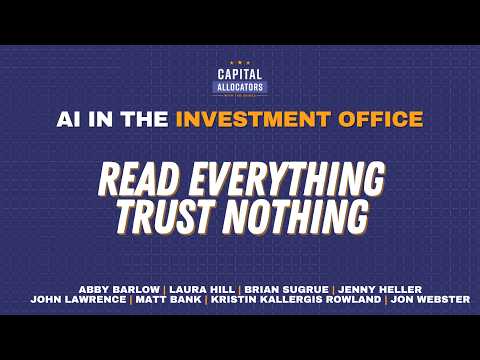
Webster outlines AI's role in enabling CPP Investments to 'read everything, remember everything, and challenge everything.' This involves using AI for scaled portfolio screening, analyzing vast amounts of data like filings and transcripts, and leveraging institutional memory for deal comparisons and intelligence.
Impact: High. Why it matters: By amplifying human capacity to process and recall information, AI allows the firm to evaluate more opportunities, make more informed decisions, and maintain a comprehensive understanding of its investment landscape.
For: Abby Barlow
17. The ROI Tightrope
Timestamp: 02:04:54 to 02:05:57 (1 min)
The pressure is on to demonstrate a clear return on investment for AI technologies within the next 12-18 months. While smaller applications like enhanced perspective-taking or NLP processing show tangible benefits, the true test lies in proving AI's impact on long-term investment outcomes, a challenge that requires solving a significant verifiability gap common across industries. The ultimate goal is to feel confident that AI investments lead to substantially better investment decisions.
Impact: High. Why it matters: This highlights the critical need for measurable AI success. Without clear ROI, adoption could stall, forcing a re-evaluation of AI strategies and investments.
For: Kristin Kallergis Rowland
Neutral: Abby Barlow, Laura Hill, Ted Seides, Brian Sugrue, Jenny Heller, John Lawrence, Matt Bank, Jon Webster
This analysis was generated by skim (skim.plus), an AI-powered content analysis platform by Credible AI. Scores and classifications represent the platform's AI-generated assessment and should be considered alongside other sources.