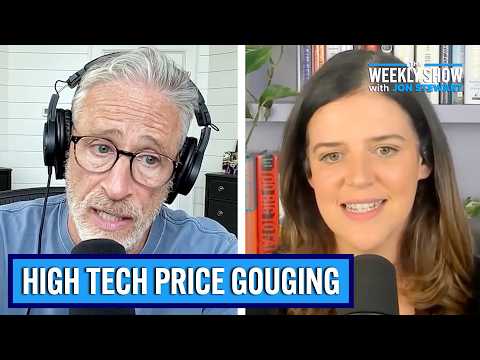
The Weekly Show with Jon Stewart's Algorithmic Price Manipulation & Targeted Gouging | The Weekly Show with Jon Stewart: skim's analysis identifies 12 key moments, with 2 potential conflicts of interest flagged. Lindsay Owens and Jon Stewart examine how corporations use algorithmic coordination, A/B experimentation, and consumer data to inflate prices beyond supply-and-demand fundamentals.
Category: Politics. Format: Interview. YouTube video analyzed by skim.
skim AI Analysis
Credibility assessment: Sourced Policy Analysis. Lindsay Owens backs her claims with specific legal complaints, corporate earnings calls, patent filings, and an original mystery-shopper study conducted with Consumer Reports. While Jon Stewart adds heavy comedic hyperbole and opinionated political commentary, the core economic arguments rest on documented cases and public records.
Bias assessment: Anti-Corporate Populist. The conversation consistently frames corporate pricing strategies as predatory extraction and blames the Trump administration and Supreme Court for regulatory failure. Market-friendly arguments for dynamic pricing or supply-and-demand efficiency are mentioned only to be mocked and dismissed.
Originality: 82% — Primary Research & Synthesis. Owens brings primary investigative work from Groundwork Collaborative, including the Instacart pricing study and archival pulls of deleted AI marketing materials from Fetcher. Combining these findings with historical examples like the Phoebus cartel and Stewart's sharp commentary creates a distinctive synthesis.
Depth: 80% — Structural Market Critique. Rather than treating inflation as a simple macroeconomic figure, the discussion dissects the specific mechanisms of price setting: A/B experimentation, algorithmic rent floors, smart-cart patents, and agentic commerce. It connects micro-level consumer friction to macro-level Federal Reserve policy and antitrust law.
Key Points (12)
1. Owens Links Inflation to Trump Policies
Timestamp: 00:03:56 to 00:06:44
Lindsay Owens argues that current US inflation is heavily policy-induced, driven by Donald Trump's trade war tariffs and war in Iran driving up oil and gas costs. Because Trump refuses to end the war or recalibrate tariffs, the Federal Reserve is left with its single blunt tool of raising interest rates. Jon Stewart concludes that workers end up paying the economic price for presidential policy failures.
Significance (High): Frames potential Federal Reserve rate hikes as a reaction to executive branch trade and foreign policy shocks rather than organic overheating.
Sources in support: Lindsay Owens (President and CEO of the Groundwork Collaborative, Author of Gouged), Jon Stewart (Host of The Weekly Show)
2. From Phoebus Cartel to Modern Price Fixing
Timestamp: 00:08:17 to 00:16:47
Challenging textbook supply-and-demand models, Owens traces corporate collusion from the 1924 Phoebus cartel, where global electric companies shortened light bulb lifespans, to modern tech-enabled schemes. She cites tech CEOs coordinating to suppress engineer wages and a California lawsuit alleging price fixing among Amazon, Walmart, and Levi's. Despite antitrust laws enforced by the Department of Justice, companies often treat potential fines as a manageable cost of doing business.
Significance (Medium): Establishes that price manipulation and planned obsolescence are recurring corporate strategies modernized by digital communication and shared algorithms.
Sources in support: Lindsay Owens (President and CEO of the Groundwork Collaborative, Author of Gouged), Jon Stewart (Host of The Weekly Show)
3. High-Tech Volatility Kills the Fixed Price Tag
Timestamp: 00:17:06 to 00:21:46
For roughly 150 years after John Wanamaker and Quaker merchants popularized fixed price tags in the late 1800s, American shoppers relied on stable, posted prices that allowed easy comparison across stores. Today, teams of pricing consultants have turned retail pricing into a volatile, second-by-second science. Shoppers now document prices shifting before their eyes at checkout and clothing racks stripped of physical price tags.
Significance (Medium): Highlights how removing fixed price tags strips consumers of the transparency required to comparison shop effectively.
Sources in support: Lindsay Owens (President and CEO of the Groundwork Collaborative, Author of Gouged), Jon Stewart (Host of The Weekly Show)
4. Instacart Caught Charging Different Prices
Timestamp: 00:23:11 to 00:30:25
Owens describes how AI firms like Eversite enable retailers to run massive, covert A/B pricing experiments on shoppers. In a joint study with Consumer Reports and More Perfect Union, secret shoppers buying the exact same 23 items on Instacart at the same store and time were offered different prices on 75% of the items, with markups up to 23% and an estimated $1,200 annual penalty for a family of four. Beyond randomized tests, companies are moving toward surveillance and agentic commerce, which McKinsey projects will reach $5 trillion by 2030.
Significance (High): Provides empirical evidence that major grocery platforms actively test shoppers' price sensitivity at the expense of unsuspecting households.
Sources in support: Lindsay Owens (President and CEO of the Groundwork Collaborative, Author of Gouged), Jon Stewart (Host of The Weekly Show)
5. Consumer Backlash Halts Delta and Instacart
Timestamp: 00:30:42 to 00:37:22
Delta partnered with an Israeli AI firm called Fetcher, whose marketing white papers explicitly divided its service into an exploration phase and an exploitation phase, expanding the pilot from 1% to 20% of routes. However, public exposure triggered PR crises that forced Delta to back down, caused Instacart to halt Eversite experiments after an FTC probe, and echoed Coca-Cola's 1990s retreat from temperature-sensitive vending machines. Owens concludes that public sunlight and consumer outrage remain powerful checks on corporate overreach.
Significance (High): Demonstrates that companies rely on secrecy for dynamic pricing and will abandon aggressive tools when public exposure threatens their brand or stock price.
Sources in support: Lindsay Owens (President and CEO of the Groundwork Collaborative, Author of Gouged), Jon Stewart (Host of The Weekly Show)
6. Crises Provide Cover for Extra Price Hikes
Timestamp: 00:39:05 to 00:49:06
Behavioral economics surveys from the 1980s and 1990s show over 80% of Americans view opportunistic markups, such as raising prices on pre-tariff inventory or auctioning scarce toys, as unfair. Despite this, executives use macroeconomic disruptions like the pandemic or tariff announcements as fog to raise prices beyond actual cost increases, as one business owner admitted to Richmond Fed Chair Tom Barkin. Furthermore, patent filings reveal Walmart has patented smart carts that adjust prices of complementary items like mayonnaise once a shopper scans tuna.
Significance (High): Exposes how corporations use real supply shocks as camouflage to expand profit margins while patenting in-store dynamic pricing hardware.
Sources in support: Lindsay Owens (President and CEO of the Groundwork Collaborative, Author of Gouged), Jon Stewart (Host of The Weekly Show)
7. RealPage and the Rise of Algorithmic Rent Fixing
Timestamp: 00:49:07 to 00:53:37
Under antitrust chief Jonathan Kanter, the Biden Justice Department sued real estate software firm RealPage for enabling commercial landlords to coordinate rents. According to the DOJ complaint, RealPage's algorithm overrides supply and demand by recommending landlords keep units vacant rather than lower rent, enforcing hard price floors alongside staff advisors who pressure landlords not to undercut. Analysts estimate RealPage may have inflated rents by up to 25% in high-penetration markets.
Significance (High): Connects the national housing affordability crisis directly to algorithmic collusion that prevents oversupply from lowering rents.
Sources in support: Lindsay Owens (President and CEO of the Groundwork Collaborative, Author of Gouged), Jon Stewart (Host of The Weekly Show)
8. Gas Stations Sued as Corporate Capture Persists
Timestamp: 00:54:57 to 01:03:06
Algorithmic coordination extends beyond housing into fragmented markets, including a class-action lawsuit alleging 1,700 California gas stations used software called Calibrate to raise gas prices by up to 30 cents a gallon, alongside similar tools for frozen French fries and hotels. When personalized pricing neutralizes bargain shoppers, markets lose their natural price discipline. Owens argues that corporate capture of government leaves regulators without the funding or political will to enforce competition laws.
Significance (High): Shows how algorithmic price tools can cartelise fragmented industries like gas stations while regulatory agencies remain largely sidelined.
Sources in support: Lindsay Owens (President and CEO of the Groundwork Collaborative, Author of Gouged), Jon Stewart (Host of The Weekly Show)
9. Walmart's Sparky Bot and State Disclosure Laws
Timestamp: 01:03:32 to 01:14:37
While consumer AI agents could theoretically help shoppers bypass website dark patterns and compare prices, corporate bots like Walmart's Sparky are already driving customer basket totals 35% higher by upselling and gauging urgency. To counter this extraction, lawmakers introduced 90 bills this year, led by a New York disclosure law that exposed algorithmic and personalized pricing at DoorDash, Uber, and the Washington Post. Owens notes the FTC also opened a nine-day public comment period on these pricing practices.
Significance (Medium): Outlines the emerging battle between enterprise shopping bots designed to maximize spend and state legislation aimed at banning surveillance pricing.
Sources in support: Lindsay Owens (President and CEO of the Groundwork Collaborative, Author of Gouged), Jon Stewart (Host of The Weekly Show)
10. Stewart Compares E-Commerce to Vegas Casinos
Timestamp: 01:16:03 to 01:20:58
Reflecting on the interview with producers Gillian Spear and Brittany Mehmedovic, Jon Stewart compares Amazon's interface and dark patterns to Las Vegas casinos engineered to trap visitors on the gaming floor. Spear and Stewart argue that corporations use real crises like the Iran war and tariffs as a pretext to double down on price hikes while simultaneously squeezing workers. They conclude that economic incentives must be rebalanced toward consumers rather than mocked as socialism.
Significance (Low): Synthesizes the guest's findings into a broader critique of how digital storefronts manipulate consumer behavior.
Sources in support: Jon Stewart (Host of The Weekly Show), Gillian Spear (Producer of The Weekly Show), Brittany Mehmedovic (Producer of The Weekly Show)
11. Stewart Urges Press to Ignore Trump and Amend Law
Timestamp: 01:20:59 to 01:27:06
Answering audience questions, Stewart argues the White House press corps should ignore Donald Trump because press briefings disallow follow-ups and merely serve as a content factory for his personal performance. Turning to the Supreme Court, Stewart contends the Roberts Court has crippled American democracy and regulatory agencies through Citizens United, narrowed corruption definitions, and executive immunity. He concludes that reversing the Court's ideological capture and money in politics will require a constitutional amendment.
Significance (Medium): Connects the inability to regulate corporate practices directly to Supreme Court rulings on campaign finance, corruption, and agency authority.
Sources in support: Jon Stewart (Host of The Weekly Show), Gillian Spear (Producer of The Weekly Show), Brittany Mehmedovic (Producer of The Weekly Show)
12. October 1 Is the Line for Halloween Decor
Timestamp: 01:27:09 to 01:30:52
Asked when it is acceptable to decorate for Halloween, Stewart enforces a strict one-month rule, setting October 1 as the starting line. He and the producers joke about the escalating scale of neighborhood decorations, from 28-foot Costco skeletons to Spirit Halloween pop-up stores appearing in September. They close by sharing how they hand out candy and critique costumes from their stoop.
Significance (Low): Provides light comedic relief to close the episode after heavy discussions of economic exploitation and constitutional corruption.
Sources in support: Jon Stewart (Host of The Weekly Show), Gillian Spear (Producer of The Weekly Show), Brittany Mehmedovic (Producer of The Weekly Show)
This analysis was generated by skim (skim.plus), an AI-powered content analysis platform by Credible AI. Scores and classifications represent the platform's AI-generated assessment and should be considered alongside other sources.