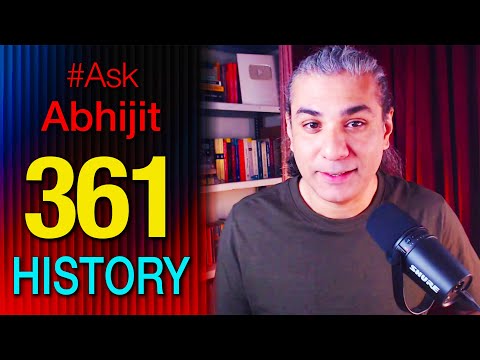
#AskAbhijit 361: Epstein & Popes, Vishwaguru, Pashupati, Anglo-Kuki War Myth, Khajuraho, Henry VIII
Abhijit Chavda
Summary
In episode 361 of the AskAbhijit Show, Abhijit Chavda answers viewer questions spanning ancient history, linguistics, genetics, and modern geopolitics. He rejects Audrey Truschke's claim that the Pashupati seal is proto-Elamite, explains that Vishwaguru is a modern term rather than an ancient Indian title, and points to retroflex consonants in Pashto as proof of its descent from an ancient Gandharan Prakrit. He also links the 1930s American Dust Bowl to the US government's nineteenth-century extermination of 60 million wild bison, dismisses the 1917-1919 Anglo-Kuki War narrative as a wartime land grab, exposes chronological and gender contradictions in the 2019 Narasimhan and Reich ancient DNA paper, and reads Vallabhbhai Patel's November 7, 1950 letter warning Jawaharlal Nehru about Chinese expansionism after the invasion of Tibet.
In the second half of the broadcast, Chavda addresses live Super Chats on military technology, colonial economics, and South Asian power politics. He praises India's Astra beyond-visual-range missiles, urges New Delhi to consider recognizing the Taliban following Russia's May 2026 military pact, and argues that the February 2026 assassination of Iranian moderates brought hardliners to power in Tehran. Comparing ancient Harappan male heights of 176.2 centimeters with modern India's 165-centimeter average, he calls for urgent dietary protein reform and warns that recent regime changes in Pakistan, Bangladesh, and Nepal show the United States encircling India in its own neighborhood.
How time-sensitive the topic is: Evergreen
By the numbers
30 to 60 million wild bison: Estimated North American wild bison population in 1800 before systematic extermination reduced them to under 1,000 by 1900. (Mentioned at 59:51)
1 million deaths: Approximate death toll, roughly one-third of Odisha's population, during the 1866 Na'anka famine under Commissioner Thomas Ravenshaw. (Mentioned at 49:31)
1.5 million soldiers: Approximate number of Indian soldiers who fought for the British Empire in World War I, with roughly 75,000 to 100,000 killed. (Mentioned at 1:18:22)
50 prostitutes: Number of courtesans recorded as attending the October 31, 1501 Banquet of Chestnuts hosted by Cesare Borgia in the Papal Palace. (Mentioned at 1:57:21)
340 kilometers: Stated range of India's Astra Mark 3 (Gandiva) beyond-visual-range air-to-air missile. (Mentioned at 2:10:19)
176.2 centimeters: Average male height in Harappa around 3000 BC cited from a skeletal comparison chart, compared to 165 cm in India today. (Mentioned at 2:55:50)
84,000 ancient texts: Number of ancient manuscripts discovered in 2003 in the wall library of Tibet's Sakya Monastery, including Indian palm-leaf texts. (Mentioned at 3:03:50)
Questions this video answers
Why does Abhijit Chavda reject Audrey Truschke's claim that the Pashupati seal is proto-Elamite?
Abhijit Chavda points out that the Pashupati seal depicts elephants, tigers, water buffaloes, and rhinoceroses, which are native to the Indian subcontinent and never existed in ancient Elam (west of the Strait of Hormuz). Together with the figure's yogic posture and three heads matching later Kushan Shiva coins, he argues it is unmistakably Proto-Shiva and urges Indians to ignore Western Indologists.
Abhijit Chavda, 11:00 to 19:19
From this keypoint: Pashupati Seal Is Proto-Shiva, Says Abhijit Chavda
What did Sardar Vallabhbhai Patel warn Jawaharlal Nehru about China and Tibet in 1950?
In a November 7, 1950 letter read aloud by Chavda, Vallabhbhai Patel warned Prime Minister Jawaharlal Nehru that China had deluded India's ambassador with peaceful talk while invading Tibet and viewed India as an enemy despite New Delhi backing Beijing at the UN. Patel cautioned that Tibet's buffer status was gone, exposing India's Himalayan frontier, Assam, and Burma to communist Chinese expansionism and creating a two-front security threat twelve years before the 1962 war.
Abhijit Chavda, 1:31:05 to 1:40:16
From this keypoint: Patel Warned Nehru in 1950 About Chinese Ambitions
What contradictions does Abhijit Chavda point out in the 2019 Narasimhan and Reich Aryan migration genetics paper?
Chavda highlights that the 2019 ancient DNA paper states steppe ancestry in the Swat Valley and South Asia until about 800 BC was incorporated largely through females, contradicting the narrative of a male-dominated Aryan invasion or migration. He also notes chronological inconsistencies where Sintashta steppe ancestry originates around 1700 BC and enters South Asia around 970 BC, yet Ancestral North Indian (ANI) formation containing steppe ancestry is dated to 2000 BC.
Abhijit Chavda, 1:22:08 to 1:31:01
From this keypoint: Time-Travel Contradictions in 2019 Aryan DNA Paper
How are the Pashto language and Pashtun people connected to ancient Gandhara and India?
Chavda explains that although Pashto is today written in the Perso-Arabic script and classified as Eastern Iranian, it contains retroflex consonants (ta, da) that do not exist in Persian languages but appear in every Indian language. He argues Pashto is a descendant of an ancient Gandharan Prakrit and that Turkic invasions after 1000 AD forcibly imposed foreign script and customs on an indigenous Indian population.
Abhijit Chavda, 24:00 to 35:35
From this keypoint: Pashto's Retroflex Sounds Prove Its Indian Roots
How did the slaughter of North American bison contribute to the 1930s Dust Bowl and Great Depression?
In the nineteenth century, the US government systematically reduced the North American wild bison population from 30-60 million in 1800 to fewer than 1,000 by 1900 in order to break the Plains Indians' way of life. Without tens of millions of bison fertilizing the Great Plains with dung and compacting the earth with their hooves, the topsoil became loose and barren, triggering the massive 1930s dust storms that devastated US agriculture.
Abhijit Chavda, 55:53 to 1:05:37
From this keypoint: Bison Slaughter Triggered the Dust Bowl, Chavda Says
Did ancient Indians call India Vishwaguru?
No, ancient Indians never referred to India as Vishwaguru; they called the land Bharatvarsha, Jambudvipa, or Aryavarta, while using the title Jagatguru for individual scholars like Adi Shankaracharya. Chavda characterizes Vishwaguru as a late twentieth-century coping term that distracts from the urgent need to reform India's corrupt colonial-era education system.
Abhijit Chavda, 19:24 to 23:56
From this keypoint: Vishwaguru Is A Late Twentieth-Century Cope
Who was Thomas Edward Ravenshaw and why is Ravenshaw University in Odisha controversial?
Thomas Edward Ravenshaw was the British colonial commissioner of Orissa during the 1866 Na'anka famine, which killed roughly one million people—a third of Odisha's population—after he declined to import rice. Chavda argues that honoring a colonial famine administrator with Ravenshaw University in Cuttack reflects deep mental colonization and calls for a national law to rename colonial institutions.
Abhijit Chavda, 45:47 to 54:59
From this keypoint: Honoring Famine Overseer Thomas Ravenshaw
What happened during the 1917-1919 Kuki rebellion in Manipur?
After defeating Manipur in 1891, the British disarmed native Manipuris while settling and arming Kukis from Burma in the region. When World War I drew British soldiers away and left only a light Assam Rifles presence, Kukis raided native villages to grab land before the British returned and suppressed them, making it an opportunistic land grab rather than an anti-colonial war.
Abhijit Chavda, 1:13:58 to 1:22:06
From this keypoint: Chavda Calls the Anglo-Kuki War a Land Grab
Why was Confederate General Robert E. Lee not executed for treason after the American Civil War?
President Abraham Lincoln and Union General Ulysses S. Grant offered generous surrender terms at Appomattox in 1865 to promote rapid national reconciliation and prevent further division. When legislators later sought to prosecute Robert E. Lee, Grant threatened to resign his command, protecting Lee from punishment.
Abhijit Chavda, 1:40:18 to 1:49:17
From this keypoint: 1453 Constantinople Pillage and Robert E. Lee's Amnesty
How did the British Charter Act of 1813 change British policy toward Indian culture and education?
Before 1813, the East India Company focused on trade profits and barred Christian missionaries to avoid angering Indians. The British Parliament's Charter Act of 1813 legalized missionary entry—immediately bringing groups like the American Marathi Mission—and funded colonial education to replace indigenous Indian schools, initiating systematic denigration of Hindu civilization.
Abhijit Chavda, 1:49:20 to 1:55:34
From this keypoint: How the 1813 Charter Act Launched Colonial Contempt
Did Gautama Buddha eat meat, and what was his last meal?
Yes, Gautama Buddha and early Buddhist monks consumed meat whenever it was donated as alms, following the principle of accepting whatever food householders offered without waste. Buddha's final meal before his death at Kushinagar was a pork dish called Sukaramaddava offered by a blacksmith named Cunda.
Abhijit Chavda, 2:00:37 to 2:08:37
From this keypoint: Henry VIII's Six Wives and Gautama Buddha's Diet
How did the Maldives and Lakshadweep islands form geologically?
After the Indian tectonic plate broke away from Madagascar and eastern Africa, it drifted northward across the Indian Ocean over the Réunion volcanic hotspot around 65 million years ago. That volcanic plume created the Deccan Traps on the Indian mainland and left behind a trail of extinct ocean volcanoes that became Mauritius, Chagos, the Maldives, and Lakshadweep.
Abhijit Chavda, 1:05:40 to 1:13:55
From this keypoint: Polytheistic Origins of Judaism and Tectonic Maldives
Credible AI™ signals
Confidence: Opinion-Driven Commentary. Abhijit Chavda cites historical texts, Vallabhbhai Patel's 1950 letter, and the 2019 Narasimhan genetics paper, yet frequently mixes them with broad, unverified assertions such as hundreds of artificial British famines, a 100,000-year human presence in South America, and sweeping claims about Vatican clergy.
Bias: Civilizational Nationalist. The commentary consistently frames history and geopolitics through an Indian civilizational lens, dismissing Western Indologists and colonial institutions while championing indigenous antiquity, military strength, and mental decolonization.
Originality (68%): Wide-Ranging Q&A Synthesis. The live Q&A format connects disparate historical, linguistic, and geopolitical topics, offering distinctive arguments like linking the American Dust Bowl to bison extermination and critiquing the internal timelines of step-ancestry genetics papers.
Depth (62%): Broad But Uneven Analysis. Several segments examine primary documents and linguistic features like retroflex consonants in Pashto or specific passages in genetics papers, while others rely on live web searches and rapid generalizations.
Key points (23)
Short (34 min): key points 1, 9, 10 and 22
Medium (1h 19min): key points 1, 3, 5, 6, 8, 9, 10, 12 and 22
Relaxed (3h 4min): all 23 key points
1. Pashupati Seal Is Proto-Shiva, Says Abhijit Chavda
Timestamp: 00:11:00 to 00:19:19 (8 min)
Speaker: Abhijit Chavda
Abhijit Chavda rejects Audrey Truschke's claim that the Pashupati seal represents proto-Elamite iconography rather than Proto-Shiva. He points out that the elephants, tigers, water buffaloes, and rhinoceroses carved on the seal are native to India and never existed in ancient Elam. He concludes that Indians should stop seeking Western validation and ignore hostile foreign Indologists.
Impact: High. Why it matters: Challenges Western Indological interpretations of Indus-Saraswati artifacts while urging Indian audiences to disengage from outrage cycles over foreign academics.
“the pashupati seal is obviously it's very clearly an ancient depiction of Lord Shiva that's what it is and I don't give a damn what Wendy Doniger or Odi Trashki or whoever else says”
In the video: Abhijit Chavda, at 18:07
2. Vishwaguru Is A Late Twentieth-Century Cope
Timestamp: 00:19:24 to 00:23:56 (5 min)
Speaker: Abhijit Chavda
Ancient Indians never used the term Vishwaguru to describe India, preferring civilizational names like Bharatvarsha, Jambudvipa, and Aryavarta, while reserving Jagatguru for individual scholars like Adi Shankaracharya. Abhijit Chavda argues that Vishwaguru is a late twentieth-century invention used to mask the rot and corruption in India's modern colonial-style education system.
Impact: Medium. Why it matters: Pushes back against popular nationalist rhetoric by contrasting ancient India's genuine educational institutions with contemporary educational shortcomings.
“This vishwaguru term is is a late 20th century cope trying we're trying to cope with with the low standards by inventing glorious terms for our past.”
In the video: Abhijit Chavda, at 23:39
3. Pashto's Retroflex Sounds Prove Its Indian Roots
Timestamp: 00:24:00 to 00:35:35 (12 min)
Speaker: Abhijit Chavda
Although linguists classify Pashto as an Eastern Iranian language and modern Afghanistan uses a Perso-Arabic script, Pashto contains retroflex consonant sounds absent in Persian languages but present across all Indian languages. Abhijit Chavda explains that Pashto descended from an ancient Gandharan Prakrit and that Pashtuns are genetically an extension of northern Indians.
Impact: High. Why it matters: Uses phonetic and historical arguments to reframe Afghan linguistic and cultural heritage as an integral branch of ancient Indian civilization.
“No Persian language has retroflex sounds. But every Indian language has retroflex sounds. Ta. These ones. Pashto has these sounds. No Persian language has these sounds. That indicates that Pashto is a descendant of an ancient Indian language.”
In the video: Abhijit Chavda, at 30:42
4. Chavda Traces Pre-Columbian Contact in the Americas
Timestamp: 00:35:38 to 00:45:42 (10 min)
Speaker: Abhijit Chavda
Abhijit Chavda challenges the traditional Bering Strait Clovis-first narrative by citing claimed evidence of human presence in South America over 100,000 years ago and African-looking Olmec stone heads in Mesoamerica. He details documented pre-Columbian European contact around 1000 AD when Viking explorers Erik the Red, Leif Erikson, and Freydis Eriksdottir reached North America and Snorri Thorfinnsson was born there.
Impact: Medium. Why it matters: Highlights how state sponsorship determined why 1492 reshaped global history while earlier Norse expeditions faded.
“In the case of the Vikings, it was all family funded, self-funded expeditions. There was no support from any crown or whatever, which is why didn't succeed.”
In the video: Abhijit Chavda, at 45:05
5. Honoring Famine Overseer Thomas Ravenshaw
Timestamp: 00:45:47 to 00:54:59 (9 min)
Speaker: Abhijit Chavda
British commissioner Thomas Edward Ravenshaw oversaw the 1866 Orissa famine, which killed roughly one million people, or a third of Odisha's population, after he decided against importing rice. Abhijit Chavda contrasts pre-colonial Indian rulers, who stockpiled grain and waived taxes during monsoon failures, with British rule, which he says engineered hundreds of artificial famines.
Impact: High. Why it matters: Connects historical colonial famine administration directly to contemporary debates over institutional decolonization in India.
“The British engineered hundreds of artificial famines in India during the period of time when they occupied India and this individual Thomas Ramanro oversaw engineered one of these famines. Okay. And today you have a college, a university named after that person.”
In the video: Abhijit Chavda, at 52:05
6. Bison Slaughter Triggered the Dust Bowl, Chavda Says
Timestamp: 00:55:53 to 01:05:37 (10 min)
Speaker: Abhijit Chavda
Addressing the causes of the Great Depression, Abhijit Chavda argues that the 1930s American Dust Bowl was caused not merely by poor farming practices, but by the systematic US government extermination of the North American wild bison. Reducing the bison population from up to 60 million in 1800 to fewer than 1,000 by 1900 to subjugate Plains Indians deprived the Great Plains soil of dung fertilization and hoof compaction.
Impact: High. Why it matters: Offers an ecological and historical causal chain linking nineteenth-century indigenous subjugation to twentieth-century economic collapse.
“The real cause of the dust bowl is the genocide of the North American wild bison which was systematically done by the government of the United States.”
In the video: Abhijit Chavda, at 58:53
7. Polytheistic Origins of Judaism and Tectonic Maldives
Timestamp: 01:05:40 to 01:13:55 (8 min)
Speaker: Abhijit Chavda
Abhijit Chavda explains that Judaism was originally polytheistic, noting that the name Israel incorporates El, a Canaanite and Near Eastern deity term, alongside early depictions of Yahweh with a wife and sacred bull, as well as worship of Baal deities before Abraham's monotheism. Shifting to geology, he traces the formation of the Maldives, Lakshadweep, and Chagos archipelagos to the Indian tectonic plate's northward drift after breaking away from Madagascar and Africa.
Impact: Medium. Why it matters: Synthesizes Near Eastern religious history and Indian Ocean plate tectonics in back-to-back explanatory segments.
“So yes, the Maldis were formed due to the northward migration, tectonic migration of the Indian tectonic plate in the Indian subcontinent roughly you could say 50 or 40 million years ago.”
In the video: Abhijit Chavda, at 1:13:42
8. Chavda Calls the Anglo-Kuki War a Land Grab
Timestamp: 01:13:58 to 01:22:06 (8 min)
Speaker: Abhijit Chavda
Abhijit Chavda disputes modern claims of a 1917-1919 Anglo-Kuki War, arguing that after Britain defeated Manipur in 1891, colonial authorities disarmed indigenous Manipuris while settling and arming Kukis from Burma as a buffer. When British forces were drawn away during World War I, leaving only minimal Assam Rifles paramilitary presence, Kukis attacked local villages to seize more indigenous land.
Impact: High. Why it matters: Directly contests historical narratives used in contemporary ethnic and territorial politics in Manipur.
“The cookies wanted to massacre more natives and take over their lands and and villages and territory. That's all they wanted to do. They were not fighting the British. They were trying to steal the land of the natives.”
In the video: Abhijit Chavda, at 1:21:36
9. Time-Travel Contradictions in 2019 Aryan DNA Paper
Timestamp: 01:22:08 to 01:31:01 (9 min)
Speaker: Abhijit Chavda
Reviewing the 2019 ancient DNA study by Vagheesh Narasimhan and David Reich, Abhijit Chavda highlights internal contradictions that undermine the 1500 BC Aryan migration theory. He shows from the paper's text that steppe ancestry in the Swat Valley and South Asia until roughly 800 BC was largely female-mediated rather than a male-led invasion, and that Sintashta steppe ancestry dates to 1700 BC and enters South Asia around 970 BC while Ancestral North Indian formation is dated to 2000 BC.
Impact: High. Why it matters: Uses the text of a landmark genetics paper against its own headline conclusions regarding Indo-Aryan migration.
“Does it not say that the step ancestry earliest existence of step ancestry in Eurasia is 1700 BC? 1700 BC. But ANI ancestor North Indian which is step ancestry is 2,000 BC. How the hell does it work?”
In the video: Abhijit Chavda, at 1:28:51
10. Patel Warned Nehru in 1950 About Chinese Ambitions
Timestamp: 01:31:05 to 01:40:16 (9 min)
Speaker: Abhijit Chavda
Reading verbatim from Vallabhbhai Patel's November 7, 1950 letter to Prime Minister Jawaharlal Nehru following China's invasion of Tibet, Abhijit Chavda shows how Patel warned that Beijing had deluded India's ambassador with professions of peace while preparing an onslaught.
Impact: High. Why it matters: Grounds critique of Nehruvian China policy in primary cabinet correspondence written twelve years before the 1962 war.
“in 1950 Mr. Patel had very clearly seen through the Chinese imperialistic hgemonistic ambitions and he had very clearly warned Mr. Neu what of what could be coming 12 years before Mao's invasion of India”
In the video: Abhijit Chavda, at 1:39:24
11. 1453 Constantinople Pillage and Robert E. Lee's Amnesty
Timestamp: 01:40:18 to 01:49:17 (9 min)
Speaker: Abhijit Chavda
Abhijit Chavda recounts how Sultan Mehmed II breached Constantinople's walls in 1453 using a giant cannon built by a Hungarian gunsmith whom the Byzantine emperor had turned away, after which Ottoman troops were granted three days of unrestricted pillage and slaughter of civilians. He then explains why Confederate General Robert E. Lee was not hanged after the American Civil War ends in 1865: President Abraham Lincoln and General Ulysses S.
Impact: Medium. Why it matters: Contrasts two major military surrenders and conquests, showing how post-war objectives dictate the treatment of defeated populations and commanders.
“When Ulysus Srant came to know about this he protested. He said that he would resign his command if any action was taken against Robert Lee. And he was the war hero the man who won the war. So he prevailed.”
In the video: Abhijit Chavda, at 1:48:16
12. How the 1813 Charter Act Launched Colonial Contempt
Timestamp: 01:49:20 to 01:55:34 (6 min)
Speaker: Abhijit Chavda
Early British East India Company traders admired Hindu culture and barred Christian missionaries from company territories so religious friction would not hurt profits. Abhijit Chavda explains that this changed with the British Parliament's Charter Act of 1813, which ended the company's trade monopoly, funded colonial education to replace indigenous schooling, and legalized missionary entry, immediately bringing the American Marathi Mission and figures like Cynthia Farrar to western India.
Impact: High. Why it matters: Pinpoints the legislative turning point that institutionalized missionary activity and colonial education in British India.
“So this is where things go wrong for India. This is where the Indian inferiority complex and mental col colonization begins with the charter act of 1813. So they started pushing Christian missionaries into India immediately after the charter act.”
In the video: Abhijit Chavda, at 1:51:59
13. Papal Scandals and the Banquet of Chestnuts
Timestamp: 01:55:35 to 02:00:35 (5 min)
Speaker: Abhijit Chavda
Asked whether the Jeffrey Epstein scandal is unique or part of a longer Western pattern, Abhijit Chavda reads historical accounts of the 1501 Banquet of Chestnuts hosted at the Papal Palace by Cardinal Cesare Borgia, son of Pope Alexander VI, involving fifty prostitutes. He also reviews Wikipedia's list of popes who fathered illegitimate children or had affairs with women and men while in office, including Julius II, Paul III, and Alexander VI.
Impact: Low. Why it matters: Uses documented Renaissance papal scandals to argue that elite misconduct in Western power centers is historically recurrent.
“The banquet was given in Chesar Bouia's apartments in the Palazzo Apostolic the official residence of the pope. 50 prostitutes were in attendance for the entertainment of the banquet guests.”
In the video: Abhijit Chavda, at 1:57:16
14. Henry VIII's Six Wives and Gautama Buddha's Diet
Timestamp: 02:00:37 to 02:08:37 (8 min)
Speaker: Abhijit Chavda
Abhijit Chavda reviews King Henry VIII's six marriages—Catherine of Aragon, Anne Boleyn, Jane Seymour, Anne of Cleves, Catherine Howard, and Catherine Parr—arguing that Henry had delusions of grandeur and repeatedly tired of his wives, executing both Anne Boleyn and Catherine Howard on trumped-up charges. He then addresses whether Gautama Buddha ate meat, confirming that Buddhist bhikkhus ate whatever alms were donated to avoid wasting food.
Impact: Low. Why it matters: Clarifies Tudor dynastic history alongside early Buddhist monastic dietary rules.
“The Buddha Gautam Buddha himself did eat meat. His last meal was pork.”
In the video: Abhijit Chavda, at 2:07:53
15. Lunar Claims, Astra Missiles, and Shiva on Coins
Timestamp: 02:08:42 to 02:14:30 (6 min)
Speaker: Abhijit Chavda
Moving to viewer Super Chats, Abhijit Chavda warns that NASA plans to use drones to mark a lunar base perimeter represent soft territorial claims on the Moon, and praises India's Astra Mark 1, Mark 2, and 340-kilometer Mark 3 Gandiva air-to-air missiles as among the world's best. He criticizes Indian elites for tolerating clubs in Mumbai that still restrict governing body membership to Europeans, calling it a sign of mental colonization.
Impact: Medium. Why it matters: Connects defense technology, space geopolitics, and numismatic evidence of Hindu iconographic continuity.
“Astra Mark 1 has a range of 110 to 160 km. Astra 2 is 200 km. Astra Mark 3 Gandhiva is 340 km. That's pretty frightening actually. That's not backwardness. The Astra is probably one of the best air-to-air missiles in the world.”
In the video: Abhijit Chavda, at 2:10:12
16. Ashoka's Coup and Why Humans Adopted Agriculture
Timestamp: 02:14:30 to 02:21:30 (7 min)
Speaker: Abhijit Chavda
Abhijit Chavda explains that medieval succession systems based on merit rarely prevented civil war because ambitious princes ignored their late father's wishes, citing how Ashoka marched from Gandhara to Pataliputra after Emperor Bindusara's death to stage a coup and kill his brothers.
Impact: Medium. Why it matters: Explains political succession dynamics and the practical survival incentives that drove the Neolithic agricultural transition.
“So when emperor bindus dies ashok comes back to patiputra all the way from gandhar on the uttarapati would have taken him weeks to re to return to patipudra and then he executes a coup.”
In the video: Abhijit Chavda, at 2:15:28
17. Western Tech, Megaliths, and Iran's Deterrence
Timestamp: 02:21:38 to 02:28:03 (6 min)
Speaker: Abhijit Chavda
Abhijit Chavda agrees that Western inventions like phones, aircraft, computers, and AI required sustained state and institutional coordination rather than lone inventors, before comparing the ages of Göbekli Tepe, Jericho, and Çatalhöyük across millennia. Turning to geopolitics, he asserts that Pakistan cannot defeat Iran in a war even with nuclear weapons because Iran's massive missile and drone arsenal would reduce Pakistan to rubble.
Impact: Medium. Why it matters: Evaluates the military balance between Pakistan and Iran while contextualizing ancient Anatolian and Levantine archaeological sites.
“If the Pakistanis unwisely decide to nuke Iran, they're going to get smashed. Iran has so many missiles and drones, they will turn Pakistan into rubble.”
In the video: Abhijit Chavda, at 2:25:50
18. Rejecting Western Labels and Recognizing the Taliban
Timestamp: 02:28:05 to 02:36:09 (8 min)
Speaker: Abhijit Chavda
Abhijit Chavda criticizes the importation of Western political labels like 'liberal' and 'conservative' into India, arguing that true liberalism means open-mindedness—exemplified by the joyful, romantic ethos of ancient Khajuraho—whereas modern Western leftists are narrow-minded and intolerant.
Impact: High. Why it matters: Advocates a pragmatic shift in Indian foreign policy toward official recognition of the Taliban alongside a critique of imported political vocabulary.
“I personally welcome this move. I would say that India should also consider consider recognizing the Taliban government in Afghanistan. It would not be a bad thing.”
In the video: Abhijit Chavda, at 2:34:28
19. Karkota Empire, Iranian Hardliners, and EU Bureaucracy
Timestamp: 02:36:42 to 02:42:15 (6 min)
Speaker: Abhijit Chavda
Abhijit Chavda identifies the Karkota Empire as a major Kashmir-based dynasty whose greatest ruler, Lalitaditya Muktapida, conquered large parts of Central Asia and the Indian subcontinent. Turning to Iran, he argues that moderates ruled Tehran until February 28, 2026—noting that Supreme Leader Ali Khamenei maintained a fatwa against nuclear weapons and backed the JCPOA—before US strikes killed the moderates and brought hardliners to power, while rating Prime Minister Narendra Modi's government.
Impact: High. Why it matters: Assesses how the February 2026 decapitation strikes shifted Iran's leadership from nuclear-restrained moderates to hardliners.
“So it was the moderates who were ruling Iran until the 28th of February 2026. The Americans killed the moderates. Now it's hardliners who are ruling Iran. You kill the moderates, you get hardliners who come to power.”
In the video: Abhijit Chavda, at 2:40:11
20. Why Chavda Admires Subhas Chandra Bose and India's Past
Timestamp: 02:42:24 to 02:51:46 (9 min)
Speaker: Abhijit Chavda
Abhijit Chavda rejects Marija Gimbutas's Kurgan hypothesis and points out that while Indus-Saraswati cities had flush toilets in 3000 BC, nineteenth-century European cities dumped human waste out of windows onto the streets. Asked which modern Indian historical figure he likes most, he selects Subhas Chandra Bose because Bose sacrificed everything to physically expel the British rather than accepting freedom on British terms.
Impact: High. Why it matters: Details the economic mechanics of colonial deindustrialization and explains Bose's appeal over negotiated transfer-of-power leaders.
“Who do I like the most? I like Mr. Bose the most. Subashindra Bose. I would say I like him the most and I need to study him more than I have so far.”
In the video: Abhijit Chavda, at 2:47:20
21. Shrinking Indian Heights, Boeing Orca, and Pataliputra
Timestamp: 02:51:53 to 02:59:38 (8 min)
Speaker: Abhijit Chavda
Abhijit Chavda notes that while Chinese male average height rose by roughly 11 centimeters over the past century to 174 centimeters due to improved nutrition, average Indian male height has fallen from 176.2 centimeters in Harappan times (around 3000 BC) to 165 centimeters today because of poor diet and low protein intake.
Impact: High. Why it matters: Uses skeletal height data from Harappa to make a public-health argument for higher protein nutrition in modern India.
“5,000 years ago, your ancestors were 175 cm tall on average. Today, the average Indian male male is 165 cm tall. It's diet, nothing else.”
In the video: Abhijit Chavda, at 2:56:34
22. US Regime Changes Encircling India and Sakya Texts
Timestamp: 02:59:44 to 03:07:02 (7 min)
Speaker: Abhijit Chavda
Abhijit Chavda warns that the United States, not India, is currently the most powerful geopolitical actor in the Indian subcontinent, citing US-backed regime changes that ousted Imran Khan in Pakistan in 2022, removed Sheikh Hasina for Muhammad Yunus in Bangladesh in 2024, and shifted power in Nepal. He reiterates that Pakistan will naturally disintegrate once India becomes economically and geopolitically dominant in its own region.
Impact: High. Why it matters: Frames recent political upheavals in Pakistan, Bangladesh, and Nepal as a coordinated US encirclement of India.
“In the subcontinent, the most powerful geopolitical actor is the United States. The US did a regime change in Pakistan in 2022. Oster of Imran Khan bringing in Shabbash Sharif.”
In the video: Abhijit Chavda, at 3:00:32
23. AI Extinction Risks, Udaipur, and Gandhi's Pranami Roots
Timestamp: 03:07:04 to 03:17:33 (10 min)
Speaker: Abhijit Chavda
In his closing segment, Abhijit Chavda argues that while US AI firms like OpenAI and Anthropic overprice their subscriptions compared to Chinese rivals, AI will soon master edge cases like chaotic traffic and could eventually view humans—including elites—as an impediment to be eliminated.
Impact: Medium. Why it matters: Explores both near-term AI pricing competition between the US and China and the religious syncretism of Mohandas Gandhi's family background.
“pronami is a sect deriving the best of the gita in the Quran in search of one goal Sri Krishna. So uh that's the background of Mr. Gandhi.”
In the video: Abhijit Chavda, at 3:15:35
Conflicts of interest (1)
Direct Audience Monetization and Book Sales
Commercial conflict, Low severity
Abhijit Chavda promotes خمس of his own Amazon eBooks in the video description, solicits direct UPI and PayPal contributions, and prioritizes paid Super Chat questions during the broadcast.
Sources: Abhijit Chavda
Significance: Direct financial support from regular viewers incentivizes catering to the audience's nationalist priors and validating recurring commenter themes.
Key sources
Abhijit Chavda: Host of the #AskAbhijit Show and author
Who's in this
Audrey Truschke
Wendy Doniger
Thomas Edward Ravenshaw
Vagheesh Narasimhan
David Reich
Vallabhbhai Patel
Jawaharlal Nehru
Mehmed II
Robert E. Lee
Ulysses S. Grant
Pope Alexander VI
Henry VIII
Gautama Buddha
Subhas Chandra Bose
Mohandas Gandhi
Ashoka
Lalitaditya Muktapida
Also mentioned
Pashupati seal (First mentioned at 6:42)
Pakistan (First mentioned at 7:00)
Gandhara (First mentioned at 7:40)
Afghanistan (First mentioned at 7:44)
Iran (First mentioned at 9:09)
China (First mentioned at 16:14)
Manipur (First mentioned at 1:14:26)
Tibet (First mentioned at 1:31:33)
Elam (First mentioned at 6:55)
Christopher Columbus (First mentioned at 40:44)
Erik the Red (First mentioned at 41:29)
Leif Erikson (First mentioned at 42:04)
Odisha (First mentioned at 45:55)
East India Company (First mentioned at 46:37)
Ravenshaw University (First mentioned at 48:53)
Israel (First mentioned at 1:05:51)
Maldives (First mentioned at 1:08:42)
Mao Zedong (First mentioned at 1:31:05)
Constantinople (First mentioned at 1:40:20)
Anne Boleyn (First mentioned at 2:00:41)
The Hindus: An Alternative History (First mentioned at 14:25)
Devdutt Pattanaik (First mentioned at 15:31)
Adi Shankaracharya (First mentioned at 20:02)
Kanishka (First mentioned at 27:57)
Freydis Eriksdottir (First mentioned at 42:31)
Snorri Thorfinnsson (First mentioned at 43:54)
Abraham Lincoln (First mentioned at 1:45:37)
Cynthia Farrar (First mentioned at 1:54:34)
Cesare Borgia (First mentioned at 1:56:35)
Astra (First mentioned at 2:09:54)
Ajit Doval (First mentioned at 2:32:23)
Michael Witzel (First mentioned at 17:42)
Franklin D. Roosevelt (First mentioned at 55:27)
This analysis was generated by skim (skim.plus), an AI-powered content analysis platform by Credible AI. Scores and classifications represent the platform's AI-generated assessment and should be considered alongside other sources.