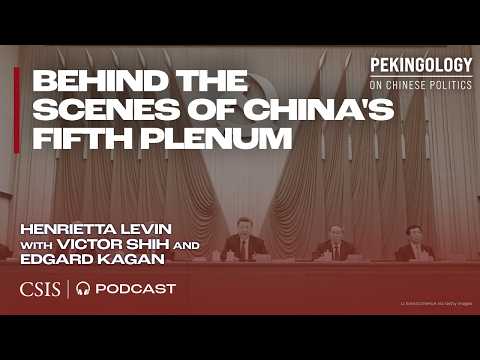
Center for Strategic & International Studies's Behind the Scenes of China's Fifth Plenum: skim's analysis identifies 8 key moments. Victor Shih, Edgard Kagan, and Henrietta Levin examine the Chinese Communist Party's Fifth Plenum of its 20th Central Committee, focusing on party building, military purges, and internal contradictions in the final resolution.
Category: Politics. Format: Panel Discussion. YouTube video analyzed by skim.
skim AI Analysis
Credibility assessment: Expert Policy Analysis. Victor Shih, Edgard Kagan, and Henrietta Levin draw directly on primary Chinese Communist Party documents, official People's Daily accounts, and decades of diplomatic and academic experience. The panelists clearly distinguish documented party rules from their own interpretive readings of opaque elite politics.
Bias assessment: Washington Policy Establishment. Hosted by CSIS and featuring former US Foreign Service officer Edgard Kagan alongside academic Victor Shih, the discussion evaluates Chinese elite politics through a US national security lens, concluding with direct advice on how Washington can extract more leverage in bilateral talks.
Originality: 82% — Granular Elite Decoding. Rather than repeating headline summaries of Xi Jinping's dominance, the speakers examine specific contradictions in the Fifth Plenum resolution, provincial birth-year patterns, Central Military Commission vacancies, and the physical sequestration of delegates inside the Jingxi Hotel.
Depth: 88% — Deep Institutional Mechanics. The conversation systematically unpacks party building thresholds, the mechanics of promoting alternate Central Committee members, patronage purges in the 31st Group Army, and the tension between intra-party democracy and correct centralism.
Key Points (8)
1. Victor Shih Defines Plenums and Party Building
Timestamp: 00:02:01 to 00:04:08
Victor Shih explains that under the party constitution, the Central Committee of roughly 200 senior officials (now down to 170) convenes annually in plenums to pass major policies. He defines party building as recruiting members and forming grassroots party groups at thresholds of roughly 12 to 15 members and committees at 50 to 100 members. These grassroots structures ensure work units implement dictates from higher party organs.
Significance (Medium): Clarifies the institutional mechanics of how the Chinese Communist Party translates central resolutions into workplace-level control across China.
Sources in support: Victor Shih (Ho Miu Lam Chair Professor at UCSD; Non-resident Affiliate at CSIS)
Neutral sources: Henrietta Levin (Host, Pekingology; Senior Fellow, Freeman Chair in China Studies at CSIS)
2. Detailed Readouts Mask Xi's Political Insecurity
Timestamp: 00:04:22 to 00:08:37
Victor Shih notes that People's Daily accounts of the Fifth Plenum preparation show the process was completely led by Xi Jinping, contrasting with shared elite opinions in the 1980s and the underground Hong Kong leaks of the 1990s. Edgard Kagan argues that publishing extensive details about Xi's personal involvement is meant to project dominance rather than genuine confidence. Both agree that factional leaks to outside press have been shut down by high penalties.
Significance (Medium): Reframes Beijing's unusually detailed procedural readouts as an effort to assert top-down control rather than proof of effortless authority.
Sources in support: Victor Shih (Ho Miu Lam Chair Professor at UCSD; Non-resident Affiliate at CSIS), Edgard Kagan (Freeman Chair in China Studies at CSIS; Former US Foreign Service Officer)
Neutral sources: Henrietta Levin (Host, Pekingology; Senior Fellow, Freeman Chair in China Studies at CSIS)
3. Plenum Revives Intra-Party Democracy Out of Desperation
Timestamp: 00:08:38 to 00:12:41
Victor Shih highlights a major internal contradiction in the Fifth Plenum resolution, which demands obeying the party center while devoting two to three paragraphs to intra-party democracy for the first time since Hu Jintao's era. He argues that because ideological education and inspections since 2013 have failed to stop waves of corruption, Xi Jinping is turning to intra-party democracy out of desperation so lower-level elites constrain each other. Edgard Kagan notes the text pairs intra-party democracy with practicing correct centralism, meaning Xi remains final arbiter.
Significance (High): Identifies a striking rhetorical shift in party documents that exposes the limits of Xi Jinping's decade-long top-down anti-corruption campaign.
Sources in support: Victor Shih (Ho Miu Lam Chair Professor at UCSD; Non-resident Affiliate at CSIS), Edgard Kagan (Freeman Chair in China Studies at CSIS; Former US Foreign Service Officer)
Neutral sources: Henrietta Levin (Host, Pekingology; Senior Fellow, Freeman Chair in China Studies at CSIS)
4. Xi Seeks an Anti-Corruption System to Outlast Him
Timestamp: 00:12:42 to 00:16:53
Responding to Edgard Kagan's question on whether anti-corruption is a genuine goal or a political tool, Victor Shih argues that Xi Jinping is beginning to confront his mortality and wants a governance system that will outlast him. Pointing to Xi's own speech explaining the resolution, Shih notes that Xi simultaneously celebrated a decade of anti-corruption achievements and warned the job is incomplete. Shih concludes that Xi fears his policies will be undone the moment he eases off, though current measures show little sign of succeeding.
Significance (High): Connects the Fifth Plenum's institutional focus to the earliest structural preparations for eventual post-Xi governance and legacy preservation.
Sources in support: Victor Shih (Ho Miu Lam Chair Professor at UCSD; Non-resident Affiliate at CSIS)
Neutral sources: Henrietta Levin (Host, Pekingology; Senior Fellow, Freeman Chair in China Studies at CSIS), Edgard Kagan (Freeman Chair in China Studies at CSIS; Former US Foreign Service Officer)
5. Purges Leave Xi's Military Hold Weakened
Timestamp: 00:16:53 to 00:22:14
Edgard Kagan argues that the intra-party democracy language reflects internal maneuvering, pointing to the confirmation of expulsions like Zhang Youxia, the promotion of internal affairs chief Zhang Shengmin as the sole remaining member on the Central Military Commission, and 10 or 11 provincial party secretaries appointed this year all born in 1965 or later. Victor Shih agrees that losing both the Miao Hua and He Weidong group and the Zhang Youxia group to corruption charges has dramatically weakened Xi Jinping's perceived hold over the military. With trusted PLA intermediaries gone, Shih suggests Xi offered civilian concessions out of insecurity.
Significance (High): Shows how sweeping purges of rival military networks have paradoxically left Xi Jinping without trusted eyes and ears inside the People's Liberation Army.
Sources in support: Victor Shih (Ho Miu Lam Chair Professor at UCSD; Non-resident Affiliate at CSIS), Edgard Kagan (Freeman Chair in China Studies at CSIS; Former US Foreign Service Officer)
Neutral sources: Henrietta Levin (Host, Pekingology; Senior Fellow, Freeman Chair in China Studies at CSIS)
6. Vacant CMC Seats Put Generals on Trial
Timestamp: 00:22:14 to 00:29:42
Henrietta Levin notes that five of the seven seats on the Central Military Commission were left vacant at the plenum. Victor Shih argues that after embarrassing removals of close elevatees like former Foreign Minister Qin Gang, Xi Jinping is keeping acting military commanders in an unannounced trial period until the 21st Party Congress. Edgard Kagan adds a more cynical view, suggesting that nearly every senior PLA officer with 20 to 25 years of service has skeletons in the closet, and withholding formal titles keeps them dependent on Xi while his wife's PLA networks help vet alternatives.
Significance (High): Explains why Beijing left five of seven top military posts empty: acting commanders are easier to vet, control, and discard before formal elevation.
Sources in support: Victor Shih (Ho Miu Lam Chair Professor at UCSD; Non-resident Affiliate at CSIS), Edgard Kagan (Freeman Chair in China Studies at CSIS; Former US Foreign Service Officer)
Neutral sources: Henrietta Levin (Host, Pekingology; Senior Fellow, Freeman Chair in China Studies at CSIS)
7. Inside the Jingxi Hotel Plenum Lockdown
Timestamp: 00:29:43 to 00:36:53
Edgard Kagan and Victor Shih describe what attending a plenum is like for provincial officials summoned to Beijing, noting they are sequestered inside the aging Jingxi Hotel under the watch of the Organization Department. Shih explains that Central Committee members are forbidden from speaking freely to one another to prevent factionalism, listen to Xi Jinping's opening speech, spend two days in regional breakout groups reviewing predetermined resolutions, and vote on the final day. When alternate members move up to fill purged seats, candidates under investigation or near age 60 without ministerial prospects are skipped.
Significance (Medium): Pulls back the curtain on the tightly choreographed, high-anxiety environment inside a Central Committee plenum.
Sources in support: Victor Shih (Ho Miu Lam Chair Professor at UCSD; Non-resident Affiliate at CSIS), Edgard Kagan (Freeman Chair in China Studies at CSIS; Former US Foreign Service Officer)
Neutral sources: Henrietta Levin (Host, Pekingology; Senior Fellow, Freeman Chair in China Studies at CSIS)
8. Edgard Kagan Urges Trump to Press Xi's Weaknesses
Timestamp: 00:36:53 to 00:41:50
Asked how President Donald Trump should approach upcoming meetings with Xi Jinping on the margins of APEC and the G20, Victor Shih points out that the plenum resolution flags corrupt officials using cryptocurrency and blockchains to move money out of China, offering Washington new diplomatic leverage alongside AI talks. Edgard Kagan argues that Xi is consumed by domestic challenges and needs external stability between May 2026 and October 2027 to arrange personnel for the next congress. Kagan advises Trump to demand more from Beijing in return for the post-Busan trade truce.
Significance (High): Translates internal Chinese party dynamics into concrete negotiating leverage for the United States ahead of upcoming presidential summits.
Sources in support: Victor Shih (Ho Miu Lam Chair Professor at UCSD; Non-resident Affiliate at CSIS), Edgard Kagan (Freeman Chair in China Studies at CSIS; Former US Foreign Service Officer)
Neutral sources: Henrietta Levin (Host, Pekingology; Senior Fellow, Freeman Chair in China Studies at CSIS)
This analysis was generated by skim (skim.plus), an AI-powered content analysis platform by Credible AI. Scores and classifications represent the platform's AI-generated assessment and should be considered alongside other sources.