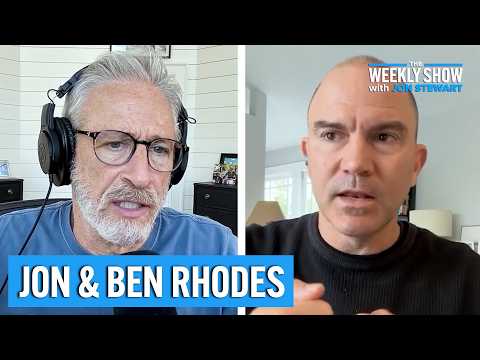
The Weekly Show with Jon Stewart's Ben Rhodes On the War In Iran & US Foreign Policy | The Weekly Show with Jon Stewart: skim's analysis identifies 12 key moments, with 3 potential conflicts of interest flagged. Former Deputy National Security Advisor Ben Rhodes joins Jon Stewart to examine the US war with Iran and the broader failures of post-9/11 American interventionism.
Category: Politics. Format: Interview. YouTube video analyzed by skim.
skim AI Analysis
Credibility assessment: Insider Policy Perspective. Former Deputy National Security Advisor Ben Rhodes provides direct operational insights into the Iran nuclear deal and White House war gaming. While his historical explanations of JCPOA inspections and the 1979 military refund are specific, his claims about current war casualties and Gulf crypto motives rely on unverified commentary.
Bias assessment: Anti-Interventionist Critique. Jon Stewart and Ben Rhodes share a strong anti-interventionist perspective, sharply criticizing Donald Trump's military actions in Iran, Benjamin Netanyahu's territorial ambitions, and decades of bipartisan US military overreach. While Rhodes critiques Obama's Libya intervention, the discussion consistently favors diplomacy over force.
Originality: 80% — Candid Situation Room View. Combining Jon Stewart's sharp questioning with Ben Rhodes's firsthand accounts of White House decision-making yields a candid autopsy of why US presidents repeatedly authorize military interventions despite running against forever wars.
Depth: 84% — Systemic Foreign Policy Review. Rather than treating the Iran conflict in isolation, the conversation connects Strait of Hormuz economics, Gulf security guarantees, Israeli coalition politics, post-9/11 counterterrorism infrastructure, and media pressures into a cohesive critique of American statecraft.
Key Points (12)
1. Rhodes Says Bombing Cannot Erase Iran's Nukes
Timestamp: 00:02:49 to 00:05:51
Ben Rhodes explains that Obama administration war games consistently showed air strikes cannot destroy Iran's scattered nuclear program or scientific knowledge. Instead, bombing predictably triggers Iran to close the Strait of Hormuz, through which 20% of global fossil fuel flows. Consequently, the war has caused immense human and economic costs without eliminating the regime or its nuclear know-how.
Significance (High): Highlights the strategic limits of air power against indigenous scientific knowledge, showing why military action often triggers predictable asymmetric retaliation.
Sources in support: Jon Stewart (Host, The Weekly Show), Ben Rhodes (Author of 'All We Say', Former Deputy National Security Advisor to President Obama)
2. Why Trump Cannot Beat the Original JCPOA Terms
Timestamp: 00:05:51 to 00:10:09
Under the JCPOA, Iran shipped out its uranium stockpile, capped enrichment at 3%, destroyed its plutonium reactor, and accepted intrusive IAEA inspections backed by the UN Security Council. Ben Rhodes and Jon Stewart argue Donald Trump's ego and hostility toward Barack Obama prevent him from accepting a similar deal or unfreezing Iranian assets. As a result, Trump is trapped between political humiliation and an escalating global energy crisis.
Significance (High): Exposes how domestic political ego and refusal to match a predecessor's diplomatic terms can prolong a military stalemate with global economic fallout.
Sources in support: Jon Stewart (Host, The Weekly Show), Ben Rhodes (Author of 'All We Say', Former Deputy National Security Advisor to President Obama)
3. Iran's Strait of Hormuz Tolls and the Dubai Model
Timestamp: 00:10:09 to 00:14:51
Rising oil prices and Iran turning the Strait of Hormuz into a toll road have replenished Iranian and Russian coffers while acting as a new deterrent against future US attacks. Furthermore, Iranian drone and missile strikes have shattered the US security guarantee and the image of places like Dubai as safe havens for global wealth. This vulnerability may push Gulf monarchies to hedge away from Washington and the petrodollar toward China and Russia.
Significance (High): Demonstrates how regional warfare can backfire financially by enriching adversaries, undermining the petrodollar system, and eroding Gulf confidence in US protection.
Sources in support: Jon Stewart (Host, The Weekly Show), Ben Rhodes (Author of 'All We Say', Former Deputy National Security Advisor to President Obama)
4. Unreported Gulf Damage and Saudi Passivity
Timestamp: 00:17:01 to 00:22:48
Ben Rhodes claims the Pentagon has not provided accurate battle damage assessments of US bases and Gulf infrastructure, noting that an Iranian strike took Qatar's largest liquid natural gas field offline for years. Despite buying tens of billions of dollars in US weaponry, Gulf states like Saudi Arabia remain passive to avoid Iranian retaliation against their overland oil pipelines. Rhodes suggests Donald Trump spares Gulf states from criticism because they invest heavily in US defense contractors and Trump family businesses.
Significance (High): Reveals the gap between massive US arms sales to Gulf allies and their actual willingness to fight, alongside financial conflicts involving Trump family ventures.
Sources in support: Jon Stewart (Host, The Weekly Show), Ben Rhodes (Author of 'All We Say', Former Deputy National Security Advisor to President Obama)
5. Killing Iran's Leaders Empowered the IRGC
Timestamp: 00:22:48 to 00:25:56
Rather than toppling the Iranian government, killing 86-year-old Supreme Leader Ali Khamenei and political operator Larijani removed figures who might have negotiated and consolidated power under the Iranian Revolutionary Guard Corps. Jon Stewart and Ben Rhodes agree that Iran has shifted from a religious theocracy into an entrenched military dictatorship led by the IRGC and Basij militia. Just as Israeli invasions boosted Hezbollah and Hamas, external attacks have left Iran's hardliners more militarized and entrenched.
Significance (High): Shows how decapitation strikes without a viable political transition can eliminate pragmatic negotiators and hand total control to hardline military factions.
Sources in support: Jon Stewart (Host, The Weekly Show), Ben Rhodes (Author of 'All We Say', Former Deputy National Security Advisor to President Obama)
6. Stewart and Rhodes on Israeli Expansionism
Timestamp: 00:25:56 to 00:33:41
Jon Stewart questions how West Bank settlements serve Israeli security, asking whether the true objective is territorial expansion across Judea and Samaria, Lebanon, and Syria. Ben Rhodes agrees, pointing out that on October 7 IDF forces were diverted to protect West Bank settlers and that ministers like Ben-Gvir and Smotrich openly seek annexation and ethnic cleansing. Both argue that Benjamin Netanyahu uses regional chaos and historically propped up Hamas to undermine the Palestinian Authority and stay in power, all enabled by US weapons and funding.
Significance (High): Challenges the security rationale of Israeli settlement policy, arguing that US military aid directly enables territorial annexation and permanent conflict.
Sources in support: Jon Stewart (Host, The Weekly Show), Ben Rhodes (Author of 'All We Say', Former Deputy National Security Advisor to President Obama)
7. Dismantling the Post-9/11 War on Terror Machine
Timestamp: 00:35:14 to 00:41:53
Ben Rhodes argues that over 20 years of building military bases, intelligence platforms, and special forces across North Africa, the Middle East, and South Asia created a self-sustaining war machine that constantly looks for new enemies. This violence displaced tens of millions of refugees, fueling far-right politics in Europe, while military gear and Baghdad counterinsurgency tactics returned home to equip ICE in cities like Minneapolis. Rhodes calls for repealing the 2002 Authorization for Use of Military Force and dismantling this sprawling infrastructure.
Significance (High): Connects overseas counterterrorism infrastructure to both European political radicalization and the domestic militarization of US immigration enforcement.
Sources in support: Jon Stewart (Host, The Weekly Show), Ben Rhodes (Author of 'All We Say', Former Deputy National Security Advisor to President Obama)
8. Lessons From Libya and the Failure of Sanctions
Timestamp: 00:41:53 to 00:49:48
Pressed by Jon Stewart on why Barack Obama intervened in Libya, Ben Rhodes admits the intervention was a mistake that slid from preventing a massacre in Benghazi into regime change. Rhodes extends this critique to economic sanctions, noting that heavily sanctioning Cuba, Iran, North Korea, and Russia only entrenched repressive regimes and enriched black-market actors like the IRGC while hurting civilians. When Stewart points to Russia taking Crimea, Rhodes argues America must accept the limits of its ability to control global events.
Significance (High): Provides a rare admission of error from an Obama insider on Libya while challenging bipartisan reliance on economic sanctions as an alternative to war.
Sources in support: Jon Stewart (Host, The Weekly Show), Ben Rhodes (Author of 'All We Say', Former Deputy National Security Advisor to President Obama)
9. Enforcing Congressional War Powers to Stop Wars
Timestamp: 00:49:48 to 00:51:34
Ben Rhodes contrasts Libya, where the Obama administration relied on a UN resolution without Congress, with the 2013 Syria chemical weapons crisis, where seeking congressional authorization stopped a bombing campaign. Even hawkish critics like Marco Rubio refused to vote for war in Syria because lawmakers know military interventions are unpopular with voters. Rhodes concludes that insisting on congressional authorization and threatening impeachment under the Constitution and War Powers Act would have prevented the war in Iran.
Significance (Medium): Identifies a concrete constitutional mechanism to curb executive warmaking by forcing lawmakers to go on the record before any military strike.
Sources in support: Jon Stewart (Host, The Weekly Show), Ben Rhodes (Author of 'All We Say', Former Deputy National Security Advisor to President Obama)
10. How Empire Peripheries and Elite Interests Profit
Timestamp: 00:52:48 to 01:02:22
Jon Stewart traces US interventionism back to the 1953 Iran coup and a post-World War II belief that America can control the world, noting the defense budget is topping $1 trillion. Ben Rhodes responds that the US functions like an empire that tolerates chaos on its periphery while protecting a core in Europe and East Asia. Inside the Situation Room, officials fixate on tactical levers while arms dealers, fossil fuel companies, financial speculators, AIPAC, and an action-hungry media insulate themselves from the resulting instability.
Significance (High): Explains the structural persistence of US interventionism by identifying the financial, lobbying, and media actors who benefit from global volatility.
Sources in support: Jon Stewart (Host, The Weekly Show), Ben Rhodes (Author of 'All We Say', Former Deputy National Security Advisor to President Obama)
11. Media Pressure and the $6 Trillion Terror Price Tag
Timestamp: 01:02:22 to 01:09:15
Ben Rhodes recalls how US media figures like Jake Tapper demanded military action in Libya and treated the failed 2009 Christmas Day bomber as a multi-week crisis, pressuring presidents to prove their toughness. Jon Stewart jokes that the bar for foreign intervention should be as high as releasing the Epstein files and notes America spent $6 trillion on the War on Terror while ignoring domestic gun violence. Both call for trading, diplomacy, and living with a reasonable standard of risk instead of chasing total control.
Significance (Medium): Critiques the Washington media culture that equates presidential leadership with bombing campaigns and quantifies the $6 trillion opportunity cost of the War on Terror.
Sources in support: Jon Stewart (Host, The Weekly Show), Ben Rhodes (Author of 'All We Say', Former Deputy National Security Advisor to President Obama)
12. Rhodes on All We Say and the Loss of Persuasion
Timestamp: 01:09:15 to 01:13:30
Discussing his upcoming book All We Say, Ben Rhodes traces the argument over American identity through 15 historical speeches, starting with Benjamin Franklin defending compromise at the Constitutional Convention. Jon Stewart and Rhodes lament that modern social media algorithms and viral clips have destroyed Americans' ability to deliver or listen to sustained persuasive arguments. Rhodes concludes that reviving political storytelling through speeches is essential to persuading people across polarized tribes.
Significance (Low): Connects the decline of long-form political speeches to modern algorithmic polarization, showing why politicians now pander to tribes rather than persuade.
Sources in support: Jon Stewart (Host, The Weekly Show), Ben Rhodes (Author of 'All We Say', Former Deputy National Security Advisor to President Obama)
This analysis was generated by skim (skim.plus), an AI-powered content analysis platform by Credible AI. Scores and classifications represent the platform's AI-generated assessment and should be considered alongside other sources.