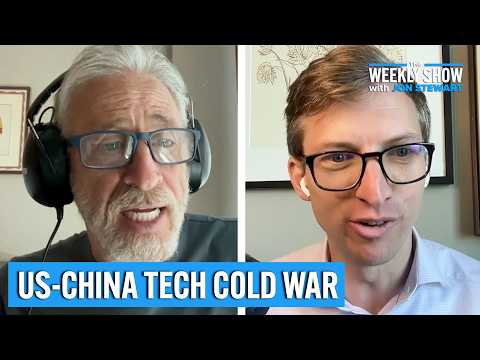
The Weekly Show with Jon Stewart's Big Tech & China: Supply Chains, Trade Wars & Industry's Future | The Weekly Show with Jon Stewart: skim's analysis identifies 12 key moments, with 1 potential conflict of interest flagged. Historian Chris Miller joins Jon Stewart to dissect the semiconductor supply chain, explaining how Silicon Valley relies on Taiwan's TSMC, Dutch lithography, Japanese wafers, and Chinese rare earths.
Category: Politics. Format: Interview. YouTube video analyzed by skim.
skim AI Analysis
Credibility assessment: Expert Historical Grounding. Chris Miller anchors the discussion in industrial history, specific chemical purity requirements, and market valuations. Jon Stewart and his producers offer unvarnished political commentary in the final segment, clearly separating academic trade analysis from editorial frustration.
Bias assessment: Anti-Trump Multilateralist. While Chris Miller maintains a measured, analytical tone that occasionally credits Trump's frustrations with European defense spending, Jon Stewart and his producers sharply criticize the Trump administration's trade war strategy, domestic spending, and transactional foreign policy.
Originality: 82% — Deep Supply-Chain Synthesis. Rather than treating the trade war as pure politics, the conversation maps the physical bottlenecks of the AI boom, connecting Silicon Valley blueprints, Dutch lithography, Japanese wafers, and Chinese rare earth refining into a single strategic picture.
Depth: 88% — Nuanced Geopolitical Dive. Miller resists broad generalizations, breaking down why Morris Chang's foundry model succeeded, why rare earth mining is a low-margin loss leader for China, and why capital controls prevent the renminbi from replacing the US dollar.
Key Points (12)
1. Taiwan's Central Role in AI Chips, Per Miller
Timestamp: 00:04:41 to 00:11:20
Chris Miller explains that while Silicon Valley firms like NVIDIA and AMD design cutting-edge chips, Taiwan's TSMC manufactures almost all of them. As China's military capabilities grow, US export controls block Beijing from buying these advanced AI chips from Taiwan. Meanwhile, generational shifts in Taiwan have solidified its desire for political and economic autonomy from mainland China.
Significance (High): America's entire AI boom rests on a single island manufacturer operating under the shadow of a potential Chinese military blockade.
Sources in support: Chris Miller (Professor of International History at Tufts University, Author of Chip War), Jon Stewart (Host, The Weekly Show)
2. Atomic Purity and the Global Chip Supply Chain
Timestamp: 00:12:44 to 00:16:50
Manufacturing semiconductors requires materials purified to eight nines, or 99.999999% purity, at the atomic level. While Silicon Valley emails the circuit blueprints, Japanese firms lead in producing ultra-pure silicon wafers and chemicals, and a single Dutch company builds the photolithography tools that carve 10 to 20 billion switches onto a fingernail-sized chip.
Significance (High): No single nation can build leading-edge chips alone, making international trade cooperation a technical necessity rather than a political choice.
Sources in support: Chris Miller (Professor of International History at Tufts University, Author of Chip War), Jon Stewart (Host, The Weekly Show)
3. Morris Chang's Foundry Bet Built TSMC
Timestamp: 00:20:54 to 00:27:25
After being passed over for CEO at Texas Instruments in 1987, Morris Chang pitched the Taiwanese government on building a pure-play semiconductor foundry that only manufactured chips without designing them. That risky bet enabled fabless firms like NVIDIA and Qualcomm to flourish, propelling NVIDIA to a $5 trillion valuation while TSMC became a $2 trillion manufacturing giant.
Significance (High): Silicon Valley captured the highest profit margins by outsourcing fabrication, inadvertently creating a massive geopolitical vulnerability in Taiwan.
Sources in support: Chris Miller (Professor of International History at Tufts University, Author of Chip War), Jon Stewart (Host, The Weekly Show)
4. Miller on Tech's Blind Spot for Rare Earths
Timestamp: 00:27:29 to 00:33:13
Tech giants and the US government failed to secure rare earth minerals like yttrium and dysprosium because mining sits several tiers removed from Silicon Valley in a global supply chain of thousands of suppliers. Although China briefly cut off rare earths to Japan in 2010 and 2011, prompting Tokyo to invest in Australian mines and Malaysian processing, Washington did essentially nothing.
Significance (High): Sixteen years of American inaction after the 2010 warning left Silicon Valley dependent on Chinese mineral inputs it barely tracks.
Sources in support: Chris Miller (Professor of International History at Tufts University, Author of Chip War), Jon Stewart (Host, The Weekly Show)
5. China Uses Rare Earths as a Loss Leader
Timestamp: 00:35:19 to 00:41:58
China controls almost 100% of the processing for certain heavy rare earths, giving Beijing a literal monopoly over critical tech inputs. Meanwhile, US CEOs push Washington to preserve their access to Chinese consumers. Miller explains that rare earths are actually a terrible business financially, as Chinese firms sell with little to no profit to undercut foreign competitors and maintain strategic leverage.
Significance (High): By treating rare earth refining as a state-backed loss leader, Beijing priced Western competitors out of the market and secured a supply chain chokehold.
Sources in support: Chris Miller (Professor of International History at Tufts University, Author of Chip War), Jon Stewart (Host, The Weekly Show)
6. Export Controls Keep China Behind on Chip Tools
Timestamp: 00:42:23 to 00:49:03
Since 2019, the US, the Netherlands, and Japan have restricted sales of the most advanced ASML photolithography tools to China. Miller argues that nanometer-scale lithography is far more complex than 1940s nuclear weapons technology, preventing China from copying the machines despite almost a decade of hacking and effort. Because chip R&D moves so rapidly, Miller says it is much easier for the US to rebuild rare earth refining than for China to catch up in advanced chips.
Significance (High): America holds the stronger technological hand, because relearning 20th-century mineral chemistry is far easier than replicating nanometer-scale lithography.
Sources in support: Chris Miller (Professor of International History at Tufts University, Author of Chip War), Jon Stewart (Host, The Weekly Show)
7. Uniting Allied Markets Beats Solo Tariffs, Says Miller
Timestamp: 00:49:13 to 00:54:17
To reduce dependence on Chinese components, Chris Miller argues the US should partner with allies like Japan, Canada, Europe, and Australia to source minerals and components collectively. Because the combined economies of the US, Europe, and Japan are two and a half times larger than China's, aggregating their market power would force Beijing to negotiate, whereas bullying allies only fractures Western leverage.
Significance (High): Tariffing allies undermines the single greatest economic weapon the West possesses: a combined consumer market 2.5 times larger than China's.
Sources in support: Chris Miller (Professor of International History at Tufts University, Author of Chip War), Jon Stewart (Host, The Weekly Show)
8. Dollar Dominance Endures Alongside Xi's Woes
Timestamp: 00:55:58 to 01:01:53
After US tariffs pushed China to expand exports to Europe and India and led Canada's Prime Minister Carney to admit Chinese EV maker BYD, Jon Stewart asks if US dollar dominance is at risk. Miller explains that the dollar remains secure because Beijing restricts the free exchange of the renminbi to keep its manufacturing competitive. Furthermore, Xi Jinping faces severe internal pressures, including a slowing economy, rising youth unemployment, and recent purges of top generals.
Significance (Medium): Beijing cannot replace the US dollar without giving up its capital controls, and domestic economic and military instability limits Xi Jinping's hand.
Sources in support: Chris Miller (Professor of International History at Tufts University, Author of Chip War), Jon Stewart (Host, The Weekly Show)
9. Beijing's Regional Clashes and the Russia Axis
Timestamp: 01:01:58 to 01:08:40
Chris Miller notes that China's aggressive foreign policy has alienated neighbors through a 2011 rare earth dispute with Japan, economic sanctions on Korea, Coast Guard rammings against the Philippines, and a 2020 Himalayan border clash with India. These countries are increasingly cooperating militarily to constrain Beijing. Meanwhile, Miller considers splitting Russia from China implausible in the short run, and argues Trump's transactional approach to Europe inflicts painful diplomatic damage despite valid complaints over European defense free-riding.
Significance (Medium): China's own neighbors are actively balancing against Beijing, offering Washington a ready-made Indo-Pacific coalition if it chooses partnership over friction.
Sources in support: Chris Miller (Professor of International History at Tufts University, Author of Chip War), Jon Stewart (Host, The Weekly Show)
10. Miller on Putin's Paranoia and Taiwan Deterrence
Timestamp: 01:08:40 to 01:14:31
Despite tensions, the US and Europe still share core interests in checking Russian expansion and protecting industrial bases from China. Miller observes that Russia has not tested NATO, while Vladimir Putin's paranoia is evident in regular mobile internet shutdowns in Moscow as Ukraine fights Russian forces to a standstill. Miller concludes that Putin would not have invaded in February 2022 had he known the cost, underscoring why the US and its allies must convince Xi Jinping that moving on Taiwan would be catastrophic.
Significance (High): Ukraine's resistance and Moscow's internal paranoia demonstrate how easily autocrats miscalculate war costs when deterrence isn't made unmistakable.
Sources in support: Chris Miller (Professor of International History at Tufts University, Author of Chip War), Jon Stewart (Host, The Weekly Show)
11. Stewart and Producers Mock Trump's China Summit
Timestamp: 01:16:31 to 01:21:04
In the post-interview discussion, Jon Stewart and producers Gillian Spear, Brittany Mehmedovic, and Lauren Walker reflect on America's 16-year failure to build rare earth mines and Trump's hostility toward the CHIPS Act. They mock the diplomatic optics of Trump's China trip, noting reports that Xi Jinping gave Trump rose seeds, the People's Republic Band played YMCA, and China altered the transliteration of Marco Rubio's name to bypass its own travel sanctions.
Significance (Low): Foreign leaders use superficial flattery and symbolic digs to manage Trump while sidestepping substantive concessions.
Sources in support: Jon Stewart (Host, The Weekly Show), Gillian Spear (Producer, The Weekly Show), Brittany Mehmedovic (Producer, The Weekly Show), Lauren Walker (Lead Producer, The Weekly Show)
12. Choosing Nixon Over Trump's $1.776B Fund
Timestamp: 01:21:30 to 01:27:29
Asked whether he would vote for Richard Nixon or Donald Trump, Jon Stewart chooses Nixon for creating the EPA and argues Watergate and Spiro Agnew's donor bribes pale beside the Trump administration's conduct. Stewart and his producers condemn an opaque $1.776 billion taxpayer fund aimed at rewarding people who sprayed Mace at police officers while millions lose Affordable Care Act coverage, calling the administration a smash-and-grab operation enabled by Congress and the Supreme Court.
Significance (Medium): Using $1.776 billion in public funds without transparency while healthcare subsidies lapse illustrates what Stewart views as unchecked institutional decay.
Sources in support: Jon Stewart (Host, The Weekly Show), Gillian Spear (Producer, The Weekly Show), Brittany Mehmedovic (Producer, The Weekly Show), Lauren Walker (Lead Producer, The Weekly Show)
This analysis was generated by skim (skim.plus), an AI-powered content analysis platform by Credible AI. Scores and classifications represent the platform's AI-generated assessment and should be considered alongside other sources.