Black Hat's Black Hat Asia 2026 | Bypassing Authentication Reflection Mitigations for SYSTEM Shells: skim's analysis identifies 9 key moments. Synacktiv researcher Guillaume André details how Microsoft's initial patch for CVE-2025-33073 failed to fix the root cause of Windows authentication reflection, leading to two new vulnerabilities: CVE-2026-24294 via custom SMB ports and CVE-2026-26128 via Unicode Kerberos coercion.
Category: Tech. Format: Educational. YouTube video analyzed by skim.
skim AI Analysis
Credibility assessment: Primary Vulnerability Research. Guillaume André presents original offensive security research backed by assigned CVE identifiers, reverse-engineered Windows kernel and user-mode functions, and live packet captures.
Bias assessment: Offensive Researcher Lens. The presentation maintains an objective, technical focus on Windows authentication internals, evaluating Microsoft patches strictly on their architectural completeness and exploitability.
Originality: 95% — Novel Exploitation Primitives. Introduces two newly discovered vulnerabilities (CVE-2026-24294 and CVE-2026-26128) alongside a novel Unicode-based Kerberos coercion technique that remains unpatched for non-SMB targets.
Depth: 96% — Deep Windows Internals. Traces vulnerability root causes down to NTDS.dit Jet Blue B-tree search keys, LCMapStringEx and CompareStringW flag discrepancies, and srv2.sys loopback checks.
Key Points (9)
1. Mechanics of CVE-2025-33073 and CMTI
Timestamp: 00:01:17 to 00:05:26
Guillaume André explains that CVE-2025-33073 allowed authenticated remote code execution as a domain user by appending a base64-encoded credential target information structure to a target hostname. LSASS stripped this data after establishing the TCP connection, tricking the machine into negotiating local NTLM or Kerberos authentication with an attacker-controlled DNS record. Microsoft patched this by making the SMB client abort connections containing marshaled credentials.
Significance (High): By patching only the specific CMTI string check inside the SMB client rather than underlying local authentication logic, Microsoft left the broader reflection attack surface exposed.
Sources in support: Guillaume André (Security Researcher and Pentester, Synacktiv)
2. Criteria for Bypassing the SMB Client Patch
Timestamp: 00:05:32 to 00:09:29
André outlines an iterative bypass methodology focused on latest Windows 11 and Windows Server 2025 default configurations without user interaction. After ruling out DCOM due to October 2022 integrity requirements and HTTP WebDAV because WebClient is disabled by default and lowercases base64 strings, his team narrowed their focus to localhost SMB coercion and novel Kerberos primitives. This filtering established two viable research paths.
Significance (Medium): Strict default-configuration criteria eliminate legacy relay vectors early, focusing offensive research on primitives that work out of the box in modern enterprise environments.
Sources in support: Guillaume André (Security Researcher and Pentester, Synacktiv)
3. Local NTLM Reflection via Custom SMB Ports
Timestamp: 00:09:30 to 00:13:46
Drawing on a blog post by James Forshaw, Guillaume André exploits a default feature in Windows 11 25H2 and Windows Server 2025 that lets low-privileged users mount SMB shares on custom TCP ports via net use. Because the SMB2 specification multiplexes multiple authenticated sessions over an existing TCP connection, coercing LSASS to access the same share reuses the low-privileged user's custom-port connection.
Significance (High): Enabling user-defined outbound SMB ports by default combined with TCP connection reuse creates a trivial local privilege escalation on Windows Server 2025.
Sources in support: Guillaume André (Security Researcher and Pentester, Synacktiv)
4. Unicode Hostnames Trigger Kerberos Reflection
Timestamp: 00:13:46 to 00:18:16
When attempting Kerberos reflection via DHCPv6 DNS poisoning, André found that the Windows DNS cache service refuses to send DNS queries for a machine's own hostname. By replacing the letter R in the target hostname with a circled Unicode R, the machine bypassed the local name check, issued a poisonable DNS query, and still obtained a valid Kerberos AP-REQ from the domain controller. Relaying this ticket back to the SMB service achieved remote SYSTEM code execution.
Significance (High): Demonstrates that Active Directory domain controllers perform server-side Unicode normalization during SPN lookups without strict hostname validation by the receiving SMB service.
Sources in support: Guillaume André (Security Researcher and Pentester, Synacktiv)
5. NTDS.dit Sort Keys Cause Unicode SPN Collisions
Timestamp: 00:18:18 to 00:21:50
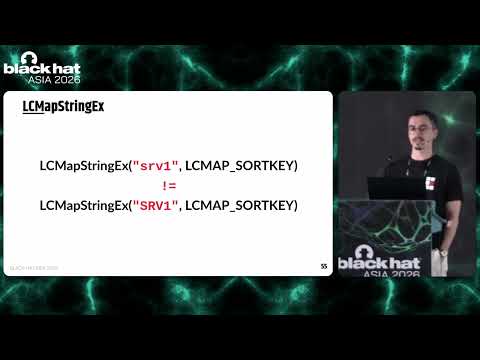
Guillaume André explains that Active Directory stores domain data in the NTDS.dit ESE database and builds B-tree search keys using JetMakeKey and LCMapStringEx with flags like NORM_IGNORE_CASE and NORM_IGNORE_NONSPACE. Because LCMapStringEx generates identical sort keys for ASCII SRV1 and SRV1 with a circled Unicode R, the domain controller maps the Unicode TGS request to the legitimate machine account.
Significance (High): Exposes how low-level database indexing in NTDS.dit creates equivalence classes between distinct Unicode strings and standard Active Directory service principal names.
Sources in support: Guillaume André (Security Researcher and Pentester, Synacktiv)
6. Combining Unicode Dots and Characters for RCE
Timestamp: 00:21:51 to 00:26:44
To register a non-colliding DNS record that still matches a target machine's FQDN SPN, André replaced standard periods with Unicode dot leaders, allowing DNS registration in Active Directory. When the client's DNS cache service blocked resolution because CompareStringW with NORM_IGNORE_CASE treated Unicode dot leaders as standard dots, he combined both the circled Unicode R and Unicode dot leaders into a single record.
Significance (High): Chaining differential string normalization between CompareStringW on the client and LCMapStringEx on the domain controller yields a full remote code execution primitive for any domain user.
Sources in support: Guillaume André (Security Researcher and Pentester, Synacktiv)
7. October Patch Blocks Remote Loopback Relay
Timestamp: 00:26:44 to 00:31:04
Days after Synacktiv reported the Unicode RCE on October 5, 2025, Microsoft's October Patch Tuesday unintentionally broke the exploit while fixing a separate ghost SPN bug, CVE-2025-58726. The patch updated the srv2.sys kernel driver to return access denied whenever a local authentication session originates from a remote IP address. Attempting to wait out the LSASS Kerberos subkey list failed because the subkey minimum lifetime is twice the five-minute AP-REQ validity window.
Significance (Medium): Checking client IP origins in srv2.sys during local authentication neutralized remote SMB reflection, forcing attackers to pivot to local forwarding techniques.
Sources in support: Guillaume André (Security Researcher and Pentester, Synacktiv)
8. Local TCP Forwarding Unlocks CVE-2026-26128
Timestamp: 00:31:06 to 00:34:38
To bypass the remote IP check in srv2.sys, Guillaume André used a low-privileged shell on the target machine to open a local TCP connection to the SMB service and forwarded the remotely captured Kerberos AP-REQ through it. Because the SMB connection originated from a local IP address, srv2.sys accepted the reflected authentication and granted a SYSTEM session, tracked as CVE-2026-26128.
Significance (High): Enforcing SMB signing on loopback connections finally closes the SMB authentication reflection class in default Windows configurations.
Sources in support: Guillaume André (Security Researcher and Pentester, Synacktiv)
9. Unpatched Unicode Coercion Compromises SCCM
Timestamp: 00:34:41 to 00:37:05
André warns that Microsoft's patch only enforced loopback signing inside the SMB service, leaving the underlying Unicode Kerberos coercion primitive completely unpatched. Even though Microsoft removed NTLM authentication from the SCCM AdminService in version 2509 to stop relay attacks, any standard domain user can now use the Unicode Kerberos coercion method to compromise default SCCM installations via Kerberos reflection or relay.
Significance (High): Standard domain users can compromise fully patched SCCM infrastructures today because the Unicode Kerberos SPN matching behavior remains active in Active Directory.
Sources in support: Guillaume André (Security Researcher and Pentester, Synacktiv)
This analysis was generated by skim (skim.plus), an AI-powered content analysis platform by Credible AI. Scores and classifications represent the platform's AI-generated assessment and should be considered alongside other sources.