Black Hat's Black Hat Asia 2026 | Ensuring the Cloud Quantum Computer Runs Your Program… But Learns Nothing: skim's analysis identifies 9 key moments, with 1 potential conflict of interest flagged. Singapore Institute of Technology researchers Vivek Balachandran and Amal Raj present Cloaq at Black Hat Asia 2026, a framework that protects quantum program outputs from untrusted cloud providers.
Category: Tech. Format: Educational. YouTube video analyzed by skim.
skim AI Analysis
Credibility assessment: Grounded Academic Research. Singapore Institute of Technology researchers Vivek Balachandran and Amal Raj present their technical methodology, mathematical logic, and live software demonstration at Black Hat Asia 2026. While performance metrics like the 0.8 total variation distance are self-reported, the release of a white paper and local Docker container supports auditability.
Bias assessment: Creator-Advocate Perspective. The speakers naturally advocate for their own Cloaq framework over prior academic obfuscation techniques. However, they ground their comparisons in clear operational criteria, such as whether a method requires extra qubits, blocks compiler optimization, or relies on owning a local quantum computer.
Originality: 88% — Novel Hybrid Obfuscation. The presentation introduces a practical hybrid quantum-classical approach to output protection. By exploiting the post-measurement collapse of specific quantum gates into classical boolean equivalents, the authors bypass the unrealistic assumption in prior literature that users possess local quantum hardware for decryption.
Depth: 85% — Rigorous Gate-Level Analysis. The talk systematically walks through the threat model of cloud quantum computing, the economic constraints of qubit allocation, truth-table mappings between quantum and classical logic gates, step-by-step bitwise decryption, and statistical divergence metrics via Total Variation Distance.
Key Points (9)
1. Quantum Speedups Drive Cloud Reliance
Timestamp: 00:00:09 to 00:03:35
Vivek Balachandran notes that while classical supercomputers like El Capitan run at 1.742 exaflops, Google's quantum processor solved a specific benchmark problem in five minutes that would take classical systems trillions of years. Because quantum hardware costs millions to over $100 million, most developers must submit their algorithms to third-party cloud providers.
Significance (Medium): High hardware costs force organizations onto third-party quantum clouds, creating an immediate need for untrusted execution security before commercial quantum applications mature.
Sources in support: Vivek Balachandran (Associate Professor, Singapore Institute of Technology)
2. Three Attack Surfaces in Quantum Cloud
Timestamp: 00:03:37 to 00:07:22
Submitting quantum workloads to untrusted cloud providers exposes three distinct assets: sensitive input data such as harvested encrypted traffic, proprietary algorithms like drug discovery circuits, and the final output results. After addressing algorithm protection in 2025 with ObfusQate, the team developed Cloaq to corrupt cloud outputs while allowing local classical recovery.
Significance (High): Separating output protection from circuit obfuscation addresses scenarios where the algorithm is standard, such as Shor's algorithm, but the resulting decrypted key is highly sensitive.
Sources in support: Vivek Balachandran (Associate Professor, Singapore Institute of Technology)
3. Amal Raj on Cloud Cost and Qubit Limits
Timestamp: 00:07:22 to 00:10:21
Amal Raj explains that cloud quantum platforms like IBM Qiskit charge roughly $100 per minute of compute, causing bills to escalate rapidly with additional operations and qubits. Consequently, a practical obfuscation scheme must not add extra qubits that increase hardware costs and noise, must not block compiler optimization, and must work across diverse circuits.
Significance (Medium): Establish strict economic and physical guardrails for quantum security tools, ruling out naive cryptographic padding that bloats circuit depth or qubit count.
Sources in support: Amal Raj (Research Engineer, Singapore Institute of Technology)
4. Why Prior Obfuscation Schemes Fail
Timestamp: 00:10:22 to 00:13:56
Prior quantum obfuscation techniques fail to meet practical deployment requirements: dummy gate insertion blocks circuit optimization, logic locking adds costly extra qubits, and phase modification only works on circuits with sufficient phase gates. Worse, all three prior approaches assume the user owns a local quantum computer to de-obfuscate and run the circuit, which invalidates the cloud threat model.
Significance (High): Exposes a fundamental flaw in prior academic quantum obfuscation literature, demonstrating why classical-only decryption is necessary for real-world cloud users.
Sources in support: Amal Raj (Research Engineer, Singapore Institute of Technology)
5. Superposition, Entanglement, and Collapse
Timestamp: 00:13:58 to 00:16:36
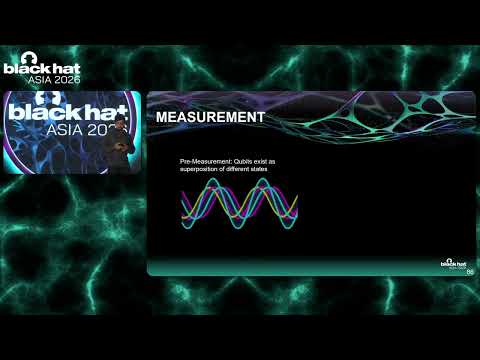
Quantum computing relies on qubits existing in superposition and operating through four functional blocks: flip, rotate, split, and link for quantum entanglement. However, once a measurement operation is performed on a quantum circuit, the superposition collapses entirely into classical binary states of zeros and ones.
Significance (Medium): Measurement acts as a one-way bridge from quantum states to classical bits, providing the physical mechanism that makes classical post-processing of quantum outputs possible.
Sources in support: Amal Raj (Research Engineer, Singapore Institute of Technology)
6. Mapping Quantum Gates to Classical Logic
Timestamp: 00:16:38 to 00:20:04
Amal Raj demonstrates that because measurement collapses quantum states, most quantum gates inserted immediately before measurement behave like standard classical logic gates: X becomes NOT, Swap remains Swap, CNOT becomes XOR, CCNOT becomes a combination of AND and XOR, and the S phase gate becomes a no-op identity. Only superposition-creating gates like the Hadamard gate lack a classical equivalent and must be excluded.
Significance (High): Proves mathematically that pre-measurement quantum state corruption can be inverted deterministically on a standard laptop using basic boolean algebra.
Sources in support: Amal Raj (Research Engineer, Singapore Institute of Technology)
7. How Vivek Balachandran Builds the Cloaq Key
Timestamp: 00:20:09 to 00:23:25
Vivek Balachandran details how Cloaq encrypts a circuit by randomly inserting gates from an eight-gate set just before measurement and recording each gate's unique numerical ID and target qubits into a classical key string. When the cloud provider runs this modified circuit over 1,000 probabilistic shots, the resulting output histogram is completely shuffled compared to the true distribution.
Significance (High): Provides a lightweight, compiler-compatible key generation scheme that hides the peak probability states of probabilistic quantum algorithms from the executing cloud server.
Sources in support: Vivek Balachandran (Associate Professor, Singapore Institute of Technology)
8. Reversing Corrupted Bitstrings Classically
Timestamp: 00:23:27 to 00:26:18
Walking through a corrupted five-bit output example, Vivek Balachandran shows how Cloaq reads the classical key backward from the final inserted gate to invert each operation step by step. By applying classical bit flips for CNOT and CCNOT, bypassing S gates as no-ops, and swapping bit positions for Swap gates, the user recovers the true bitstring locally without quantum hardware.
Significance (High): Demonstrates that local decryption requires only trivial bitwise operations on measurement strings, eliminating any client-side quantum compute requirement.
Sources in support: Vivek Balachandran (Associate Professor, Singapore Institute of Technology)
9. Live Demo and 0.8 Total Variation Distance
Timestamp: 00:26:18 to 00:33:36
Amal Raj evaluates Cloaq using Total Variation Distance (TVD), reporting a 0.8 TVD score out of 1.0 compared to 0.4 to 0.7 for prior obfuscation methods. In a live web and Docker demonstration using a QASM circuit, he shows that while the cloud observes shifted histogram peaks, classical decryption restores the exact peak pattern (101 and 110) of the unobfuscated simulation.
Significance (High): Validates both the statistical strength of the output corruption and the practical usability of the open-source Docker tool for developers protecting quantum IP.
Sources in support: Amal Raj (Research Engineer, Singapore Institute of Technology)
This analysis was generated by skim (skim.plus), an AI-powered content analysis platform by Credible AI. Scores and classifications represent the platform's AI-generated assessment and should be considered alongside other sources.