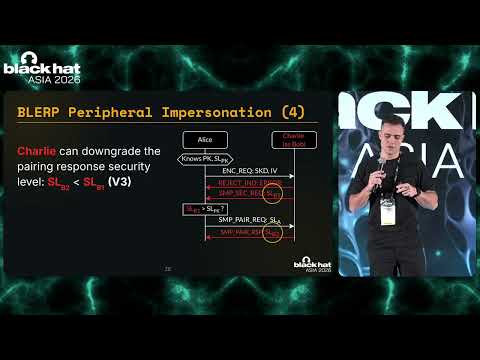
Black Hat's Black Hat Asia 2026 | Exploiting BLE Re-Pairing with the BLERP Attacks: skim's analysis identifies 8 key moments. EURECOM researchers Tommaso Sacchetti and Daniele Antonioli present the BLERP attacks, exploiting six protocol flaws in Bluetooth Low Energy re-pairing to overwrite trusted Long-Term Keys.
Category: Tech. Format: Educational. YouTube video analyzed by skim.
skim AI Analysis
Credibility assessment: Peer-Reviewed Security Audit. EURECOM researchers Daniele Antonioli and Tommaso Sacchetti back their Bluetooth Low Energy security findings with a peer-reviewed NDSS paper, an open-source GitHub reproduction toolkit, empirical tests across 23 devices, a live hardware exploit demonstration, and an assigned CVE.
Bias assessment: Pro-Disclosure Security Lens. The speakers present objective technical vulnerability research. Their perspective naturally favors rigorous cryptographic enforcement and transparent vendor patching, leading to pointed criticism of the Bluetooth SIG, Microsoft, and Logitech for dismissing protocol flaws.
Originality: 94% — Novel Protocol Vulnerability. The presentation introduces the first security evaluation of Bluetooth Low Energy re-pairing, uncovering six protocol-level flaws, developing four novel BLERP attacks, and releasing custom open-source exploitation tooling on nRF52 hardware.
Depth: 91% — Deep Protocol Breakdown. The talk dissects Bluetooth Low Energy state machines, packet-level feature negotiation, security level bit flags, key entropy downgrades, and cryptographic key derivation formulas, pairing theoretical protocol flaws with practical hardware testing.
Key Points (8)
1. Daniele Antonioli Outlines BLE Security Basics
Timestamp: 00:01:53 to 00:06:37
Daniele Antonioli explains that Bluetooth Low Energy operates in the 2.4 GHz band at ranges up to one kilometer and relies on pairing and session establishment protocols for security. Because these protocols are standardized in the core specification, a single protocol flaw exposes billions of devices across all hardware and operating systems. Prior research broke legacy pairing, key entropy, and elliptic curve coordinates during initial pairing.
Significance (High): Standard-level vulnerabilities bypass vendor-specific defenses, meaning a single flaw in the Bluetooth core specification places the entire global ecosystem of mobile, IoT, medical, and automotive devices at risk.
Sources in support: Daniele Antonioli (Assistant Professor, EURECOM)
2. Why Unexamined BLE Re-Pairing Expands Risk
Timestamp: 00:06:38 to 00:10:34
Antonioli highlights that the Bluetooth re-pairing feature lets already-paired devices overwrite their stored pairing key with a new one, yet the keyword appears only four times across the 3,000-page specification and is absent from the official threat model. While traditional pairing attacks require observing a rare initial pairing session, exploiting re-pairing lets an attacker force devices to re-pair at will.
Significance (High): By weaponizing re-pairing, attackers eliminate the main practical barrier to Bluetooth exploitation: they no longer need to wait for a user to pair a device for the first time.
Sources in support: Daniele Antonioli (Assistant Professor, EURECOM)
3. Tommaso Sacchetti Details BLE Feature Negotiation
Timestamp: 00:10:36 to 00:14:33
Tommaso Sacchetti explains that Bluetooth Low Energy pairing begins with feature negotiation, where devices set a security level bit flag for bonding, Man-in-the-Middle protection, and Secure Connections alongside a key entropy value between 7 and 16 bytes. When two devices are already paired, a central can initiate re-pairing directly, or a peripheral can trigger it by sending an SMP Security Request with a higher security level.
Significance (Medium): Relying on an unauthenticated peripheral message to compare security levels creates the architectural opening for attackers to force re-pairing without possessing the existing root of trust.
Sources in support: Tommaso Sacchetti (PhD Candidate, EURECOM)
4. Peripheral Impersonation and Live Mouse Exploit
Timestamp: 00:14:34 to 00:20:15
Sacchetti details how an attacker impersonates a peripheral by spoofing its broadcast address, rejecting session encryption with an error while staying connected, and sending a high-security SMP Security Request to trigger re-pairing. Because the standard fails to enforce the requested security level during the subsequent pairing response, the attacker downgrades the security level and overwrites the central's pairing key without authentication.
Significance (High): Attackers can hijack trusted peripherals like mice or keyboards while they sleep, gaining full input control over a target smartphone or computer after a single routine connection prompt.
Sources in support: Tommaso Sacchetti (PhD Candidate, EURECOM)
5. Central Impersonation and Stealthy MitM Attacks
Timestamp: 00:20:17 to 00:25:15
Sacchetti explains that an attacker can also impersonate a central device by sending an unauthenticated re-pairing request with a downgraded security level to a peripheral, overwriting its key with zero clicks on headless devices.
Significance (High): Headless peripherals like keyboards, smart locks, and IoT sensors are vulnerable to zero-click takeovers and silent eavesdropping that leave no visible trace to the user.
Sources in support: Tommaso Sacchetti (PhD Candidate, EURECOM)
6. Open-Source BLERP Toolkit and 23-Device Audit
Timestamp: 00:25:16 to 00:28:59
To evaluate the vulnerabilities, the researchers built the open-source BLERP Toolkit using the Apache NimBLE stack on Nordic nRF52 boards, offering both a portable standalone CLI for impersonation and a Linux Python host supporting dual-radio Man-in-the-Middle attacks and automatic advertisement cloning. Between mid and late 2024, they tested 23 devices across 13 vendors covering Bluetooth versions 4.2 to 5.3, including Apple, Google, Xiaomi, Samsung, Logitech, and Xbox hardware.
Significance (High): Releasing an inexpensive, portable audit toolkit on nRF52 hardware allows security teams to verify re-pairing flaws across their own Bluetooth hardware deployments.
Sources in support: Tommaso Sacchetti (PhD Candidate, EURECOM)
7. Cryptographic Fixes and Practical Vendor Defenses
Timestamp: 00:29:00 to 00:32:52
Sacchetti proposes two tiers of defenses against BLERP attacks: a specification-level cryptographic overhaul and immediate vendor-level checks. At the specification level, deriving the new pairing key from the old pairing key provides implicit authentication, and chaining a protocol transcript hash into the key derivation prevents single-channel Man-in-the-Middle tampering.
Significance (High): Vendors do not need to wait for a slow Bluetooth specification overhaul; enforcing state-machine checks and disconnecting on failed encryption immediately neutralizes peripheral impersonation.
Sources in support: Tommaso Sacchetti (PhD Candidate, EURECOM)
8. Mixed Vendor Patches and Bluetooth SIG Inaction
Timestamp: 00:32:54 to 00:37:41
Following responsible disclosure in August 2024, the Bluetooth SIG dismissed the findings as old techniques used in novel ways and argued that re-pairing constitutes a new pairing, leaving the core standard unpatched in 2026. Among vendors, Google, Apple, and Apache NimBLE acknowledged and patched the flaws, with Apache assigning a CVE rated 8.1 CVSS, whereas Logitech called central impersonation intended behavior and Microsoft declined to fix the underlying issues on Windows.
Significance (High): Because the Bluetooth SIG left the core specification unchanged and major vendors like Microsoft and Logitech declined to patch, millions of deployed devices remain permanently exposed.
Sources in support: Tommaso Sacchetti (PhD Candidate, EURECOM)
This analysis was generated by skim (skim.plus), an AI-powered content analysis platform by Credible AI. Scores and classifications represent the platform's AI-generated assessment and should be considered alongside other sources.