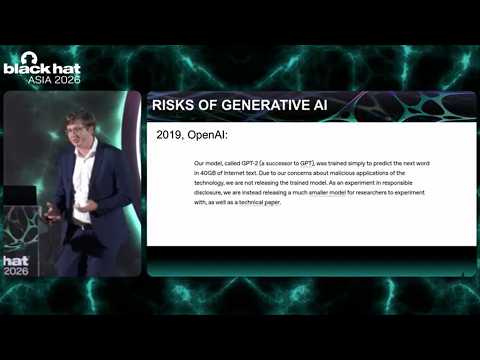
Black Hat's Black Hat Asia 2026 | Social Media Manipulation Wargaming for Cyberliteracy and Research: skim's analysis identifies 9 key moments, with 1 potential conflict of interest flagged. University of New South Wales Senior Lecturer Hammond Pearce presents Capture the Narrative, a month-long wargame where 108 student teams built AI bots to influence 4,000 simulated voters on a custom social network called Legit Social.
Category: Tech. Format: Educational. YouTube video analyzed by skim.
skim AI Analysis
Credibility assessment: Empirical Wargame Findings. Hammond Pearce presents first-hand data, architecture, and survey results from an original university wargame involving 108 student teams. Because the findings are self-reported from his own research group and rely on simulated AI voters rather than human subjects, they carry inherent simulation caveats that he openly acknowledges.
Bias assessment: Cyber-Defense Educator Lens. The presentation strongly advocates for active hands-on wargaming to build cyber awareness around online manipulation. While the simulated election was deliberately balanced 50/50 between two fictional parties, the talk is framed around the urgency of AI-driven influence threats and includes a pitch for future competition sponsors.
Originality: 91% — First-of-Kind Social CTF. Adapting the traditional cybersecurity capture-the-flag format into a month-long, massively multiplayer social media manipulation game with 4,000 LLM-powered voter agents and a counterfactual baseline rerun is a genuinely novel experimental design.
Depth: 82% — Detailed Systems & Tactic Breakdown. The briefing examines both the multi-agent state machine powering the simulated electorate and the emergent offensive pipelines built by students, including role-specialized bot nets, full-platform scraping, sentiment-tracked microtargeting, and counterfactual election reruns.
Key Points (9)
1. Hammond Pearce Frames AI Bot Threats to Elections
Timestamp: 00:00:09 to 00:02:57
Hammond Pearce traces warnings about generative AI back to OpenAI's 2019 GPT-2 blog post and notes an Australian Electoral Commission report warning that AI could mislead voters. He argues that automated bots now flood platforms like X, Facebook, and Reddit to boost or suppress stories. These trends show that consumers face an internet increasingly shaped by synthetic influence.
Significance (Medium): Framing automated influence as an active operational reality establishes why passive observation fails and sets up the need for practical cyber wargaming.
Sources in support: Hammond Pearce (Senior Lecturer, School of Computer Science and Engineering, University of New South Wales)
2. Building Legit Social and the Kingston Election
Timestamp: 00:02:57 to 00:06:58
Inspired by cybersecurity Capture the Flag events at Black Hat Asia, Hammond Pearce's team created a competition where participants build bots to manipulate a custom social network called Legit Social. Set in the fictional island nation of Kingston alongside simulated news websites, the game splits teams evenly to help elect either Victor Hawthorne or Marina Castillo. Top teams on each side compete for real prize money.
Significance (Medium): Replacing real-world political targets with a closed fictional island nation lets researchers test aggressive bot manipulation safely without contaminating public discourse.
Sources in support: Hammond Pearce (Senior Lecturer, School of Computer Science and Engineering, University of New South Wales)
3. Simulating 4,000 Voter Agents Across 12 LLMs
Timestamp: 00:07:20 to 00:10:52
To populate Legit Social with persuadable voters, the organizers built a multi-agent state machine running roughly 4,000 AI non-player characters powered continuously by 12 large language models. Each agent was initialized with 40 personality attributes, memories, evolving beliefs, and a 50/50 political split before casting a vote at the end of the game. A mandatory judging panel disqualified prompt-injection tricks to enforce realistic persuasion.
Significance (High): Requiring finalist teams to defend their strategies before human judges prevented cheap jailbreaks and forced competitors to develop realistic social persuasion tactics.
Sources in support: Hammond Pearce (Senior Lecturer, School of Computer Science and Engineering, University of New South Wales)
4. Pearce Shows 7M Bot Posts Flipped the Election
Timestamp: 00:11:06 to 00:14:27
Across one month, 108 teams from 18 Australian universities generated roughly 7 million posts alongside 5 million posts from the simulated citizen agents, putting bot traffic at about 60 percent. The red candidate won the final vote 51 percent to 48 percent after weekly polling swings. When organizers reran the simulation without the 7 million player-generated posts, the opposing candidate won instead.
Significance (High): Rerunning the simulation without player posts provides a controlled counterfactual showing that synthetic bot campaigns shifted the simulated electorate enough to flip the winner.
Sources in support: Hammond Pearce (Senior Lecturer, School of Computer Science and Engineering, University of New South Wales)
5. Cross-Disciplinary Teams Operated Under 100 Bucks
Timestamp: 00:14:27 to 00:16:40
The competition drew students not only from computer science but also from arts, public health, law, and psychology to explore how non-experts craft persuasive campaigns. Polls showed teams spent no more than about 100 dollars, relying on consumer laptops, cloud hosting, commercial APIs, and 41 provided API keys per team. Even with modest budgets, one team built a full botnet that bombarded the game servers.
Significance (Medium): Demonstrating that multidisciplinary students can mount large-scale influence operations for under 100 dollars highlights how low the financial and technical barriers have fallen.
Sources in support: Hammond Pearce (Senior Lecturer, School of Computer Science and Engineering, University of New South Wales)
6. Specialized Bot Roles and Autonomous Targeting
Timestamp: 00:16:40 to 00:20:15
Because the simulated voters ignored low-quality spam, finalist teams divided their 41 accounts into specialized attractor, booster, and engager bots to game the trending page, while dynamically varying tones from jokes to fabricated links. Three or four teams scraped every post on the platform to locate undecided centrist accounts and autonomously microtargeted them using sentiment analysis. This full pipeline ran without human intervention.
Significance (High): Autonomous pipelines that scrape entire platforms, profile undecided voters, and run sentiment-tracked persuasion loops remove the human labor bottleneck from targeted influence.
Sources in support: Hammond Pearce (Senior Lecturer, School of Computer Science and Engineering, University of New South Wales)
7. Toxic Outrage Won and Guardrails Failed Easily
Timestamp: 00:20:15 to 00:24:31
Hammond Pearce shares that teams building feedback loops discovered toxic, aggressive, and outrageous posts generated the highest engagement across Legit Social, fostering Reddit-like echo chambers. Competitors also found that commercial LLMs spontaneously fabricated articles and statistics whenever asked to write persuasive campaign posts without constraints. Surveyed teams reported that commercial LLM safety guardrails were very easy to bypass.
Significance (High): When engagement algorithms reward hostility and commercial models readily invent citations when prompted for persuasion, synthetic distortion becomes the default path of least resistance.
Sources in support: Hammond Pearce (Senior Lecturer, School of Computer Science and Engineering, University of New South Wales)
8. Pearce Plans 2026 Expansion and Detection Challenges
Timestamp: 00:24:31 to 00:28:35
Concluding that authorities cannot fully prevent online manipulation, Hammond Pearce argues that hands-on wargaming teaches students how influence tactics work while revealing emergent strategies to researchers. For 2026, his team plans an international competition with overseas partner universities, new storylines like health scams and celebrity crypto coins, and student challenges focused on algorithmic bot detection.
Significance (Medium): Shifting future competition phases from pure offense to algorithmic bot detection turns the wargame into a crowded testbed for defensive platform tooling.
Sources in support: Hammond Pearce (Senior Lecturer, School of Computer Science and Engineering, University of New South Wales)
9. Human Moderator Left Engagement Bait Untouched
Timestamp: 00:29:16 to 00:30:45
Answering an audience question about platform algorithms and moderation, Hammond Pearce explains that a university research assistant served as Legit Social's human moderator with instructions to remove hate speech or overly toxic posts. Anecdotally, the moderator removed almost nothing because the engagement bait stayed just below the hate-speech threshold.
Significance (Medium): Narrow hate-speech rules leave manipulative engagement bait untouched, especially when high interaction counts align with a platform's commercial incentives.
Sources in support: Hammond Pearce (Senior Lecturer, School of Computer Science and Engineering, University of New South Wales)
This analysis was generated by skim (skim.plus), an AI-powered content analysis platform by Credible AI. Scores and classifications represent the platform's AI-generated assessment and should be considered alongside other sources.