Black Hat's Black Hat Asia 2026 | When 3.5 Billion Strangers Can Exploit Your WhatsApp Devices: skim's analysis identifies 9 key moments. Zengo CTO Tal Be'ery demonstrates how WhatsApp's end-to-end encryption and Sesame multi-device architecture expose client endpoints to silent reconnaissance, OS fingerprinting, and targeted exploit delivery by any of its 3.
Category: Tech. Format: Educational. YouTube video analyzed by skim.
skim AI Analysis
Credibility assessment: Technical Research With Demos. Tal Be'ery grounds his presentation in empirical security research, live demonstrations on test accounts, prior academic literature, and responsible disclosure to Meta. He clearly distinguishes between architectural properties of the Signal and Sesame protocols and implementation bugs.
Bias assessment: Client-Side Security Focus. The presentation approaches messaging design strictly through an offensive and defensive security lens, prioritizing attack-surface reduction over the frictionless user onboarding that drove WhatsApp's growth. Be'ery nonetheless praises WhatsApp's overall encryption while critiquing its side channels.
Originality: 86% — Novel Fingerprinting Tooling. Building on academic work like Careless Whisper, Be'ery introduces a custom Baileys-based research tool, 11 types of silent malformed pings, OS fingerprinting via corner-case acks and prekey IDs, and an architectural alternative called the Ambassador protocol.
Depth: 89% — Protocol-Level Breakdown. The talk moves systematically from high-level threat modeling of end-to-end encryption to the mechanics of X3DH key bundles, Sesame multi-device sessions, implementation discrepancies across Java/Kotlin, Swift, and JavaScript clients, and structural mitigations.
Key Points (9)
1. Tal Be'ery on Why E2EE Shifts Risk to Clients
Timestamp: 00:01:31 to 00:05:42
While WhatsApp's 2016 adoption of Signal end-to-end encryption eliminated the server as a mass-surveillance target, it forced attackers to target client endpoints directly. Because the server acts as a dumb pipe that cannot inspect encrypted content, it can no longer shield clients from malicious payloads or social engineering. Consequently, protecting the server inevitably weakens client-side defenses.
Significance (High): Highlights a core security trade-off: removing server-side visibility stops mass data breaches but strips the platform of content-based filtering against endpoint attacks.
Sources in support: Tal Be'ery (CTO and Co-Founder of Zengo (acquired by eToro); Black Hat Speaker)
2. How APTs Chain Recon and Zero-Click Exploits
Timestamp: 00:05:59 to 00:09:46
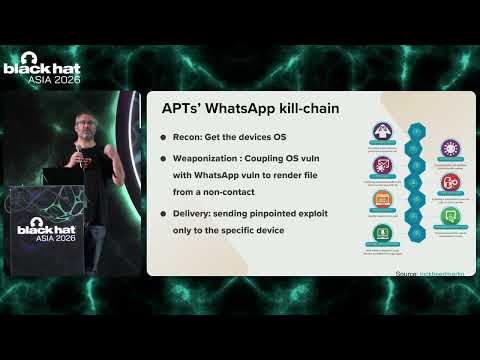
Attackers on WhatsApp range from stalkers abusing mandatory delivery checkmarks to advanced persistent threats executing zero-click remote code execution. Sophisticated attackers must first identify a victim's operating system, pair an OS exploit with a WhatsApp auto-preview bypass, and target the right device. Be'ery illustrates this kill chain with Paragon's Android PDF exploit and an iOS device-sync image exploit.
Significance (High): Breaks down the exact operational hurdles state-level spyware vendors must clear to turn a phone number into a silent, zero-click device compromise.
Sources in support: Tal Be'ery (CTO and Co-Founder of Zengo (acquired by eToro); Black Hat Speaker)
3. X3DH Public Keys Act as Implicit Device IDs
Timestamp: 00:09:49 to 00:13:31
Under WhatsApp's extended triple Diffie-Hellman handshake, each client generates its own cryptographic key bundle and uploads its public keys to the server directory so senders can initiate encrypted sessions even when the recipient is offline. Because a fresh key pair is generated every time WhatsApp is installed on a new phone, that public key acts as an implicit device identifier. An attacker querying the server directory can therefore detect whenever a target switches phones.
Significance (Medium): Demonstrates how public cryptographic material required for asynchronous end-to-end encryption unintentionally leaks hardware lifecycle metadata to anyone querying the directory.
Sources in support: Tal Be'ery (CTO and Co-Founder of Zengo (acquired by eToro); Black Hat Speaker)
4. Tal Be'ery Shows How Sesame Leaks Device Counts
Timestamp: 00:13:32 to 00:17:51
WhatsApp's multi-device feature relies on the Signal Sesame protocol, which treats the primary phone and up to four linked companion devices as independent cryptographic entities with separate sessions. To establish these sessions, a sender queries an API that returns all of the recipient's active device IDs and key bundles. Using a custom open-source research client built on the Baileys API, Be'ery shows how anyone can enumerate how many devices a target has linked.
Significance (High): Exposes a design flaw in Sesame where every sender is granted full visibility into a recipient's multi-device topology before sending a single message.
Sources in support: Tal Be'ery (CTO and Co-Founder of Zengo (acquired by eToro); Black Hat Speaker)
5. Pinpointing Exploits via Per-Device Sessions
Timestamp: 00:17:54 to 00:19:58
Because a sender establishes a separate encrypted session with each of a recipient's linked devices, nothing forces a rogue client to send the same message across all sessions. In a live demonstration, Be'ery sends 'parrot' to a target's desktop client and 'dog' to their web client within the same conversation, breaking chat history integrity. For an APT attacker, this allows pinpointing an OS-specific exploit strictly to the vulnerable device without alerting other linked devices.
Significance (High): Solves a major operational problem for attackers by letting them deliver platform-specific zero-day payloads solely to the intended endpoint.
Sources in support: Tal Be'ery (CTO and Co-Founder of Zengo (acquired by eToro); Black Hat Speaker)
6. Silent Malformed Pings Track User Routines
Timestamp: 00:19:59 to 00:22:52
Expanding on the Careless Whisper research, Be'ery's team implemented 11 types of silent pings that trigger automatic delivery acknowledgments from a target's device without displaying any notification. Because the WhatsApp client acknowledges receipt immediately before parsing, sending a reaction, edit, or deletion referencing a nonexistent message ID gets silently discarded after returning an ack.
Significance (High): Turns mandatory delivery receipts into a covert, continuous surveillance beacon that reveals a user's physical schedule and device activity.
Sources in support: Tal Be'ery (CTO and Co-Founder of Zengo (acquired by eToro); Black Hat Speaker)
7. Tal Be'ery Fingerprints OS via Silent Pings
Timestamp: 00:22:54 to 00:27:33
WhatsApp maintains three separate client codebases: Java/Kotlin for Android, Swift for iOS and Mac, and JavaScript for Web and Windows. While outgoing messages reveal the sender's OS through message ID character lengths (32 for Android, 20 for iPhone, 22 for Web), attackers can also fingerprint a passive target silently because each codebase handles malformed pings differently.
Significance (High): Gives attackers a covert reconnaissance method to identify the exact operating system running on each of a target's linked devices.
Sources in support: Tal Be'ery (CTO and Co-Founder of Zengo (acquired by eToro); Black Hat Speaker)
8. Server-Only OS Fingerprinting via Prekey Pogo
Timestamp: 00:27:34 to 00:32:18
After Be'ery's team reported the silent ping bugs, Meta paid a small bounty and blocked nonexistent message reactions on WhatsApp Web, which inadvertently created a way to fingerprint Baileys-based AI agents like OpenClaw that still answer those reactions. Furthermore, building on the Prekey Pogo technique, Be'ery shows that an attacker can fingerprint Android, iOS, and Web purely by querying the server's prekey bundles without sending a single packet to the victim.
Significance (High): Proves that OS reconnaissance can be performed completely passively against WhatsApp's directory server, leaving zero trace on the target's device.
Sources in support: Tal Be'ery (CTO and Co-Founder of Zengo (acquired by eToro); Black Hat Speaker)
9. Tal Be'ery Proposes Lockdown and Ambassador
Timestamp: 00:32:23 to 00:36:27
Because individual users currently have no settings to block these attacks, Be'ery argues that WhatsApp must update its 2010-era 'anyone can message anyone' architecture for its 3.5 billion user base. First, WhatsApp should add a lockdown mode or text-only message requests so only approved contacts can interact directly with a client, shrinking the attack surface from 3.5 billion strangers to roughly 1,000 contacts.
Significance (High): Offers concrete architectural blueprints that fix the root cause of multi-device metadata leakage and unsolicited exploit delivery rather than patching individual bugs.
Sources in support: Tal Be'ery (CTO and Co-Founder of Zengo (acquired by eToro); Black Hat Speaker)
This analysis was generated by skim (skim.plus), an AI-powered content analysis platform by Credible AI. Scores and classifications represent the platform's AI-generated assessment and should be considered alongside other sources.