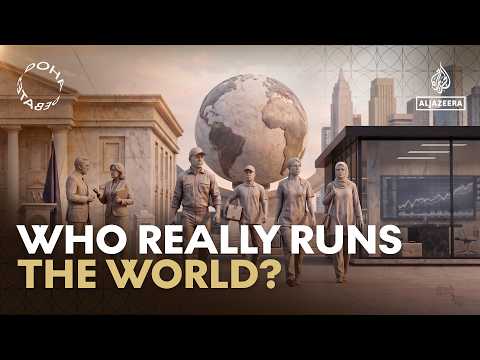
Doha Debates host Soraya Salam convenes Mark Littlewood, Sophie Scott-Brown, Henry Wang, and Antara Haldar to examine whether governments or corporations hold real power. Littlewood argues Western states dominate through their monopoly on force and sprawling regulation, pointing to the UK Online Safety Bill overruling tech leaders. Haldar counters that corporate power from the East India Company to BlackRock's $14 trillion asset base and the five tech leaders requires Keynesian guardrails, citing the 2008 financial crash and Mariana Mazzucato's research on state-funded innovation. Wang presents China's tri-pillar system of private firms, state-owned enterprises, and multinationals as an alternative that lifted 800 million people out of poverty.
Scott-Brown challenges the binary framing, arguing that non-state actors and shrinking local community agency demand stronger civil society institutions. Despite sharp disagreements over welfare spending and regulation, the panel converges in 2026 on the need to rebalance local self-government and global institutions as artificial intelligence reshapes authority.
How time-sensitive the topic is: Evergreen
By the numbers
14 trillion USD: Wealth and assets managed by BlackRock, larger than the GDP of every country except China and the US. (Mentioned at 8:54)
10%: Mark Littlewood's round-number estimate of the European Union's share of the world's population. (Mentioned at 12:44)
20%: Mark Littlewood's rough estimate of the European Union's share of global GDP. (Mentioned at 12:48)
50%: Mark Littlewood's estimate that the EU accounts for more than 50 percent of global welfare spending. (Mentioned at 12:51)
800 million people: Number of people lifted out of poverty in China under its state-market model. (Mentioned at 31:28)
70%: Share of the world's high-speed rail and 5G systems located in China, according to Henry Wang. (Mentioned at 31:56)
250 years: Time elapsed between the 1776 economic and political inflection point and 2026. (Mentioned at 42:56)
Questions this video answers
Do governments or corporations hold more power in the modern world?
Mark Littlewood argues Western governments hold far more power because they monopolize force and pass laws like the UK Online Safety Bill against corporate wishes. Antara Haldar counters that corporations from the East India Company to modern tech giants and BlackRock dominate until crises force state bailouts. The debate reveals that power is not static, shifting between state coercion and capital mobility.
Mark Littlewood, 1:21 to 3:38
From this keypoint: Mark Littlewood Says States Hold Monopoly on Force
How much money does BlackRock manage compared to national economies?
Host Soraya Salam notes that BlackRock controls $14 trillion in assets under management, exceeding the GDP of every country except the United States and China. Antara Haldar argues this concentration of financial power gives asset managers immense global leverage, while Mark Littlewood argues private asset management is far more efficient than state allocation.
Antara Haldar, 6:59 to 10:55
From this keypoint: Antara Haldar Traces Corporate Rule to Tech Bros
Did deregulation or regulatory failure cause the 2008 financial crisis?
Antara Haldar attributes the 2008 crash to Thatcher-Reagan era deregulation, London's Big Bang, and the US repeal of Glass-Steagall that merged commercial and investment banking. Mark Littlewood contends UK financial services were already the second most regulated sector in the economy, arguing that massive compliance bureaucracies failed to prevent the collapse.
Antara Haldar, 14:45 to 19:08
From this keypoint: Haldar and Littlewood Clash Over the 2008 Crash
Who funded the core technologies behind the iPhone and the internet?
Citing UCL economist Mariana Mazzucato, Antara Haldar explains that foundational technologies including the internet, email, and components of the iPhone emerged from government-funded R&D. She adds that public research funding also drove China's lead in green tech and AI as well as Canada's AI sector, challenging the view that innovation is purely private.
Antara Haldar, 14:45 to 19:08
From this keypoint: Haldar and Littlewood Clash Over the 2008 Crash
How does China's tri-pillar economic system balance state and corporate power?
Henry Wang explains that China combines a majority private sector, state-owned enterprises handling heavy infrastructure, and foreign multinationals driving trade, all guided by five-year plans. He credits this structure with lifting 800 million people from poverty and building 70 percent of the world's high-speed rail and 5G networks.
Henry Wang, 31:03 to 33:38
From this keypoint: Henry Wang Touts China's Tri-Pillar Economic Model
What are the blind spots of the free-market price mechanism?
While agreeing that markets allocate resources and drive innovation effectively, Antara Haldar argues the price mechanism is blind to empire, climate change, war, and the fertility crisis. Because short-term profit motives ignore these externalities, she argues governments must establish guardrails to align markets with human welfare.
Mark Littlewood, 23:36 to 31:03
From this keypoint: Market Blind Spots Versus 19th-Century Small State
Why does Antara Haldar compare the year 2026 to 1776?
Antara Haldar notes that 1776 saw the publication of Adam Smith's Wealth of Nations, the steam engine inflection point, and the founding of the United States. Two hundred and fifty years later, she argues that the industrialization of intelligence through AI requires a comparable overhaul of neoclassical economics and the nation-state.
Antara Haldar, 41:55 to 48:10
From this keypoint: Antara Haldar Calls 2026 a New 1776 Inflection Point
How will artificial intelligence affect the power of politicians and the state?
Mark Littlewood predicts that the final stages of the information revolution and AI apps will allow voters to check politicians' claims immediately, reducing reliance on state authority. Antara Haldar and Henry Wang view industrialized intelligence as a transformative force that requires new local and global governance frameworks.
Antara Haldar, 41:55 to 48:10
From this keypoint: Antara Haldar Calls 2026 a New 1776 Inflection Point
Credible AI™ signals
Confidence: Credentialed Academic Debate. Four credentialed scholars and policy directors ground their competing claims in named economic histories, specific legislation like the UK Online Safety Act and Glass-Steagall, and cited research from Mariana Mazzucato and Paul Krugman, though several macro figures are offered as rough estimates.
Bias: Multi-Ideological Clash. Moderator Soraya Salam gives balanced airtime to four distinct worldviews: Mark Littlewood's free-market minimalism, Antara Haldar's institutional Keynesianism, Henry Wang's defense of Chinese state capitalism, and Sophie Scott-Brown's localist pluralism.
Originality (74%): Cross-System Synthesis. By placing British free-market conservatism, Chinese state-market theory, Keynesian law and economics, and anarchist-inflected political philosophy at the same table, the discussion moves past binary state-versus-market tropes into concrete institutional comparisons.
Depth (80%): Historically Grounded. Panellists test abstract theories of power against historical cases including the East India Company, Bretton Woods, the 2008 financial crash, the repeal of Glass-Steagall, China's tri-pillar model, and the Ant Group IPO intervention.
Key points (10)
Short (15 min): key points 1, 3, 8 and 10
Medium (31 min): key points 1, 3, 4, 5, 7, 8 and 10
Relaxed (47 min): all 10 key points
1. Mark Littlewood Says States Hold Monopoly on Force
Timestamp: 00:01:21 to 00:03:38 (2 min)
Speaker: Mark Littlewood
Mark Littlewood argues that Western governments hold overwhelming power compared to corporations because the state possesses a monopoly on force and can alter laws at will. He contends that corporate lobbying only exists because excessive regulation touches every part of daily life. He concludes that shrinking state power would reduce lobbying and empower free civil arrangements.
Impact: High. Why it matters: Framing corporate lobbying as a symptom of state overreach rather than corporate greed flips the standard critique of regulatory capture on its head.
“I wish corporations had more power but unfortunately, governments do. And I want the state to really have rather less power.”
In the video: Mark Littlewood, at 2:31
Against: Antara Haldar
Neutral: Sophie Scott-Brown
2. Shifting Alliances and Turbulence, per Scott-Brown
Timestamp: 00:03:38 to 00:06:59 (3 min)
Speaker: Sophie Scott-Brown
Sophie Scott-Brown rejects the binary question of who rules the world, arguing that global power is pluralistic and defined by temporary alliances among states, corporations, and other political actors. Henry Wang adds that while business drove wealth after Bretton Woods, governments take on a larger stabilizing role during turbulent, multipolar eras and the rise of AI. Both conclude that state and corporate functions remain deeply intertwined.
Impact: Medium. Why it matters: Replacing a static state-versus-corporation binary with shifting, issue-specific coalitions better explains how modern geopolitical and technological crises actually unfold.
“We've got lots of different kinds of political actors. Some are states. Some are corporations. Some are other forms of political actor and they're forming temporary alliances, temporary configurations.”
In the video: Sophie Scott-Brown, at 4:22
For: Henry Wang
Neutral: Soraya Salam
3. Antara Haldar Traces Corporate Rule to Tech Bros
Timestamp: 00:06:59 to 00:10:55 (4 min)
Speaker: Antara Haldar
Antara Haldar argues that corporations are far more powerful than states, tracing a lineage from the East India Company, United Fruit, and De Beers to the five tech leaders and asset managers like BlackRock today. She cites the 2008 financial crash to show how finance nearly broke the global economy before governments stepped in, contrasting this with the healthier post-war balance inspired by John Maynard Keynes and Franklin Delano Roosevelt's New Deal.
Impact: High. Why it matters: Linking colonial charter companies directly to modern tech and asset-management giants highlights how unchecked private capital repeatedly outgrows state oversight.
“There's a notion in economics called the collective action problem which points to the fact that individual rationality could lead to collective ruin. And private profit and public interest do not automatically align.”
In the video: Antara Haldar, at 8:21
Against: Mark Littlewood
Neutral: Soraya Salam
4. Markets Beat Welfare States, Argues Littlewood
Timestamp: 00:10:55 to 00:14:45 (4 min)
Speaker: Mark Littlewood
Invoking Friedrich Hayek's concept of the fatal conceit, Mark Littlewood defends market turbulence and creative destruction as superior to state resource allocation. He calls the European welfare state a catastrophic failure, estimating that the EU accounts for roughly 10 percent of world population, 20 percent of GDP, and over 50 percent of welfare spending without eliminating poverty.
Impact: High. Why it matters: Using the UK Online Safety Bill as a concrete test case challenges the narrative that big tech firms can effortlessly veto legislation in Western democracies.
“If this was a football match, its UK government 10, tech bros nil. I'm finding it a bit difficult to understand why the tech bros have got the power in terms of how we're regulated here in the UK.”
In the video: Mark Littlewood, at 14:31
Against: Antara Haldar
5. Haldar and Littlewood Clash Over the 2008 Crash
Timestamp: 00:14:45 to 00:19:08 (4 min)
Speaker: Antara Haldar
Antara Haldar cites Mariana Mazzucato's research to argue that public R&D funded innovations from the internet and iPhone to Chinese green tech, and characterizes capitalism as a suicidal baby that needed 2008 bailouts after Thatcher-Reagan deregulation and the repeal of Glass-Steagall. Mark Littlewood counters that UK financial services were the second most regulated sector before 2008, behind only weapons-grade plutonium, yet massive compliance armies still failed to prevent the collapse.
Impact: High. Why it matters: The debate exposes the core divide in financial regulation: whether the 2008 crash resulted from dismantling structural walls like Glass-Steagall or from the inherent limits of compliance bureaucracy.
“The entrepreneurial state, which establishes that a lot of the innovation that the private companies get the credit for and the profits for, certainly the profits for come out of R&D that was government funded.”
In the video: Antara Haldar, at 15:08
Against: Mark Littlewood
6. Campaign Donors and Non-State Actors Reshape Power
Timestamp: 00:19:08 to 00:23:36 (4 min)
Speaker: Sophie Scott-Brown
Sophie Scott-Brown advocates democratizing turbulence by distributing rule-making power away from revolving elites, noting that non-state and non-corporate actors in conflicts like Israel, as well as post-colonial nations pushing back against the US-shaped 1945 order, complicate neat categories. Henry Wang contrasts Western elections, where corporate campaign donations buy influence and ambassadorships, with a model where government maintains strong control while allowing business flexibility.
Impact: Medium. Why it matters: Highlighting non-state militant actors and campaign finance patronage shows why traditional state-versus-market models fail to capture real-world political leverage.
“You know, there's always a campaign, raise funds and whoever gets big donations will get appointees as ambassadors. And you see that system, very familiar in the Western society.”
In the video: Henry Wang, at 22:55
For: Henry Wang
Neutral: Soraya Salam
7. Market Blind Spots Versus 19th-Century Small State
Timestamp: 00:23:36 to 00:31:03 (7 min)
Speaker: Mark Littlewood
Mark Littlewood praises the small bureaucracy of 19th-century Britain under Gladstone and Disraeli and the late-19th-century US under Grover Cleveland, arguing states should only provide what markets cannot, such as courts, borders, and nuclear defense. Antara Haldar responds that the price mechanism is blind to empire, climate crisis, war, and fertility decline, while Sophie Scott-Brown notes US expansion was an imperial adventure for indigenous Americans.
Impact: High. Why it matters: Confronting free-market nostalgia with externalities like climate change, fertility decline, and indigenous displacement exposes what price signals alone cannot solve.
“They don't see empire. They don't see the climate apocalypse. They do not price war, which is a defining factor in the world that we're living in now. They do not price children properly even which is driving the fertility crisis.”
In the video: Antara Haldar, at 25:45
Against: Antara Haldar, Sophie Scott-Brown
8. Henry Wang Touts China's Tri-Pillar Economic Model
Timestamp: 00:31:03 to 00:33:38 (3 min)
Speaker: Henry Wang
Henry Wang presents China's tri-pillar structure of private enterprises, state-owned enterprises, and foreign multinationals guided by five-year plans as an alternative that lifted 800 million people out of poverty and built 70 percent of the world's high-speed rail and 5G systems.
Impact: High. Why it matters: China's combination of state five-year planning and private market dynamism challenges the Western assumption that heavy state control prevents rapid infrastructure and GDP growth.
“The longest 70 percent of the world’s speed rails are in China and, also, 70 percent of 5G systems are in China. So, that really kind of produces miracles with this right combination of business and government structure.”
In the video: Henry Wang, at 31:56
For: Antara Haldar
Neutral: Soraya Salam
9. Local Civil Society Contraction and Planning Delays
Timestamp: 00:33:38 to 00:41:55 (8 min)
Speaker: Sophie Scott-Brown
Sophie Scott-Brown argues that ordinary people in the US and Britain have lost meaningful control over their communities despite a proliferation of NGOs, and calls for genuine local democratic participation rather than welfare systems constantly playing catch-up.
Impact: Medium. Why it matters: Connecting voter alienation and infrastructure paralysis shows how over-centralized Western states simultaneously frustrate local community agency and block physical development.
“I think that the ability to direct and shape one's life in a meaningful sense to community level, has contracted. A lot of people feel incredibly excluded.”
In the video: Sophie Scott-Brown, at 35:34
For: Mark Littlewood
Neutral: Soraya Salam
10. Antara Haldar Calls 2026 a New 1776 Inflection Point
Timestamp: 00:41:55 to 00:48:10 (6 min)
Speaker: Antara Haldar
Antara Haldar argues that 2026 represents a 1776-scale inflection point, comparing the industrialization of intelligence, economic rethinking, and the crisis of the nation-state to the 1776 convergence of Adam Smith's Wealth of Nations, the steam engine, and America's founding. Henry Wang recommends China's tri-pillar model as a reference for the Global South, while Sophie Scott-Brown flips Patrick Geddes's phrase to urge thinking locally and acting globally.
Impact: High. Why it matters: Despite deep ideological divides, the panel converges on a shared forecast: industrializing AI and failing nation-state models will force power downward to local communities and upward to new global networks.
“I think now is the precise moment for a rethink of these systems as intelligence starts to be industrialised as the economic model needs to be fundamentally rethought and, I would argue, as the notion of the nation state needs to be rethought.”
In the video: Antara Haldar, at 43:24
For: Sophie Scott-Brown, Henry Wang, Mark Littlewood
Neutral: Soraya Salam
Conflicts of interest (1)
Antara Haldar Promotes Her Own Book
Commercial conflict, Low severity
Antara Haldar references her own book, Everyman, while defining the core purpose of the economy during the debate.
Sources: Antara Haldar
Significance: Framing the debate's central economic question around her book's thesis serves to promote her published work to the audience.
Key sources
Soraya Salam: Host, Doha Debates Podcast
Mark Littlewood: Director, Popular Conservatism
Sophie Scott-Brown: Political Philosopher, University of Saint Andrews
Henry Wang: Founder and President, Center for China and Globalization
Antara Haldar: Professor of Law and Economics, University of Cambridge
Who's in this
BlackRock
John Maynard Keynes
Franklin Delano Roosevelt
Friedrich Hayek
Mariana Mazzucato
Paul Krugman
Adam Smith
Ant Group
Jack Ma
Didi
United Nations
HSBC
Also mentioned
China (First mentioned at 6:42)
United States (First mentioned at 9:07)
United Kingdom (First mentioned at 12:16)
Doha Debates (First mentioned at 0:44)
Bretton Woods (First mentioned at 5:15)
European Union (First mentioned at 12:42)
Glass-Steagall (First mentioned at 18:29)
Popular Conservatism (First mentioned at 1:01)
Center for China and Globalization (First mentioned at 1:11)
British East India Company (First mentioned at 7:17)
Dutch East India Company (First mentioned at 7:17)
Hudson's Bay Company (First mentioned at 7:21)
United Fruit (First mentioned at 7:36)
De Beers (First mentioned at 7:41)
Africa (First mentioned at 7:46)
London (First mentioned at 13:23)
iPhone (First mentioned at 14:50)
Israel (First mentioned at 20:52)
William Gladstone (First mentioned at 24:07)
Benjamin Disraeli (First mentioned at 24:07)
Grover Cleveland (First mentioned at 24:41)
Everyman (First mentioned at 33:25)
Beijing (First mentioned at 36:23)
Wealth of Nations (First mentioned at 43:10)
University of Saint Andrews (First mentioned at 1:07)
University of Cambridge (First mentioned at 1:17)
UCL (First mentioned at 15:05)
Canada (First mentioned at 15:44)
ChatGPT (First mentioned at 24:03)
Google (First mentioned at 24:07)
Coke (First mentioned at 27:20)
Uber (First mentioned at 36:20)
New York (First mentioned at 36:23)
This analysis was generated by skim (skim.plus), an AI-powered content analysis platform by Credible AI. Scores and classifications represent the platform's AI-generated assessment and should be considered alongside other sources.