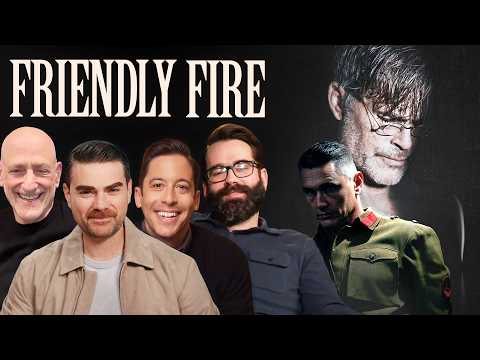
Following behind-the-scenes interviews with actors James Franco, a speaker, a speaker, a speaker, and a speaker, along with the director and production designer a speaker, Daily Wire hosts Ben Shapiro, Michael Knowles, Matt Walsh, and Andrew Klavan discuss the making of Confession. Shapiro explains how he wrote the 82-page script in four days for two rooms, how Rob Lowe begged to play the broken Soviet professor after a routine phone call, and how Marhoul shot on 35mm film in two-minute takes without a musical score.
The panel examines the film's literary roots in Arthur Koestler's Darkness at Noon, Timothy Snyder's Bloodlands, and Fyodor Dostoevsky's The Brothers Karamazov, arguing that starting with a deeply flawed protagonist and depicting Christian faith as costly sacrifice elevates the drama above didactic conservative movies. They close by analyzing online reactions from the commentator and Rod Dreher, while Shapiro reveals he was having brunch with Rob Lowe when Charlie Kirk was shot.
How time-sensitive the topic is: Developing story
By the numbers
14-page scene length: Length of a major dialogue scene broken down into intimate moments by the director. (Mentioned at 12:57)
3 weeks: Time taken by production designer a speaker to build the 1930s Moscow prison sets. (Mentioned at 17:20)
35 mm negative: Film stock format used by the director to shoot Confession in anamorphic ratio. (Mentioned at 22:32)
7 Oscar nominations: Combined number of Academy Award nominations held by the cast members of Confession. (Mentioned at 31:06)
82 pages: Total length of Ben Shapiro's shooting script for Confession. (Mentioned at 40:49)
4-day writing process: Time it took Ben Shapiro to write the screenplay for Confession. (Mentioned at 53:24)
2 minute segments: Duration of continuous takes the director filmed before stopping to maintain peak actor intensity. (Mentioned at 57:45)
10,000 dollars: Reward offered by Candace Owens to identify who Ben Shapiro was dining with when Charlie Kirk was shot. (Mentioned at 1:19:19)
Questions this video answers
How did Ben Shapiro get Rob Lowe and James Franco to star in Confession?
Ben Shapiro initially called Rob Lowe only to ask for casting recommendations for a broken-down Soviet professor, but Lowe asked to read the script, called back in tears, and begged to play the role himself. After director joined, Shapiro texted James Franco out of the blue on a Sunday, and Franco signed on after being blown away by the script. Securing two recognizable stars allowed Daily Wire to build an ensemble with seven Oscar nominations.
Ben Shapiro, 35:36 to 40:20
From this keypoint: How Rob Lowe Begged to Play the Broken Professor
What books and historical events inspired the movie Confession?
Ben Shapiro modeled the interrogation setup heavily on Arthur Koestler's Darkness at Noon and drew accounts of the Ukrainian famine directly from Timothy Snyder's Bloodlands. He also wove in references to Vasily Grossman's Life and Fate and centered the final act on Fyodor Dostoevsky's Grand Inquisitor argument from The Brothers Karamazov. These classic works ground the film's debate between Christian faith and Soviet totalitarianism.
Ben Shapiro, 40:20 to 47:56
From this keypoint: Dostoevsky, Koestler, and Flawed Protagonists
What does the ending of Confession mean when Alexei kisses Vladimir on the forehead?
When Rob Lowe's character Alexei confesses both his crime against the state and his Christian faith to the Commissar, he accepts martyrdom rather than living spiritually dead. Walking down the hallway, he kisses his former student and interrogator Vladimir on the forehead, echoing Christ kissing the Grand Inquisitor in Dostoevsky's The Brothers Karamazov. That literary signal prompts Vladimir to go home and read that exact passage in the final shot.
Ben Shapiro, 47:57 to 56:27
From this keypoint: Christian Martyrdom and the Grand Inquisitor Kiss
How did director film Confession in only two rooms without it feeling boring?
The director shot on 35mm anamorphic film without a musical score, storyboards, or rehearsals, using continuous camera movement like choreography and placing the camera on a rotating pyramid in the center of the cell. Rather than shooting full master scenes, he filmed intense two-minute segments to keep the actors throwing fastballs. He also added a cramped historical Lubyanka standing cell and subtle physical blocking to keep visual tension high.
Matt Walsh, 59:21 to 1:07:16
From this keypoint: Scoreless Camera Choreography and Standing Cells
Why did Matt Walsh and Andrew Klavan say most Christian and conservative movies fail?
Matt Walsh and Andrew Klavan argue that typical faith-based and conservative films prioritize ideological lecturing over emotional craft and are afraid to give protagonists genuine, pathetic flaws. By introducing Rob Lowe's character licking spilled vodka off a prison floor and showing that following Christ carries a painful cost, Confession earns its redemption arc the way classic Russian literature does.
Ben Shapiro, 28:26 to 35:35
From this keypoint: Hosts Praise Film-First Approach Over Propaganda
Who was Ben Shapiro having brunch with when Charlie Kirk was shot?
Ben Shapiro reveals during the roundtable that he was having brunch with actor Rob Lowe in Los Angeles when news broke that Charlie Kirk had been shot. Shapiro explains he kept the meeting private at the time because they were working on Confession, which debunked a viral conspiracy theory for which Candace Owens had offered a $10,000 reward.
Ben Shapiro, 1:17:37 to 1:23:08
From this keypoint: Candace Owens Bounty and Disrupting the Culture
Where was Confession filmed and how were the Soviet Lubyanka prison sets built?
Confession was filmed on a soundstage in Los Angeles where production designer a speaker reconstructed 1930s Moscow Lubyanka prison cells from historical photographs. Using recycled walls from another film and adding heavy humidity and cold running water textures, the crew built the sets in under three weeks before deconstructing them after wrap.
YouTube: Ben Shapiro, 16:44 to 19:13
From this keypoint: Building 1930s Moscow Cells in Three Weeks
Credible AI™ signals
Confidence: Insider Promotional Panel. The cast and writer provide firsthand accounts of filming and writing Confession. However, the entire panel works for Daily Wire and explicitly pitches paid subscriptions to watch their own movie, making their effusive praise self-serving promotion rather than independent critique.
Bias: Anti-Communist House Promo. The hosts openly frame the discussion around conservative and Christian culture-war goals, contrasting their film with mainstream Hollywood and leftist politics while repeatedly urging viewers to buy Daily Wire subscriptions.
Originality (78%): Firsthand Production Breakdown. Includes exclusive on-set interviews with actors and crew alongside writer Ben Shapiro's detailed breakdown of his casting process, literary inspirations, and on-set script adjustments with the director.
Depth (72%): Substantive Literary Breakdown. Beyond promotional praise, the roundtable explores the film's philosophical debts to Fyodor Dostoevsky and Arthur Koestler, analyzing how two-room staging, 35mm camera choreography, and flawed protagonists build dramatic tension.
Key points (12)
Short (23 min): key points 1, 5, 6 and 9
Medium (45 min): key points 1, 5, 6, 7, 8, 9 and 11
Relaxed (1h 4min): all 12 key points
1. James Franco on Interrogating Rob Lowe on Set
Timestamp: 00:03:55 to 00:07:10 (3 min)
Speaker: James Franco
James Franco explains that he joined Confession after getting an unexpected Sunday text from Ben Shapiro and being blown away by the script. Playing an interrogator confronting his former professor allowed him to explore resentment and intimacy with his old friend Rob Lowe. He concludes that shooting a major emotional centerpiece every day made the production the most exacting experience of his career.
Impact: Medium. Why it matters: Having a mainstream actor like James Franco praise Ben Shapiro's script and the daily emotional rigor lends Hollywood credibility to Daily Wire's drama.
“This process has been the most exacting, detailed, focused experience that I have ever had.”
In the video: James Franco, at 6:17
2. Cast Details Gulag Prep and 360-Degree Camera
Timestamp: 00:10:05 to 00:14:14 (4 min)
Speaker: YouTube: Ben Shapiro
Actors a speaker, a speaker, a speaker, and a speaker describe what drew them to the dialogue-heavy Soviet prison script. A speaker notes she initially hesitated because it took place entirely in a prison, but agreed after meeting the charismatic director and researching Soviet gulags through the book Whisperers. The actors highlight how director placed a 35mm camera on a rotating pyramid in the center of the cell to break 14-page scenes into intimate whispers.
Impact: Medium. Why it matters: Shows how seasoned actors approached the claustrophobic 14-page dialogue scenes and how central camera placement kept a single-room set visually dynamic.
“I'm Emil Hirs and I play Dimmitri in Confession.”
In the video, at 10:05
3. Building 1930s Moscow Cells in Three Weeks
Timestamp: 00:16:44 to 00:19:13 (2 min)
Speaker: YouTube: Ben Shapiro
Production designer a speaker and the crew explain how they recreated 1930s Moscow prison cells and execution basements based on an 1888 hotel taken over by the Soviet secret police. By repurposing recycled walls from another movie, the team erected the shell in days and completed the heavily textured, humid sets in under three weeks. The director notes that these aggressive, tactile walls directly elevated the actors' performances.
Impact: Low. Why it matters: Demonstrates how practical set recycling and tactile wall texturing allowed a rapid three-week build that still felt oppressive to actors on camera.
“So because we were able to erect the shell of these walls and the sets in a few days, it only took us about two to two and 1/2 weeks.”
In the video, at 17:40
4. The Director Directs on 35mm Without Storyboards
Timestamp: 00:22:00 to 00:25:55 (4 min)
Speaker: YouTube: Ben Shapiro
The director and the production team explain the challenge of shooting an entire feature across five rooms and hallways on 35mm anamorphic film. Marhoul works without a shot list, storyboards, or rehearsals, spending 15 minutes discussing emotions with actors before creating shots in the moment and editing in camera. The featurette concludes with producers arguing that artists outside the traditional Hollywood system can make serious films without corporate quotas.
Impact: Medium. Why it matters: Highlights an unconventional European directing method—shooting 35mm anamorphic film without storyboards—used to prevent a confined drama from feeling static.
“I'm not using storyboard, you know. I'm creating every shot in that very moment.”
In the video, at 23:09
For: Ben Shapiro
5. Hosts Praise Film-First Approach Over Propaganda
Timestamp: 00:28:26 to 00:35:35 (7 min)
Speaker: Ben Shapiro
Michael Knowles, Ben Shapiro, Matt Walsh, and Andrew Klavan open their roundtable by evaluating Confession as a breakthrough for Daily Wire. Shapiro argues that while conservative movies usually prioritize politics over craft, this project put filmmaking first while remaining rooted in Christianity and anti-communism. Walsh and Klavan agree that the movie succeeds because it makes the audience feel the emotional weight of the story rather than lecturing them like typical Christian or conservative films.
Impact: High. Why it matters: Articulates the panel's core thesis on why ideological entertainment often fails: prioritizing didactic messaging over emotional storytelling alienates viewers.
“In this one, I think it may be the the first thing that we've done um that that is really film first that just happens to be deeply deeply rooted in Christianity”
In the video: Ben Shapiro, at 31:28
For: Michael Knowles, Matt Walsh, Andrew Klavan
6. How Rob Lowe Begged to Play the Broken Professor
Timestamp: 00:35:36 to 00:40:20 (5 min)
Speaker: Ben Shapiro
Ben Shapiro recounts how he assembled a cast with seven Oscar nominations after another well-known actor had a scheduling conflict. When Shapiro called Rob Lowe merely to ask for casting suggestions for the alcoholic, broken-down professor, Lowe read the script, called back in tears, and begged to play the role himself, offering to shave his head and look ugly. Shapiro also praises late replacement Brad Dourif, a speaker, Nick Nolte, and a speaker for disappearing into character-driven arguments.
Impact: High. Why it matters: Reveals the behind-the-scenes casting pivot that placed Rob Lowe against type as a degraded Soviet academic, anchoring the movie's star power.
“He called me about an hour later and he was teary on the phone. He said, "God has only touched me a couple of times in my life. I feel like this script is God reaching out to me and touching me."”
In the video: Ben Shapiro, at 36:49
For: Andrew Klavan
7. Dostoevsky, Koestler, and Flawed Protagonists
Timestamp: 00:40:20 to 00:47:56 (8 min)
Speaker: Ben Shapiro
Andrew Klavan notes that the 82-page script reads like a dense stage play, and Ben Shapiro explains he purposefully wrote for two rooms to match studio budget constraints. Shapiro details his literary inspirations, citing Timothy Snyder's Bloodlands for the Ukrainian famine, Arthur Koestler's Darkness at Noon, Vasily Grossman's Life and Fate, and Fyodor Dostoevsky's The Brothers Karamazov. Matt Walsh adds that starting with Rob Lowe licking vodka off the floor works because great Russian literature redeems deeply pathetic, broken protagonists rather than sanitized heroes.
Impact: High. Why it matters: Connects the screenplay's two-room structure and broken protagonist directly to classic 20th-century anti-totalitarian literature and Russian novels.
“The total shoot script on this film was 82 pages.”
In the video: Ben Shapiro, at 40:48
For: Michael Knowles, Matt Walsh, Andrew Klavan
8. Christian Martyrdom and the Grand Inquisitor Kiss
Timestamp: 00:47:57 to 00:56:27 (9 min)
Speaker: Ben Shapiro
Asked why he wrote a Soviet interrogation drama now, Ben Shapiro says historical echoes in daily news inspired him to craft what he pitched to Daily Wire's board as the most anti-communist, pro-Christian film since The Passion of the Christ. Michael Knowles and Andrew Klavan argue that communism's core evil is its hatred of God, and praise the film for showing that Christian faith demands painful sacrifice rather than easy comfort. They dissect the ending, where Alexei confesses his faith to the Commissar and kisses his interrogator Vladimir on the forehead in an homage to Dostoevsky's Grand Inquisitor.
Impact: High. Why it matters: Unpacks the theological climax of the film, showing how an Orthodox Jewish writer constructed a Christian martyrdom arc around Dostoevsky's Grand Inquisitor.
“The elevator pitch for it is it's the single most anti-communist pro-Christian film probably ever made.”
In the video: Ben Shapiro, at 49:50
For: Michael Knowles, Andrew Klavan
9. Scoreless Camera Choreography and Standing Cells
Timestamp: 00:59:21 to 01:07:16 (8 min)
Speaker: Matt Walsh
Matt Walsh, Andrew Klavan, and Ben Shapiro examine how the director kept a scoreless dungeon movie visually gripping by moving the camera like choreography. Shapiro reveals that Marhoul grew up under communism and asked him to add a historical Lubyanka standing cell half the size of a telephone booth, which took five minutes to write and gave Walsh and Klavan physical claustrophobia. Shapiro also details on-set adjustments, such as having James Franco politely say 'please' when asking Rob Lowe to kneel to create psychological intimidation without premature violence.
Impact: High. Why it matters: Illustrates how specific directorial additions—removing the musical score, adding a Lubyanka standing cell, and softening a command to 'please'—heightened tension.
“And so he said, you know, there are these standing cells that were in Lianca. Can you write that in the script? said, "Absolutely. That take me five minutes. I'll just put that in the script."”
In the video: Ben Shapiro, at 1:02:06
For: Ben Shapiro, Andrew Klavan
10. Lubyanka Set Accuracy and Political Hostility
Timestamp: 01:07:17 to 01:10:02 (3 min)
Speaker: Ben Shapiro
Ben Shapiro explains where the film balances dramatic license with historical reality, noting that while prisoners passing in hallways was dramatized, the Lubyanka set was reconstructed on a Los Angeles soundstage from historical photographs, right down to a worker mopping blood near the execution room. Michael Knowles and Andrew Klavan connect the Soviet setting to modern political hostility, arguing that some contemporary leftists who celebrated Charlie Kirk's murder would gladly put conservatives against the wall.
Impact: Medium. Why it matters: Contrasts the historical reconstruction of Soviet execution corridors with the hosts' contention that modern ideological opponents harbor similar authoritarian impulses.
“The person who was actually doing all of the reconstruction and accuracy was working off of legit pictures of the Lianca and this the whole set was built from scratch”
In the video: Ben Shapiro, at 1:08:36
For: Michael Knowles, Matt Walsh, Andrew Klavan
11. The Commentator Trailer Clip and the Casting Test
Timestamp: 01:10:03 to 01:15:46 (6 min)
Speaker: Ben Shapiro
The panel watches a clip of streamer the commentator reacting in disbelief to seeing Rob Lowe, James Franco, Dean Norris, and a speaker in a Ben Shapiro movie, before mocking Piker's silent streaming style. Andrew Klavan and Shapiro argue that critics are outraged because Daily Wire is no longer easy to ignore when working with top Hollywood talent. Shapiro explains producer Dallas Sonnier's 'Louisiana cousin test' for casting recognizable faces like Nick Nolte and James Franco.
Impact: Medium. Why it matters: Explains Daily Wire's strategy for breaking out of the conservative media ghetto: hiring recognizable mainstream stars who force critics to engage.
“When I talk with Dallas about how we're going to cast all of our films, one of the things that I usually say is like he has what he calls the Louisiana cousin test, which is like would my Louisiana cousin know who that person is?”
In the video: Ben Shapiro, at 1:14:40
For: Michael Knowles, Matt Walsh, Andrew Klavan
12. Candace Owens Bounty and Disrupting the Culture
Timestamp: 01:17:37 to 01:23:08 (6 min)
Speaker: Ben Shapiro
Michael Knowles reads glowing social media reactions to Confession from Glenn Beck, David Limbaugh, and Rod Dreher before asking about Tucker Carlson and Candace Owens. Ben Shapiro reveals that when Charlie Kirk was shot, he was actually having brunch in Los Angeles with Rob Lowe, debunking a conspiracy theory for which Candace Owens had offered a $10,000 reward. Closing the show, Matt Walsh argues that a subtle, artistically credible film scares the left and disrupts culture far more than trolling movies.
Impact: Medium. Why it matters: Provides a concrete personal revelation from Ben Shapiro debunking a viral brunch rumor while summarizing the panel's case for artistic credibility over political trolling.
“I can say that the reason I couldn't talk about it is because the person I was having brunch with was Rob. Rob and I were having brunch in LA”
In the video: Ben Shapiro, at 1:18:46
For: Michael Knowles, Matt Walsh, Andrew Klavan
Conflicts of interest (2)
Daily Wire Hosts Promoting In-House Film
Commercial conflict, High severity
Ben Shapiro wrote Confession and co-founded Daily Wire, where panelists Michael Knowles, Matt Walsh, and Andrew Klavan are employed and pitch paid subscriptions to view the movie.
Sources: Ben Shapiro, Michael Knowles, Matt Walsh, Andrew Klavan
Significance: The roundtable acts as an extended commercial for their employer's flagship release, incentivizing unanimous praise and framing subscribing as a cultural duty.
Paid Sponsor Reads for Home Title Lock and Bedding
Commercial conflict, Low severity
Home Title Lock and Boll & Branch are paying sponsors of this episode, with hosts delivering scripted promotional endorsements and discount codes mid-show.
Sources: Ben Shapiro, Michael Knowles, Matt Walsh, Andrew Klavan
Significance: The hosts interrupt their film analysis to endorse property title monitoring and luxury sheets for direct commercial compensation.
Key sources
Ben Shapiro: Screenwriter of Confession and Daily Wire Co-Founder
Michael Knowles: Host of The Michael Knowles Show at Daily Wire
Matt Walsh: Daily Wire Host
Andrew Klavan: Novelist, Screenwriter, and Daily Wire Host
James Franco: Actor playing Vladimir in Confession
YouTube: Ben Shapiro: Media Channel and Film Producer
Who's in this
Rob Lowe
Nick Nolte
Brad Dourif
Dean Norris
Fyodor Dostoevsky
Arthur Koestler
Timothy Snyder
Dallas Sonnier
Candace Owens
Charlie Kirk
Home Title Lock
Boll & Branch
Also mentioned
Confession (First mentioned at 3:46)
Daily Wire (First mentioned at 7:25)
Darkness at Noon (First mentioned at 43:03)
The Brothers Karamazov (First mentioned at 52:30)
Lubyanka (First mentioned at 1:02:09)
Moscow (First mentioned at 17:14)
Bloodlands (First mentioned at 42:58)
Life and Fate (First mentioned at 43:18)
Vasily Grossman (First mentioned at 43:19)
Leo Tolstoy (First mentioned at 44:05)
No Country for Old Men (First mentioned at 1:00:47)
Run Hide Fight: Infidels (First mentioned at 1:13:54)
The Interview (First mentioned at 4:50)
The Whisperers (First mentioned at 11:54)
The Painted Bird (First mentioned at 30:50)
The Death of Ivan Ilyich (First mentioned at 44:03)
The Passion of the Christ (First mentioned at 50:05)
God's Not Dead (First mentioned at 51:31)
Terror on the Prairie (First mentioned at 1:00:38)
Crime and Punishment (First mentioned at 1:03:25)
Glenn Beck (First mentioned at 1:17:42)
Rod Dreher (First mentioned at 1:18:03)
This analysis was generated by skim (skim.plus), an AI-powered content analysis platform by Credible AI. Scores and classifications represent the platform's AI-generated assessment and should be considered alongside other sources.