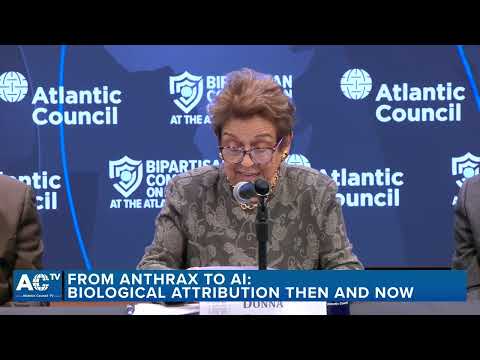
AtlanticCouncil's From anthrax to AI: Biological attribution then and now: skim's analysis identifies 22 key moments, with 1 potential conflict of interest flagged. The Bipartisan Commission on Biodefense examines how biological attribution has evolved from the seven-year 2001 anthrax investigation to the era of artificial intelligence and synthetic biology.
Category: Politics. Format: Panel Discussion. YouTube video analyzed by skim.
Key Points (22)
1. Houlahan Pushes Synthetic DNA Screening Laws
Timestamp: 00:01:50 to 00:07:20
Congresswoman Chrissy Houlahan reflects on the 25th anniversary of the 2001 anthrax attacks, noting it took the FBI seven years to name a suspect. To address AI-era threats, she highlights the 82-member bipartisan Congressional Biotech Caucus and the Biosecurity Modernization and Innovation Act to mandate synthetic DNA customer and sequence screening. She concludes that the window for congressional action is narrow and the nation cannot wait for another attack to test its defenses.
Significance (High): Mandating customer and sequence screening by statute shifts synthetic DNA security from voluntary industry norms to enforceable law.
Sources in support: Chrissy Houlahan (U.S. Representative, Pennsylvania's 6th District; Co-Chair, Biotech Caucus)
2. McCrory on Public-Private Crisis Communication
Timestamp: 00:08:23 to 00:14:53
Former Governor Pat McCrory argues that effective crisis response requires trusted communication between government and private companies, which may hesitate to report biological incidents out of fear of customer backlash. Drawing on his 2003 Homeland Security Advisory Commission service and gubernatorial emergency simulations, he stresses eliminating turf battles over public messaging and training before a crisis hits. He concludes that pre-established hospital coordination and simulations are vital for handling communicable disease events.
Significance (Medium): Private sector reluctance to report contamination can delay federal attribution and outbreak containment during the most critical early hours.
Sources in support: Pat McCrory (Former Governor of North Carolina and Former Mayor of Charlotte)
3. Shalala Cites Lab Death and White Powder Hoaxes
Timestamp: 00:14:57 to 00:19:41
A secretary outlines why biological attribution remains a major national security gap 25 years after the 2001 anthrax mailings and six years after COVID-19. She points to a recent bird flu death in Washington state, the death of a laboratory technician at Russia's Anti-Plague Research Institute, and a man charged with mailing hundreds of white powder hoax letters before the midterm election. She announces the Commission's new report offering solutions to ensure tracing tools keep pace with AI.
Significance (High): Recent lab fatalities in closed nations and domestic mail hoaxes show that attribution gaps remain an active vulnerability, not a historical relic.
Sources in support: YouTube: AtlanticCouncil (Host Channel / Unidentified Panelists)
4. Tom Ridge on Acting Before Attribution Is Known
Timestamp: 00:20:31 to 00:22:52
Former White House Homeland Security Adviser Tom Ridge recalls taking office in October 2001 just a week before an anthrax letter was opened in Senator's office. He explains that officials had to decide which buildings to close, who should receive antibiotics, and what to tell the public without knowing who sent the letters or whether a foreign nation was behind them. He warns that AI could make future attacks even harder to trace, emboldening attackers who think they will not be caught.
Significance (Medium): Executive leaders must make high-stakes public health decisions in an evidence vacuum, making credible attribution a core requirement for deterrence.
Sources in support: Tom Ridge (Co-Chair, Bipartisan Commission on Biodefense; Former White House Homeland Security Adviser)
5. The Senator Recounts the 2001 Senate Anthrax Attack
Timestamp: 00:23:10 to 00:34:07
Former Senate Majority Leader the senator recounts October 15, 2001, when an envelope filled with concentrated anthrax spores was opened in his Hart Senate Office Building suite five weeks after 9/11. The attack forced the closure of the Hart building, exposed his staff, and was part of a broader campaign that infected 22 Americans and killed five, including Brentwood postal workers Joseph Curseen Jr. and Thomas Morris Jr. He reflects that the FBI's seven-year Amerithrax probe pointing to Fort Detrick scientist Bruce Ivins was never tested in court.
Significance (High): The realization that the prime anthrax suspect worked at a U.S. Army biodefense lab exposed how defensive institutions can become insider threat sources.
Sources in support: YouTube: AtlanticCouncil (Host Channel / Unidentified Panelists)
6. Greenwood Warns AI Can Erase Bioweapon Signatures
Timestamp: 00:34:34 to 00:38:14
Former Representative and BIO CEO Jim Greenwood recalls being told in 2005 that regulating synthetic biology tools was impractical because equipment could be built anywhere. He argues that the marriage of synthetic biology with machine learning now creates a severe dual-use danger where malicious actors can design fatal, contagious viral weapons without traceable genetic signatures. He concludes that the United States must lead international regulation despite the decentralization of the technology to non-state actors.
Significance (High): If AI enables malicious actors to engineer pathogens lacking recognizable genetic signatures, traditional sequence-matching attribution could fail.
Sources in support: Jim Greenwood (Commissioner; Former U.S. Representative; Former President & CEO of BIO)
7. Why the 2001 Anthrax Probe Took Seven Years
Timestamp: 00:38:19 to 00:46:23
Responding to a secretary, the senator explains why the 2001 anthrax investigation took seven years: investigators lacked protocols, initially assumed a foreign 9/11 connection rather than a domestic lab miles away, and pursued false leads including draining lakes. Answering Raj Panjabi, the senator warns that America suffers from chronic normalcy bias and reactive policymaking. Answering Susan Brooks, he recalls chaotic early disagreements between the CDC and NIH and staffers bringing contaminated clothes to Capitol Hill in plastic bags.
Significance (Medium): Early investigative fixation on foreign terrorists and interagency confusion between public health and law enforcement cost years of attribution time.
Sources in support: YouTube: AtlanticCouncil (Host Channel / Unidentified Panelists), Jim Greenwood (Commissioner; Former U.S. Representative; Former President & CEO of BIO), Raj Panjabi (Commissioner, Bipartisan Commission on Biodefense; Former NSC Official), Susan Brooks (Commissioner; Former U.S. Representative from Indiana; Former U.S. Attorney)
8. DiNanno Details Mandatory DNA Screening & GOF Ban
Timestamp: 00:49:06 to 00:57:32
Under Secretary of State a secretary notes that seven years after COVID-19 appeared, there is still no official attribution, and the recent sudden death of a plague researcher in Russia's Irkutsk region shows authoritarian states remain opaque. He highlights two new U.S. government policies: mandatory nucleic acid synthesis screening under Executive Order 14292 extending to benchtop DNA printers, and a July policy prohibiting federal funding for dangerous gain-of-function research overseen by an independent third-party body. He also warns of high-containment biolab proliferation in developing nations.
Significance (High): Extending synthesis screening to benchtop DNA printers and cutting federal funds for risky foreign and domestic gain-of-function work targets threats before physical release.
Sources in support: YouTube: AtlanticCouncil (Host Channel / Unidentified Panelists)
9. Pressing Moscow on Irkutsk Plague Death & OSTP Role
Timestamp: 00:57:33 to 01:04:38
Questioned by Susan Brooks on the Russian plague researcher's death, a secretary reveals that the State Department issued a formal demarche in Moscow with detailed technical questions crafted with the CDC, NIH, and intelligence community, and plans to press the issue at the Biological Weapons Convention in Geneva. Responding to the senator on federal organization, a secretary argues against another government reorganization, noting that OSTP Director Kratsios currently convenes biweekly high-level interagency biosecurity policy meetings at the White House.
Significance (High): Relying on diplomatic demarches when an adversary conceals a plague lab fatality highlights the lack of enforceable verification under the Biological Weapons Convention.
Sources in support: YouTube: AtlanticCouncil (Host Channel / Unidentified Panelists)
Neutral sources: YouTube: AtlanticCouncil (Host Channel / Unidentified Panelists), Susan Brooks (Commissioner; Former U.S. Representative from Indiana; Former U.S. Attorney)
10. Allied Biosecurity Standards and DNA Printer Controls
Timestamp: 01:07:14 to 01:18:04
Addressing a speaker and a commissioner on international coalitions, a secretary explains that U.S. expert teams recently visited Sweden, Finland, and Germany to study their laboratory access and research security practices ahead of the Geneva BWC meetings. Questioned by Raj Panjabi and Jim Greenwood on global lab proliferation, benchtop DNA printers, and AI models, a secretary points to draft NIH high-containment lab safety standards, potential export controls and know-your-customer rules on DNA printer supply chains, and AI confidence-building measures.
Significance (Medium): Controlling decentralized benchtop DNA synthesis requires supply-chain export controls and international alignment with European and Asian biotech powers.
Sources in support: YouTube: AtlanticCouncil (Host Channel / Unidentified Panelists)
Neutral sources: Jim Greenwood (Commissioner; Former U.S. Representative; Former President & CEO of BIO), Raj Panjabi (Commissioner, Bipartisan Commission on Biodefense; Former NSC Official), YouTube: AtlanticCouncil (Host Channel / Unidentified Panelists)
11. Kafadar Exposes Flaws in FBI Anthrax Statistics
Timestamp: 01:25:18 to 01:31:46
University of Virginia statistics professor details six statistical lessons from the 2011 National Academies review of the FBI's 2001 anthrax investigation, which found the Justice Department's scientific conclusions less certain than claimed. She explains that although seven of the eight samples showing all four morphological variants (A1, A3, D, and E) came from Lab F, Lab F supplied 598 of the roughly 1,000 repository samples, yielding a 14% probability by chance. Furthermore, when one suspect sample was assayed 30 times, all four morphotypes appeared in only 16 replicates.
Significance (High): The 14% random probability and 16-of-30 assay replication rate demonstrate why unvalidated forensic sampling cannot independently prove attribution.
Sources in support: YouTube: AtlanticCouncil (Host Channel / Unidentified Panelists)
12. Caine Warns of Anthrax Antitoxin Stockpile Shortfalls
Timestamp: 01:31:49 to 01:37:19
Ryan Caine of Elusys Therapeutics explains that antibiotics alone cannot save patients once anthrax symptoms appear around 48 hours after exposure, requiring antitoxins like Anthim to neutralize the bacterial toxin. He warns that the Strategic National Stockpile is chronically underfunded and that federal threat models unrealistically assume a 2001-style warning note rather than a clandestine drone release sickening 100,000 people. He adds that U.S. troops lack forward-deployed anthrax countermeasures while China recently invested $1 billion to expand its offensive anthrax capabilities.
Significance (High): If threat models rely on an attacker giving advance warning for antibiotic prophylaxis, the U.S. could face mass casualties in a no-notice aerosol release.
Sources in support: Ryan Caine (Vice President of Government Affairs and Business Development, Elusys Therapeutics)
13. Giordano on Precision Pathogens and Insectoid Drones
Timestamp: 01:37:22 to 01:43:27
The researcher argues that future biological warfare will pivot from weapons of mass destruction to weapons of maximum disruption using gene editing, big data, and AI to craft personalized pathogens. He outlines three targeting modes: decapitating high-priority individuals, random attacks to induce population dread, and combining pathogens with nanotechnology or covert insectoid drones that threaten humans and agriculture. To counter adversary AI concealing pathogen signatures, he calls for whole-of-nation 'left of bang' biodeterrence.
Significance (High): Covert, precision-targeted pathogens and natural-mimicking bio-signatures challenge traditional WMD deterrence and complicate attribution under the BTWC.
Sources in support: YouTube: AtlanticCouncil (Host Channel / Unidentified Panelists)
14. Insectoid Swarms, AI vs. AI, and Bio-Watermarking
Timestamp: 01:43:28 to 01:50:44
Responding to a speaker, the researcher explains that bug-sized insectoid drones can intermingle with real insects to deliver toxins and disintegrate, while a professor and the researcher detail how AI speeds Ames strain identification even as adversaries use AI to mimic natural signatures. Answering Raj Panjabi on watermarking AI biological design tools, the researcher identifies three hurdles: non-universal compliance, watermark forgery, and downstream degradation when combined with other agents. He recommends a classified program of record for bio-cybersecurity watermarking.
Significance (High): Biological watermarking alone cannot solve attribution if adversaries strip or forge markers downstream, requiring classified bio-cybersecurity governance.
Sources in support: YouTube: AtlanticCouncil (Host Channel / Unidentified Panelists)
Neutral sources: Raj Panjabi (Commissioner, Bipartisan Commission on Biodefense; Former NSC Official), YouTube: AtlanticCouncil (Host Channel / Unidentified Panelists)
15. Coopetition, $2B Stockpile Need, and Amerithrax Doubts
Timestamp: 01:50:46 to 01:58:47
Responding to a commissioner on continuing resolutions and left-of-bang disruption, the researcher proposes 'coopetition' and intelligence disruption to slow adversaries whose permissive ethics accelerate research, while Ryan Caine notes the Strategic National Stockpile receives $1 billion annually against a $2 billion need. Questioned by the senator on whether the FBI's 2001 anthrax attribution was accurate, a professor states that because forensic science was not kept separate from the investigation, uncertainties remain and 'maybe he did it, maybe he didn't.'
Significance (High): Kafadar's assessment that Bruce Ivins' guilt remains uncertain underscores why forensic testing must be structurally independent from law enforcement leads.
Sources in support: YouTube: AtlanticCouncil (Host Channel / Unidentified Panelists)
Sources against: Ryan Caine (Vice President of Government Affairs and Business Development, Elusys Therapeutics)
Neutral sources: YouTube: AtlanticCouncil (Host Channel / Unidentified Panelists)
16. Drug Shelf-Life Extensions and Capability Piling
Timestamp: 01:58:53 to 02:08:27
Following up on the senator and a secretary's questions, the researcher urges moving beyond fixed BTWC agent lists, while a professor confirms the FBI lacked strong internal biology capabilities in 2001 compared to the Defense Department. Questioned by Jim Greenwood on why the Strategic National Stockpile requires $2 billion annually, Ryan Caine explains that biologics like Anthim expire after seven years, warm manufacturing bases must be sustained, and funding shortages force the government to scratch out expiration dates under the Shelf-Life Extension Program (SLEP). The researcher recommends 'capability piling' alongside stockpiling.
Significance (Medium): Relying on shelf-life extensions and letting domestic biologic manufacturing lines go cold leaves the stockpile unable to surge during an attack.
Sources in support: YouTube: AtlanticCouncil (Host Channel / Unidentified Panelists), Ryan Caine (Vice President of Government Affairs and Business Development, Elusys Therapeutics)
Neutral sources: YouTube: AtlanticCouncil (Host Channel / Unidentified Panelists), Jim Greenwood (Commissioner; Former U.S. Representative; Former President & CEO of BIO)
17. Treangen on Petabyte Bio-Attribution in 24 Hours
Timestamp: 02:11:05 to 02:17:30
Rice University professor and former NBACC principal investigator a professor contrasts 2001 forensics with today's computational speed, noting his lab recently won a DARPA bio-threat attribution challenge by accurately analyzing one petabyte of data in 24 hours. He highlights his group's tools, SeqScreen for species-agnostic pathogen detection and PlasmidScreen for engineered DNA detection, which relies heavily on public repositories like Addgene. He recommends academic-government workforce partnerships, expanded reference sequencing, and building biosecurity safeguards directly into biological foundation models.
Significance (High): Demonstrating accurate petabyte-scale genomic analysis within 24 hours proves computational pipelines can support real-time national biosurveillance.
Sources in support: YouTube: AtlanticCouncil (Host Channel / Unidentified Panelists)
18. Bernstein on Graded Intelligence & AI Sycophancy
Timestamp: 02:17:35 to 02:23:51
Former ODNI and National Intelligence Council official Zachary Bernstein explains that intelligence attribution is rarely binary, instead offering graded confidence assessments that evolve over time. He notes that when adversaries use AI to design biological weapons, crucial attribution evidence resides inside private frontier AI labs rather than traditional intelligence channels. He recommends legal data-sharing mechanisms with private AI labs, applying intelligence tradecraft to prevent sycophantic LLMs from overstating confidence on tactical questions, and training senior policymakers in AI and bio literacy.
Significance (High): Uncalibrated LLMs that deliver falsely confident tactical answers could mislead senior policymakers into taking military or legal action on weak attribution.
Sources in support: Zachary Bernstein (Research Scholar, Center for the Governance of AI; Former ODNI & NIC Official)
19. Franz on Forensic Readiness and Evidence Retention
Timestamp: 02:24:02 to 02:28:07
A speaker argues that while machine learning and protein watermarking can help detect genetic engineering and lab of origin, their success depends on data quality and investigative workflows. She offers three recommendations: embedding genetic engineering detection into routine human and animal genomic surveillance, establishing forensic chain-of-custody and retention periods for DNA synthesis screening logs and suspicious AI queries before an incident occurs, and sustaining validation of attribution models against unseen laboratories and provenance-obscuring techniques.
Significance (High): Without mandatory retention periods for DNA synthesis screening logs and suspicious AI prompts, crucial digital attribution trails will vanish before an outbreak is detected.
Sources in support: YouTube: AtlanticCouncil (Host Channel / Unidentified Panelists)
20. Campus DNA Screening and Houston Wastewater Sequencing
Timestamp: 02:28:12 to 02:38:25
Responding to a speaker on laboratory surveillance, a speaker notes that intelligence assessments like the COVID-19 origins report rely heavily on biosafety records, synthesis orders, and AI query logs rather than sequence signatures alone. A professor explains that his SeqScreen software actively screens all synthetic DNA generated on Rice University's campus, notes that recent generative AI phage genomes like Evo 2 are only modest deviations from known viruses, and highlights Houston's CASPER wastewater project sequencing a billion reads per sample. Responding to Susan Brooks, Zachary Bernstein and a professor emphasize strict personnel vetting.
Significance (High): Combining campus-level synthetic DNA screening with deep billion-read wastewater metagenomics creates an early warning net for novel engineered pathogens.
Sources in support: YouTube: AtlanticCouncil (Host Channel / Unidentified Panelists), Zachary Bernstein (Research Scholar, Center for the Governance of AI; Former ODNI & NIC Official)
Neutral sources: Susan Brooks (Commissioner; Former U.S. Representative from Indiana; Former U.S. Attorney), YouTube: AtlanticCouncil (Host Channel / Unidentified Panelists)
21. Customer Screening Logs and Preparing for AGI
Timestamp: 02:38:30 to 02:45:58
Answering Jim Greenwood on whether the government knows who buys DNA sequences and printers, Zachary Bernstein, a speaker, and a speaker note that while industry screening has been largely voluntary, the new federal nucleic acid synthesis policy formalizes data retention and law enforcement handovers. Questioned by the senator on preparing for inevitable AGI and singularity, a speaker recommends scenario-agnostic attribution frameworks, Bernstein urges well-practiced interagency crisis relationships, and a professor calls for multi-layered detection capabilities.
Significance (Medium): Transitioning DNA synthesis and AI provider logs from ad hoc voluntary sharing to standardized retention policies gives law enforcement faster access during crises.
Sources in support: YouTube: AtlanticCouncil (Host Channel / Unidentified Panelists), Zachary Bernstein (Research Scholar, Center for the Governance of AI; Former ODNI & NIC Official)
Neutral sources: YouTube: AtlanticCouncil (Host Channel / Unidentified Panelists), Jim Greenwood (Commissioner; Former U.S. Representative; Former President & CEO of BIO)
22. Bernstein Proposes an AI Threat Fusion Center
Timestamp: 02:46:01 to 02:56:01
Responding to a commissioner's question on cataloging suspicious activities at labs, Zachary Bernstein stresses investing in shrinking national security workforces, while a professor explains that when his campus DNA screening software flags a sequence, specific protocols require contacting the researcher and notifying the FBI. Answering Raj Panjabi and a speaker, Bernstein recommends mandatory war-gaming and AI literacy crash courses for senior officials, and outlines Rebecca Hersman's proposal for an AI Threat Fusion Center inside the intelligence community where cleared AI company staff and government analysts share tactical and strategic threat data bidirectionally.
Significance (High): An AI Threat Fusion Center housing cleared industry personnel inside the intelligence community would bridge private AI query observations with classified threat intelligence.
Sources in support: YouTube: AtlanticCouncil (Host Channel / Unidentified Panelists), Zachary Bernstein (Research Scholar, Center for the Governance of AI; Former ODNI & NIC Official)
Neutral sources: YouTube: AtlanticCouncil (Host Channel / Unidentified Panelists), Raj Panjabi (Commissioner, Bipartisan Commission on Biodefense; Former NSC Official)
This analysis was generated by skim (skim.plus), an AI-powered content analysis platform by Credible AI. Scores and classifications represent the platform's AI-generated assessment and should be considered alongside other sources.