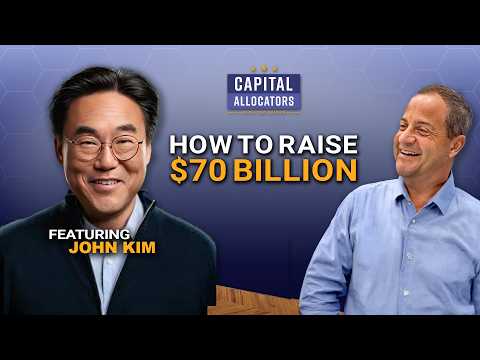
Fundraising Mastery: the Tao of Kimmer – John Kim (EP.503)
Capital Allocators with Ted Seides
Summary
Veteran fundraiser John Kim joins host Ted Seides to discuss the lessons from his thirty-year career raising more than $70 billion for venture capital and private equity firms. Drawing from his book, Kim explains that persuasion equals desire minus fear, meaning fundraisers succeed by addressing an allocator's past burns and insecurities rather than simply pitching upside. He outlines practical frameworks for capital formation, including his four mandatory steps to open any meeting, the Law of Differentiation, and a taxonomy of what pensions, sovereigns, endowments, insurance companies, funds of funds, and family offices each value.
Beyond individual meetings, Kim breaks down how alternative investment firms build and compensate investor relations teams. He contrasts database tools, service roles, and territory salespeople against the coveted Secretary of State fundraiser who holds deep authority with both general and limited partners. Finally, he critiques the industry's habit of hiring for persona over skill and underpaying senior investor relations partners, before sharing how he applies his principles as Chairman and Co-President at Lila Sciences.
How time-sensitive the topic is: Evergreen
By the numbers
70 billion USD: Amount John Kim has raised across his career for venture capital and private equity firms. (Mentioned at 2:39)
500 conversations: Number of Capital Allocators podcast episodes available to listeners. (Mentioned at 4:30)
99%: Estimated share of people who respond to a cynical prospect by pitching positives rather than asking what made them angry. (Mentioned at 11:28)
6 billion to 20 billion USD: Growth in fund size achieved by proactive mega-funds following the 2009 global financial crisis. (Mentioned at 50:06)
59 years old: John Kim's age at the time of recording, noting he still writes pitchbooks. (Mentioned at 57:42)
90 to 99%: Estimated share of the investor relations industry whose compensation is calculated using blended role buckets. (Mentioned at 58:18)
Questions this video answers
How should fundraisers structure the opening of an investor pitch meeting?
John Kim states that every meeting must quickly establish four things: rapport, credibility, attention, and interest. Because busy allocators enter meetings distracted by prior obligations, fundraisers must charm them first to clear their minds before pitching, and should always enter knowing their opening line and closing objective.
John Kim, 20:39 to 25:53
From this keypoint: The Four Mandatory Steps to Open Any Meeting
What is John Kim's Law of Differentiation for raising investment capital?
The Law of Differentiation states that a fund's capital-raising potential equals its track record plus its differentiation, divided by the complexity of its story. Story complications destroy trust and make it difficult for internal champions to defend the investment to contentious investment committees, requiring a simple, repeatable catchphrase.
John Kim, 25:53 to 32:29
From this keypoint: Kim's Law of Differentiation and Story Complexity
How do you handle investor objections about high fund fees?
Fundraisers should repeat the objection back to the investor and ask a clarifying question to uncover the real objection, which is often that the track record does not justify the fee. If the objection truly centers on a strict institutional fee rule, the fundraiser can test if dropping the fee closes the deal immediately.
John Kim, 32:59 to 39:23
From this keypoint: Investor Taxonomy and Ted Williams Objection Handling
What are the different types of institutional investors looking for in a pitch?
According to John Kim's taxonomy, pension plans look for respect for their bureaucratic processes, sovereign wealth funds want strategic benefits for their nation, funds of funds seek differentiation, insurance companies focus on risk mitigation, and endowments want to feel special. With family offices, the priority is identifying the actual decision-maker.
John Kim, 32:59 to 39:23
From this keypoint: Investor Taxonomy and Ted Williams Objection Handling
How do you persuade a cynical investor during a fundraising meeting?
Because persuasion equals desire minus fear, fundraisers must focus on reducing a cynical investor's fear rather than pitching upside benefits. When an allocator sounds cynical, it usually means they were burned in the past, so asking them directly what went wrong and offering a lower-risk way to engage builds deep trust.
John Kim, 8:34 to 13:36
From this keypoint: Persuasion Equals Desire Minus Fear
How should private equity and venture capital firms structure and hire an investor relations team?
Firms should map roles across GP knowledge and LP knowledge, aiming at the top level for a 'Secretary of State' who deeply understands both the firm and its investors and can negotiate on the general partners' behalf. Firms should avoid the common mistake of hiring untrained bankers or dealmakers based solely on persona rather than trained sales skill.
John Kim, 50:11 to 55:18
From this keypoint: The Secretary of State Model for IR Teams
How should investor relations professionals be compensated in alternative asset management?
Most firms mistakenly calculate IR pay by blending time spent on associate-level pitchbooks, VP-level selling, and partner-level strategy, which underpays senior IR partners relative to deal partners. John Kim argues firms should pay IR staff equally by rank alongside investment staff to prevent competitors from poaching top fundraisers.
John Kim, 55:18 to 1:00:35
From this keypoint: Fixing Broken IR Compensation Structures
What is the formula for managing a fundraising sales pipeline?
Total capital raised equals the size of the pipeline multiplied by the conversion ratio and the average investment bite size. Improving this equation requires a six-step process of identifying, contacting, qualifying, persuading, pitching, and closing prospects, supported by warm introductions from respected connectors who know the firm well.
John Kim, 16:20 to 20:38
From this keypoint: Pipeline Formula and Warm Outreach Strategy
How do fund size, terms, and speed interact during a fundraise?
Under the Law of Trade-offs, fund size, terms, and speed are locked in constant tension. Tightening fund terms to favor the manager will inevitably slow down the fundraising process or reduce commitment sizes.
John Kim, 44:58 to 50:11
From this keypoint: Laws of Trade-Offs, Leverage, and Market Cycles
Credible AI™ signals
Confidence: Seasoned Practitioner Insight. John Kim draws on three decades of institutional fundraising experience, having raised over $70 billion for venture capital and private equity firms. While his psychological frameworks and investor taxonomies are subjective heuristics rather than empirical studies, they represent tested industry practice from an established insider.
Bias: Sales-Centric Fundraiser Lens. The conversation approaches institutional capital allocation entirely from the marketer and fundraiser perspective, treating investor skepticism as an emotional hurdle to overcome. Host Ted Seides overtly praises John Kim's book and shares his industry worldview without challenging his sales-driven premises.
Originality (78%): Codified Industry Playbook. While drawing on classic persuasion texts by Robert Cialdini and Aristotle, John Kim synthesizes these concepts into original, quantitative-style formulas tailored to private markets, such as his Law of Differentiation and the two-by-two Secretary of State investor relations matrix.
Depth (76%): Structured Tactical Breakdown. The discussion systematically deconstructs the capital raising lifecycle from initial cold outreach to meeting structure, objection handling, and investor relations team compensation. It pairs high-level behavioral psychology with concrete institutional examples across endowments, pensions, and sovereign funds.
Key points (12)
Short (20 min): key points 1, 2, 6 and 10
Medium (37 min): key points 1, 2, 5, 6, 7, 10 and 11
Relaxed (1h 3min): all 12 key points
1. John Kim's Path From IBM Sales to Fundraising
Timestamp: 00:05:11 to 00:08:34 (3 min)
Speaker: John Kim
John Kim traces his career from selling expensive IBM cash registers door-to-door in the late 1980s to pioneering institutional investor relations in private markets. After transitioning from placement agent roles at Bank of America and Chase into in-house investor relations in 2000, he wrote The Tao of Fundraising as a farewell gift to the industry before joining AI company Lila Sciences. He concludes that the power of persuasion carries heavy emotional and character costs if used manipulatively rather than balanced with personal values.
Impact: Low. Why it matters: Frames institutional fundraising not as an elitist financial pedigree, but as a structured enterprise sales discipline rooted in classic door-to-door training.
“One of the things I should get out in the open is I wrote the book as my farewell gift to the industry. I now run a artificial intelligence company called Lila Sciences”
In the video: John Kim, at 7:01
Neutral: Ted Seides
2. Persuasion Equals Desire Minus Fear
Timestamp: 00:08:34 to 00:13:36 (5 min)
Speaker: John Kim
Applying a Taoist lens of dualities and the Nash equilibrium to sales, John Kim defines persuasion as what people want minus how scared they are. When meeting a cynical prospect who has been burned before, 99% of salespeople mistakenly pitch positive features rather than asking what made the prospect angry and offering a low-risk way to reduce their fear. Ultimately, deals rarely fail because investors doubt a manager's competence; they fail because the investor does not trust the person.
Impact: High. Why it matters: Flips standard pitch strategy on its head by prioritizing psychological safety and fear reduction over aggressive promotion of fund returns.
“I believe that persuasion is desire minus fear. So what people want minus how scared they are.”
In the video: John Kim, at 10:15
Neutral: Ted Seides
3. Building Trust via Cialdini's Six Principles
Timestamp: 00:13:36 to 00:16:20 (3 min)
Speaker: John Kim
To help investors overcome insecurity and build trust, fundraisers rely on the six principles articulated by Robert Cialdini in 1986: authority, consistency, liking, reciprocity, scarcity, and consensus. While scarcity drives fear of missing out, consensus is the macro force that moves institutional capital from early adopters to the early majority. Once enough evidence exists that a strategy works, consensus establishes collective trust and unlocks mainstream institutional adoption.
Impact: Medium. Why it matters: Maps classic behavioral psychology directly onto the institutional adoption curve for emerging fund managers.
“everybody's trying to make that early adopter to early majority leap. And that leap is usually defined as trust. In other words, there's enough evidence now that people can trust that it works.”
In the video: John Kim, at 16:03
Neutral: Ted Seides
4. Pipeline Formula and Warm Outreach Strategy
Timestamp: 00:16:20 to 00:20:38 (4 min)
Speaker: John Kim
John Kim defines selling as persuasion with a process, governed by the formula that pipeline times conversion ratio times bite size equals total capital raised. Executing this macro process requires six steps: identifying, contacting, qualifying, persuading, pitching, and closing buyers across different investor tiers. When lacking an established brand, fundraisers should only seek introductions from respected connectors who genuinely know their firm, as blind favors waste social reciprocity.
Impact: High. Why it matters: Provides a mathematical framework for capital formation while warning against the common mistake of asking acquaintances for blind introductions.
“The macro process is your pipeline times your conversion ratio times the size of the contract or the bite size of the investment equals the amount of money you're going to receive”
In the video: John Kim, at 16:51
Neutral: Ted Seides
5. The Four Mandatory Steps to Open Any Meeting
Timestamp: 00:20:39 to 00:25:53 (5 min)
Speaker: John Kim
Every effective pitch meeting must rapidly establish four elements: rapport, credibility, attention, and interest. Under John Kim's Copernican theory of selling, the prospect is the center of the universe and enters the room distracted by their own busy life, making it a mistake to jump straight into business without charming them first. Furthermore, a fundraiser should always enter a room knowing the exact first line they will say and their specific closing objective.
Impact: High. Why it matters: Offers a concrete checklist for managing meeting dynamics and preventing pitches from derailing before the core presentation even begins.
“Every meeting must start with four things. You must establish rapport. You must establish credibility. You have to gain their attention. You have to generate interest. And you better do it fast.”
In the video: John Kim, at 20:55
Neutral: Ted Seides
6. Kim's Law of Differentiation and Story Complexity
Timestamp: 00:25:53 to 00:32:29 (7 min)
Speaker: John Kim
Drawing on Aristotle's logos, ethos, and pathos and Simon Sinek's view of rationalization, John Kim argues that fundraisers must appeal to emotion and values before logic. He codifies this in his Law of Differentiation: a fund's capital-raising potential equals its track record plus its differentiation, divided by the complications of its story. Because investment committees can be contentious and political, fundraisers must arm their champion with a single, simple phrase that neutralizes story complications.
Impact: High. Why it matters: Explains why strong performers with complex narratives fail to raise money: internal LP champions cannot easily defend complicated stories to hostile investment committees.
“This is the essence of the equation I call the law of differentiation. Your track record plus your differentiation divided by the complexity of your story is generally how much money you can raise.”
In the video: John Kim, at 28:39
Neutral: Ted Seides
7. Investor Taxonomy and Ted Williams Objection Handling
Timestamp: 00:32:59 to 00:39:23 (6 min)
Speaker: John Kim
John Kim categorizes institutional allocators by their core psychological drivers: pension plans seek respect for their bureaucratic processes, sovereign wealth funds require strategic national benefits, funds of funds want differentiation, family offices require identifying the true decision-maker, insurance companies prioritize risk mitigation, and endowments want to feel special. When handling objections like high fees, fundraisers should repeat the objection back as a clarifying question to uncover the real concern, such as doubts about performance. Like baseball hitter Ted Williams waiting for his five best pitches, fundraisers should aggressively attack objections in their strike zone and lower expectations when hit on a weakness.
Impact: High. Why it matters: Equips capital raisers with tailored messaging for six distinct LP archetypes and a disciplined method for diagnosing and answering pushback.
“Repeat back what they said. You want to make sure they say an objection. I think your fees are too high. Okay, that's an objection. Then you literally just have to repeat back.”
In the video: John Kim, at 35:50
Neutral: Ted Seides
8. Persona Play and Addressing Investor Insecurities
Timestamp: 00:39:23 to 00:44:58 (6 min)
Speaker: John Kim
Bridging the GP-LP divide requires treating the pitch as an audition and adopting the specific persona the allocator trusts, whether intellectual or folksy. Alongside persona play, John Kim applies the Sedona Method to identify whether an investor's underlying insecurity centers on control, approval, safety, or group oneness. He maintains that adapting one's communication style to serve the listener's psychological needs is authentic empathy, provided the fundraiser genuinely cares about the counterparty rather than just manipulating an outcome.
Impact: Medium. Why it matters: Addresses the ethical tension between sales adaptability and personal authenticity in high-stakes relationship management.
“You need to know what you're auditioning for because it's not a sales pitch. It's not an interview. It's an audition. The idea that you're walking in, they know what they think they're looking for.”
In the video: John Kim, at 40:16
Neutral: Ted Seides
9. Laws of Trade-Offs, Leverage, and Market Cycles
Timestamp: 00:44:58 to 00:50:11 (5 min)
Speaker: John Kim
Expanding on macro fundraising rules, John Kim explains the Law of Trade-offs, where fund size, terms, and speed constantly pull against one another, and the Law of Leverage, where elite fundraisers can amplify a strong fund's potential energy but cannot rescue an undifferentiated fund with a poor track record. When market cycles turn against a strategy, managers must accept raising less capital rather than fighting the tape. However, as seen after the 2009 global financial crisis, firms with top investor relations teams that communicated weekly with clients deployed capital effectively and scaled from $6 billion funds into $20 billion mega-funds.
Impact: High. Why it matters: Demonstrates how proactive investor relations during market downturns creates the foundation for massive asset gathering when the cycle turns.
“you're always trading off size and terms and speed. It's size times terms times speed.”
In the video: John Kim, at 45:40
Neutral: Ted Seides
10. The Secretary of State Model for IR Teams
Timestamp: 00:50:11 to 00:55:18 (5 min)
Speaker: John Kim
John Kim maps investor relations roles on a two-by-two matrix of GP knowledge and LP knowledge: low on both is a database like Preqin or Salesforce, high GP knowledge alone is a service-oriented IR role, high LP knowledge alone is a territory salesperson, and high on both is the coveted Secretary of State. Like a diplomatic ambassador who speaks for the president and negotiates policy, a Secretary of State fundraiser commands deep internal authority and external trust. Paradoxically, general partners often hire untrained bankers or dealmakers for this role based on the external persona they project, just as US presidents pick Secretaries of State to mirror their desired image.
Impact: High. Why it matters: Exposes a major hiring flaw in private equity and venture capital: prioritizing a candidate's polished persona over trained sales execution.
“The whole industry is upside down. People aren't looking for skills. They're looking for personas. If you have a great persona that actually fits, you'll get the job even though you have no experience.”
In the video: John Kim, at 55:06
Neutral: Ted Seides
11. Fixing Broken IR Compensation Structures
Timestamp: 00:55:18 to 01:00:35 (5 min)
Speaker: John Kim
Roughly 90% to 99% of alternative investment firms miscalculate investor relations pay by blending time spent across three buckets: associate-level pitchbook creation, vice-president-level selling, and partner-level strategy. Because even 59-year-old IR heads still write pitchbooks, this weighted formula overpays junior analysts relative to their peers while underpaying senior IR partners compared to deal partners. John Kim argues firms should instead pay IR professionals strictly by their rank to prevent competitors from poaching top fundraising partners and to eliminate second-class cultural resentment.
Impact: High. Why it matters: Pinpoints the exact compensation mechanics that drive high turnover and cultural friction among senior private equity fundraisers.
“Same thing with a partner. Like, if the partner is doing all this other stuff, that's great, but you're a partner. Pay them like a partner. Pay them like a deal partner.”
In the video: John Kim, at 59:20
Neutral: Ted Seides
12. Applying Fundraising Lessons at Lila Sciences
Timestamp: 01:00:35 to 01:08:31 (8 min)
Speaker: John Kim
Transitioning to Chairman and Co-President at AI healthcare firm Lila Sciences allowed John Kim to drop the feeling of being in an isolated support function while retaining his investor relationships and outward-centric sales habits. To simplify Lila Sciences' complex business for investment committees, he distills their thesis into the repeatable 'Lila paradox': to use AI to eliminate laboratories, you must first train AI on laboratories. Looking back on his IBM training and life lessons, he emphasizes that sales is a trainable skill and that true empathy means treating others the way they want to be treated, not the way you want to be treated.
Impact: Medium. Why it matters: Illustrates how his own 'if the glove doesn't fit' catchphrase rule works in practice for a deep-tech startup raising venture capital.
“You do realize that the Laya paradox is that in order to actually not need laboratories, you need to train on laboratories.”
In the video: John Kim, at 1:02:51
Neutral: Ted Seides
Conflicts of interest (2)
Book Promotion for The Tao of Fundraising
Commercial conflict, Low severity
John Kim is the author of The Tao of Fundraising, which host Ted Seides endorses in the introduction as the best book he has ever read on fundraising.
Sources: Ted Seides, John Kim
Significance: The interview serves as a promotional platform for John Kim's book, incentivizing both speakers to present his proprietary frameworks as essential industry wisdom.
Active Capital Raising for Lila Sciences
Financial conflict, Medium severity
John Kim serves as Chairman and Co-President of Lila Sciences, where he is actively responsible for raising Series A and Series B capital.
Sources: John Kim
Significance: John Kim uses the podcast to pitch Lila Sciences' laboratory-trained AI thesis directly to an audience of institutional capital allocators.
Key sources
Ted Seides: Host, Capital Allocators
John Kim: Author of The Tao of Fundraising; Chairman and President of Corporate Development, Lila Sciences
Who's in this
Lila Sciences
General Catalyst
IBM
Robert Cialdini
Simon Sinek
Ted Williams
Also mentioned
The Tao of Fundraising (First mentioned at 2:51)
Capital Allocators (First mentioned at 2:31)
Aristotle (First mentioned at 26:25)
Merrill Lynch (First mentioned at 5:57)
Bank of America (First mentioned at 6:21)
Chase (First mentioned at 6:23)
Connecticut (First mentioned at 24:05)
Florida (First mentioned at 3:42)
Will Ferrell (First mentioned at 4:06)
Old School (First mentioned at 4:08)
Spotify (First mentioned at 4:49)
NCR (First mentioned at 5:27)
Casio (First mentioned at 5:29)
Uber (First mentioned at 13:12)
New York Knicks (First mentioned at 25:39)
Preqin (First mentioned at 50:42)
Salesforce (First mentioned at 50:43)
Bill Clinton (First mentioned at 54:04)
Madeleine Albright (First mentioned at 54:06)
George W. Bush (First mentioned at 54:14)
Colin Powell (First mentioned at 54:16)
Condisa Rice (First mentioned at 54:26)
Barack Obama (First mentioned at 54:29)
Hillary Clinton (First mentioned at 54:39)
Donald Trump (First mentioned at 54:42)
Rex Tillerson (First mentioned at 54:44)
Exxon (First mentioned at 54:45)
Mike Pompeo (First mentioned at 54:48)
Budweiser (First mentioned at 1:07:08)
This analysis was generated by skim (skim.plus), an AI-powered content analysis platform by Credible AI. Scores and classifications represent the platform's AI-generated assessment and should be considered alongside other sources.