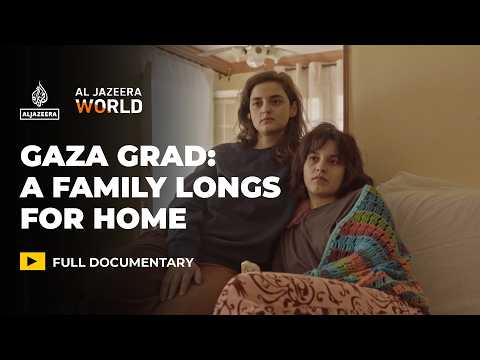
Gaza Grad: A Palestinian-Russian family’s longing for home | Al Jazeera World Documentary
Al Jazeera English
Summary
When war destroys their neighborhood in Gaza, the Palestinian-Russian Ashour family evacuates via Russian citizenship to Volgograd, leaving behind their home, jobs, and beloved five-year-old dog Gucci. In Russia, 60-year-old Ghassan Ashour overcomes severe financial hardship by teaching Quran at a local mosque, while his wife Anna takes a new job while mourning the beauty salon and 25 years of life she lost in Gaza. Struggling with cultural isolation and language barriers in Russia, daughters Lisa and Donia relocate to Cairo.
Living in Egypt allows the sisters to work in an Arabic-speaking environment while remaining geographically close to Gaza in case return becomes possible, even as they battle survivor's guilt. Ten months into exile, the divided family stays connected through video calls and visits, caught between the safety of Russia, the familiarity of Egypt, and the enduring hope of returning to Gaza.
How time-sensitive the topic is: Developing story
By the numbers
60 years old: Age at which Ghassan Ashour questions how a person can start rebuilding life from zero after evacuating Gaza. (Mentioned at 4:25)
5 years: Time the family's dog Gucci lived with them as part of the family before their evacuation. (Mentioned at 4:43)
51 years old: A speaker's stated age while visiting her grandparents' 70-year-old house in Russia. (Mentioned at 30:36)
24 years old: A speaker's age when speaking with a neighbor in Volgograd and reflecting on her years spent in Gaza. (Mentioned at 35:51)
25 years: Duration a speaker lived in Russia and subsequent duration she lived in Gaza, making her feel half-Russian and half-Gazawi. (Mentioned at 38:11)
10 months: Time Ghassan and a speaker have spent displaced in Russia by the end of the documentary. (Mentioned at 44:47)
Questions this video answers
Why did the Ashour daughters move to Egypt instead of staying with their parents in Russia?
Lisa and a speaker relocated from Volgograd to Cairo because Donia struggled with the language and cultural barrier in Russia, and both sisters wanted to live closer to Gaza. Living in Egypt allows them to feel culturally connected and ready to return to Gaza immediately if the war ends.
YouTube: Al Jazeera English, 39:46 to 42:48
From this keypoint: Why Lisa and Donia Choose Cairo Over Russia
How did Ghassan and a speaker support themselves financially after evacuating to Volgograd?
Upon arriving in Russia, Ghassan faced severe financial hardship where he briefly could not afford bread, prompting him to visit a Volgograd mosque where he was hired to teach Arabic and Quran to children. Anna, who previously ran a large beauty salon in Gaza, immediately found work in Russia to help the family survive.
Ghassan Ashour, 14:21 to 18:38
From this keypoint: Ghassan Finds Mosque Work as Family Splits
Why is the documentary titled 'Gaza Grad'?
The title comes from Anna and Ghassan Ashour comparing the total bombardment of Gaza to the World War II destruction of Stalingrad (now Volgograd), where Anna's grandparents lived. Looking at family photos in Volgograd, Ghassan remarks that their family survived Stalingrad only to flee a new war he calls 'Gaza Grad.'
YouTube: Al Jazeera English, 23:17 to 26:49
From this keypoint: From Stalingrad to 'Gaza Grad': Family Albums
How did the Ashour family manage to evacuate from the Gaza Strip?
Because Anna is Russian, the family held Russian passports and waited for the Russian government and Ministry of Emergency Situations (MChS) to evacuate Russian citizens from Gaza. Although they evacuated safely to Russia, they were forced to leave behind their home, extended relatives, and their pet dog Gucci.
YouTube: Al Jazeera English, 1:35 to 5:42
From this keypoint: Generational Refugeedom and Waiting for Evacuation
How does survivor's guilt affect Palestinian evacuees living in Cairo?
While setting up their apartment in Cairo, the Ashour sisters experience intense guilt when watching news of ongoing airstrikes and aid drops in Gaza. Even simple comforts like taking a hot hotel shower after leaving Gaza or eating vegetables trigger tears and distress over those still suffering.
YouTube: Al Jazeera English, 19:28 to 23:11
From this keypoint: Rebuilding in Cairo Amid Survivor's Guilt
How did a speaker's feelings about Russia and Gaza change after 10 months of displacement?
Having lived 25 years in Russia and 25 years in Gaza, Anna initially thought six months in Russia had eased her painful memories of Gaza. However, seeing a ruined house in Russia made her realize she is half-Gazawi and that Gaza remains permanently in her heart.
YouTube: Al Jazeera English, 34:06 to 38:54
From this keypoint: Lisa Visits Volgograd and Anna Mourns Gaza
Credible AI™ signals
Confidence: Direct Observational Account. The documentary relies entirely on first-person testimony and observational footage of the Ashour family during their displacement from Gaza to Russia and Egypt. It captures authentic personal experiences without making unsourced macro-political assertions.
Bias: Humanitarian Displacement Lens. The film centers exclusively on the emotional and material toll of war on a displaced Palestinian-Russian family, naturally fostering empathy for their plight while avoiding broader geopolitical debate.
Originality (88%): Intimate Cross-Cultural Lens. By following a mixed Palestinian-Russian family split between Volgograd and Cairo, the documentary offers a rare perspective on the Gaza war that connects modern Palestinian displacement with Soviet World War II memory.
Depth (74%): Personal & Generational Depth. While not an analytical policy piece, the documentary deeply explores the psychological weight of survivor's guilt, generational refugee status, and cultural alienation across two continents.
Key points (11)
Short (16 min): key points 1, 4, 9 and 10
Medium (26 min): key points 1, 4, 5, 6, 9, 10 and 11
Relaxed (39 min): all 11 key points
1. Generational Refugeedom and Waiting for Evacuation
Timestamp: 00:01:35 to 00:05:42 (4 min)
Speaker: YouTube: Al Jazeera English
In displaced camps in Gaza, a speaker notes her husband, his father, and his grandfather were all refugees, comparing the total destruction of Gaza to Stalingrad. Ghassan Ashour explains they are waiting for the Russian government to evacuate Russian passport holders, questioning how a 60-year-old can start from scratch. The family prepares to evacuate but must leave their beloved five-year-old dog behind.
Impact: High. Why it matters: Highlights how the 2023 war extends multi-generational Palestinian displacement to Russian-Palestinian family members.
“когда фашисты полностью разбомбили город Сталинград. Так, газа сейчас - это второй Сталинград. Ни одного дома не осталось.”
In the video, at 3:13
For: Ghassan Ashour
2. Painful Farewells and a Modern Nakba on the Road
Timestamp: 00:05:58 to 00:09:20 (3 min)
Speaker: YouTube: Al Jazeera English
As the Ashour family packs their passports and says goodbye to relatives and their dog, Ghassan expresses his deepest fear that he will never return to Gaza. Travelling south toward the exit, a daughter recalls her father's stories of the 1948 Nakba on foot, realizing they are living a surreal modern Nakba by car. Evacuees part ways at the Russian airport toward Volgograd and Tver, promising to meet again.
Impact: High. Why it matters: Captures the emotional trauma of forced departure and connects the current exodus directly to the historical memory of 1948.
“وجعني اني اترك بلدي وجعني اني اترك مدينتي وجعني اني اترك بيتي اهلي اخواني خايف في يوم من الايام اني ما ارجعلها”
In the video, at 7:29
For: Ghassan Ashour
3. Alienation in Russia and Fears for Rafah
Timestamp: 00:10:05 to 00:13:56 (4 min)
Speaker: YouTube: Al Jazeera English
Settling into a cramped apartment in Russia, the daughters struggle with isolation and the lack of friends compared to Gaza. While Ghassan points out the safety, snowy weather, and state pensions for seniors, the daughters feel they cannot bear the quiet life without community. They send anxious voice messages to friends still trapped under bombardment in Rafah.
Impact: Medium. Why it matters: Illustrates the generational divide in adaptation, as physical safety in Russia fails to resolve the daughters' social isolation.
“مشتاقه للبحر مشتاقه للبيت مشتاقه لشارع البيت مشتاقه امشي بشوارع كل مره بمشيها بدون يعني كنت ازهق منها”
In the video, at 13:14
For: Ghassan Ashour
4. Ghassan Finds Mosque Work as Family Splits
Timestamp: 00:14:21 to 00:18:38 (4 min)
Speaker: Ghassan Ashour
Facing severe poverty in Russia where he briefly could not afford a loaf of bread, Ghassan Ashour visits a Volgograd mosque where Vasil hires him to teach Quran to children. Anna reflects on losing her large beauty salon in Gaza and immediately takes a job in Russia to survive. When a daughter decides to move to Egypt, Ghassan refuses to force her to stay, lamenting that Palestinians are scattered like people without a homeland.
Impact: High. Why it matters: Shows the economic collapse faced by older evacuees and the painful fracturing of the family unit across borders.
“بعد ما كان وضع الماده جيد وجيت في وضع مادي هلقيت سيء للغايه يعني اجت علي فتره انه معيش اشتري حق رغيف الخبز”
In the video: Ghassan Ashour, at 14:21
For: YouTube: Al Jazeera English
5. Rebuilding in Cairo Amid Survivor's Guilt
Timestamp: 00:19:28 to 00:23:11 (4 min)
Speaker: YouTube: Al Jazeera English
In Cairo, the two sisters furnish an empty apartment from scratch while examining the few clothes they grabbed during evacuation. Watching news of airstrikes and aid drops in Gaza triggers intense survivor's guilt, with one sister recalling a bombing near a lemon grove where she felt it was the perfect moment to die. She admits to crying during her first hot hotel shower after leaving Gaza.
Impact: High. Why it matters: Reveals the severe psychological trauma and survivor's guilt haunting evacuees even after they reach physical safety.
6. From Stalingrad to 'Gaza Grad': Family Albums
Timestamp: 00:23:17 to 00:26:49 (4 min)
Speaker: YouTube: Al Jazeera English
Looking through old family photographs saved from their bombed homes, Anna and Ghassan reminisce about their children's youth and Russian relatives who survived the Battle of Stalingrad. Ghassan notes that while their ancestors survived Stalingrad, the family has now fled a war he calls 'Gaza Grad.' Visiting Russian aunts in Volgograd, relatives express hope that Gaza will be rebuilt just as Stalingrad was.
Impact: High. Why it matters: Delivers the documentary's central thematic parallel between the historical destruction of Stalingrad and modern Gaza.
For: Ghassan Ashour
7. Music, Memory, and Longing for Father's Routine
Timestamp: 00:27:23 to 00:30:28 (3 min)
Speaker: YouTube: Al Jazeera English
Living in Egypt, one of the daughters reflects on how displacement changed her relationship with music, which she couldn't access without internet in Gaza's camps. She recalls her father's sacred daily routine of listening to Umm Kulthum on the radio at 6:00 PM in Gaza. Now separated across continents, she realizes how much she misses simply sitting in the same kitchen with her father.
Impact: Medium. Why it matters: Demonstrates how displacement erodes cherished everyday family rituals and deepens the pain of separation.
“بابا كان بسمع ام كلثوم دائما الساعه 6:00 على الراديو وكان هذا يعني شيء مقدس عند ابوي ومرات اقعد اشاركه”
In the video, at 29:56
8. Lisa and Donia Connect with Parents and Crochet
Timestamp: 00:30:33 to 00:33:57 (3 min)
Speaker: Ghassan Ashour
While Anna visits her 70-year-old childhood home in Russia and Ghassan teaches children Quran recitation, they hold a video call with Lisa and Donia in Egypt. Donia shares that her new work trainer in Cairo is also from Gaza and understands their situation, while the parents urge the girls to visit in the summer. In Cairo's summer heat, the sisters practice crochet to disconnect from mental stress and feel closer to their mother.
Impact: Medium. Why it matters: Shows how the divided family maintains emotional bonds through video calls and shared domestic crafts learned from their mother.
“اي حاجه بتعملها بايدك بتخليك مركز هنا مخك بطريقه ما بيفصلك اه عن الواقع هيك تاخذ بريك من كل الجنون اللي بصير حواليك”
In the video: YouTube: Al Jazeera English, at 33:17
For: YouTube: Al Jazeera English
9. Lisa Visits Volgograd and Anna Mourns Gaza
Timestamp: 00:34:06 to 00:38:54 (5 min)
Speaker: YouTube: Al Jazeera English
Lisa flies from Cairo to visit her parents and their pets in Volgograd for August, enjoying the greenery and quiet pace of the city. She credits her Russian heritage and her mother's family stories with helping her adapt, though language and cultural barriers still make her feel alienated. Seeing an old ruined building in Russia, Anna breaks down, realizing that after 25 years in Russia and 25 years in Gaza, Gaza remains permanently in her heart.
Impact: High. Why it matters: Reveals that even for Russian-born Anna, 25 years of life in Gaza forged an unbreakable identity that returning to Russia cannot erase.
“25 سنه انا كنت في روسيا 25 سنه في غزه انا مش روسيه نص روسيه نص جزاويه”
In the video, at 38:11
10. Why Lisa and Donia Choose Cairo Over Russia
Timestamp: 00:39:46 to 00:42:48 (3 min)
Speaker: YouTube: Al Jazeera English
Walking with her parents in Russia, Lisa reminisces about watching the sunset by the sea in Gaza with their dog Gucci. She explains the constant internal conflict between staying with her parents in Russia or building a future where she feels comfortable. Preparing to fly back to Cairo after spending 24 years of her life in Gaza, she states that she and Donia chose Egypt specifically to stay close to Gaza for whenever return becomes possible.
Impact: High. Why it matters: Clarifies why younger displaced Palestinians prefer neighboring Arab countries over safer but culturally distant European or Russian cities.
“نحن اخترنا مصر عشان اقرب لغزه هذا السبب الحقيقي انه في اي وقت يقولوا لنا مثلا خلصت الحرب وفي امكانيه انه نرجع”
In the video, at 42:03
11. Ten Months in Exile and Fears of Wider War
Timestamp: 00:44:28 to 00:46:35 (2 min)
Speaker: Ghassan Ashour
After 10 months in Russia with their daughters in Egypt, Ghassan tells Anna that his friend Marwan reports conditions in Gaza remain terrible. Anna notes that Ghassan's aunts are already scattered across Palestine, America, Kuwait, and Jordan, calling displacement the Palestinian fate. Longing for Friday mornings on Gaza's beach with their dog Gucci, they worry that escalating war with Ukraine could force them to flee a second time.
Impact: High. Why it matters: Concludes the film on a note of profound precariousness, as refugees from Gaza realize even their Russian sanctuary could be touched by war.
For: YouTube: Al Jazeera English
Key sources
Ghassan Ashour: Father in the Palestinian-Russian Ashour family
YouTube: Al Jazeera English: Documentary Channel
Who's in this
Gucci
Umm Kulthum
Ruslan
Marwan
Also mentioned
Gaza (First mentioned at 1:35)
Volgograd (First mentioned at 8:38)
Russia (First mentioned at 10:05)
Egypt (First mentioned at 18:00)
Stalingrad (First mentioned at 3:16)
Cairo (First mentioned at 35:06)
Quran (First mentioned at 15:52)
Moscow (First mentioned at 12:37)
Rafah (First mentioned at 13:40)
MChS (First mentioned at 15:17)
Ukraine (First mentioned at 46:20)
Tver (First mentioned at 8:41)
America (First mentioned at 45:09)
Kuwait (First mentioned at 45:12)
Jordan (First mentioned at 45:12)
This analysis was generated by skim (skim.plus), an AI-powered content analysis platform by Credible AI. Scores and classifications represent the platform's AI-generated assessment and should be considered alongside other sources.