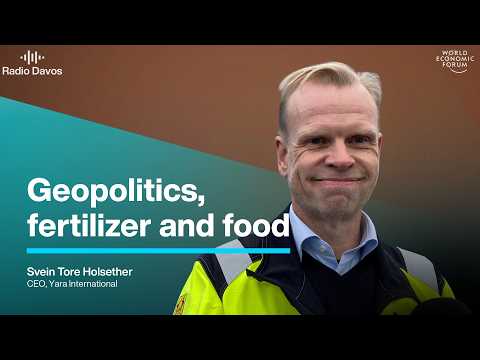
Geopolitics’ impact on farming and food, with the CEO of fertilizer giant Yara
World Economic Forum
Summary
Yara International CEO Svein Tore Holsether joins the World Economic Forum's Linda Lacina to examine how geopolitical conflicts and extreme weather threaten global food supplies. While energy dominates headlines during the Strait of Hormuz crisis, roughly 30% of traded urea nitrogen fertilizer passes through that same waterway. Because half of global food production relies on fertilizer, shipping bottlenecks and volatile energy costs quickly hit farmers worldwide. Meanwhile, Ukrainian growers who braved mined fields to harvest higher yields in 2026 now face infrastructure and vessel attacks that block crop sales.
To cope with six years of continuous supply shocks, Yara redesigned its manufacturing plants across 60 countries to flex production as energy prices fluctuate. On the farm, Holsether argues that cutting the food system's roughly 30% share of global greenhouse gas emissions requires keeping farmers profitable so they can reinvest. Technologies like tractor-mounted nutrient sensors, heat-stress biostimulants, satellite smartphone agronomy, and artificial intelligence can boost yields while lowering emissions, provided leaders at the upcoming COP climate talks prioritize food affordability.
How time-sensitive the topic is: Developing story
By the numbers
50%: Around half of global food production directly results from applying fertilizer in the field. (Mentioned at 9:56)
30%: Roughly 30% of traded urea nitrogen fertilizer volume passes through the Strait of Hormuz. (Mentioned at 4:16)
121 years: Age of Yara International, which was founded in 1905 to extract nitrogen from the air. (Mentioned at 2:26)
60 countries: Number of countries in which Yara International operates. (Mentioned at 2:46)
140 countries: Number of countries where Yara International sells its fertilizer products. (Mentioned at 2:48)
6 years: Duration of continuous emergency conditions Yara has navigated since the start of the COVID-19 pandemic. (Mentioned at 4:56)
30%: Estimated share of global greenhouse gas emissions that come from the food system. (Mentioned at 13:03)
Questions this video answers
How does the Strait of Hormuz crisis affect global food prices and fertilizer supply?
About 30% of globally traded urea nitrogen fertilizer passes through the Strait of Hormuz alongside major energy shipments. When conflict interrupts or delays vessels in that waterway, farmers worldwide face fertilizer shortages and higher energy-driven input costs, directly impacting food availability and affordability.
Svein Tore Holsether, 2:22 to 4:51
From this keypoint: Hormuz Disruption Threatens Global Fertilizer Flow
What percentage of the world's food production depends on fertilizer?
Around half of all food produced globally is a direct result of fertilizer and plant nutrition applied in farmers' fields. Because plants require balanced nutrients to grow, agriculture cannot simply discontinue fertilizer use without causing severe drops in global food supply.
Svein Tore Holsether, 8:11 to 11:23
From this keypoint: Precision Tractor Sensors Cut Fertilizer Waste
How do fertilizer manufacturers cope with volatile energy prices?
Producing synthetic fertilizer requires massive amounts of energy, making manufacturers vulnerable to price spikes. Yara redesigned its plants and trained shop-floor operators to flex production down when energy costs surge and ramp output up when energy prices drop, while shifting volume across its 60-country network.
Svein Tore Holsether, 4:52 to 8:11
From this keypoint: Holsether on Flexing Plants for Energy Volatility
Can precision agriculture reduce the amount of fertilizer farmers use?
Yes, tractor-mounted N-sensors can read crop nutrient needs directly in front of the tractor and automatically adjust the fertilizer spreader behind it. This applies less fertilizer where soil is rich and more where needed, lowering total consumption while producing a more even harvest.
Svein Tore Holsether, 8:11 to 11:23
From this keypoint: Precision Tractor Sensors Cut Fertilizer Waste
What share of global greenhouse gas emissions comes from the food system?
Yara CEO Svein Tore Holsether estimates that roughly 30% of global greenhouse gas emissions originate from the food system. However, because farmers are also heavily impacted by extreme weather and low margins, they must be profitable before they can reinvest in lower-emission practices.
Svein Tore Holsether, 11:23 to 14:00
From this keypoint: Farmer Profitability Drives Climate Transition
How do biostimulants and healthy soil help farmers survive extreme weather?
Biostimulants help crops tolerate severe heat stress, allowing farmers in drought-hit southern Spain to maintain yields where crops would normally fail. In Kenya, building healthy, nutrient-rich soil improved water retention so effectively that a treated farm survived consecutive drought and flooding while neighboring fields washed away.
Svein Tore Holsether, 14:00 to 17:19
From this keypoint: Biostimulants and Soil Health Protect Harvests
How is the war in Ukraine affecting grain farmers in 2026?
Despite working fields contaminated with landmines, Ukrainian farmers produced a higher crop yield in 2026 than in 2025. However, military attacks on export infrastructure, storage inventories, and shipping vessels have left farmers struggling to sell their harvest, threatening them with financial ruin.
Svein Tore Holsether, 17:19 to 20:06
From this keypoint: Holsether on Farm Bankruptcies and War in Ukraine
What is the fourth agricultural revolution and how does AI play a role?
While the third agricultural revolution used better seeds and inputs to boost yields at the cost of higher emissions, the fourth agricultural revolution uses technology to raise productivity while cutting emissions. Artificial intelligence accelerates this shift by modeling complex interactions between weather patterns, soil health, biodiversity, and water use.
Svein Tore Holsether, 20:06 to 24:01
From this keypoint: AI Accelerates Fourth Agricultural Revolution
How are satellite imagery and smartphones changing agronomy for small farms?
Previously, only large-scale farms could afford to employ an on-site agronomist for expert crop advice. Today, satellites photograph farm fields from orbit and deliver tailored nutrient recommendations straight to a farmer's smartphone at global scale.
Svein Tore Holsether, 24:01 to 27:01
From this keypoint: Satellite Agronomy and Crop Timing Boost Profits
How did Yara International manage its global operations when COVID-19 stopped travel?
Instead of centralizing control at its Oslo headquarters when travel halted, Yara cut reporting requirements to a minimum and trusted local teams across 60 countries. Employees were given three strict priorities: protect site safety, obey regulations, and maximize fertilizer production and delivery to farmers.
Svein Tore Holsether, 27:01 to 29:48
From this keypoint: Decentralized Leadership During Global Crises
Credible AI™ signals
Confidence: Executive Industry Account. Svein Tore Holsether provides first-hand operational insight from managing a global fertilizer manufacturer across 60 countries. While trade statistics like the 30% urea volume through Hormuz are well-grounded, specific agricultural outcomes rely on unverified company case studies from Kenya, Spain, and China.
Bias: Corporate Agritech Optimism. The conversation reflects the perspective of a major fertilizer CEO speaking on a World Economic Forum platform. It naturally frames precision chemical nutrition, corporate biologicals, and artificial intelligence as the primary solutions to food insecurity and climate change while omitting critiques of industrial agriculture.
Originality (74%): First-Hand Supply Insights. Examining the Strait of Hormuz shock through the lens of nitrogen fertilizer rather than crude oil offers a distinct angle on geopolitical risk. First-hand anecdotes from Ukrainian, Kenyan, and Chinese farms add concrete operational texture to broad macroeconomic themes.
Depth (72%): Practical Supply Chain Focus. The interview effectively connects maritime choke points and energy price volatility to plant-level manufacturing flexibility and farm profitability. However, the format remains a friendly executive profile without tough questioning on Yara's own emissions footprint or pricing margins.
Key points (10)
Short (8 min): key points 1, 2 and 10
Medium (14 min): key points 1, 2, 4, 6 and 10
Relaxed (30 min): all 10 key points
1. Hormuz Disruption Threatens Global Fertilizer Flow
Timestamp: 00:02:22 to 00:04:51 (2 min)
Speaker: Svein Tore Holsether
Svein Tore Holsether explains that while global trade lifted billions out of famine, supply chain disturbances in one region spill straight into food affordability elsewhere. Because roughly 30% of traded urea nitrogen fertilizer passes through the Strait of Hormuz, delays there impact farmers worldwide. The crisis demonstrates that the global food system remains too fragile to absorb major geopolitical shocks.
Impact: High. Why it matters: Frames the Strait of Hormuz not merely as an oil bottleneck but as a direct threat to global harvest yields and food prices.
“Both because of energy going through the Strait of Hormuz is also one of the most important shipping lanes for fertilizer, nitrogen fertilizer, urea. About 30% of the traded volume goes through the Strait of Hormuz.”
In the video: Svein Tore Holsether, at 4:04
Neutral: Linda Lacina
2. Holsether on Flexing Plants for Energy Volatility
Timestamp: 00:04:52 to 00:08:11 (3 min)
Speaker: Svein Tore Holsether
Following six years of continuous emergencies from COVID to Russia's invasion of Ukraine and the Hormuz crisis, Yara moved away from relying purely on low-cost rules-based global trade. Because fertilizer manufacturing consumes immense energy, Yara redesigned its plants and engaged shop-floor operators to flex production down when energy prices spike and up when costs fall. Operating across 60 countries allows the company to shift production across its global network while helping farmers maximize every kilo of nutrient.
Impact: High. Why it matters: Illustrates how heavy industrial manufacturers must trade pure cost efficiency for operational flexibility to survive energy and trade shocks.
“Also, redesigning our plants to be able flex much more than they did, because to produce fertilizer, you need large amounts of energy and when we see how energy cost has fluctuated, we need to be able to deal with that”
In the video: Svein Tore Holsether, at 6:59
Neutral: Linda Lacina
3. Precision Tractor Sensors Cut Fertilizer Waste
Timestamp: 00:08:11 to 00:11:23 (3 min)
Speaker: Svein Tore Holsether
Sourcing raw plant nutrients requires navigating conflict zones and adapting factory processes to handle differing material characteristics. While agriculture cannot transition away from fertilizer entirely because it directly supports roughly half of global food production, farmers can apply nutrients far more precisely. Tractor-mounted N-sensors read crop needs ahead of the vehicle and adjust the spreader behind it, reducing total fertilizer consumption while creating a more uniform harvest.
Impact: Medium. Why it matters: Clarifies that a fertilizer transition means precision application rather than elimination, aligning lower input use with consistent crop yields.
“Just a few weeks ago, I was in the field of one farmer that uses our sensor on top of the tractor is called an end sensor. That sensor reads the field in front of the tractor to see, okay, so how much nutrient is needed?”
In the video: Svein Tore Holsether, at 10:33
Neutral: Linda Lacina
4. Farmer Profitability Drives Climate Transition
Timestamp: 00:11:23 to 00:14:00 (3 min)
Speaker: Svein Tore Holsether
Svein Tore Holsether warns that volatile energy costs and extreme weather events like sequential droughts and floods have turned once-a-century shocks into an annual reality for farmers. He estimates that about 30% of global greenhouse gas emissions originate from the food system, yet farmers are also among the hardest hit by climate change. Because unprofitable farmers cannot reinvest in sustainable practices, ensuring farm profitability is essential for both reducing emissions and growing more food.
Impact: High. Why it matters: Links agricultural decarbonization directly to farm balance sheets, arguing that green transitions fail when growers cannot afford to reinvest.
“I think about 30% of global emissions come from the food system, and the farmers are the ones that are hardest hit, or one of the occupations hardest hit by climate change.”
In the video: Svein Tore Holsether, at 13:03
Neutral: Linda Lacina
5. Biostimulants and Soil Health Protect Harvests
Timestamp: 00:14:00 to 00:17:19 (3 min)
Speaker: Svein Tore Holsether
To help farmers maximize profit per kilo of nutrient during extreme weather, Yara is investing heavily in biostimulants. In southern Spain, agronomists applied biological products to help crops endure severe heat stress and drought rather than suffering total yield loss. Similarly, outside Nairobi, Kenya, a farm treated to build healthy, nutrient-rich soil retained its crop through consecutive drought and heavy flooding while neighboring untreated fields were completely washed away.
Impact: Medium. Why it matters: Demonstrates how biological inputs and soil health management act as physical insurance against catastrophic weather swings.
“And where our agronomists in the field of the farmers, they work with them on bio-stimulants that are helping to put the right products and the right biologicals into the ground in order to help the crops to deal with the impact of heat stress”
In the video: Svein Tore Holsether, at 15:04
Neutral: Linda Lacina
6. Holsether on Farm Bankruptcies and War in Ukraine
Timestamp: 00:17:19 to 00:20:06 (3 min)
Speaker: Svein Tore Holsether
Svein Tore Holsether describes the emotional toll on struggling farmers who view their land not just as a business but as a multi-generational family legacy threatened by bankruptcy. Speaking in the fall of 2026, he notes that Ukrainian farmers risked their lives working mined fields to produce higher crop yields than in 2025. However, subsequent attacks on Ukrainian infrastructure, inventories, and export vessels have left those farmers struggling to sell their harvest, threatening both their livelihoods and global food supplies.
Impact: High. Why it matters: Highlights the human and economic vulnerability of food producers caught between financial insolvency and active military targeting of export logistics.
“This year, they have, against all odds, been able to produce a higher crop yield than last year. Only now to be faced with attacks on infrastructure, on inventories, vessels, so that they're struggling now to sell their crops and to get the revenue.”
In the video: Svein Tore Holsether, at 19:21
Neutral: Linda Lacina
7. AI Accelerates Fourth Agricultural Revolution
Timestamp: 00:20:06 to 00:24:01 (4 min)
Speaker: Svein Tore Holsether
While the third agricultural revolution boosted farm yields through better seeds and chemical inputs, it also increased greenhouse gas emissions. Today's fourth agricultural revolution must simultaneously raise food production for a growing population and lower emissions, a task too complex for any single government or company. Artificial intelligence provides the modeling power to combine weather patterns, soil health, human nutrition, water use, and biodiversity into science-driven farming decisions.
Impact: Medium. Why it matters: Positions artificial intelligence as the essential coordinating engine needed to solve the dual mandate of higher agricultural output and lower carbon emissions.
“We are now in the fourth agricultural revolution that is driven by technology, but now that is being accelerated significantly because of artificial intelligence and the power of these models in order to drive productivity and to really accelerate this agricultural revolution.”
In the video: Svein Tore Holsether, at 21:22
Neutral: Linda Lacina
8. Satellite Agronomy and Crop Timing Boost Profits
Timestamp: 00:24:01 to 00:27:01 (3 min)
Speaker: Svein Tore Holsether
Modern technology scales agronomic expertise by delivering satellite field imagery and nutrient recommendations directly to any farmer's smartphone, eliminating the need to employ an on-site agronomist. In China, a former financial auditor turned melon farmer combined financial discipline with targeted crop nutrition to grow larger, sweeter melons. By applying nutrients in the right sequence, she brought her harvest to market two weeks ahead of competitors, capturing higher prices while lowering emissions.
Impact: Medium. Why it matters: Shows how digital agronomy democratizes expert advice for smaller farms and translates precise nutrient timing into premium market pricing.
“I mean, who would have thought just a few years ago that you can actually use images from a satellite above Earth taking pictures of a field, of a farm field, and then be able to give recommendation on what nutrients you should put in that field.”
In the video: Svein Tore Holsether, at 24:47
Neutral: Linda Lacina
9. Decentralized Leadership During Global Crises
Timestamp: 00:27:01 to 00:29:48 (3 min)
Speaker: Svein Tore Holsether
When the COVID-19 pandemic halted international travel six years ago, Yara leadership in Oslo resisted the instinct to impose strict central control over its operations in 60 countries. Instead, Svein Tore Holsether cut daily reporting requirements to a minimum and empowered local teams with three clear rules: protect site safety, follow regulations, and maximize fertilizer production and delivery. Trusting local employees who understood the company's purpose enabled the organization to maintain global food supply lines under extreme pressure.
Impact: Medium. Why it matters: Offers a concrete crisis-management framework: replace bureaucratic reporting with decentralized autonomy anchored by a clear organizational purpose.
“And the immediate response that would be extreme control from the headquarter in order to compensate for the lack of travelling. That was the instinct. We did the opposite.”
In the video: Svein Tore Holsether, at 28:20
Neutral: Linda Lacina
10. Holsether Urges COP to Prioritize Food Security
Timestamp: 00:29:48 to 00:32:18 (3 min)
Speaker: Svein Tore Holsether
Looking ahead to the upcoming COP climate summit, Svein Tore Holsether argues that food availability, food affordability, and farmer profitability must take center stage. He suggests the food system is often overlooked in policy discussions because its supply chains are highly fragmented across diverse regional realities. Yet as the 2026 Strait of Hormuz disruption proves, shocks in one waterway impact consumers and growers from New York City to Brazil and Vietnam.
Impact: High. Why it matters: Calls on global climate negotiators to elevate agricultural resilience and farm economics to the top of the international climate agenda.
“For the upcoming COP, food availability, food affordability needs to really take the centre stage here.”
In the video: Svein Tore Holsether, at 30:00
Neutral: Linda Lacina
Conflicts of interest (1)
Yara CEO Promoting Corporate Agritech Solutions
Commercial conflict, Medium severity
Svein Tore Holsether is the Chief Executive Officer of Yara International, a commercial producer of synthetic fertilizers, biostimulants, and precision farming sensors.
Sources: Svein Tore Holsether
Significance: His assessment of global food security and climate adaptation emphasizes purchasing targeted crop nutrition, biological products, and proprietary sensor hardware that directly drive Yara's revenue.
Key sources
Svein Tore Holsether: CEO of Yara International
Linda Lacina: Interviewer at World Economic Forum
Robin Pomeroy: Podcast Host at World Economic Forum
Who's in this
Yara International
World Economic Forum
Strait of Hormuz
Ukraine
COP
Also mentioned
Radio Davos (First mentioned at 0:13)
New York (First mentioned at 2:04)
Russia (First mentioned at 5:08)
Spain (First mentioned at 14:57)
Kenya (First mentioned at 15:58)
Nairobi (First mentioned at 15:58)
China (First mentioned at 25:35)
Oslo (First mentioned at 28:32)
Meet the Leader (First mentioned at 1:22)
Agenda Dialogues (First mentioned at 1:22)
Red Sea (First mentioned at 4:40)
Brazil (First mentioned at 31:53)
Vietnam (First mentioned at 31:59)
Davos (First mentioned at 32:29)
Taz Kelleher (First mentioned at 32:39)
This analysis was generated by skim (skim.plus), an AI-powered content analysis platform by Credible AI. Scores and classifications represent the platform's AI-generated assessment and should be considered alongside other sources.