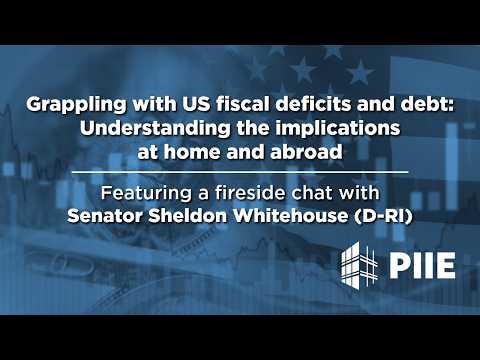
Credible AI™ signals
Confidence: Highly Credible. The video features leading economists and a senior policymaker from reputable institutions (Peterson Institute, Brookings, IMF, Harvard) discussing complex fiscal policy. The analysis is data-driven, referencing CBO baselines and market interest rates, and acknowledges uncertainties and different perspectives. The speakers demonstrate deep expertise and a nuanced understanding of the subject matter.
Bias: Slightly Leaning. While presenting data and economic principles, the discussion leans towards advocating for fiscal responsibility and deficit reduction. The framing of certain policy choices (e.g., tax cuts) and the emphasis on potential crises suggest a persuasive undertone, though balanced by acknowledging different viewpoints and the complexity of political action.
Originality (65%): Insightful Analysis. The video offers a structured analysis of US fiscal deficits and debt, going beyond surface-level numbers. It contextualizes current debt levels against historical data, explores different projection baselines (CBO vs. preferred), and critically examines the assumptions behind forecasts. The discussion on potential drivers (aging, tax cuts) and forcing events (Social Security/Medicare exhaustion) provides a comprehensive, though not entirely novel, perspective.
Depth (85%): Deep Dive. The speakers delve into the intricacies of fiscal policy, dissecting debt-to-GDP ratios, deficit flows, interest rate impacts, and the assumptions underpinning economic forecasts. They differentiate between various baselines, discuss the role of productivity growth (AI), and explore the nuances of policy choices and their political feasibility. The analysis considers both linear and non-linear dynamics of debt and potential crisis scenarios.
Key points (20)
- Short (21 min): key points 1, 6, 8, 11, 13, 15 and 20
- Medium (45 min): key points 1, 2, 4, 6, 7, 8, 9, 10, 11, 12, 13, 14, 15, 16, 18, 19 and 20
- Relaxed (54 min): all 20 key points
1. Jason Furman: US Debt is Unsustainable
Timestamp: 00:11:22 to 00:19:22 (8 min)
The US fiscal situation is serious, with debt held by the public at 100% of GDP and deficits stabilizing around 6% of GDP, which is unsustainable. Projections show debt continuing to rise, necessitating significant policy adjustments. While historical precedents exist for high debt, the current trajectory and deficit levels are concerning, especially compared to other advanced economies.
Impact: High. Why it matters: This unsustainable trajectory could lead to economic instability and reduced fiscal flexibility, impacting future generations and national security.
For: Jason Furman, Aviva Aron-Dine, Oya Celasun
Neutral: Maurice Obstfeld
2. Furman: The Nuance in Debt Projections
Timestamp: 00:19:22 to 00:24:22 (5 min)
Standard CBO projections may underestimate future debt due to optimistic assumptions about interest rates and productivity growth. Adjusting for current market interest rates and more realistic policy changes (like expiring tax cuts) leads to a similar, unsustainable debt path. Faster productivity growth from AI could help, but relying on it for fiscal stability is a risky gamble.
Impact: Medium. Why it matters: Underestimating future debt burdens due to overly optimistic forecasts can lead to delayed action and more severe consequences when the reality sets in.
For: Jason Furman, Aviva Aron-Dine
Neutral: Oya Celasun
3. Furman: The Risk of Non-Linear Dynamics
Timestamp: 00:21:26 to 00:24:26 (3 min)
While gradual increases in debt may have manageable consequences (like termites), the greater concern lies in non-linear dynamics and potential fiscal crises. The trust event serves as a reminder that market perceptions and institutional trust are critical, and crises can emerge unexpectedly, irrespective of the precise debt-to-GDP ratio.
Impact: High. Why it matters: The possibility of sudden fiscal crises, driven by market panic or loss of confidence, represents a significant, unpredictable risk that policy must consider beyond gradual debt accumulation.
For: Jason Furman
Neutral: Maurice Obstfeld, Aviva Aron-Dine, Oya Celasun
4. Furman: Social Security and Medicare as Catalysts
Timestamp: 00:24:02 to 00:26:02 (2 min)
The impending exhaustion of Social Security and Medicare trust funds (2032 and 2033 respectively) represents a significant fiscal gap (1.75% of GDP) and a potential 'accounting forcing event' that could compel necessary reforms.
Impact: High. Why it matters: Addressing the solvency of these critical programs offers a concrete pathway to fiscal sustainability, providing a much-needed impetus for comprehensive budget reform.
For: Jason Furman
Neutral: Aviva Aron-Dine, Oya Celasun
5. Aviva Aron-Dine: The Political Roadblocks
Timestamp: 00:25:38 to 00:29:36 (4 min)
Achieving the necessary deficit reduction (around 2% of GDP or $8 trillion over 10 years) is politically challenging today, unlike a decade ago. While the required adjustments are plausible, enacting them faces significant hurdles. The current political climate makes it difficult to imagine substantial deficit reduction packages passing in the near future.
Impact: High. Why it matters: The political difficulty in enacting fiscal reforms means the US is likely to continue on an unsustainable debt path, increasing the risk of future economic crises.
For: Aviva Aron-Dine, Maurice Obstfeld
Neutral: Jason Furman, Oya Celasun
6. Arguments for Deficit Reduction
Timestamp: 00:31:28 to 00:31:55 (1 min)
Prioritizing deficit reduction is crucial to avoid future fiscal crises that could force drastic policy changes and to ensure the capacity to respond to economic downturns or unforeseen events like recessions or pandemics. Acting sooner rather than later allows for more considered policy decisions.
Impact: High. Why it matters: This argument frames deficit reduction as a proactive measure for economic stability and resilience, essential for long-term fiscal health.
For: Maurice Obstfeld
Neutral: Jason Furman, Aviva Aron-Dine
7. Competing Fiscal Priorities
Timestamp: 00:34:01 to 00:35:51 (2 min)
Significant fiscal resources are allocated to competing priorities, such as healthcare expansion and tariff reduction, which offer tangible benefits like reduced poverty and improved trade relations. These priorities often outweigh the marginal benefits of deficit reduction, especially when considering the scale of spending required.
Impact: High. Why it matters: This highlights the difficult trade-offs policymakers face, where deficit reduction must be weighed against immediate social and economic benefits offered by alternative policies.
For: Jason Furman
Neutral: Maurice Obstfeld, Aviva Aron-Dine, Oya Celasun, Senator Sheldon Whitehouse, Kimberly Clausing
8. Europe's Fiscal Challenges
Timestamp: 00:40:19 to 00:42:21 (2 min)
Europe faces escalating fiscal pressures from increased defense spending commitments, the need for energy security, rising interest bills on elevated debt, and the persistent impact of aging populations on healthcare and pension costs, projecting a significant increase in debt-to-GDP ratios.
Impact: High. Why it matters: This underscores the multifaceted and long-term nature of fiscal sustainability challenges in Europe, requiring substantial adjustments to avoid unsustainable debt trajectories.
For: Aviva Aron-Dine
Neutral: Maurice Obstfeld, Jason Furman, Oya Celasun
9. Required Fiscal Adjustment in Europe
Timestamp: 00:42:42 to 00:44:45 (2 min)
To stabilize debt-to-GDP ratios, particularly for countries exceeding 90%, Europe needs substantial deficit reductions, estimated at around 5% of GDP over five years. Such adjustments are historically rare outside of crisis periods and require significant political will, as delaying action only increases the future adjustment burden.
Impact: High. Why it matters: This quantifies the scale of the fiscal challenge in Europe, emphasizing the difficulty and urgency of implementing corrective measures to ensure long-term financial stability.
For: Aviva Aron-Dine
Neutral: Maurice Obstfeld, Jason Furman, Oya Celasun
10. Growth-Enhancing Reforms as a Solution
Timestamp: 00:46:16 to 00:48:14 (2 min)
A package of growth-enhancing structural reforms, including market liberalization and improved governance, could significantly boost European productivity and GDP per capita, thereby easing the fiscal adjustment needed. While not a complete solution, these reforms can make the fiscal challenge more manageable.
Impact: High. Why it matters: This proposes a dual strategy where economic growth reforms complement fiscal consolidation, offering a more sustainable path to addressing debt challenges.
For: Aviva Aron-Dine
Neutral: Maurice Obstfeld, Jason Furman, Oya Celasun
11. The Global Ripple of US Fiscal Policy
Timestamp: 01:00:01 to 01:02:08 (2 min)
The recent run-up in global bond yields is a correlated, global phenomenon, not solely attributable to US fiscal policy, but US fiscal policy is a significant underlying factor. While the last 20 years of debt accumulation might plausibly explain higher interest rates, the recent surge in yields over the past three months is less likely to be solely due to debt, suggesting other macro factors like central bank responses to inflation are at play.
Impact: Medium. Why it matters: This highlights the interconnectedness of global financial markets and the complex interplay of factors influencing interest rates, moving beyond a simple US-centric view.
For: Aviva Aron-Dine
12. AI Bubble: A Mild Recession or Systemic Crisis?
Timestamp: 01:03:04 to 01:05:13 (2 min)
A potential AI bubble popping would likely lead to a mild recession rather than a global financial crisis, akin to the dot-com bubble of 2000. Unlike the 2008 crisis where perceived safe assets lost value, AI investments are already understood as risky. The primary concern is whether AI will deliver sustained productivity growth, which is crucial for long-term fiscal and economic health, rather than short-term financial market fluctuations.
Impact: Medium. Why it matters: This perspective reframes the potential impact of an AI bubble, suggesting a less catastrophic outcome than a financial crisis, but emphasizes the critical need for actual productivity gains to justify valuations.
For: Aviva Aron-Dine
Neutral: Kimberly Clausing
13. US Fiscal Irresponsibility: A Systemic Flaw
Timestamp: 01:19:58 to 01:24:42 (5 min)
The United States suffers from a lack of fiscal responsibility due to an institutional problem with the budget committee, which is designed not to address fiscal issues, exacerbated by the Senate's decision that budget reconciliation no longer needs to be deficit-reducing. This, coupled with a persistent desire for tax cuts, particularly for corporations and the wealthy, has led to a dramatic decrease in federal revenue as a percentage of GDP.
Impact: High. Why it matters: This points to deep-seated structural issues within the US legislative process that actively hinder fiscal discipline, creating a cycle of increasing debt and underfunded public services.
For: Sheldon Whitehouse
14. Tax Expenditures: A Hidden Spending Problem
Timestamp: 01:25:15 to 01:27:21 (2 min)
The US relies heavily on 'tax expenditures'—spending through the tax code—which are often overlooked but represent significant fiscal commitments. Unlike appropriations, these provisions, often driven by special interests, are harder to eliminate as they don't expire and are not subject to regular review, contributing substantially to the deficit.
Impact: Medium. Why it matters: This highlights a critical blind spot in fiscal oversight, where 'tax spending' operates with less scrutiny than direct appropriations, enabling persistent deficits and benefiting specific interests.
For: Sheldon Whitehouse
Neutral: Steve
15. The Perilous Path of Economic Inequality and Climate Risk
Timestamp: 01:31:02 to 01:33:24 (2 min)
Extreme economic inequality, exacerbated by tax policies favoring the wealthy, coupled with the looming threat of climate-driven economic crashes (like insurance collapse), creates a dangerous social and political environment. This could lead to social dissension and potentially more extreme leadership, underscoring the urgent need to rebalance the social contract and restore a sense of shared national purpose before the situation deteriorates further.
Impact: High. Why it matters: This paints a stark picture of the potential societal consequences of unchecked inequality and climate risk, framing fiscal and tax policy as critical tools for maintaining social order and stability.
For: Sheldon Whitehouse
16. Corporate Tax: A Tool for Inequality and AI
Timestamp: 01:33:37 to 01:36:38 (3 min)
The corporate tax system can be a powerful tool to address both economic inequality and the potential disruptions from AI. By increasing corporate tax rates, the government can capture more revenue from profitable companies, including those benefiting from AI advancements, and ensure that the wealthiest individuals and corporations contribute their fair share, thereby mitigating the 'looting' of the economy by the rich.
Impact: High. Why it matters: This proposes a dual-purpose solution for corporate taxation, linking it directly to wealth redistribution and the economic challenges posed by emerging technologies like AI.
For: Steve
Neutral: Sheldon Whitehouse
17. Combating Tax Avoidance: International Cooperation
Timestamp: 01:35:38 to 01:38:05 (2 min)
Addressing tax avoidance through offshore havens and profit shifting is essential to prevent billionaires from paying lower tax rates than plumbers and to ensure fair competition for domestic companies. International cooperation, such as the Pillar 2 agreement for a minimum corporate tax, is crucial, though its weakening is unfortunate. Making tax evasion as unpopular as child labor would incentivize countries to eliminate these hiding spots for wealth.
Impact: High. Why it matters: This emphasizes the critical role of international tax reform and global cooperation in closing loopholes, ensuring tax fairness, and preventing the erosion of public trust and revenue.
For: Steve
18. Obstfeld: Climate Club as a Fiscal Tool
Timestamp: 01:38:35 to 01:40:21 (2 min)
Maurice Obstfeld suggests that a 'climate club' with a minimum carbon price, similar to international tax agreements, could facilitate global cooperation on climate change and potentially serve as a revenue-generating mechanism, addressing both climate and fiscal challenges.
Impact: High. Why it matters: This proposal offers a novel approach to tackling climate change by linking it to fiscal policy, potentially incentivizing countries to adopt carbon pricing and fostering international collaboration.
Neutral: Jason Furman, Aviva Aron-Dine, Oya Celasun, Senator Sheldon Whitehouse, Kimberly Clausing, Sheldon Whitehouse
19. Furman: The Immense Subsidy of Pollution
Timestamp: 01:40:35 to 01:42:03 (1 min)
Jason Furman highlights that the US provides over $700 billion annually in subsidies to the fossil fuel industry through its 'freedom to pollute,' arguing that this massive financial incentive fuels the industry's extensive political influence operations, which are arguably its most lucrative aspect. This situation is morally and economically inexcusable, akin to dumping waste into a neighbor's yard.
Impact: High. Why it matters: This staggering figure underscores the immense economic distortion caused by fossil fuel subsidies, revealing how political power, rather than economic principle, sustains the industry and hinders necessary environmental action.
Neutral: Maurice Obstfeld, Jason Furman, Oya Celasun, Kimberly Clausing, Sheldon Whitehouse
20. Obstfeld: The Urgency of Fiscal Responsibility
Timestamp: 01:50:19 to 01:52:03 (2 min)
Maurice Obstfeld likens the US approach to fiscal deficits to a blindfolded person walking off a diving board, warning that the transition from gradual decline to catastrophic collapse can be abrupt and unpredictable. He stresses the importance of budget committee reforms to ensure responsible oversight and prevent the problem from being ignored.
Impact: High. Why it matters: This vivid analogy highlights the extreme vulnerability of the US economy to fiscal irresponsibility, underscoring the critical need for proactive policy measures and structural reforms to avert a potential crisis.
Neutral: Jason Furman, Aviva Aron-Dine, Oya Celasun, Senator Sheldon Whitehouse, Kimberly Clausing, Sheldon Whitehouse
This analysis was generated by skim (skim.plus), an AI-powered content analysis platform by Credible AI. Scores and classifications represent the platform's AI-generated assessment and should be considered alongside other sources.