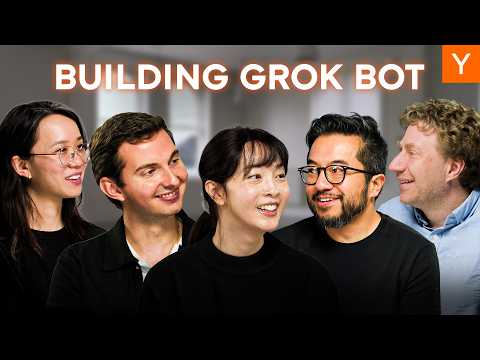
Y Combinator's Grok Bot: What Changes When You Can Build AI Teammates: skim's analysis identifies 13 key moments, with 2 potential conflicts of interest flagged. Grok Bot creators Lauren Tan and Roman Ugarte join Lightcone hosts to examine how autonomous AI teammates are changing software engineering and company operations.
Category: Tech. Format: Interview. YouTube video analyzed by skim.
skim AI Analysis
Credibility assessment: Practitioner First-Hand Account. Lauren Tan and Roman Ugarte provide direct, detailed operational accounts of building Grok Bot and running high-volume agent workflows, complete with concrete architectural examples. Claims regarding product reception and customer impact are self-reported by the product creators without external audit.
Bias assessment: AI-Native Builder Optimism. The hosts and guests share a strong conviction that autonomous AI agents and software factories will rapidly transform every corporate function. While they candidly discuss current failure modes like token costs and social context gaps, the conversation actively promotes Grok Bot and Y Combinator.
Originality: 86% — Cutting-Edge Workflow Insights. Rather than speaking in abstract AI platitudes, the discussion offers rare, granular mechanics of how an engineer merges over 4,000 pull requests monthly using Slack-based outer loops, open-source skill packs like Pstack, and static analysis guardrails.
Depth: 84% — Deep Architectural Breakdown. The speakers move seamlessly from high-level organizational theory to specific technical trade-offs, such as replacing expensive multi-million-token adversarial LLM code reviews with zero-token compiler lint rules and Electron thread import constraints.
Key Points (13)
1. Roman Ugarte on Building Grok Bot in 7 Weeks
Timestamp: 00:00:57 to 00:03:36
Roman Ugarte explains that his team incubated Grok Bot as an internal prototype in seven weeks to bring autonomous engineering agent workflows to non-engineers. They designed the product around three principles: organizing work around persistent bot identities rather than chats, giving bots their own computers and human-equivalent tools, and keeping them always on via proactive loops. Internal users across the technical spectrum quickly adopted the tool before its public launch.
Significance (High): Shifting the core AI primitive from ephemeral chat threads to persistent, tool-equipped bot identities lowers the barrier for non-technical workers to run continuous background automations.
Sources in support: Roman Ugarte (Core Team, Grok Bot), Lauren Tan (Core Team Engineer, Grok Bot)
2. Automating Marketing and Outer-Loop Slack Work
Timestamp: 00:03:36 to 00:06:49
Roman Ugarte reports that users progressively trust Grok Bot with larger responsibilities, citing their internal performance marketing team giving a bot its own ad logins and budget to coordinate A/B tests with a design bot. Lauren Tan adds that embedding Grok Bot directly into Slack and X creates an ergonomic outer loop that eliminates manually copying bug reports and context into coding agents. Bringing bots into existing communication channels lets engineers collaborate with AI like human coworkers.
Significance (Medium): Integrating agents directly into team messaging platforms eliminates the manual context-gathering bottleneck that previously slowed down developer-agent workflows.
Sources in support: Roman Ugarte (Core Team, Grok Bot), Lauren Tan (Core Team Engineer, Grok Bot)
3. Specialist Bot Teams vs Single Super-Agents
Timestamp: 00:06:49 to 00:10:39
Lauren Tan explains that users can structure Grok Bot horizontally by customer or vertically by specialist role, matching how their own brains compartmentalize work. After a host notes that small businesses rapidly adopt Grok Bot to fill hiring gaps like bookkeeping, Roman Ugarte argues that dedicating separate bots to specific problems mirrors hiring obsessed human specialists. Domain experts can then manage these focused bots like apprentices rather than relying on one omniscient AI.
Significance (Medium): Scoping individual bots to narrow contexts and specific skill files prevents context bloat and aligns AI management with traditional departmental ownership.
Sources in support: Roman Ugarte (Core Team, Grok Bot), Lauren Tan (Core Team Engineer, Grok Bot), YouTube: Y Combinator (Host Channel, The Lightcone)
4. Multiplayer Team Bots Turn Sales Into Factories
Timestamp: 00:10:39 to 00:14:46
Roman Ugarte notes that launching multiplayer team bots two weeks prior enabled builder-minded employees across departments to create shared automations for their peers. Lauren Tan illustrates this non-technical software factory by showing how their sales team built shared specialist bots to research leads and handle operational deal workflows. Centralizing a team's best practices into shared expert bots allows the entire organization to benefit from encoded domain skills.
Significance (High): Multiplayer team bots extend the software factory paradigm beyond engineering, allowing sales and support teams to codify and scale their operational best practices.
Sources in support: Roman Ugarte (Core Team, Grok Bot), Lauren Tan (Core Team Engineer, Grok Bot)
5. Solving Bot Identity, Social Context, and Auth
Timestamp: 00:14:46 to 00:18:37
Roman Ugarte highlights that putting bots into multiplayer Slack threads exposes a lack of social awareness, as models do not natively know which human holds decision-making authority. To solve authentication and permissions without reinventing enterprise software, the team models bot onboarding after human hiring: granting each bot a computer and scoped credentials that expand as it builds trust. A host contrasts this with Y Combinator's open-source Quartermaster bot, which inherits permissions directly from the querying user.
Significance (Medium): Treating AI agents as human employees for authentication and progressive permissioning avoids rebuilding enterprise security infrastructure from scratch.
Sources in support: Roman Ugarte (Core Team, Grok Bot), Lauren Tan (Core Team Engineer, Grok Bot)
Neutral sources: YouTube: Y Combinator (Host Channel, The Lightcone)
6. Bot-to-Bot Collaboration and Progressive Trust
Timestamp: 00:18:37 to 00:22:35
After a host describes Y Combinator's internal bot forum and raises safety concerns about unrefusing obliterated models, Lauren Tan explains that her personal engineering bot, Potato, explicitly collaborates with a specialist Data Bot inside public Slack threads. Roman Ugarte outlines a three-step trust progression for enterprise bots: starting with read-only database or procurement bots in Slack, advancing to end-to-end task execution, and eventually owning full job outcomes. Starting with read-only Slack visibility lets companies verify bot behavior safely.
Significance (Medium): Keeping agent-to-agent communication visible in public Slack channels and starting with read-only database access gives teams an auditable path to trusting autonomous workflows.
Sources in support: Roman Ugarte (Core Team, Grok Bot), Lauren Tan (Core Team Engineer, Grok Bot), YouTube: Y Combinator (Host Channel, The Lightcone)
7. Lauren Tan's 4,000-PR Slack Workflow and Pstack
Timestamp: 00:22:35 to 00:29:01
Prompted on how she scaled from 2,000 to over 4,000 pull requests per month, Lauren Tan demonstrates building an entire feature end-to-end inside a 200-message public Slack thread with her colleague Samantha and her bot Potato. Potato spawns a Cursor cloud agent on its own virtual machine, runs the Grok Bot app, posts video and screenshot artifacts to Slack, and merges its own PR without Tan reading the code. She achieves this reliability by equipping agents with Pstack, her open-source Cursor plugin pack inspired by Gary's Gstack.
Significance (High): Moving feature iteration into public Slack threads where cloud agents post visual artifacts and auto-merge PRs compresses product feedback loops and multiplies individual engineering output.
Sources in support: Roman Ugarte (Core Team, Grok Bot), Lauren Tan (Core Team Engineer, Grok Bot), YouTube: Y Combinator (Host Channel, The Lightcone)
8. Public Slack Workflows Lift Whole Organizations
Timestamp: 00:29:01 to 00:33:44
Gary describes using his Cappy software factory to monitor open-source stacks like Pstack and learn his personal intervention preferences from agent transcripts. Roman Ugarte observes that moving agent interactions from private single-player editors into public Slack threads allows the rest of the company to watch and copy how top power users prompt and orchestrate agents. Lauren Tan notes she keeps personal assistant bots private while putting engineering bots in Slack where collaborative work naturally happens.
Significance (Medium): Running agentic workflows in public company channels creates an organic training loop where non-power users learn advanced prompting and automation by observing peers.
Sources in support: Roman Ugarte (Core Team, Grok Bot), Lauren Tan (Core Team Engineer, Grok Bot), YouTube: Y Combinator (Host Channel, The Lightcone)
9. AI-Native Companies Shift to Goal Specification
Timestamp: 00:33:44 to 00:40:13
Looking toward 2027, Lauren Tan envisions bots having phone numbers, credit cards, and fluid intent interfaces, while Roman Ugarte points out that non-engineering departments lack the compiler checks and centralized codebase context that make software factories work. Discussing Jack Dorsey's three-role AI-native company model, Ugarte argues that as agent execution becomes abundant and cheap, corporate failures will stem from poor goal specification and undefined KPIs rather than execution bandwidth. Builders will increasingly need founder-level clarity to translate user intent into quantifiable objectives.
Significance (High): As autonomous agents commoditize task execution, companies must retool around defining rigorous objective functions and digitizing institutional knowledge that currently lives outside codebases.
Sources in support: Roman Ugarte (Core Team, Grok Bot), Lauren Tan (Core Team Engineer, Grok Bot), YouTube: Y Combinator (Host Channel, The Lightcone)
10. Teaching Agents to Empirically Check Their Work
Timestamp: 00:40:13 to 00:43:56
Lauren Tan demonstrates that the minimal viable loop for autonomous coding is teaching an agent to run its own code empirically, capture CPU traces and performance metrics, and test the application like a real user. While self-checking guarantees functional correctness, engineers must still engineer the loop to produce resource-efficient, high-quality code. Once this inner verification loop is solid, teams can attach outer-loop triggers like monitoring alerts so bots automatically reproduce and fix regressions without human babysitting.
Significance (High): Giving coding agents the tools to empirically execute applications and read performance traces closes the verification loop, shifting engineers from babysitting single agents to orchestrating fleets.
Sources in support: Lauren Tan (Core Team Engineer, Grok Bot), YouTube: Y Combinator (Host Channel, The Lightcone)
11. Codebase Guardrails Beat 50M-Token LLM Reviews
Timestamp: 00:43:56 to 00:52:20
When Gary asks how to reduce his agent code review step from 50 million tokens down to 10 million without missing bugs, Lauren Tan explains why she scaled back multi-model adversarial reviews in Pstack. Because agents lack broader product roadmap context, heavy LLM reviews risk overfitting on abstract perfection for features that may soon be deprecated. Instead, Tan uses an inverted pyramid strategy that invests heavily in codebase architecture, static analysis, and custom dependency graph lint rules—such as forbidding imports between Electron's main and renderer threads—to enforce quality at zero token cost.
Significance (High): Replacing token-heavy LLM code reviews with deterministic compiler checks and architectural lint rules prevents AI slop while drastically cutting inference costs.
Sources in support: Lauren Tan (Core Team Engineer, Grok Bot), YouTube: Y Combinator (Host Channel, The Lightcone)
12. Product Taste and Guarding the User Experience
Timestamp: 00:52:20 to 00:56:29
Roman Ugarte explains that when engineers can easily generate weekend pull requests for every idea, the core bottleneck becomes team alignment and preventing a disjointed product. While Lauren Tan's factory bot Sandy automatically reproduces, fixes, and merges small customer-reported bugs at 3 a.m., the team strictlywithholds user interface changes until extensive internal dogfooding proves strong internal product-market fit. Tan emphasizes that she points her autonomous factories at software maintenance and bug fixing so humans can focus on intentional product design.
Significance (High): Separating autonomous background bug-fixing from human-gated UI changes allows software teams to achieve self-healing reliability without subjecting users to chaotic interface churn.
Sources in support: Roman Ugarte (Core Team, Grok Bot), Lauren Tan (Core Team Engineer, Grok Bot)
13. Lauren Tan's Path from Finance to AI Engineering
Timestamp: 00:56:29 to 00:59:46
Asked how she transitioned from an accounting and finance degree in Australia to working on the React compiler and AI engineering, Lauren Tan credits discovering a passion for logic through Excel and Visual Basic financial modeling. After co-founding an early startup, she blogged publicly on X about learning the Ember JavaScript framework, which led Tom Dale and Leah Silber to invite her to speak at a conference in Portland. She advises builders to build interesting projects and share their learning publicly in a continuous loop.
Significance (Low): Sharing technical learning publicly on social platforms creates compounding career serendipity, even for self-taught developers coming from non-traditional backgrounds.
Sources in support: Lauren Tan (Core Team Engineer, Grok Bot), YouTube: Y Combinator (Host Channel, The Lightcone)
This analysis was generated by skim (skim.plus), an AI-powered content analysis platform by Credible AI. Scores and classifications represent the platform's AI-generated assessment and should be considered alongside other sources.