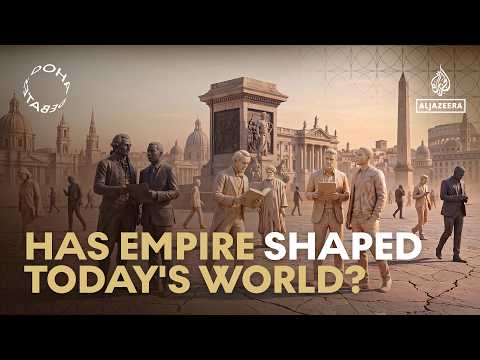
Hosted by Mohamed Hassan on Doha Debates, scholars Gurminder K Bhambra, Ian Almond, and Nigel Biggar join journalist Inaya Folarin Iman to debate the legacy of empire. Bhambra distinguishes land-based empires of incorporation from European overseas empires of extraction, detailing how East India Company tax collection after 1757 contributed to the 1770 Bengal famine and how Indian colonial taxes later helped fund British abolition. Almond argues 19th-century industrial weaponry and post-Bretton Woods financial rules made Western dominance uniquely enduring.
Biggar and Iman counter that empires produced both harms and benefits, pointing to global English, liberal institutions, Royal Navy trade protection, and Britain's fight against Nazi Germany. While Bhambra and Almond back reparations and global economic reform, Biggar and Iman argue trillion-pound reparations would bankrupt Britain and favor domestic political development and foreign aid instead.
How time-sensitive the topic is: Evergreen
By the numbers
300 million Indians: Population of India in 1900 compared to 164,000 Britons, cited by Nigel Biggar to argue British rule required indigenous buy-in. (Mentioned at 7:14)
164,000 Britons: Total number of Britons in India in 1900 alongside 300 million Indians, according to Nigel Biggar. (Mentioned at 7:19)
1 to 20,000 official to Africans: Proportion of colonial official to native Africans in East Africa cited by Nigel Biggar. (Mentioned at 7:33)
30 million people: Population across Bengal, Bihar, and Orissa from whom the East India Company gained tax collection rights after the 1757 Battle of Plassey. (Mentioned at 12:22)
one-third of the population: Share of Bengal's population that Gurminder K Bhambra states died of starvation or related disease during the 1770 famine. (Mentioned at 13:30)
12.5 million Africans: Estimated number of Africans transported across the Atlantic by Europeans from the 1500s to the 1800s, cited by Nigel Biggar and called an underestimate by Gurminder K Bhambra. (Mentioned at 19:10)
17 million Africans: Estimated number of Africans transported by Arabs to the Mediterranean and Middle East, cited by Nigel Biggar and disputed as a vast overestimate across 12 centuries by Gurminder K Bhambra. (Mentioned at 19:29)
4 million slaves: Number of slaves Nigel Biggar states were employed on Fulani slave plantations in northern Nigeria around 1850, matching the American South. (Mentioned at 26:07)
60,000 people: Number of people Nigel Biggar states are employed in Britain by the Indian conglomerate Tata. (Mentioned at 32:54)
12 months: Period between May 1940 and June 1941 during which Nigel Biggar states the British Empire offered Nazi Germany the only military resistance. (Mentioned at 33:25)
Questions this video answers
What is the difference between empires of incorporation and empires of extraction?
Gurminder K Bhambra explains that empires of incorporation, such as the Ottoman, Chinese, and Mughal empires, used violence to expand but granted formal equality to populations once incorporated. Empires of extraction, such as the British, Dutch, and French overseas empires, dominated populations and excluded colonial subjects from governance in the imperial heartland.
Gurminder K Bhambra, 1:36 to 5:05
From this keypoint: Incorporation vs Extraction Empires
How did East India Company tax policies contribute to the 1770 Bengal famine?
After the 1757 Battle of Plassey, the East India Company acquired the right to collect taxes from 30 million people across Bengal, Bihar, and Orissa and sent that wealth to England instead of moving surplus grain to famine-hit areas as Mughal rulers had done. Gurminder K Bhambra states that one-third of the population died in the 1770 famine while the Company collected even higher taxes by forcing survivors to pay the taxes of the dead.
Gurminder K Bhambra, 12:06 to 15:21
From this keypoint: East India Company Taxes and Bengal Famines
How could a small number of British officials rule hundreds of millions of people in India and Africa?
Nigel Biggar argues that because there were only 164,000 Britons among 300 million Indians in 1900 and one official per 20,000 Africans in East Africa, British rule relied on indigenous cooperation and negotiation. Gurminder K Bhambra and Ian Almond counter that Britain maintained control through devastating famines, hierarchical divide-and-rule tactics, and unrepresented taxation.
Nigel Biggar, 6:43 to 12:06
From this keypoint: Nigel Biggar Cites Indigenous Buy-In
How did the transatlantic slave trade differ from pre-modern and Middle Eastern slavery?
While Nigel Biggar argues slavery was a universal institution and cites estimates of 12.5 million Africans transported by Europeans versus 17 million by Arabs, Gurminder K Bhambra points out that the 12.5 million figure occurred over just three to four centuries compared to 12 centuries for the disputed 17 million estimate. Bhambra emphasizes that European slavery uniquely turned human beings themselves into financial commodities used as collateral for loans and mortgages and established permanent racialized slave societies.
Gurminder K Bhambra, 18:29 to 21:04
From this keypoint: Disputing Slave Trade Numbers and Chattel Status
Who paid for Britain's suppression and abolition of the slave trade?
Inaya Folarin Iman highlights that Britain spent a significant share of its GDP to compensate slave owners and expedite the abolition of slavery. Gurminder K Bhambra counters that the funds used to suppress the slave trade came largely from taxes extracted from colonial subjects in India, since working- and middle-class people in Britain did not pay income tax until the 1920s.
Gurminder K Bhambra, 24:34 to 27:56
From this keypoint: Indian Colonial Taxes Funded Abolition
What positive legacies does Nigel Biggar attribute to the British Empire?
Nigel Biggar credits the British Empire with abolishing and suppressing slavery, ending famine in India around 1900, protecting global free trade via the Royal Navy so companies like Tata could prosper, spreading liberal institutions like a free press and independent judiciary, and standing alone against Nazi Germany from May 1940 to June 1941.
Nigel Biggar, 31:04 to 35:19
From this keypoint: Nigel Biggar's Balance Sheet vs Recolonization
What role did the British Empire play in Southeast Asia immediately after World War II?
Gurminder K Bhambra explains that after the defeat of the Japanese Empire in 1945, territories like Indonesia, Malaya, and Vietnam asserted their independence. Britain then used the Indian Army, which was still under British control, to reinstall French and Dutch colonial rule across the Indian Ocean world, triggering bloody wars of independence.
Nigel Biggar, 31:04 to 35:19
From this keypoint: Nigel Biggar's Balance Sheet vs Recolonization
Credible AI™ signals
Confidence: Academic Multi-Side Debate. Three university professors and a think-tank director debate historical evidence, directly challenging each other's statistics and interpretations in real time. Claims are rooted in historical events like the 1757 Battle of Plassey and the 1770 Bengal famine, though speakers fiercely contest each other's causal links and slave-trade estimates.
Bias: Balanced Postcolonial Clash. The panel is intentionally structured as a two-against-two ideological divide: Gurminder K Bhambra and Ian Almond argue that European colonialism caused enduring global inequality, while Nigel Biggar and Inaya Folarin Iman argue empire had mixed outcomes and oppose financial reparations. Mohamed Hassan moderates neutrally.
Originality (76%): Direct Ideological Confrontation. Rather than letting postcolonial theorists and imperial revisionists speak in separate echo chambers, the episode puts them at the same table to dispute specific numbers, tax policies in colonial India, and the funding of British abolition.
Depth (85%): Rigorous Historical Nuance. The panelists move past slogans to examine structural distinctions between empires of incorporation and extraction, East India Company tax collection after 1757, chattel commodification versus pre-modern slavery, and post-WWII recolonization in Southeast Asia.
Key points (12)
Short (16 min): key points 1, 4, 6 and 12
Medium (29 min): key points 1, 3, 4, 6, 7, 10 and 12
Relaxed (46 min): all 12 key points
1. Incorporation vs Extraction Empires
Timestamp: 00:01:36 to 00:05:05 (3 min)
Speaker: Gurminder K Bhambra
Nigel Biggar argues empires, like states, produce both injustices and humanitarian benefits. Gurminder K Bhambra counters by distinguishing empires of incorporation, which treated subjects equally once conquered, from European overseas empires of extraction that subjugated populations. Ian Almond adds that 19th-century industrial weaponry and postwar economic rules made Western colonialism uniquely permanent.
Impact: High. Why it matters: Separating land-based empires of incorporation from overseas extractive empires reframes why European colonialism faces sharper modern critique than earlier empires.
“there were empires of incorporation which over time incorporated different territories and populations within their ambit and there were empires of extraction which tended to be overseas empires and who dominated and subjugated their populations.”
In the video: Gurminder K Bhambra, at 2:13
For: Ian Almond
Against: Nigel Biggar
Neutral: Mohamed Hassan
2. Inaya Folarin Iman Weighs Colonial Borders
Timestamp: 00:05:05 to 00:06:43 (2 min)
Speaker: Inaya Folarin Iman
Inaya Folarin Iman questions whether Western imperialism's effectiveness is a principled argument against it, arguing its legacy is mixed. She notes that arbitrary colonial borders in places like Nigeria still fuel ethnic and religious conflict, yet points to English as a global language and parliamentary democracy as positive legacies. She concludes that such a long period of history produced both good and bad outcomes.
Impact: Medium. Why it matters: Acknowledging both arbitrary border conflicts in Nigeria and shared global institutions challenges purely celebratory or purely condemnatory narratives of empire.
“when it comes to uh the harms, we know that many parts of the world were effectively carved up and they're still negotiating the ethnic and religious conflict by way of uh putting disperate groups together”
In the video: Inaya Folarin Iman, at 5:43
Neutral: Mohamed Hassan
3. Nigel Biggar Cites Indigenous Buy-In
Timestamp: 00:06:43 to 00:12:06 (5 min)
Speaker: Nigel Biggar
Nigel Biggar argues the British Empire in India and Africa depended on indigenous participation, noting that in 1900 just 164,000 Britons ruled 300 million Indians and East Africa had one colonial official per 20,000 Africans. Gurminder K Bhambra counters that Britain imposed income tax on Indians without democratic representation, while Ian Almond describes British rule as strategic divide-and-rule.
Impact: High. Why it matters: Contrasting tiny British staffing ratios with unrepresented colonial taxation exposes the tension between administrative collaboration and political exclusion.
“because in 1900 in India there were 300 million Indians and a total of 164,000 Britons.”
In the video: Nigel Biggar, at 7:14
For: Inaya Folarin Iman
Against: Gurminder K Bhambra, Ian Almond
4. East India Company Taxes and Bengal Famines
Timestamp: 00:12:06 to 00:15:21 (3 min)
Speaker: Gurminder K Bhambra
Gurminder K Bhambra explains that after the 1757 Battle of Plassey, the East India Company gained tax rights over 30 million people in Bengal, Bihar, and Orissa and sent the revenue to England rather than funding famine relief like the Mughal emperors had. She states the resulting 1770 Bengal famine killed one-third of the population while the Company increased tax collection by forcing survivors to pay the taxes of the dead. Nigel Biggar concedes the Company taxed when it should not have, but argues famines existed in pre-British India.
Impact: High. Why it matters: Tracing how East India Company tax extraction preceded the death of one-third of Bengal's population provides a concrete fiscal mechanism for how small colonial forces subdued vast populations.
“It's one of the worst famines in human history where one-third of the population die of starvation or of the deaths of starvation or of the diseases of starvation.”
In the video: Gurminder K Bhambra, at 13:27
For: Ian Almond
Against: Nigel Biggar
5. Transatlantic Slavery and Modern Wealth
Timestamp: 00:15:21 to 00:18:29 (3 min)
Speaker: Inaya Folarin Iman
Responding to Mohamed Hassan on whether Europe bears an unfair burden for slavery, Ian Almond says his objection is to the scientific and industrial power Europe used to exercise hegemony over the past 250 years. Inaya Folarin Iman agrees the transatlantic slave trade caused moral trauma, but questions a direct link between slavery and modern wealth, noting that Brazil and the American South kept slavery longer yet remained less economically developed than the northern US states. Nigel Biggar and Gurminder K Bhambra then clash over whether colonialism had any redeeming features.
Impact: Medium. Why it matters: Comparing the economic development of the northern US states with Brazil and the American South challenges simple causal models linking slave labor directly to modern national prosperity.
“one of the things that again I would push back about some of the discussion is the straightforward link between the transatlantic slave trade and the kind of present economic conditions.”
In the video: Inaya Folarin Iman, at 16:47
For: Nigel Biggar
Against: Gurminder K Bhambra, Ian Almond
Neutral: Mohamed Hassan
6. Disputing Slave Trade Numbers and Chattel Status
Timestamp: 00:18:29 to 00:21:04 (3 min)
Speaker: Gurminder K Bhambra
Nigel Biggar argues slavery was practiced globally until the early 1800s, citing estimates that Europeans transported 12.5 million Africans across the Atlantic while Arabs transported 17 million Africans. Gurminder K Bhambra disputes both the numbers and the equivalence, stating the author of those figures admits 17 million over 12 centuries is a vast overestimate and 12.5 million over three to four centuries is an underestimate. She stresses that European slavery uniquely commodified human beings as collateral for loans and mortgages alongside Enlightenment emancipation rhetoric.
Impact: High. Why it matters: Exposing the methodological flaws in comparing 12 centuries of Middle Eastern slavery to four centuries of transatlantic chattel slavery sharpens the historical distinction of human commodification.
“it's not just that their labor is commodified and working but they themselves are commodified and as commodified they are traded they are sold they are marketed they are used as collateral for loans for mortgages”
In the video: Gurminder K Bhambra, at 19:57
Against: Nigel Biggar
Neutral: Mohamed Hassan
7. British Abolition, Wokeness, and Reparations
Timestamp: 00:21:04 to 00:24:34 (4 min)
Speaker: Inaya Folarin Iman
Inaya Folarin Iman argues that Britain's expenditure of a significant portion of its GDP to compensate slave owners and expedite abolition was a moral victory, even if aligned with economic shifts. Mohamed Hassan asks why moral action then is praised while reparations today are labeled woke, a point Gurminder K Bhambra and Ian Almond endorse. Iman replies that she supports targeted reparations for specific events like the Holocaust or the Mau Mau rebellion, but argues trillion-pound slave-trade reparations would bankrupt British society.
Impact: High. Why it matters: Contrasting 19th-century slave-owner compensation with modern resistance to reparations highlights a central moral tension in how states reckon with historical injustice.
“some numbers that have been put forward is you know trillions in order to compensate Caribbean countries. that would literally bankrupt um Britain and other countries.”
In the video: Inaya Folarin Iman, at 24:03
For: Nigel Biggar
Against: Gurminder K Bhambra, Ian Almond
Neutral: Mohamed Hassan
8. Indian Colonial Taxes Funded Abolition
Timestamp: 00:24:34 to 00:27:56 (3 min)
Speaker: Gurminder K Bhambra
Gurminder K Bhambra argues that European slavery uniquely transported populations across continents into slave societies backed by scientific racism and centuries of segregation. Nigel Biggar admits there is no exact parallel, though he cites Fulani slave plantations in 1850s northern Nigeria employing four million slaves. When Inaya Folarin Iman presses for recognition of the money Britain spent suppressing slavery, Bhambra states that money came largely from taxing colonial subjects in India, since working- and middle-class Britons did not pay income tax until the 1920s.
Impact: High. Why it matters: Pointing out that Indian colonial taxes helped fund Britain's suppression of the slave trade complicates attempts to treat British abolition as a purely domestic financial sacrifice.
“The money that was used to suppress the slave trade came in large part from the taxes of colonial subjects in India. It was not a consequence of taxes enforced within England because up until the 1920s, the workingclass and the middle class in Britain did not pay income tax.”
In the video: Gurminder K Bhambra, at 27:15
Against: Nigel Biggar, Inaya Folarin Iman
9. Ian Almond Links Postwar Rules to Colonialism
Timestamp: 00:27:56 to 00:31:04 (3 min)
Speaker: Ian Almond
Ian Almond argues that the 30 wealthiest countries today are former colonizing powers and that post-Bretton Woods financial institutions, currencies, and credit conditions forcing developing nations to privatize water and assets reflect an ongoing colonial legacy. Inaya Folarin Iman replies that international relations have never been altruistic or a level playing field. Gurminder K Bhambra adds that Portuguese and Dutch expansion combined trade with violent dispossession, insisting that colonization rather than trade produced enduring global inequalities.
Impact: Medium. Why it matters: Connecting 17th-century armed trade monopolies to post-Bretton Woods privatization mandates illustrates how critics see imperial power operating through modern financial rules.
“It's not trade that produces inequalities, it's colonization that produces inequalities. And those inequalities continue through to the present.”
In the video: Gurminder K Bhambra, at 30:47
For: Gurminder K Bhambra
Against: Inaya Folarin Iman
10. Nigel Biggar's Balance Sheet vs Recolonization
Timestamp: 00:31:04 to 00:35:19 (4 min)
Speaker: Nigel Biggar
Nigel Biggar outlines a moral balance sheet for the British Empire: debits include inadvertent disease in North America and Australia, unjust land seizures, racism, and disproportionate violence, while credits include abolishing slavery, ending Indian famine around 1900, Royal Navy trade protection enabling firms like Tata, liberal institutions, and standing alone against Nazi Germany from May 1940 to June 1941. Gurminder K Bhambra rejects the credit-and-debit framing, noting that after defeating Japan in 1945, Britain used the Indian Army to help France and the Netherlands violently recolonize Indonesia, Malaya, and Vietnam.
Impact: High. Why it matters: Juxtaposing Britain's 1940 stand against fascism with its 1945 deployment of the Indian Army to restore French and Dutch colonial rule shows why a simple ledger of empire remains fiercely contested.
“The British then used the Indian army which was still under its control at that time in order to reinstall the colonial empires of the Dutch and the French across the Indian Ocean world.”
In the video: Gurminder K Bhambra, at 34:41
Against: Gurminder K Bhambra
Neutral: Mohamed Hassan
11. Apologies, Aid, and Charming Psychopath Analogy
Timestamp: 00:35:19 to 00:40:28 (5 min)
Speaker: Ian Almond
Asked by Mohamed Hassan whether Britain should apologize for slavery, Inaya Folarin Iman argues Britain has already transformed from 1980s street racism into an inclusive society where Kemi Badenoch, a woman of African heritage, leads its oldest political party. Ian Almond rejects redemptive complexity, likening colonial massacres followed by building libraries or railways to a charming psychopath, and calls for NGO-based reparations and global economic reform. Iman counters that billions in international aid have not transformed poorer economies and that durable political development must happen internally.
Impact: Medium. Why it matters: Almond's analogy of the charming psychopath directly challenges the argument that colonial infrastructure projects can morally offset colonial violence.
“first, you know, you you you have a massacre, then you build a library. Yeah. Then you sort of have a famine, and then you build a railway. Um, and I just feel that the the complexity there's it's not a redemptive complexity.”
In the video: Ian Almond, at 37:39
Against: Inaya Folarin Iman
Neutral: Mohamed Hassan
12. Development Aid Over Reparations and Final Lessons
Timestamp: 00:40:28 to 00:47:10 (7 min)
Speaker: Nigel Biggar
Speaking as a UK legislator, Nigel Biggar rejects formal apologies and reparations because no living person is guilty of historic slavery and multiple regions participated in slave trading, advocating instead for regret and development aid to address present injustices. In closing reflections, Inaya Folarin Iman warns against treating Western history as an unforgivable original sin, while Gurminder K Bhambra insists rigorous scholarship on contested histories is needed to stop reproducing past inequalities. Biggar concludes unequal power is permanent and must be used well, while Ian Almond argues empire's supply chains of suffering never ended.
Impact: High. Why it matters: The closing exchange crystallizes the policy divide between addressing global poverty through discretionary foreign aid versus structural reparations and historical reckoning.
“I don't think a apology is is appropriate simply because an apology is something that someone who's guilty makes and and no one living is guilty for historic slavery.”
In the video: Nigel Biggar, at 42:35
For: Inaya Folarin Iman
Against: Gurminder K Bhambra, Ian Almond
Neutral: Mohamed Hassan
Conflicts of interest (2)
Nigel Biggar's Role in the UK House of Lords
Professional conflict, Medium severity
Nigel Biggar serves as a legislator in the United Kingdom House of Lords while debating whether the British state owes formal apologies or financial reparations for empire and slavery.
Sources: Nigel Biggar
Significance: As an active British parliamentarian, Biggar has an institutional stake in defending the fiscal and political standing of the UK state against trillion-pound reparation demands.
Inaya Folarin Iman's Equiano Project Leadership
Professional conflict, Low severity
Inaya Folarin Iman is the director of the Equiano Project, an advocacy initiative focused on race, history, and British civic integration.
Sources: Inaya Folarin Iman
Significance: Her organizational mission aligns with her on-air rejection of reparations and emphasis on shared British civic identity over historical grievance.
Key sources
Mohamed Hassan: Host, Doha Debates podcast
Nigel Biggar: Member of the House of Lords and Professor Emeritus of Moral Theology at the University of Oxford
Gurminder K Bhambra: Professor of Historical Sociology at the University of Sussex
Ian Almond: Professor of World Literature at Georgetown University in Qatar
Inaya Folarin Iman: Journalist and Director of the Equiano Project
Who's in this
British Empire
East India Company
India
Bengal
Tata
Kemi Badenoch
Muammar Gaddafi
International Monetary Fund
Also mentioned
Britain (First mentioned at 7:14)
Ottoman Empire (First mentioned at 0:12)
Doha Debates (First mentioned at 1:01)
United States (First mentioned at 3:02)
Mughal Empire (First mentioned at 4:16)
Nigeria (First mentioned at 6:01)
House of Lords (First mentioned at 1:12)
Haiti (First mentioned at 9:48)
London (First mentioned at 11:14)
Bihar (First mentioned at 12:24)
Orissa (First mentioned at 12:24)
Brazil (First mentioned at 17:05)
North America (First mentioned at 24:43)
Bretton Woods (First mentioned at 28:47)
Australia (First mentioned at 31:49)
Hong Kong (First mentioned at 32:43)
Royal Navy (First mentioned at 32:45)
China (First mentioned at 33:11)
Nazi Germany (First mentioned at 33:19)
Sukarno (First mentioned at 34:30)
Malaya (First mentioned at 34:36)
Vietnam (First mentioned at 34:39)
University of Oxford (First mentioned at 1:17)
Equiano Project (First mentioned at 1:22)
Georgetown University in Qatar (First mentioned at 1:26)
University of Sussex (First mentioned at 1:30)
Singapore (First mentioned at 28:28)
Iran (First mentioned at 33:11)
Russia (First mentioned at 33:11)
Barbados (First mentioned at 41:52)
Jamaica (First mentioned at 41:52)
This analysis was generated by skim (skim.plus), an AI-powered content analysis platform by Credible AI. Scores and classifications represent the platform's AI-generated assessment and should be considered alongside other sources.