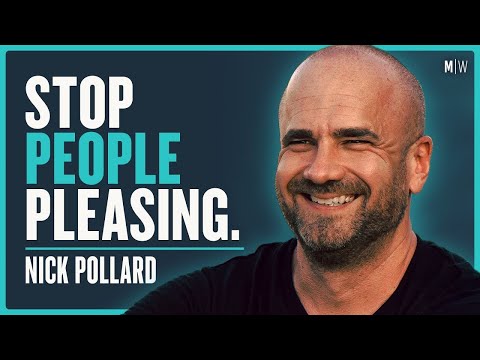
How To Put Yourself First Without Feeling Guilty - Nick Pollard
Chris Williamson
Summary
Coach and speaker Nick Pollard joins Chris to examine why chronic people-pleasing is not a virtue, but a dishonest childhood survival strategy driven by toxic shame and a fear of abandonment. Pollard details how constantly subjugating one's needs leads to physical neglect, financial drain, disconnection from praise, and severe burnout by age 38. He also contrasts how men and women process the shame of pliability and explains why people-pleasers struggle to maintain same-sex friendships or experience joy.
To rehabilitate these habits, Pollard shares concrete behavioral tools rather than abstract affirmations. These include a seven-day game of saying no to every request with a 90-second window to reconsider, a four-question cognitive belief audit, a two-second pause under pressure, and a personal Bill of Rights reviewed daily on a laminated business card. While enforcing boundaries initially triggers a lonely transitional phase as transactional friends leave, enduring that discomfort builds genuine self-trust and lasting relationships.
How time-sensitive the topic is: Evergreen
By the numbers
7 days: Duration Nick Pollard instructs clients to say no to every request in his boundary boot camp game. (Mentioned at 9:40)
90 seconds: Waiting period required before a participant in Nick Pollard's no game is allowed to change their answer to yes. (Mentioned at 10:05)
38 years old: Age at which Nick Pollard says the average people-pleaser he works with is either burned out or about to burn out. (Mentioned at 23:39)
3 same-sex friends: Threshold below which Nick Pollard claims a person likely has a people-pleasing problem. (Mentioned at 37:13)
2 seconds: Pause Nick Pollard recommends taking under pressure before speaking whatever response comes to mind. (Mentioned at 1:27:17)
3 people: Total number of people Nick Pollard says he has permanently cut out of his life via no contact. (Mentioned at 1:46:41)
250,000 dollars per year: Minimum annual income of the highly successful 35-to-55-year-old client cohort Nick Pollard describes. (Mentioned at 1:51:21)
Questions this video answers
Why is people-pleasing considered a form of dishonesty?
Nick Pollard explains that saying yes when you actually mean no, or committing to events you resent attending, is fundamentally lying. As coach Joe Hudson notes, if people cannot trust your no, they cannot trust your yes, which prevents authentic connection and turns relationships into shallow transactions.
Nick Pollard, 4:12 to 8:56
From this keypoint: Why Chronic People-Pleasers Are Dishonest
How can I practice saying no without ruining my relationships?
Nick Pollard recommends a seven-day game where your default answer to every request is no, and you can openly tell friends and coworkers you are playing. After sitting with the discomfort of saying no for 90 seconds, you are allowed to change your mind, which rapidly desensitizes your brain to rejection.
Nick Pollard, 8:56 to 13:00
From this keypoint: Nick Pollard's Seven-Day 'Say No' Game
What childhood family dynamics cause adults to become people-pleasers?
According to Nick Pollard, people-pleasing typically develops when one parent enmeshes the child as the center of their world while the other parent is absent or abusive. The child learns to appease others or stay invisible to avoid abandonment, carrying that survival strategy into adulthood where it no longer serves them.
Nick Pollard, 0:00 to 4:10
From this keypoint: Childhood Enmeshment Breeds People-Pleasing
How do you tell the difference between being genuinely considerate and people-pleasing?
Nick Pollard distinguishes the two by the physical emotion felt in the body: authentic generosity brings a sense of peace even when inconvenient, whereas people-pleasing sparks resentment in the solar plexus. Putting an hour or a day between the urge to give and the action helps reveal whether you are acting from love or seeking validation.
Nick Pollard, 26:00 to 28:37
From this keypoint: Distinguishing Genuine Generosity From Validation
Why do people-pleasers struggle to feel proud of their achievements and praise?
Chris explains that when you constantly say and do whatever you think others want to hear, any praise you receive only applauds the role you performed. Because nobody is seeing the real you, external validation and career successes feel disconnected, as if someone else achieved them on your behalf.
YouTube: Chris Williamson, 38:05 to 48:04
From this keypoint: Chris and Nick on Losing Opinions and Praise
What are the four questions to stop feeling like you are not good enough?
When feeling inadequate, Nick Pollard asks himself four questions: What am I believing right now? How am I reinforcing this belief through my actions or inaction? What would I prefer to believe instead? What do I need to do right now to reinforce that new belief?
Nick Pollard, 56:14 to 1:02:16
From this keypoint: Four Questions to Rewire Pre-Show Anxiety
What is a personal Bill of Rights for setting boundaries?
Rather than treating boundaries as rules imposed on other people or selfishly putting yourself first, Nick Pollard frames them as a personal Bill of Rights that makes your needs equal to everyone else's. It is a pre-written list of values you hold yourself to, such as being allowed to have opinions and refusing to tolerate yelling.
Nick Pollard, 1:02:20 to 1:10:59
From this keypoint: Boundaries as a Personal Bill of Rights
How can sensitive people be more assertive when put on the spot?
Nick Pollard advises deferring emotional boundary conversations until everyone is calm whenever possible. If an immediate answer is required, take one deep breath to reset your nervous system, pause for two seconds, remind yourself that no feeling is fatal or permanent, and speak whatever honest answer comes out.
Nick Pollard, 1:19:42 to 1:28:08
From this keypoint: Assertiveness Under Pressure: Pause and Speak
Why does life feel lonelier when you first stop people-pleasing?
When you start enforcing boundaries and treating your needs as equal, people who only valued you for what you provided often exit your life. Nick Pollard notes that this creates a lonely transitional wilderness before healthier friends arrive, but enduring it builds massive personal freedom and self-trust.
Nick Pollard, 1:28:11 to 1:39:07
From this keypoint: Overcoming Guilt and the Lonely Middle Chapter
When should you actually go no contact and cut someone out of your life?
Nick Pollard argues that people today cut others off far too quickly by labeling anyone who bumps into a boundary as toxic or narcissistic. Having gone no contact with only three people in his life, he advises reserving permanent estrangement strictly for unmistakable malevolence.
Nick Pollard, 1:40:50 to 1:47:37
From this keypoint: Triggers, Adversity, and Cutting Off Malevolence
How do male and female people-pleasers differ in how they process shame?
In Nick Pollard's coaching experience, female people-pleasers tend to externalize the problem onto others and display passive aggression, believing they could set boundaries if others changed first. Male people-pleasers tend to internalize the failure as self-hatred, feeling intense shame for lacking stoic assertiveness.
Nick Pollard, 28:39 to 38:03
From this keypoint: Gender Differences and Same-Sex Friendship Gaps
Credible AI™ signals
Confidence: Candid Coaching Insights. Nick Pollard openly disclaims clinical psychology credentials, grounding his advice in personal addiction recovery and five years of coaching experience. While his observations on boundaries and people-pleasing are practical and transparent, several broad generalizations about gender and friendships rely entirely on anecdotal client patterns.
Bias: Self-Ownership Coaching. The conversation strongly favors radical personal responsibility, behavioral conditioning, and action-oriented self-improvement over traditional talk therapy. Both speakers critique modern therapeutic culture and online victimhood narratives while promoting direct self-advocacy.
Originality (78%): Tactical Boundary Reframing. Rather than treating people-pleasing as excess kindness, Nick Pollard reframes it as dishonesty and fear-driven manipulation. His specific tactical exercises, such as the seven-day game of saying no with a 90-second reversal window and a personal Bill of Rights, offer fresh operational tools.
Depth (76%): Nuanced Behavioral Unpacking. Chris and Nick Pollard systematically dissect the roots, costs, and recovery mechanics of people-pleasing across two hours. They move beyond surface symptoms to examine childhood enmeshment, toxic shame, gender-specific manifestations, and the temporary loneliness of setting boundaries.
Key points (16)
Short (24 min): key points 1, 2, 3 and 14
Medium (45 min): key points 1, 2, 3, 10, 11, 14 and 15
Relaxed (1h 56min): all 16 key points
1. Childhood Enmeshment Breeds People-Pleasing
Timestamp: 00:00:00 to 00:04:10 (4 min)
Speaker: Nick Pollard
Nick Pollard explains that people-pleasing stems from an overwhelming core belief of not being enough, reinforced by social media comparison and childhood family dynamics. He observes that his clients commonly experienced enmeshment with one parent while the other parent was absent or abusive. This teaches children to appease others or become invisible as a survival strategy to avoid abandonment.
Impact: High. Why it matters: Reframes people-pleasing from a polite personality trait into an outdated childhood survival mechanism driven by fear of abandonment.
“what that teaches them is that you know to make this other person happy means they won't get abandoned to if they don't get abandoned they'll get their needs met”
In the video: Nick Pollard, at 3:46
Neutral: YouTube: Chris Williamson
2. Why Chronic People-Pleasers Are Dishonest
Timestamp: 00:04:12 to 00:08:56 (5 min)
Speaker: Nick Pollard
When asked how to self-diagnose people-pleasing, Nick Pollard states that most people-pleasers are liars because saying yes when meaning no is fundamentally dishonest. Chris agrees, quoting Joe Hudson that an untrustworthy no invalidates every yes, and shares his own therapy realization about enduring prolonged misery to avoid minor friction. Both conclude that compulsory niceness strips away genuine virtue and leaves relationships shallow.
Impact: High. Why it matters: Challenges the moral superiority of people-pleasers by exposing compulsory agreeableness as a form of relational dishonesty.
“saying yes when you mean to say no that's dishonest right committing to things you don't want to go to well that is also dishonest”
In the video: Nick Pollard, at 4:47
For: YouTube: Chris Williamson
3. Nick Pollard's Seven-Day 'Say No' Game
Timestamp: 00:08:56 to 00:13:00 (4 min)
Speaker: Nick Pollard
To break the addiction to the dopamine rush of saying yes, Nick Pollard teaches a seven-day boundary boot camp exercise where participants must default to saying no to every request. Players can tell everyone they are playing the game and are allowed to change their answer to yes only after sitting with the discomfort of no for 90 seconds. Practicing hundreds of repetitions over one week rewires the brain's default response and frees up time.
Impact: High. Why it matters: Provides an immediate, low-stakes behavioral drill to desensitize nervous systems to the discomfort of declining requests.
“spend seven days saying no to everything everything just do you want to go out to lunch no do you want to hang out on Saturday no”
In the video: Nick Pollard, at 9:40
For: YouTube: Chris Williamson
4. Self-Invention Through Play and Receiving Joy
Timestamp: 00:13:00 to 00:21:04 (8 min)
Speaker: Nick Pollard
Nick Pollard advises clients never to try to 'find themselves,' arguing they should instead continuously invent themselves through play, much like children learning physical and social boundaries on a playground. Chris notes that extreme delayed gratification makes high achievers rigid and joyless, while Pollard compares people-pleasing to addiction driven by toxic shame.
Impact: Medium. Why it matters: Connects the inability to play and receive personal rewards directly to toxic shame and identity loss in adulthood.
“they're always asking me like how do I find myself my advice is never do that never ever find yourself constantly invent the new version of you”
In the video: Nick Pollard, at 13:43
For: YouTube: Chris Williamson
5. Physical, Financial, and Emotional Burnout at 38
Timestamp: 00:21:06 to 00:26:00 (5 min)
Speaker: Nick Pollard
Chronic people-pleasing severely damages physical health, emotional stability, and personal finances as individuals neglect exercise, feel inferior to peers, and give away their money to buy love. Nick Pollard states that the average client he works with is either burned out or approaching total burnout at age 38, even when their entrepreneurial income is rising. Overcoming this requires recognizing that the opposite of people-pleasing is believing you are enough, not becoming an abrasive jerk.
Impact: High. Why it matters: Highlights the compounding life costs of unaddressed people-pleasing and dispels the fear that self-care requires hostility.
“the average people pleaser that I work with is is either at or about to be burnt out at 38 like completely burned out”
In the video: Nick Pollard, at 23:31
Neutral: YouTube: Chris Williamson
6. Distinguishing Genuine Generosity From Validation
Timestamp: 00:26:00 to 00:28:37 (3 min)
Speaker: Nick Pollard
To tell the difference between genuine consideration and self-sacrificing people-pleasing, Nick Pollard looks at the underlying bodily emotion. Authentic giving produces an internal sense of peace even when the task is inconvenient, whereas people-pleasing triggers resentment in the solar plexus. Pollard recommends putting an hour or a day of space between a decision to give to a loved one and the action itself to examine whether the motive is love or validation.
Impact: Medium. Why it matters: Gives listeners a somatic check and a cooling-off rule to separate authentic altruism from validation-seeking.
“when you're ready to give to somebody you love give yourself an hour give yourself a day to ask the question like what am what is the purpose of this”
In the video: Nick Pollard, at 28:18
Neutral: YouTube: Chris Williamson
7. Gender Differences and Same-Sex Friendship Gaps
Timestamp: 00:28:39 to 00:38:03 (9 min)
Speaker: Nick Pollard
Nick Pollard observes that while all people-pleasers harbor anger and dishonesty, women in his practice tend to externalize blame onto others and act passive-aggressively, whereas men internalize it as self-hatred. Chris suggests men feel extra shame over pliability due to societal expectations of stoic strength, and Pollard critiques both modern psychology and the manosphere for failing men.
Impact: Medium. Why it matters: Identifies how gender expectations shape the shame of people-pleasing and highlights same-sex isolation as a diagnostic marker.
“what I find mostly in women is they tend to externalize it as a problem of everyone else where men tend to internalize it as I'm a piece of [ __ ]”
In the video: Nick Pollard, at 29:49
For: YouTube: Chris Williamson
8. Chris and Nick on Losing Opinions and Praise
Timestamp: 00:38:05 to 00:48:04 (10 min)
Speaker: YouTube: Chris Williamson
Exploring why self-advocacy feels so terrifying, Nick Pollard realizes that to a people-pleaser, rejection feels like childhood abandonment. Chris notes that years of appeasing others bury a person's preferences so deeply that they no longer know their own opinions or desires. Chris further observes that people-pleasers feel disconnected from their achievements and praise because compliments only validate the fake role they performed rather than their true self.
Impact: High. Why it matters: Explains why external success never cures people-pleasing: praise given to a mask cannot nourish the real person underneath.
“any positive reinforcement that you get is not somebody seeing you that just applauding this role that you play”
In the video, at 46:08
For: Nick Pollard
9. Keeping Empathy While Sitting With Insufficiency
Timestamp: 00:48:05 to 00:56:14 (8 min)
Speaker: Nick Pollard
Chris cites Thomas Sowell on trade-offs to argue that transcending pathological people-pleasing leaves behind admirable empathy and social agility. Nick Pollard agrees that kindness does not have to die when self-deprecation ends, comparing human course-correction to Maxwell Maltz's servo-mechanisms.
Impact: Medium. Why it matters: Reassures empathetic people that boundary work removes self-deprecation without destroying their core generosity.
“the beautiful parts of you don't have to die for the toxic parts to go away”
In the video: Nick Pollard, at 49:54
For: YouTube: Chris Williamson
10. Four Questions to Rewire Pre-Show Anxiety
Timestamp: 00:56:14 to 01:02:16 (6 min)
Speaker: Nick Pollard
Confirming that insufficiency is the root cause of people-pleasing, Nick Pollard shares how he managed his own anxiety on a five-mile walk to the Denver Capitol steps before recording Chris's podcast. He walks through four self-inquiry questions: what am I believing, how am I reinforcing this belief, what would I prefer to believe, and what must I do to reinforce the new belief.
Impact: High. Why it matters: Demonstrates a repeatable four-step cognitive reframing tool in real time using the guest's own vulnerability.
“the first question is what am I believing so our beliefs Drive our Behavior our Behavior creates our environments”
In the video: Nick Pollard, at 1:00:02
For: YouTube: Chris Williamson
11. Boundaries as a Personal Bill of Rights
Timestamp: 01:02:20 to 01:10:59 (9 min)
Speaker: Nick Pollard
Nick Pollard clarifies two major misconceptions about boundaries: they are not rules to control other people, and they are not about selfishly putting yourself first. Instead, boundaries make your needs equal to everyone else's and operate as a personal Bill of Rights based on core values, such as not tolerating yelling or refusing responsibility for other adults' drinking choices.
Impact: High. Why it matters: Transforms boundary setting from confrontational demands on others into pre-committed personal operating guidelines.
“boundaries are about making your needs equal to everyone around you so rather than saying I'm putting myself first I have to be selfish well no”
In the video: Nick Pollard, at 1:03:47
For: YouTube: Chris Williamson
12. Daily Habits to Maintain Evolving Boundaries
Timestamp: 01:11:39 to 01:19:24 (8 min)
Speaker: Nick Pollard
Chris shares the quote 'don't try to fix people, just set boundaries,' and Nick Pollard agrees that ignoring red flags is the biggest red flag of all. To maintain boundaries without complex morning routines, Pollard advises handwriting the top three personal rights on a laminated business card and reading the list once a day, a habit he learned after being mentored at age 19 by sales trainer Zig Ziglar.
Impact: Medium. Why it matters: Offers a simple daily review habit to move boundary enforcement from conscious effort into automatic behavior.
“take your top three that you want to make sure you focus on put them on a business card like go get a blank business card put it on that business card handw write it”
In the video: Nick Pollard, at 1:16:02
For: YouTube: Chris Williamson
13. Assertiveness Under Pressure: Pause and Speak
Timestamp: 01:19:42 to 01:28:08 (8 min)
Speaker: Nick Pollard
For sensitive people struggling to be assertive, Nick Pollard first advises conflict deferment: stepping away to let emotions settle rather than forcing a boundary conversation in the heat of the moment. When an immediate decision is required, Pollard uses a deep martial arts breath to reset his nervous system, reminds himself that no feeling is fatal or permanent, and defines bravery as acting while afraid.
Impact: High. Why it matters: Equips sensitive individuals with conflict deferment, breathwork, and a two-second rule to handle high-pressure confrontations.
“if somebody is really pressuring you or somebody's really pushing on a boundary give yourself two seconds two seconds one two and then speak whatever comes out”
In the video: Nick Pollard, at 1:27:11
Neutral: YouTube: Chris Williamson
14. Overcoming Guilt and the Lonely Middle Chapter
Timestamp: 01:28:11 to 01:39:07 (11 min)
Speaker: Nick Pollard
Addressing the guilt of choosing yourself over others, Nick Pollard challenges clients to ask whether they are actually feeling excitement or indulging in hubris by assuming their 'no' will devastate someone else. He warns that stopping people-pleasing initially makes life harder and lonelier because transactional friends leave before healthier relationships form.
Impact: High. Why it matters: Prepares recovering people-pleasers for the temporary social isolation that follows boundary enforcement so they do not relapse.
“from the moment you change to you know what what would might consider to be the end result um you're going to experience a pretty high level of loneliness in between those two points”
In the video: Nick Pollard, at 1:34:04
For: YouTube: Chris Williamson
15. Triggers, Adversity, and Cutting Off Malevolence
Timestamp: 01:40:50 to 01:47:37 (7 min)
Speaker: Nick Pollard
Nick Pollard distinguishes true PTSD triggers—which cause visceral fear and require clinical care—from ordinary emotional discomfort, insisting that managing one's reactions is always a personal responsibility. When asked when to give up on someone, Pollard argues that modern culture goes 'no contact' far too quickly and labels everyone who bumps against a boundary a narcissist.
Impact: Medium. Why it matters: Pushes back against therapy-speak overreactions by separating everyday discomfort from trauma and reserving no-contact for true malice.
“I think there's almost an epidemic of no contact in the world right now so I think giving up on people is happening a little too quickly”
In the video: Nick Pollard, at 1:45:36
Neutral: YouTube: Chris Williamson
16. Affluent People-Pleasers and Core Reading List
Timestamp: 01:47:58 to 01:59:10 (11 min)
Speaker: Nick Pollard
Examining highly successful people-pleasers aged 35 to 55 earning over $250,000, Nick Pollard notes they feel like human ATM machines and must redefine their relationship with family and money, though their high status helps them break the habit permanently once it clicks. Chris observes that their established prestige gives others faith to follow their new direction. Pollard concludes by recommending his top books for recovery: Not Nice by Aziz Gazipura, No More Mr.
Impact: Medium. Why it matters: Shows how high earners can untangle financial appeasement and provides a curated reading roadmap for deeper recovery.
“with the highly successful variety so my my clients between you know like 35 and 55 you know making a quarter million plus a year when the Habit breaks it usually breaks for good”
In the video: Nick Pollard, at 1:51:13
For: YouTube: Chris Williamson
Conflicts of interest (2)
Nick Pollard Promotes His Coaching Practice
Commercial conflict, Medium severity
Nick Pollard operates The People Displeaser coaching business, boundary boot camps, and paid client groups.
Sources: Nick Pollard
Significance: Nick Pollard has a financial incentive to frame people-pleasing as a pervasive, lifelong condition that benefits from structured coaching and group accountability.
Host Promotes Neutonic Energy Drink
Commercial conflict, Low severity
Chris markets his co-owned productivity drink Neutonic in the video description and references his business partner during the episode.
Sources: Neutonic
Significance: The commercial tie is routine channel promotion and does not alter the psychological discussion on boundaries.
Key sources
Nick Pollard: Coach and Speaker, The People Displeaser
YouTube: Chris Williamson
Who's in this
Alex Hormozi
James Smith
Joe Hudson
James Clear
David Goggins
Bill Perkins
Robert Glover
Scott Galloway
M. Scott Peck
Thomas Sowell
Maxwell Maltz
Zig Ziglar
Andrew Huberman
Tim Ferriss
Mark Manson
Jordan Peterson
Aziz Gazipura
Kurt Vonnegut
Neutonic
Also mentioned
Not Nice (First mentioned at 1:59:55)
No More Mr. Nice Guy (First mentioned at 2:00:17)
The Road Less Traveled (First mentioned at 2:00:37)
America (First mentioned at 25:35)
Psycho-Cybernetics (First mentioned at 51:28)
Denver (First mentioned at 57:56)
TikTok (First mentioned at 1:13:43)
Instagram (First mentioned at 1:13:45)
Stone (First mentioned at 1:57:24)
The Subtle Art of Not Giving a F*ck (First mentioned at 2:00:55)
Atomic Habits (First mentioned at 2:01:01)
The Sirens of Titan (First mentioned at 2:01:39)
YouTube (First mentioned at 2:02:46)
Chernobyl (First mentioned at 8:01)
Iron Man (First mentioned at 15:09)
Donald Trump (First mentioned at 43:33)
Joe Biden (First mentioned at 43:36)
Harvard (First mentioned at 1:00:22)
ChatGPT (First mentioned at 1:09:09)
Panama (First mentioned at 1:11:25)
Sam Harris (First mentioned at 1:15:00)
Waking Up (First mentioned at 1:15:02)
Post-it (First mentioned at 1:19:20)
Australia (First mentioned at 1:39:14)
Elon Musk (First mentioned at 1:48:51)
London (First mentioned at 1:54:36)
Slaughterhouse-Five (First mentioned at 2:01:35)
This analysis was generated by skim (skim.plus), an AI-powered content analysis platform by Credible AI. Scores and classifications represent the platform's AI-generated assessment and should be considered alongside other sources.