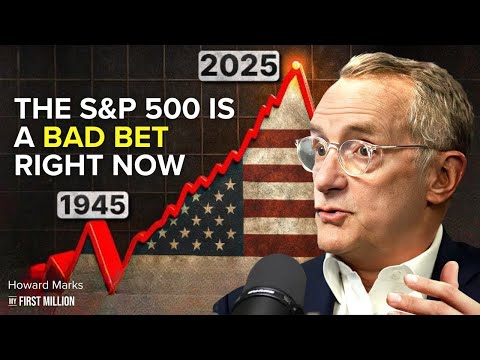
Oaktree Capital co-founder Howard Marks joins Sam Parr and Shaan Puri to evaluate passive S&P 500 investing against current market valuations. Citing JP Morgan research, Marks notes that buying the S&P 500 at a P/E ratio of 23 has historically generated 10-year annualized returns between plus 2% and minus 2% in every instance. For cautious investors worried about elevated stock multiples around 24, Marks recommends shifting part of their portfolio into high-yield bonds paying contractual yields of 7% to 8%.
Marks also recounts how studying historical manias like the 1720 South Sea Bubble helped him call the 2000 dot-com crash, and how raising an $11 billion standby fund in 2007 allowed Oaktree to invest $650 million a week after Lehman Brothers failed. Ultimately, he urges investors to avoid emotional extremes and aim for steady second-quartile consistency rather than risky home runs.
How time-sensitive the topic is: Evergreen
By the numbers
23 P/E ratio: Historical S&P 500 purchase P/E ratio at which every subsequent 10-year annualized return fell between 2% and minus 2% per JP Morgan. (Mentioned at 5:27)
10 percent per year: Average annual return of the S&P 500 over 100 years, though annual returns almost never fall between 8% and 12%. (Mentioned at 6:38)
7 to 8 percent yield: Current yields available on US and European high-yield bonds and low-grade credit. (Mentioned at 9:35)
11 billion dollars: Size of Oaktree Capital's standby distressed debt fund 7B raised prior to the 2008 financial crisis. (Mentioned at 32:51)
650 million dollars per week: Average weekly capital deployed by Oaktree Capital overall for 15 weeks following the September 2008 Lehman Brothers bankruptcy. (Mentioned at 34:56)
4th percentile: Overall 14-year ranking of the General Mills Pension Fund equity portfolio after finishing between the 27th and 47th percentile every year. (Mentioned at 38:31)
Questions this video answers
What happens to 10-year S&P 500 returns when you buy at a P/E ratio of 23 or higher?
According to a late 2024 JP Morgan study cited by Howard Marks, buying the S&P 500 at a P/E ratio of 23 has historically produced 10-year annualized returns between plus 2% and minus 2% in every single case. Marks notes that with current P/E multiples around 23 to 25, passive index investors should not blindly expect the historical 10% century average over the next decade.
Howard Marks, 3:52 to 6:59
From this keypoint: High S&P 500 P/E Ratios Compress 10-Year Returns
What does Howard Marks recommend buying instead of an expensive S&P 500 index fund?
Howard Marks suggests reallocating a portion of capital into high-yield bonds and low-grade credit, which currently offer contractual yields of 7% to 8%. Because bondholders have a legal contract for interest payments and bankruptcy claims on company assets, credit provides near-equity returns with significantly less downside uncertainty.
Howard Marks, 6:59 to 11:39
From this keypoint: Howard Marks Recommends High-Yield Bonds at 7-8%
How did Oaktree Capital deploy billions during the 2008 financial crisis?
Recognizing reckless deal-making in 2005 and 2006, Howard Marks and Bruce Karsh raised a $3.5 billion fund and an $11 billion standby distressed debt fund in 2007 before the crisis hit. When Lehman Brothers collapsed in September 2008, Oaktree concluded the world would likely survive and invested $650 million a week across the firm for 15 straight weeks.
Howard Marks, 29:32 to 35:52
From this keypoint: Deploying $650M a Week After Lehman's Collapse
How can a fund that never finishes in the top quartile end up in the top 4% long term?
Howard Marks shares how Dave Van Benscoten's General Mills Pension Fund finished between the 27th and 47th percentile every year for 14 consecutive years, yet ranked in the 4th percentile overall for the full period. By consistently avoiding big losses in bad years while competitors suffered severe drawdowns, steady second-quartile performance compounds to elite long-term results.
Howard Marks, 35:52 to 41:05
From this keypoint: Second-Quartile Consistency Beats Volatile Home Runs
How did Howard Marks spot the 2000 dot-com bubble before it crashed?
While reading Devil Take the Hindmost in late 1999, Howard Marks noticed that speculators quitting their jobs to trade the 1720 South Sea Company mirrored 1999 day traders buying profitless internet stocks. He published his bubble.com memo on January 2, 2000, just months before the tech market collapsed.
Howard Marks, 11:48 to 18:34
From this keypoint: Spotting the 2000 Tech Bubble via 1720 History
Why does Howard Marks say you cannot raise money during a financial crisis?
Marks explains that the same terrifying news and falling prices that create bargain investment opportunities also paralyze prospective fund investors. Clients refuse to commit capital while trying to avoid catching a falling knife, meaning distressed debt managers must raise standby capital during bull markets before the crisis arrives.
Howard Marks, 29:32 to 35:52
From this keypoint: Deploying $650M a Week After Lehman's Collapse
What does Howard Marks consider the biggest mistake of his investing career?
Marks states that his biggest mistake was being overly conservative across his 56-year career, a trait inherited from parents who were traumatized as adults in their 30s during the Great Depression. While choosing credit over equities or venture capital limited his personal net worth, that same caution helped him win client trust when pioneering high-yield and distressed debt.
Howard Marks, 24:32 to 29:32
From this keypoint: Depression-Era Upbringing Made Marks Too Cautious
What three questions should investors ask themselves to avoid major mistakes?
Howard Marks advises investors to ask whether they falsely believe they can predict the future, whether they assume current market trends will continue unchanged, and whether their emotions dictate their actions. Auditing these three tendencies alongside a clinical market-temperature checklist helps investors resist crowd euphoria and panic.
Howard Marks, 44:07 to 46:32
From this keypoint: Three Mistakes and a Market Temperature Checklist
Credible AI™ signals
Confidence: Veteran Investor Track Record. Howard Marks draws on 56 years of institutional investing experience at Citibank and Oaktree Capital, citing specific historical fund sizes, P/E data from JP Morgan, and pension fund performance records. While his market assessments are inherently interpretive, he openly distinguishes historical data from future projections.
Bias: Credit-First Value Perspective. Howard Marks explicitly acknowledges a tendency to talk his own book when recommending high-yield bonds and credit over equities. His lifelong caution, shaped by his Depression-era parents and decades in fixed income and distressed debt, naturally favors defensive capital preservation over aggressive equity growth.
Originality (78%): Distilled Contrarian Wisdom. While many concepts echo Howard Marks's published memos and books, applying them directly to a young entrepreneur's S&P 500 index strategy produces fresh, practical insights. His detailed first-hand account of raising an $11 billion standby distressed debt fund before the 2008 crash offers rare institutional perspective.
Depth (82%): Behavioral and Cycle Mechanics. The conversation moves past surface-level stock tips to examine the mechanics of P/E valuation vs. 10-year returns, the contractual downside protection of high-yield debt, the psychology of market cycles, and the mathematical compounding of consistent second-quartile returns over 14-year horizons.
Key points (10)
Short (18 min): key points 1, 2, 7 and 8
Medium (29 min): key points 1, 2, 3, 4, 7 and 8
Relaxed (46 min): all 10 key points
1. Market Risk Stems From Investor Behavior
Timestamp: 00:00:29 to 00:03:52 (3 min)
Speaker: Howard Marks
Shaan Puri asks whether Sam Parr is too complacent relying on a 10% long-term S&P 500 return. Howard Marks responds that while wealthy entrepreneurs should prioritize comfort, the riskiest place in the world is wherever people believe there is no risk. Carefree investor behavior inflates asset prices and creates market vulnerability.
Impact: High. Why it matters: Reframes investment risk away from company fundamentals toward crowd psychology, warning passive index investors that universal consensus can make safe assets precarious.
“The risk in the markets does not come from the companies, the securities, or the institutions like the exchanges. The risk in the markets comes from the behavior of people.”
In the video: Howard Marks, at 2:32
For: Shaan Puri
Neutral: Sam Parr
2. High S&P 500 P/E Ratios Compress 10-Year Returns
Timestamp: 00:03:52 to 00:06:59 (3 min)
Speaker: Howard Marks
Howard Marks cites a late 2024 JP Morgan chart mapping S&P 500 purchase P/E ratios against subsequent 10-year annualized returns. Historically, buying the S&P 500 at a P/E ratio of 23 has produced 10-year annualized returns between plus 2% and minus 2% without exception. He also notes that despite a 10% century average, the annual return almost never falls between 8% and 12%.
Impact: High. Why it matters: Challenges passive investors' assumption of steady 10% annual gains by showing how elevated entry valuations historically flatten decade-long equity returns.
“if you bought the S&P when the P/E ratio was 23, in every case, there were no exceptions. In every case, your annualized return over the next 10 years was between two and minus two.”
In the video: Howard Marks, at 5:39
Neutral: Shaan Puri, Sam Parr
3. Howard Marks Recommends High-Yield Bonds at 7-8%
Timestamp: 00:06:59 to 00:11:39 (5 min)
Speaker: Howard Marks
When Sam Parr asks what alternative exists for non-professional investors when equity P/E ratios are high, Howard Marks points to high-yield bonds and low-grade credit. Drawing on 47 years in high-yield debt since his 1978 move at Citibank, he explains that bond contracts compel borrowers to pay interest or forfeit the company in bankruptcy. Investors can currently earn 7% to 8% yields and calibrate their portfolio along an aggressive-to-defensive continuum.
Impact: High. Why it matters: Offers cautious investors a concrete contractual alternative to equities, trading modest after-tax upside for substantially lower downside volatility.
“So, today, you can buy high-yield bonds, whether it be the US or Europe or variations on that theme, what we call low grade uh credit. And you can buy buy it to get yields of seven to eight.”
In the video: Howard Marks, at 9:23
For: Sam Parr
Neutral: Shaan Puri
4. Spotting the 2000 Tech Bubble via 1720 History
Timestamp: 00:11:48 to 00:18:34 (7 min)
Speaker: Howard Marks
Prompted by Shaan Puri about his January 2000 bubble.com memo, Howard Marks explains that Oaktree avoids macro forecasts in favor of assessing where markets stand in the current cycle. Reading Devil Take the Hindmost in late 1999 about the 1720 South Sea Bubble showed him identical speculative behavior in dot-com day traders and profitless startups. Recognizing how human nature rhymes across cycles allowed him to warn clients months before the mid-2000 tech collapse.
Impact: High. Why it matters: Demonstrates how studying historical financial manias equips investors to diagnose contemporary speculative bubbles without needing to predict exact macro timelines.
“One of the great sayings in our business is that being too far ahead of your time is indistinguishable from being wrong. So, the the answer is I was not too far ahead.”
In the video: Howard Marks, at 14:56
For: Shaan Puri
5. Buying When Consensus Is Most Pessimistic
Timestamp: 00:18:45 to 00:24:32 (6 min)
Speaker: Howard Marks
Howard Marks explains that although Oaktree did not short tech stocks in 2000, recognizing widespread greed and credulousness helped them avoid bad deals elsewhere. He quotes a retired trader's maxim that when the time comes to buy, you will not want to, because the lowest prices occur amid faltering corporate fortunes, widespread losses, and dire media headlines. During the 1998 Russian ruble and Long-Term Capital Management crisis, Marks told a terrified portfolio manager to go back to his desk and do his job.
Impact: High. Why it matters: Illustrates the operational discipline required for contrarian investing: acting against overwhelming negative news when asset prices detach downward from intrinsic value.
“I came across a great quote within the last year from a guy who's a retired trader, when the time comes to buy, you won't want to.”
In the video: Howard Marks, at 20:39
For: Shaan Puri
Neutral: Sam Parr
6. Depression-Era Upbringing Made Marks Too Cautious
Timestamp: 00:24:32 to 00:29:32 (5 min)
Speaker: Howard Marks
Asked by Sam Parr and Shaan Puri about emotional detachment and his biggest career mistake, Howard Marks says he and partner Bruce Karsh are naturally unemotional, so temperament was never his flaw. Instead, Marks identifies his worst mistake as being too conservative throughout his 56-year career because his parents were traumatized as adults during the Great Depression. While choosing credit over venture capital or leveraged buyouts cost him personal wealth, that innate caution earned client trust when he pioneered high-yield and distressed debt.
Impact: Medium. Why it matters: Reveals how generational financial trauma shapes an investor's lifelong asset-class selection, trading maximum wealth accumulation for downside protection and client trust.
“My worst mistake is that I have always been too conservative. My parents were traumatized by the Depression.”
In the video: Howard Marks, at 26:11
Neutral: Shaan Puri, Sam Parr
7. Deploying $650M a Week After Lehman's Collapse
Timestamp: 00:29:32 to 00:35:52 (6 min)
Speaker: Howard Marks
Howard Marks corrects Shaan Puri's premise that Oaktree raised $10 billion during the 2008 crash, explaining that you cannot raise money once a crisis hits. Instead, spotting reckless deal-making in 2005 and 2006, Oaktree raised a $3.5 billion fund and an $11 billion standby fund starting in January 2007. After Lehman Brothers went bankrupt in September 2008, Marks reasoned that not investing if the world survived meant failing their job, so Oaktree deployed $650 million a week for 15 weeks.
Impact: High. Why it matters: Provides a blueprint for institutional crisis preparation: capital must be locked in standby funds during euphoric markets so it can be deployed decisively during panics.
“If we invest it and the world melts down, it doesn't matter what we did. But if I don't invest it and the world doesn't melt down, then we didn't do our job.”
In the video: Howard Marks, at 33:48
For: Shaan Puri
8. Second-Quartile Consistency Beats Volatile Home Runs
Timestamp: 00:35:52 to 00:41:05 (5 min)
Speaker: Howard Marks
Howard Marks shares that he reads books on investor behavior like John Kenneth Galbraith's A Short History of Financial Euphoria and Charlie Ellis's Winning the Loser's Game rather than technical manuals. He illustrates defensive compounding with Dave Van Benscoten's General Mills Pension Fund, which finished between the 27th and 47th percentile every year for 14 years yet ranked in the 4th percentile overall. Avoiding bad years places Oaktree's philosophy squarely on fewer losers rather than more winners.
Impact: High. Why it matters: Proves mathematically that avoiding bottom-decile drawdowns over multi-decade horizons outperforms high-variance strategies that swing between top and bottom rankings.
“So, if you if you can do well for 14 years in a row and avoid the tendency to shoot yourself in the foot in a bad year, you can pop up to the top.”
In the video: Howard Marks, at 38:34
For: Shaan Puri
Neutral: Sam Parr
9. Why Investing Principles Are Simple But Not Easy
Timestamp: 00:41:05 to 00:44:07 (3 min)
Speaker: Howard Marks
Sam Parr and Shaan Puri note how investors like Warren Buffett and Howard Marks have become modern life philosophers. Marks replies that sharing investment principles openly does not erode an edge because, as Richard Oldfield titled his book, the rules are simple but not easy to execute. Marks also reveals to Sam Parr that he is working on an untitled book connecting investing principles to how to live life, which should be out in a few years.
Impact: Low. Why it matters: Explains why publicizing investment frameworks never arbitrages away their value: human emotion prevents most market participants from executing simple rules under stress.
“Friend of mine Richard Oldfield in London wrote a book once entitled simple but not easy. I think the things we have to do are simple. They're just not easy to do.”
In the video: Howard Marks, at 42:55
For: Shaan Puri, Sam Parr
10. Three Mistakes and a Market Temperature Checklist
Timestamp: 00:44:07 to 00:46:32 (2 min)
Speaker: Howard Marks
Asked by Shaan Puri for a final self-reflection question for listeners, Howard Marks identifies three core investor mistakes: believing you can accurately predict the future, assuming current trends will continue unchanged, and letting emotions dictate decisions. He recommends using a clinical checklist like the Poor Man's Guide to Market Assessment from his book The Most Important Thing to gauge whether deals are oversubscribed and markets are overheated or frigid.
Impact: Medium. Why it matters: Gives individual investors a practical three-part diagnostic and behavioral checklist to audit their own biases and assess market temperature.
“I think the biggest single mistake that investors make is that they think the world will remain the way it is. That the things that are working today will continue to work”
In the video: Howard Marks, at 44:50
For: Shaan Puri, Sam Parr
Conflicts of interest (1)
Oaktree Co-Founder Promoting Credit Assets
Commercial conflict, Medium severity
Howard Marks is the co-founder of Oaktree Capital, an investment firm specializing in high-yield bonds, credit, and distressed debt.
Sources: Howard Marks, Oaktree Capital
Significance: Marks explicitly notes he is talking his own book when advising passive S&P 500 investors to reallocate capital into high-yield bonds and credit instruments, which are Oaktree Capital's core product offerings.
Key sources
Howard Marks: Co-founder of Oaktree Capital
Shaan Puri: Co-host, My First Million
Sam Parr: Co-host, My First Million
Who's in this
Oaktree Capital
Warren Buffett
JP Morgan
Citibank
Michael Milken
Bruce Karsh
Lehman Brothers
Dave Van Benscoten
John Kenneth Galbraith
Charlie Ellis
Long-Term Capital Management
Enron
Also mentioned
S&P 500 (First mentioned at 0:34)
bubble.com (First mentioned at 11:53)
Devil Take the Hindmost (First mentioned at 15:12)
Milken (First mentioned at 8:33)
Mastering the Market Cycle (First mentioned at 13:28)
Britain (First mentioned at 15:53)
South Sea Company (First mentioned at 16:01)
Mark Twain (First mentioned at 17:14)
Federal Reserve (First mentioned at 35:14)
A Short History of Financial Euphoria (First mentioned at 36:36)
Winning the Loser's Game (First mentioned at 36:51)
Fewer Losers, or More Winners (First mentioned at 37:17)
The Route to Performance (First mentioned at 37:52)
General Mills (First mentioned at 37:57)
Financial Times (First mentioned at 40:03)
Richard Oldfield (First mentioned at 42:56)
Simple But Not Easy (First mentioned at 43:00)
The Most Important Thing (First mentioned at 45:21)
Bitcoin (First mentioned at 1:01)
Ethereum (First mentioned at 1:01)
California (First mentioned at 8:31)
On the Couch (First mentioned at 11:44)
Brazil (First mentioned at 16:08)
Andrew (First mentioned at 27:27)
Wall Street Journal (First mentioned at 31:01)
New York (First mentioned at 40:26)
SEC (First mentioned at 40:59)
Munger (First mentioned at 42:03)
This analysis was generated by skim (skim.plus), an AI-powered content analysis platform by Credible AI. Scores and classifications represent the platform's AI-generated assessment and should be considered alongside other sources.