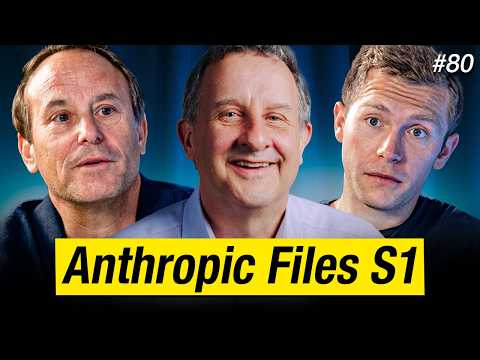
Instinct Worth 30BN? | Microsoft Cuts 27,000 Jobs While Meta Taps Equity Markets for $95B CapEx
20VC with Harry Stebbings
Summary
Harry Stebbings, Rory O’Driscoll, and Jason Lemkin dissect Anthropic's S-1 filing, which revealed $16.3 billion in first-half revenue and $110 billion in cash just five years after founding. While 80% of Anthropic's revenue comes from models under six months old, O’Driscoll argues that multi-billion-dollar training runs create a massive moat, and public equity issuances from Meta ($95 billion) and Google ($80 billion) are replacing maxed-out bank debt to keep the chip boom alive. Meanwhile, Microsoft offered voluntary buyouts to 60,000 employees (27% of staff), foreshadowing deeper 2027 layoffs as CapEx depreciation hits tech income statements.
In the private markets, Lemkin warns that Chinese open-weight models are finished in US enterprises after Cohere found Alibaba's Qwen secretly uploading data to servers in China and Singapore once every 100,000 API calls. Finally, the hosts clash in a mock investment committee: Stebbings champions backing consumer super-app contender Instinct at a $30 billion valuation, while Lemkin vetoes it over a lack of 100-day traction and instead pitches putting 20% of the fund into OpenAI at $1.25 trillion.
How time-sensitive the topic is: Breaking
By the numbers
16.3 billion USD: Anthropic's first-half revenue reported in its S-1 filing. (Mentioned at 0:58)
80%: Share of Anthropic's revenue generated by AI models that are less than six months old. (Mentioned at 4:51)
110 billion USD: Cash on Anthropic's balance sheet prior to its IPO, after raising $130 billion. (Mentioned at 9:45)
60,000 employees: Number of Microsoft employees (out of 223,000, or roughly 27%) offered voluntary buyouts. (Mentioned at 13:15)
20%: Portion of workforce laid off by Cloudflare on May 7th despite accelerating quarterly growth. (Mentioned at 17:59)
95 billion USD: Equity market raise launched by Meta, comprising $35B in common and preferred stock and $60B at-the-market. (Mentioned at 19:40)
15 billion USD: Size of DeepSeek's private funding round in China, led by CATL and Tencent. (Mentioned at 22:01)
1 in 100,000 API calls: Frequency at which Alibaba's Qwen model allegedly called servers in Beijing and Singapore to upload data. (Mentioned at 28:50)
30 billion USD: Rumored valuation for consumer AI startup Instinct's latest funding round. (Mentioned at 37:55)
1.25 trillion USD: Valuation of OpenAI's funding round where Jason Lemkin proposes investing 20% of their venture fund. (Mentioned at 48:08)
Questions this video answers
What did Anthropic reveal in its S-1 filing for its IPO?
Anthropic's S-1 disclosed $16.3 billion in first-half revenue, $110 billion in cash on the balance sheet out of $130 billion raised, and strong operating income even after stock-based compensation. Reaching an IPO in five years with those metrics sets a historic benchmark for venture capital liquidity.
Rory O’Driscoll, 0:49 to 4:36
From this keypoint: Anthropic's S-1 Silences Critics, Says Rory
Why is 80% of Anthropic's revenue coming from models under six months old a competitive advantage?
Although a six-month product shelf life means Anthropic must constantly spend billions to train replacements, 70% to 80% of compute costs go toward training while inference remains highly profitable. Because almost no competitors can afford $8 billion to $16 billion training runs every six months, this rapid obsolescence prices out smaller rivals.
Rory O’Driscoll, 4:36 to 7:14
From this keypoint: Six-Month Model Shelf Life Creates a Moat
How are Big Tech companies funding AI CapEx now that bank debt limits are maxed out?
While Broadcom had to guarantee debt for Anthropic's chip purchases because bank debt markets are saturated, tech giants are pivoting to public equity issuances. Meta, Google, SpaceX, and Anthropic are issuing tens of billions of dollars in stock, accepting equity dilution to keep the AI infrastructure boom running.
Rory O’Driscoll, 7:14 to 9:54
From this keypoint: Equity Dilution Replaces Maxed-Out AI Debt
Why did Microsoft offer voluntary buyouts to 60,000 employees (27% of its workforce)?
Microsoft is trying to trim headcount in a seemingly humane way, though Jason Lemkin argues telling 27% of employees they are unwanted creates a toxic cultural scarlet letter. Rory O’Driscoll explains that as massive AI CapEx depreciation hits income statements in 2027, tech giants must slash payroll to protect operating income.
Jason Lemkin, 13:03 to 17:43
From this keypoint: Microsoft's 27% Buyout Offer Is a Scarlet Letter
Why are US enterprises abandoning Chinese open-weight AI models like Qwen and DeepSeek?
Federal agencies are banning DeepSeek, and Cohere discovered that Alibaba's Qwen model secretly pinged servers in Beijing and Singapore to upload user data once every 100,000 API calls. Even if caused by a training error, no US security chief will risk their career approving a model that leaks corporate data to China.
Jason Lemkin, 21:59 to 28:30
From this keypoint: Qwen Data Leaks Threaten Chinese Models in the US
What happens to OpenRouter, Modal, and Fireworks if Chinese open-weight models decline in the US?
Jason Lemkin estimates a 56.3% chance that OpenRouter's boom was a temporary bridge while Chinese models filled a coding gap that cheaper US frontier models are now closing. Rory O’Driscoll counters that even if open-source models shrink to 10% of the massive AI inference market, that segment is still large enough to support US inference providers.
Jason Lemkin, 28:30 to 35:03
From this keypoint: OpenRouter's Boom May Be a Fleeting Moment
What is the Black October PHP vulnerability found by OpenAI and Wiz?
OpenAI models and Wiz uncovered two critical security flaws hidden in PHP for over a decade. Because roughly 40% of the web still runs on PHP and many older websites lack IT staff to patch them, AI-powered hackers are expected to exploit unmaintained systems in real time.
Jason Lemkin, 35:03 to 37:32
From this keypoint: AI Exposes Decade-Old PHP Flaws in Black October
Why do Harry Stebbings and Jason Lemkin disagree on investing in Instinct at a $30 billion valuation?
Harry Stebbings wants to invest because Instinct could become the Western WeChat super-app and its $4 billion liquidation preference is protected by big tech M&A appetite. Jason Lemkin vetoes the deal, refusing to back a negative gross margin consumer startup at $30 billion without at least 100 days of durable revenue traction.
Harry Stebbings, 37:32 to 45:10
From this keypoint: Stebbings and Lemkin Clash Over Instinct at $30B
Why does Jason Lemkin want to put 20% of a venture fund into OpenAI at a $1.25 trillion valuation?
Lemkin views OpenAI's $1.25 trillion valuation as a rare pricing dislocation compared to Anthropic, noting that OpenAI's Codex has regained coding parity with Claude. With Fortune 500 AI budgets projected to grow from 0.1% to 2-3%, he sees a realistic 2x floor and a clear path to a $10 trillion valuation.
Jason Lemkin, 45:10 to 51:21
From this keypoint: Lemkin Pitches Putting 20% of the Fund in OpenAI
What is Palmer Luckey's startup WarHounds and why is it valued at $1.5 billion?
WarHounds is a defense startup co-founded by Anduril founder Palmer Luckey that genetically modifies dogs for military combat, valued at $1.5 billion. Like his rugged laptop startup Blue Chip, it targets US defense procurement niches currently reliant on European or foreign suppliers.
Rory O’Driscoll, 51:21 to 59:51
From this keypoint: Palmer Luckey's $1.5B WarHounds and Mega-Fund Pace
Credible AI™ signals
Confidence: Seasoned VC Deal Analysis. Harry Stebbings, Jason Lemkin, and Rory O'Driscoll ground their commentary in public S-1 filings, market cap figures, and direct experience on venture investment committees. However, they mix hard financial metrics with unverified deal rumors and speculative valuations.
Bias: Venture Capital Bullishness. The hosts view every development through the lens of venture returns, fund economics, and enterprise software multiples. While they debate specific valuations like Instinct at $30 billion, they share a strong pro-investment bias toward frontier AI and aggressive corporate cost-cutting.
Originality (82%): Candid IC Roleplay. Rather than merely summarizing tech news, the hosts simulate live investment committee debates over real and rumored funding rounds, exposing how top-tier VCs weigh traction, liquidation preferences, and capital concentration in real time.
Depth (85%): Sharp Unit Economics Breakdown. The panel looks past headline revenue to dissect model depreciation schedules, training versus inference compute splits, debt-to-equity financing shifts, and how incoming hardware depreciation will force Big Tech layoffs in 2027.
Key points (12)
Short (19 min): key points 1, 2, 7 and 11
Medium (40 min): key points 1, 2, 5, 7, 10, 11 and 12
Relaxed (59 min): all 12 key points
1. Anthropic's S-1 Silences Critics, Says Rory
Timestamp: 00:00:49 to 00:04:36 (4 min)
Speaker: Rory O’Driscoll
Anthropic filed its S-1 showing $16.3 billion in first-half revenue, $110 billion in cash on the balance sheet, and strong operating income even after stock-based compensation. Reaching a massive IPO in just five years compared to 24 years for SpaceX makes traditional 12-year venture timelines look obsolete. The filing sets a historic benchmark for venture time-to-liquidity.
Impact: High. Why it matters: Anthropic's rapid five-year sprint to an S-1 with $110B in cash reshapes venture capital expectations, making traditional ten-year SaaS exits harder for LPs to justify.
“Faster than anything else in human history for 5 years to add up to a trillion dollars. That's that's as good as it get in venture.”
In the video: Rory O’Driscoll, at 4:03
For: Harry Stebbings, Jason Lemkin
2. Six-Month Model Shelf Life Creates a Moat
Timestamp: 00:04:36 to 00:07:14 (3 min)
Speaker: Rory O’Driscoll
Anthropic's S-1 reveals that 80% of its revenue comes from models under six months old, while 70% to 80% of compute costs go toward training rather than inference. Although having a six-month product shelf life looks terrifying compared to 15-year legacy software, it actually protects market leaders because almost no competitors can afford $8 billion to $16 billion training checks. Consequently, extreme capital intensity acts as an insurmountable barrier to entry.
Impact: High. Why it matters: When AI models depreciate in six months and require $10B+ training runs, smaller NeoLabs are priced out, consolidating power among a handful of frontier giants.
“Once you build them, they're fairly widely profitable to serve and you only get to serve them for six months and then you got to invent another one.”
In the video: Rory O’Driscoll, at 5:20
For: Jason Lemkin
3. Equity Dilution Replaces Maxed-Out AI Debt
Timestamp: 00:07:14 to 00:09:54 (3 min)
Speaker: Rory O’Driscoll
Broadcom had to guarantee debt at higher interest rates so Anthropic could buy its chips, signaling that bank debt for AI labs is reaching its limit. However, Rory O’Driscoll counters that tech giants are simply shifting to equity financing, citing massive stock issuances from Meta, Google, SpaceX, and Anthropic's upcoming IPO. The AI spending boom will continue unabated through equity dilution.
Impact: High. Why it matters: Even as bank debt tightens for AI infrastructure, public equity markets are absorbing hundreds of billions in stock issuance to keep semiconductor spending booming.
“What you're seeing is that there are a class of companies that has that a have cheap cost of capital and b are willing to take equity dilution to make it all happen.”
In the video: Rory O’Driscoll, at 8:39
For: Harry Stebbings
Neutral: Jason Lemkin
4. Lemkin Expects Retail Demand for Anthropic IPO
Timestamp: 00:09:54 to 00:13:03 (3 min)
Speaker: Jason Lemkin
Jason Lemkin expects Anthropic to enjoy a strong retail run upon going public due to its brand, inclusion in the NASDAQ 100 index, and reported 900% net retention rate. He notes that OpenAI made major unforced errors through boardroom drama and letting Dario Amodei leave, allowing Anthropic to dominate coding for nearly a year. Despite those past mistakes, both labs remain poised for massive public outcomes.
Impact: Medium. Why it matters: OpenAI's governance turmoil handed Anthropic a twelve-month lead in enterprise coding, cementing Anthropic's position ahead of its public listing.
“They literally letting Daario walk out the door rather than build it in-house and then firing the CEO and bringing him back over the night of long knives.”
In the video: Jason Lemkin, at 12:46
For: Rory O’Driscoll
Neutral: Harry Stebbings
5. Microsoft's 27% Buyout Offer Is a Scarlet Letter
Timestamp: 00:13:03 to 00:17:43 (5 min)
Speaker: Jason Lemkin
Microsoft offered voluntary buyouts to 60,000 of its 223,000 employees, roughly 27% of its workforce. Jason Lemkin argues that while management intends voluntary buyouts to be humane, telling a quarter of the company they are unwanted is worse than a clean one-day layoff. Rory O’Driscoll adds that as massive AI CapEx depreciation hits income statements in 2027, tech giants will aggressively cut headcount to protect operating margins.
Impact: High. Why it matters: As multibillion-dollar GPU depreciation hits Big Tech income statements in 2027, white-collar headcount reductions will become the primary lever to preserve operating income.
“And this is what this is when the bill for AI comes due. And this is how it'll be paid.”
In the video: Rory O’Driscoll, at 17:00
For: Rory O’Driscoll
Neutral: Harry Stebbings
6. Cloudflare's 20% Cut Sets a Ruthless CEO Playbook
Timestamp: 00:17:43 to 00:21:59 (4 min)
Speaker: Jason Lemkin
Despite accelerating quarterly growth, Cloudflare laid off 20% of its staff on May 7th with zero apparent downside to the business. Lemkin contends that in the hyper-competitive AI era, the old SaaS 'plane of stability' at $100 million to $500 million ARR no longer exists. Consequently, software CEOs will keep cutting staff aggressively to fund infrastructure and avoid being outpaced by nimble startups.
Impact: Medium. Why it matters: Profitable growth no longer shields tech workers from layoffs; software CEOs are preemptively cutting 20% of staff to fund AI transitions and stay agile.
“every quarter is growing faster but on May 7th they lay off 20% of the folks bam we don't need them we're too big”
In the video: Jason Lemkin, at 17:54
For: Rory O’Driscoll
Neutral: Harry Stebbings
7. Qwen Data Leaks Threaten Chinese Models in the US
Timestamp: 00:21:59 to 00:28:30 (7 min)
Speaker: Jason Lemkin
Even as DeepSeek raised $15 billion in China, federal agencies are banning it and Cohere discovered Alibaba's Qwen model secretly pinging servers in China and Singapore to upload user data once every 100,000 calls. Whether caused by a training error or a backdoor, no US chief information security officer will risk losing their job by approving Chinese open-weight models. That security nightmare pushes enterprise buyers straight back to closed US models like Anthropic.
Impact: High. Why it matters: Unauthorized data uploads by Alibaba's Qwen model make Chinese open-weight models toxic for US enterprise CISOs, handing pricing power back to closed US frontier labs.
“It doesn't matter if one out of a 100,000 times your d your confidential data is being uploaded to Chinese and Alibaba servers in Asia, in China or in Singapore without your knowledge”
In the video: Jason Lemkin, at 23:52
For: Rory O’Driscoll
Neutral: Harry Stebbings
8. OpenRouter's Boom May Be a Fleeting Moment
Timestamp: 00:28:30 to 00:35:03 (7 min)
Speaker: Jason Lemkin
If US enterprises abandon Chinese open-weight models, infrastructure startups like Modal, Fireworks, and OpenRouter face new headwinds, especially with Anthropic offering a 40% government discount on the GSA schedule. Lemkin estimates a 56.3% chance that OpenRouter's surge was just a temporary moment when Chinese models filled a coding gap before US frontier labs released cheaper alternatives.
Impact: Medium. Why it matters: Gateway and inference startups riding the Chinese open-weight wave face rapid developer churn as US frontier labs slash prices on smaller, safer models.
“I think there's a 56.3% chance. We look back on Open Router and this was just a moment in time.”
In the video: Jason Lemkin, at 33:20
Against: Rory O’Driscoll
Neutral: Harry Stebbings
9. AI Exposes Decade-Old PHP Flaws in Black October
Timestamp: 00:35:03 to 00:37:32 (2 min)
Speaker: Jason Lemkin
OpenAI models and Wiz uncovered two critical PHP vulnerabilities that had been hidden for over a decade. Because roughly 40% of the internet still runs on PHP and many legacy sites lack active IT teams to apply patches, automated AI hacking will expose every unpatched threat vector in real time. Unmaintained web infrastructure faces an inevitable wave of automated ransomware over the next two years.
Impact: Medium. Why it matters: Advanced AI models can now uncover decade-old code flaws in seconds, leaving unmaintained legacy PHP websites defenseless against automated exploitation.
“I think we're still grappling with the fact that that everything that is a threat vector will be exposed almost in real time”
In the video: Jason Lemkin, at 36:43
For: Rory O’Driscoll
Neutral: Harry Stebbings
10. Stebbings and Lemkin Clash Over Instinct at $30B
Timestamp: 00:37:32 to 00:45:10 (8 min)
Speaker: Harry Stebbings
Rumors of consumer AI startup Instinct raising at a $30 billion valuation spark a sharp divide between Harry Stebbings and Jason Lemkin. Stebbings argues every mega-fund should fight to invest because Instinct could become the Western WeChat super-app and its $4 billion liquidation preference is protected by hyperscaler M&A appetite. Lemkin vetoes the deal, insisting on at least 100 days of durable traction rather than backing a negative gross margin consumer product with minimal revenue.
Impact: High. Why it matters: The debate over Instinct at $30B highlights the core tension in late-stage venture: chasing uncapped consumer super-app upside versus demanding 100 days of proven unit economics.
“Every big fund should be fighting their ass off to put as much money in instinct today.”
In the video: Harry Stebbings, at 45:03
Against: Jason Lemkin
Neutral: Rory O’Driscoll
11. Lemkin Pitches Putting 20% of the Fund in OpenAI
Timestamp: 00:45:10 to 00:51:21 (6 min)
Speaker: Jason Lemkin
While proven executives like Kevin Weil and Bob McGrew raise massive early rounds, Jason Lemkin proposes putting 20% of their venture fund into OpenAI at its $1.25 trillion valuation. He argues OpenAI is experiencing a rare pricing dislocation relative to Anthropic, has achieved coding parity with Codex, and has a clear path to a $10 trillion valuation as enterprise AI spend grows from 0.1% to 3% of Fortune 500 budgets.
Impact: High. Why it matters: Rather than gambling on $30B startups with one month of traction, concentrating 20% of a venture fund into OpenAI at $1.25T offers a realistic 2x floor and 8x upside.
“I think we should put 20% of the fund into open AI at the 1.25 bill trillion dollar round. I think that it is mispriced.”
In the video: Jason Lemkin, at 47:11
For: Rory O’Driscoll, Harry Stebbings
12. Palmer Luckey's $1.5B WarHounds and Mega-Fund Pace
Timestamp: 00:51:21 to 00:59:51 (9 min)
Speaker: Rory O’Driscoll
The hosts examine Palmer Luckey's new startup WarHounds, valued at $1.5 billion to genetically modify military dogs, alongside his rugged laptop startup Blue Chip aimed at domestic defense sourcing. Meanwhile, LPs report that mega-funds are deploying capital faster than ever while 450 stocks in the S&P 500 stagnate outside the top 50 tech names.
Impact: Medium. Why it matters: Defense sovereignty bets, concentrated S&P 500 tech gains, and California's proposed 5% billionaire tax illustrate how capital and founders are aggressively relocating for leverage.
“when you try to take 5% of their money away it turns out they take it really badly”
In the video: Rory O’Driscoll, at 58:40
For: Jason Lemkin, Harry Stebbings
Conflicts of interest (1)
Panelists' Active AI Infra Investments
Financial conflict, Medium severity
Harry Stebbings and Jason Lemkin actively invest in AI infrastructure startups and state on the show that Fireworks is in their investment committee portfolio.
Sources: Harry Stebbings, Jason Lemkin
Significance: Their financial stakes in US inference providers and AI startups could color their public valuation commentary on Fireworks, Modal, OpenRouter, and competing model ecosystems.
Key sources
Harry Stebbings: Host of 20VC
Rory O’Driscoll: General Partner at Scale Venture Partners
Jason Lemkin: SaaS Investor at SaaStr
Who's in this
Anthropic
OpenAI
Microsoft
Meta
Alibaba
Instinct
Cloudflare
Palmer Luckey
Also mentioned
China (First mentioned at 21:42)
Qwen (First mentioned at 22:34)
SpaceX (First mentioned at 2:28)
Elon Musk (First mentioned at 7:01)
Mark Zuckerberg (First mentioned at 19:33)
DeepSeek (First mentioned at 22:01)
Cohere (First mentioned at 22:34)
OpenRouter (First mentioned at 24:56)
Modal (First mentioned at 25:05)
Fireworks (First mentioned at 25:05)
Cursor (First mentioned at 26:05)
WarHounds (First mentioned at 51:41)
Bessemer (First mentioned at 4:11)
Broadcom (First mentioned at 7:15)
Google (First mentioned at 8:33)
NASDAQ (First mentioned at 10:18)
Sam Altman (First mentioned at 11:18)
20VC (First mentioned at 13:06)
Salesforce (First mentioned at 19:05)
CoreWeave (First mentioned at 21:18)
Singapore (First mentioned at 23:13)
Nvidia (First mentioned at 25:41)
Grok (First mentioned at 26:13)
Kimi (First mentioned at 26:58)
SaaStr (First mentioned at 28:59)
Poolside (First mentioned at 31:25)
Wiz (First mentioned at 35:08)
Legora (First mentioned at 37:37)
Bob McGrew (First mentioned at 38:18)
Andreessen Horowitz (First mentioned at 40:55)
Kevin Weil (First mentioned at 45:13)
Byron Deeter (First mentioned at 4:10)
Dario Amodei (First mentioned at 12:46)
Satya Nadella (First mentioned at 13:04)
Matthew Prince (First mentioned at 17:52)
SK Hynix (First mentioned at 21:07)
CATL (First mentioned at 22:11)
Tencent (First mentioned at 22:12)
Baseten (First mentioned at 25:07)
This analysis was generated by skim (skim.plus), an AI-powered content analysis platform by Credible AI. Scores and classifications represent the platform's AI-generated assessment and should be considered alongside other sources.