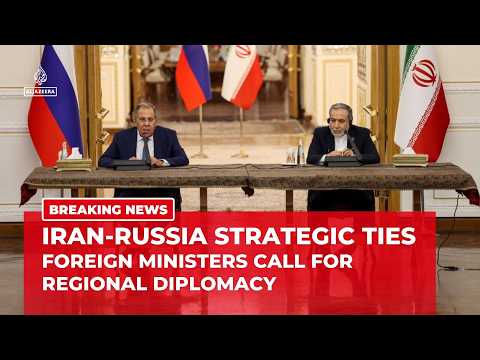
Iran and Russia FMs condemn US-Israeli attacks, call for regional diplomacy
Al Jazeera English
Summary
Iranian Foreign Minister Abbas Araghchi and Russian Foreign Minister Sergey Lavrov held a joint press conference to reaffirm their strategic partnership and condemn American and Israeli military aggression against Iran. Lavrov announced that bilateral trade is projected to grow toward 10% under Eurasian free trade agreements and confirmed that Russian specialists are working to bring an Iranian nuclear facility back into operation. Both ministers blamed Western policies for instability in the Strait of Hormuz, global oil markets, Ukraine, and Gaza, where Araghchi stated more than 80,000 Palestinians have been killed.
The talks highlight deepening coordination between Moscow and Tehran across BRICS, the United Nations, and Eurasian security forums to counter Western influence. Moving forward, both nations are promoting a collective security framework for the Persian Gulf involving Iran and the Gulf Cooperation Council while urging the removal of American military bases, alongside scheduled bilateral summits in Moscow, New York, and Minsk.
How time-sensitive the topic is: Developing story
By the numbers
1%: Sergey Lavrov states that bilateral trade exchange between Russia and Iran was boosted by 1% last year. (Mentioned at 8:23)
10%: Sergey Lavrov projects that bilateral trade growth between Russia and Iran will reach roughly 10% following free trade agreements. (Mentioned at 8:31)
80 years: Sergey Lavrov says Russia renewed its humanitarian services presence in Iran for the first time in 80 years. (Mentioned at 9:47)
10,000 students: Sergey Lavrov notes there are around 10,000 Iranian students currently studying in Russian universities. (Mentioned at 10:07)
80,000 Palestinians: Abbas Araghchi claims that unjustified Western support for Israel has led to the killing of more than 80,000 Palestinians in Gaza. (Mentioned at 24:27)
5,000 fighter jets: Abbas Araghchi claims NATO stated a few days ago that more than 5,000 American fighter jets flew from European bases toward Iran. (Mentioned at 25:08)
Questions this video answers
What did Sergey Lavrov say about Russia's involvement with Iran's nuclear facilities?
Sergey Lavrov stated that Russia will never give up technological and economic cooperation with Iran despite international pressure, confirming that Russian colleagues are actively working to bring an Iranian nuclear facility back into operation. This demonstrates Moscow's willingness to provide material technical support to Tehran even after military strikes.
Sergey Lavrov, 6:00 to 10:11
From this keypoint: Lavrov Pledges Nuclear and Trade Support
Who do Iran and Russia blame for instability in the Strait of Hormuz?
Abbas Araghchi and Sergey Lavrov blame US and Israeli military aggression and economic blockades against Iran for causing insecurity in the Persian Gulf and the Strait of Hormuz. Lavrov stressed that returning to pre-crisis maritime normalcy requires guarantees that military aggression against Iran will not be repeated.
Abbas Araghchi, 2:22 to 5:58
From this keypoint: US-Israeli Actions Blamed for Gulf Instability
What is the collective security proposal for the Persian Gulf discussed by Lavrov and Araghchi?
The proposal is a regional diplomatic framework studied for over a year that brings together Iran and the Gulf Cooperation Council (GCC) states to build trust and ensure stability without foreign military intervention. Araghchi added that American bases in the region failed to defend themselves and that security should be managed exclusively by regional countries.
Sergey Lavrov, 28:11 to 31:07
From this keypoint: Collective Security Proposal for the Persian Gulf
How is bilateral trade between Iran and Russia changing under their strategic partnership?
Sergey Lavrov reported that bilateral trade exchange grew by 1% last year and is projected to reach roughly 10% growth thanks to their strategic agreement and the free trade pact between Iran and the Eurasian Economic Union. Both ministers emphasized ongoing work in transport and commercial committees to overcome sanctions.
Sergey Lavrov, 6:00 to 10:11
From this keypoint: Lavrov Pledges Nuclear and Trade Support
What claims did Abbas Araghchi make about European involvement in the war against Iran?
Abbas Araghchi claimed that NATO recently disclosed that more than 5,000 American fighter jets flew from European bases toward Iran over nine months of conflict, and noted that France sent messages supporting Donald Trump. He argued that European nations are now suffering domestic economic and social crises as a direct result of these policies.
Abbas Araghchi, 23:30 to 27:47
From this keypoint: Araghchi Condemns European Backing for US Strikes
How did Sergey Lavrov respond to claims that Russia and Iran are responsible for high global oil prices?
Sergey Lavrov denied that Russia destabilized energy markets, blaming the Biden administration and European governments for boycotting Russian energy supplies. He stated that Russia relies on stable oil prices for sustainable national budget planning.
Sergey Lavrov, 17:25 to 19:14
From this keypoint: Oil Market Volatility Blamed on Western Sanctions
What is Russia's position on peace negotiations with Ukraine and Europe?
Sergey Lavrov stated that while Russia remains committed to achieving the objectives of its military operation, neither Kyiv nor European governments are currently ready for negotiations. He also thanked Iran for its objective understanding of the conflict.
Sergey Lavrov, 14:01 to 17:20
From this keypoint: Lavrov Reaffirms Ukraine War Objectives
Why did Sergey Lavrov criticize Ukraine's religious and language policies?
Responding to a question about ideological wars, Lavrov accused the Ukrainian government of attacking the Russian Orthodox Church and banning the Russian language across schools, universities, and media outlets. He contrasted this with Iran, where he noted multiple languages including Arabic and Hebrew are spoken without prohibition.
Sergey Lavrov, 19:16 to 23:26
From this keypoint: Lavrov Accuses Ukraine of Language and Church Bans
What diplomatic approach do Russia and Iran support for Yemen and the South Caucasus?
Sergey Lavrov called for renewing dialogue in Yemen based on the 2023 roadmap prepared by Saudi Arabia and keeping the Palestinian issue at the forefront of UN efforts. For the South Caucasus, he highlighted joint Iranian-Russian support for the 3+3 regional consultation format involving Armenia, Azerbaijan, Georgia, Iran, Russia, and Turkey.
Sergey Lavrov, 10:14 to 13:56
From this keypoint: Calls for Hormuz Normalization and Regional Peace
How does Iran view the presence of US military bases in the Middle East?
Abbas Araghchi stated that the recent conflict showed American military bases in the region cause trouble rather than provide security, claiming that US bases were targeted and destroyed after failing to defend themselves. He urged neighboring states to establish regional peace arrangements free of foreign military forces.
Abbas Araghchi, 31:11 to 32:28
From this keypoint: Araghchi Calls US Regional Bases a Liability
Credible AI™ signals
Confidence: Official State Messaging. The broadcast captures a primary diplomatic press conference between Iranian Foreign Minister Abbas Araghchi and Russian Foreign Minister Sergey Lavrov. While it accurately reflects official state positions and bilateral agreements, both officials make sweeping, unverified geopolitical and military claims that go unchallenged.
Bias: Anti-Western State Alignment. As a joint press conference by Iranian and Russian foreign ministers, the remarks exclusively advance Moscow and Tehran's shared geopolitical narrative, attributing all regional instability, economic sanctions, and military conflicts in West Asia and Ukraine to US, Israeli, and European policies.
Originality (72%): Primary Diplomatic Record. The footage provides direct, unedited access to high-level bilateral statements in Tehran following military escalations, offering primary documentation of how Russia and Iran publicly coordinate their economic, nuclear, and regional security messaging.
Depth (58%): Broad Diplomatic Rhetoric. The ministers outline multiple bilateral mechanisms, trade targets, and regional frameworks like the 3+3 Caucasus platform and Gulf collective security, though much of the runtime relies on standard diplomatic talking points rather than granular policy analysis.
Key points (10)
Short (11 min): key points 1, 3 and 8
Medium (16 min): key points 1, 2, 3, 6 and 8
Relaxed (31 min): all 10 key points
1. Araghchi Touts Iran-Russia Strategic Pact
Timestamp: 00:00:02 to 00:02:13 (2 min)
Speaker: Abbas Araghchi
Abbas Araghchi states that relations between Moscow and Tehran have progressed significantly following the strategic partnership agreement signed in the Kremlin. He notes that ministerial and presidential exchanges, including meetings in Turkmenistan, are actively advancing practical economic and commercial mechanisms. Both nations aim to overcome existing obstacles to accelerate bilateral trade.
Impact: High. Why it matters: Formalizing practical trade mechanisms helps both heavily sanctioned states build resilient commercial channels outside Western financial systems.
“We have examined these mechanism in order to boost the economic cooperation between Russia and Iran and we are achieving a good progress in this regard.”
In the video: Abbas Araghchi, at 1:03
For: Sergey Lavrov
2. US-Israeli Actions Blamed for Gulf Instability
Timestamp: 00:02:22 to 00:05:58 (4 min)
Speaker: Abbas Araghchi
Addressing regional crises from Palestine and Lebanon to Ukraine, Abbas Araghchi asserts that political disputes cannot be resolved through military force. He attributes the lack of security in the Persian Gulf and the Strait of Hormuz directly to American and Israeli military aggression and economic blockades against Iran. He concludes that deeper cooperation through BRICS and Eurasian institutions is needed to counter unipolarity and stabilize the region.
Impact: High. Why it matters: Framing Strait of Hormuz insecurity solely as a byproduct of US and Israeli actions positions Tehran to demand sanction and military relief as a precondition for maritime calm.
“The war that has been imposed by America and the Zanist entity in addition to the economic block and siege are the reasons behind the lack of security in our region.”
In the video: Abbas Araghchi, at 3:35
For: Sergey Lavrov
3. Lavrov Pledges Nuclear and Trade Support
Timestamp: 00:06:00 to 00:10:11 (4 min)
Speaker: Sergey Lavrov
Sergey Lavrov affirms Russia's commitment to the strategic partnership, noting that Moscow opposed attempts at the United Nations to justify American and Israeli attacks on Iran and supplied humanitarian food and medicine. He reports that bilateral trade grew by 1% last year and is projected to reach 10% following the Eurasian free trade agreement.
Impact: High. Why it matters: Moscow's public pledge to restore an Iranian nuclear facility and expand Eurasian trade signals that Western pressure has not deterred Russian technical backing for Tehran.
“Russia will never give up cooperation with Iran in the technology domain, economic domain. Our colleagues are now bringing back the nuclear facility to operate again.”
In the video: Sergey Lavrov, at 9:00
For: Abbas Araghchi
4. Calls for Hormuz Normalization and Regional Peace
Timestamp: 00:10:14 to 00:13:56 (4 min)
Speaker: Sergey Lavrov
Sergey Lavrov states that Russia and Iran are coordinating across the UN, BRICS, the Shanghai Cooperation Organisation, and the Organization of Islamic Cooperation to oppose unilateral policies. He emphasizes the necessity of returning to pre-crisis conditions in the Strait of Hormuz with guarantees against future attacks on Iran. He also calls for reviving the 2023 Saudi-prepared roadmap for Yemen, keeping Palestine at the top of the international agenda, and advancing the 3+3 Caucasus dialogue.
Impact: High. Why it matters: Linking Strait of Hormuz normalization to explicit security guarantees for Iran establishes Moscow's diplomatic baseline for any broader Middle East de-escalation.
“It's quite important to go back to the normal situation before the crisis in the uh straight of Hormuz and the Gulf and we need to guarantee that the aggression will never happen again.”
In the video: Sergey Lavrov, at 12:04
For: Abbas Araghchi
5. Lavrov Reaffirms Ukraine War Objectives
Timestamp: 00:14:01 to 00:17:20 (3 min)
Speaker: Sergey Lavrov
Turning to Ukraine, Sergey Lavrov thanks Iran for its understanding of Russia's position and reiterates that Moscow remains committed to the objectives of its military operation. He claims that neither Kyiv nor European governments are ready for serious negotiations. The segment concludes with the moderator opening the press conference to media questions, starting with a journalist asking about European blame for high oil prices and US claims of ideological warfare.
Impact: Medium. Why it matters: Reiterating uncompromising war goals while inviting Iran to the Minsk Eurasian security conference underscores how Moscow integrates Tehran into its broader security architecture.
“I have said that we will be committed to the objectives of the military operation. The negotiations will help, but no one in Kiev and no one in Europe are ready for that.”
In the video: Sergey Lavrov, at 14:13
Neutral: YouTube: Al Jazeera English
6. Oil Market Volatility Blamed on Western Sanctions
Timestamp: 00:17:25 to 00:19:14 (2 min)
Speaker: Sergey Lavrov
Responding to a question on energy markets, Sergey Lavrov cites Vladimir Putin to argue that Russia did not initiate attacks on Ukrainian infrastructure or destabilize global oil prices. Instead, he blames European governments and the Biden administration for proudly boycotting Russian energy resources. He insists that Moscow prefers stable oil prices to support sustainable budget planning rather than short-term crisis windfalls.
Impact: Medium. Why it matters: Deflecting blame for energy inflation onto Western sanctions aims to exploit domestic economic anxieties within European consumer nations.
“President Putin said more than once that Russia has not started this war and the instability in the oil market is not because of the Russian. It's because of the Europeans and the Biden administration”
In the video: Sergey Lavrov, at 17:57
7. Lavrov Accuses Ukraine of Language and Church Bans
Timestamp: 00:19:16 to 00:23:26 (4 min)
Speaker: Sergey Lavrov
Addressing the US Secretary of State's remark on ideological wars, Sergey Lavrov accuses the Ukrainian government of waging a campaign against the Russian Orthodox Church and banning the Russian language in schools, universities, and media. He contrasts Kyiv's policies with Iran, claiming that Tehran permits residents to speak Arabic, Hebrew, and other languages freely without persecution. He concludes that Russia is fighting to defend the cultural and religious rights of Russian speakers.
Impact: Medium. Why it matters: Contrasting Ukrainian language laws with minority practices in Iran allows Moscow to reframe its military campaign as a defense of religious and linguistic rights.
“But the war against the church in Ukraine started and they uh um burned every Russian thing. They prevented Russian language from the schools, from the universities.”
In the video: Sergey Lavrov, at 20:24
8. Araghchi Condemns European Backing for US Strikes
Timestamp: 00:23:30 to 00:27:47 (4 min)
Speaker: Abbas Araghchi
Abbas Araghchi argues that European states are suffering social and economic crises due to their own miscalculations in Ukraine, Gaza, and Iran. He claims that unilateral Western backing for Israel enabled the killing of more than 80,000 Palestinians in Gaza, and cites NATO statements that over 5,000 American fighter jets flew from European bases toward Iran during nine months of conflict. He insists that the US failed to defeat the Islamic Republic and must return to diplomacy.
Impact: High. Why it matters: Highlighting the use of European airbases for US sorties against Iran directly challenges European claims of non-belligerence and warns of diplomatic repercussions.
“where the NATO few days ago spoke about more than 5,000 American fight jets have flown from European bases towards Iran.”
In the video: Abbas Araghchi, at 25:03
9. Collective Security Proposal for the Persian Gulf
Timestamp: 00:28:11 to 00:31:07 (3 min)
Speaker: Sergey Lavrov
Answering a Russian news agency question on collective security, Sergey Lavrov explains that Russia has promoted a Gulf collective security concept involving Iran and the GCC states for over a year. He notes that building trust among Gulf nations and incorporating UN Security Council permanent members and Islamic organizations can foster regional stability. He adds that Iran could also engage with parallel regional frameworks involving Saudi Arabia, Turkey, and Pakistan.
Impact: High. Why it matters: Promoting a Gulf security architecture that pairs GCC states with Iran and UN Security Council guarantors seeks to supplant the traditional US-led security umbrella.
“Our formula is called collective security in the Gulf. It is understood that the countries around this Gulf including the GCC and Iran, we have studied this idea for more than a year”
In the video: Sergey Lavrov, at 28:11
For: Abbas Araghchi
10. Araghchi Calls US Regional Bases a Liability
Timestamp: 00:31:11 to 00:32:28 (1 min)
Speaker: Abbas Araghchi
In closing remarks, Abbas Araghchi states that the recent war demonstrated that American military bases in the Middle East cause trouble rather than provide protection. He claims these US installations failed to defend themselves and were targeted and destroyed during hostilities. Consequently, Iran welcomes security initiatives crafted exclusively by regional countries without any foreign military presence.
Impact: High. Why it matters: Asserting that US bases were destroyed and unable to defend themselves aims to persuade Gulf host nations that American forces are a strategic liability.
“These American bases failed to defend themselves. The American bases have been targeted and destroyed. We welcome any initiative that will bring peace peace for the region”
In the video: Abbas Araghchi, at 31:36
Conflicts of interest (1)
State Diplomatic Advocacy by Belligerents
Political Activist conflict, High severity
Abbas Araghchi and Sergey Lavrov serve as the chief diplomats for Iran and Russia, two governments actively engaged in the military conflicts and sanctions disputes they are evaluating.
Sources: Abbas Araghchi, Sergey Lavrov
Significance: Both speakers frame military hostilities, casualty figures, and economic disruptions exclusively to absolve their own governments and rally international opposition against US and European policies.
Key sources
Abbas Araghchi: Foreign Minister of Iran
Sergey Lavrov: Foreign Minister of Russia
YouTube: Al Jazeera English: Broadcasting Channel and Unidentified Press Conference Speakers
Who's in this
Vladimir Putin
United Nations
BRICS
Eurasian Economic Union
Gulf Cooperation Council
NATO
Volodymyr Zelenskyy
Donald Trump
Joe Biden
Russian Orthodox Church
Also mentioned
Russia (First mentioned at 0:05)
Iran (First mentioned at 0:05)
Persian Gulf (First mentioned at 2:13)
Ukraine (First mentioned at 2:24)
United States (First mentioned at 2:28)
Strait of Hormuz (First mentioned at 3:13)
Israel (First mentioned at 3:24)
Europe (First mentioned at 14:25)
Masoud Pezeshkian (First mentioned at 1:54)
Palestine (First mentioned at 2:54)
Middle East (First mentioned at 12:51)
United Nations Security Council (First mentioned at 13:18)
Gaza (First mentioned at 24:28)
Kremlin (First mentioned at 0:27)
West Asia (First mentioned at 2:13)
Yemen (First mentioned at 2:54)
Lebanon (First mentioned at 2:57)
Caspian Sea (First mentioned at 4:17)
Afghanistan (First mentioned at 4:21)
Pakistan (First mentioned at 4:27)
Shanghai Cooperation Organisation (First mentioned at 5:01)
Moscow (First mentioned at 7:46)
United Nations Charter (First mentioned at 10:23)
Organization of Islamic Cooperation (First mentioned at 11:07)
Saudi Arabia (First mentioned at 12:36)
Turkey (First mentioned at 13:52)
Kyiv (First mentioned at 14:25)
Minsk (First mentioned at 15:16)
France (First mentioned at 25:20)
Turkmenistan (First mentioned at 1:45)
Kazakhstan (First mentioned at 7:52)
Armenia (First mentioned at 13:49)
Azerbaijan (First mentioned at 13:49)
Georgia (First mentioned at 13:49)
New York (First mentioned at 14:58)
Mecca (First mentioned at 30:11)
This analysis was generated by skim (skim.plus), an AI-powered content analysis platform by Credible AI. Scores and classifications represent the platform's AI-generated assessment and should be considered alongside other sources.