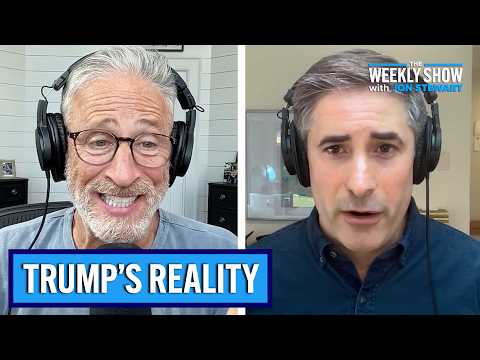
The Weekly Show with Jon Stewart's Jonathan Swan’s Dive into Trump’s Reality | The Weekly Show with Jon Stewart: skim's analysis identifies 12 key moments, with 3 potential conflicts of interest flagged. New York Times reporter Jonathan Swan joins Jon Stewart to examine how Donald Trump's second administration operates without the legal guardrails or internal factions of his first term, focusing on the ongoing Iran war and depleted U.
Category: Politics. Format: Interview. YouTube video analyzed by skim.
skim AI Analysis
Credibility assessment: Sourced Investigative Depth. Jonathan Swan anchors his claims in specific New York Times reporting and his book Regime Change, refusing to speculate beyond what his sources establish. Even when Jon Stewart invites psychological theories about officials, Swan repeatedly stops at the boundary of his reporting and notes where confidential national security sourcing limits him.
Bias assessment: Anti-Trump Satirical Lens. Jon Stewart and his producers openly ridicule Donald Trump, JD Vance, and Republican officials with sharp satire and profanity. Jonathan Swan maintains a disciplined, fact-focused reporter's posture, balancing the host's partisan mockery with measured descriptions of internal White House decision-making.
Originality: 86% — Insider Reporting & Craft. The conversation combines fresh behind-the-scenes reporting on the Iran war and Trump's second-term legal apparatus with a candid look at high-stakes television interviewing. Swan's breakdown of studying Oriana Fallaci, Mike Wallace, and Andrew Neil after his 2018 interview offers rare practical insight into journalism.
Depth: 88% — Structural Power Analysis. Rather than treating Trump's second term as mere personality drama, the discussion examines structural shifts: the 2024 Supreme Court immunity ruling, the replacement of cautious White House counsel with permissive lawyers, the collapse of congressional oversight, and the economic pressures facing corporate-owned journalism.
Key Points (12)
1. Swan on No White House Denials of Regime Change
Timestamp: 00:03:09 to 00:06:35
Jonathan Swan notes that while Donald Trump posted angry attacks on Truth Social calling his book fake, senior administration officials have made no specific denials of its Situation Room or Oval Office scenes. Vice President JD Vance even suggested on Megyn Kelly's podcast that the authors might have tapes from the Situation Room. Meanwhile, insiders have privately told Swan that the Iran war's depletion of U.S. weapons stockpiles is even worse than reported, triggering leak investigations and FBI visits to his colleagues' homes.
Significance (High): The absence of specific official denials alongside aggressive federal leak investigations suggests the administration views the national security reporting as accurate and politically damaging.
Sources in support: Jonathan Swan (White House reporter for The New York Times and co-author of Regime Change), Jon Stewart (Host of The Weekly Show and The Daily Show)
2. Reporting Depleted U.S. Weapons Stockpiles
Timestamp: 00:06:35 to 00:13:15
Reporting on depleted U.S. air defense interceptors and missiles requires navigating extreme secrecy from Central Command, which argues that publishing stockpile numbers tips off enemies. Swan counters that Russia and China already track U.S. inventories through spies and electronic surveillance, meaning the American public deserves to know the state of its arsenal in an undeclared war. Because sources risk prison and espionage charges to share classified figures, Swan refuses to discuss his exact verification methods to avoid giving legal ammunition to prosecutors.
Significance (High): Exposing munition shortages challenges the administration's narrative of a cost-free conflict while placing national security reporters and their confidential sources under severe legal threat.
Sources in support: Jonathan Swan (White House reporter for The New York Times and co-author of Regime Change), Jon Stewart (Host of The Weekly Show and The Daily Show)
3. Inert Congress Leaves War Without Oversight
Timestamp: 00:13:15 to 00:16:50
Unlike the Watergate or Pentagon Papers eras, investigative reporting on the Iran war produces little formal accountability because Congress has abandoned its oversight role and courts defer heavily to the president on national security. While Trump claimed the Iranian military was demolished, Swan's team reported that Iran regained access to 30 of its 33 cruise missile sites along the Strait of Hormuz. Even if Democrats win the House and issue subpoenas, enforcement relies on a Justice Department run by Trump's former personal lawyer.
Significance (High): When legislative and judicial checks retreat, factual journalism can turn public opinion against a war but cannot trigger institutional enforcement on its own.
Sources in support: Jonathan Swan (White House reporter for The New York Times and co-author of Regime Change), Jon Stewart (Host of The Weekly Show and The Daily Show)
4. Immunity Ruling Unleashed Second-Term Power
Timestamp: 00:18:01 to 00:23:38
Swan explains that the Supreme Court's 2024 immunity ruling and a revamped legal apparatus made Trump's second term unrecognizable compared to his first. Where first-term counsels like Don McGahn maintained a firewall with the Justice Department, Trump now privately jokes about pardoning anyone within 200 feet of the Oval Office and relies on aggressive lawyers selected by Stephen Miller. This permissive legal environment allowed Trump to bypass Coast Guard law enforcement and order lethal military strikes blowing up fishing boats suspected of trafficking cocaine.
Significance (High): Replacing institutionalist lawyers with permissive loyalists under the shield of presidential immunity removes internal barriers to lethal executive action.
Sources in support: Jonathan Swan (White House reporter for The New York Times and co-author of Regime Change), Jon Stewart (Host of The Weekly Show and The Daily Show)
5. Post-2020 Lawyer Shopping Replaced Factions
Timestamp: 00:23:38 to 00:30:10
Jon Stewart and Jonathan Swan trace how Trump's post-2020 election effort—where he bypassed loyalist lawyers like Bill Barr who refused to overturn the vote in favor of Sidney Powell and Rudy Giuliani—taught him to eliminate internal pushback entirely in his second term. Although Swan notes he has no reporting that Trump's team expected the Capitol riot itself, Trump returned to office determined to staff only compliant officials. Consequently, first-term factional leaks have dried up because no senior officials view their job as protecting the country from the president.
Significance (High): Eliminating internal rivals and institutionalist officials has unified the White House and made inside-the-room reporting significantly harder.
Sources in support: Jonathan Swan (White House reporter for The New York Times and co-author of Regime Change), Jon Stewart (Host of The Weekly Show and The Daily Show)
6. Vance Opposed Iran War as Bessent Curbed Tariffs
Timestamp: 00:30:10 to 00:34:08
When Jon Stewart asks whether the worsening Iran war erodes administration loyalists' belief in Trump's competence, Swan reveals that JD Vance was the lone inner-circle official who argued against the war beforehand, irritating Trump. Despite his private opposition, Vance publicly defended the decision by claiming Trump was too smart to let it go badly. Swan adds that officials are not all blind sycophants, noting that Scott Bessent and Howard Lutnick recognized bond market turmoil during Trump's global trade war and persuaded him to pause tariffs on most countries except China.
Significance (Medium): Even inside a loyalist administration, severe market reactions and military risks force pragmatic officials to privately push for course corrections.
Sources in support: Jonathan Swan (White House reporter for The New York Times and co-author of Regime Change), Jon Stewart (Host of The Weekly Show and The Daily Show)
7. Swan Details Trump's Miscalculation on Iran
Timestamp: 00:37:36 to 00:41:36
According to Jonathan Swan, Trump entered the war believing at a cellular level that the Iranian regime would collapse quickly, causing him to ignore warnings about weapons stockpiles and the Strait of Hormuz. Shocked when Iran kept fighting and expressing disbelief to Joint Chiefs Chairman General Caine, Trump pivoted to diplomacy in April and unveiled a June memorandum of understanding. However, the 60-day deadline expired in August without a deal, and heavy strikes hit a U.S. base in Jordan the night before taping, leaving Trump flailing without a strategy.
Significance (High): Assuming a rapid regime collapse left the United States trapped in an escalating conflict with depleted munitions and a failed diplomatic exit.
Sources in support: Jonathan Swan (White House reporter for The New York Times and co-author of Regime Change), Jon Stewart (Host of The Weekly Show and The Daily Show)
8. Actions Show Trump Knows the Iran War Is Failing
Timestamp: 00:41:36 to 00:45:06
While Trump publicly spins gas prices and casualties, Swan argues that realities like bond markets, gas prices, and dead American service members are too intrusive for him to ignore. Proof that Trump recognizes the Iran war's reality lies in his actions since April: instead of escalating, he authorized JD Vance, Jared Kushner, and Steve Witkoff to negotiate a settlement to exit the conflict. Swan declines to speculate on whether aides now view Trump as incompetent, noting many simply view him as an instinct player.
Significance (High): Watching a president's private diplomatic orders rather than his public rhetoric reveals when material setbacks have punctured his political spin.
Sources in support: Jonathan Swan (White House reporter for The New York Times and co-author of Regime Change), Jon Stewart (Host of The Weekly Show and The Daily Show)
9. Studying Fallaci and Wallace for 2020 Interview
Timestamp: 00:45:06 to 00:55:35
Swan reveals that his widely criticized 2018 interview with Trump was his first-ever on-camera television interview, prompting him to build a personal curriculum studying master interviewers Oriana Fallaci, Mike Wallace, and Andrew Neil. From them, he learned that deep preparation and studying a subject's programmed answers liberate an interviewer to put notes aside, listen closely, and press to a third or fourth follow-up question. That approach produced the viral 2020 Axios interview moment when Swan examined Trump's COVID-19 charts on camera, though Swan notes Trump now mostly avoids serious sit-downs in favor of friendly outlets and easily controlled press briefings.
Significance (Medium): Exhaustive preparation paired with active listening remains the only reliable method to unhorse rehearsed politicians in accountability interviews.
Sources in support: Jonathan Swan (White House reporter for The New York Times and co-author of Regime Change), Jon Stewart (Host of The Weekly Show and The Daily Show)
10. How Aides Feed Trump's Reality Distortion Field
Timestamp: 00:57:16 to 01:04:50
After Jon Stewart compares Trump's denial of reality to Roy Cohn denying he had AIDS to Mike Wallace, Swan explains that Trump sometimes genuinely believes false claims, such as insisting after an interview with Terry Moran that a photoshopped MS-13 tattoo on Abrego Garcia's fist was real. By contrast, Trump knows his public boasts about ample Iran war munitions are false because he pulled back from major planned bombing campaigns. Both Stewart and Swan note that aides like Natalie Harp and Housing Finance Agency head Bill Pulte—who brings foam boards to Trump's golf clubs—actively feed him flattering charts that fuel his weekend Truth Social posts.
Significance (Medium): Distinguishing between falsehoods the president genuinely believes and strategic lies he knows are false clarifies how sycophantic aides shape White House behavior.
Sources in support: Jonathan Swan (White House reporter for The New York Times and co-author of Regime Change), Jon Stewart (Host of The Weekly Show and The Daily Show)
11. Corporate Fear vs. New York Times Independence
Timestamp: 01:04:50 to 01:15:49
Swan notes that HBO canceled Axios two weeks after it won an Emmy, and Jon Stewart shares that Apple restricted political guests on his former show out of fear of government retaliation like Ron DeSantis suing Disney. Because tech and streaming conglomerates prioritize phone sales and mergers, investigative journalism only threatens their bottom line, whereas Swan argues The New York Times can withstand Trump's lawsuits and FBI visits because the Sulzberger family focuses solely on news. However, Swan and Stewart agree that tough interviews dry up future bookings and train social media audiences to demand blood rather than insight.
Significance (High): Corporate media consolidation leaves investigative national security reporting dependent on a handful of single-purpose news institutions that do not rely on government mergers or licenses.
Sources in support: Jonathan Swan (White House reporter for The New York Times and co-author of Regime Change), Jon Stewart (Host of The Weekly Show and The Daily Show)
12. Stewart on Satire's Limits and Trump's 9/11 Claims
Timestamp: 01:23:07 to 01:33:57
In the post-interview breakdown and listener Q&A with producers Gillian Spear and Brittany Mehmedovic, the team discusses how politicians now avoid tough interviews and how the administration uses a planned list of distractions to derail negative news cycles. Answering a listener question about whether The Daily Show causes 'political diabetes,' Stewart explains that satire must calibrate its outrage and preserve fairness rather than become an ungrounded outrage machine. Finally, asked why Trump seeks credit for 9/11 efforts, Stewart and his producers critique Trump's narcissism and compare America's re-election of him to returning to a destructive ex-partner.
Significance (Low): Self-aware political satire requires constant internal calibration so that exposing official hypocrisy does not degenerate into reflexive, exhausting outrage.
Sources in support: Jon Stewart (Host of The Weekly Show and The Daily Show), Gillian Spear (Producer of The Weekly Show), Brittany Mehmedovic (Producer of The Weekly Show)
This analysis was generated by skim (skim.plus), an AI-powered content analysis platform by Credible AI. Scores and classifications represent the platform's AI-generated assessment and should be considered alongside other sources.