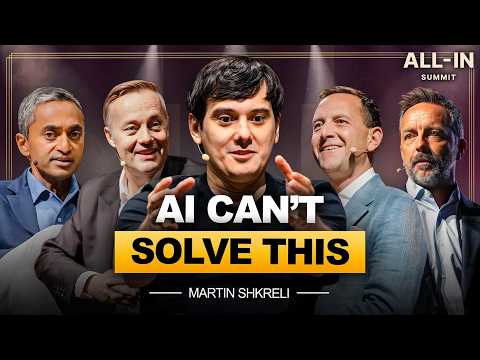
Martin Shkreli: Big Pharma's Blind Spot, Betting Against Quantum & What Prison Taught Him
All-In Podcast
Summary
Martin Shkreli joins the All-In podcast to lay out his contrarian financial and technical positions across frontier technologies. He details why he shorts quantum computing stocks, arguing that physical quantum hardware operates at slow clock speeds and provides performance advantages strictly for integer factorization rather than general computing. Shkreli also challenges predictions that artificial intelligence will revolutionize biotechnology, asserting that biological clinical trials remain the real development bottleneck and projecting zero AI-discovered drugs will achieve commercial approval within the next decade.
Reflecting on his career as a biotech entrepreneur and hedge fund manager, Shkreli outlines how mispriced assets from large pharmaceutical companies enabled his early ventures, including the approval of Sparsentan for rare kidney diseases. He concludes with an introspection on how the psychological trap of intellectual pride and the refusal to admit failure led high-profile founders, including himself, into catastrophic legal ruin.
How time-sensitive the topic is: Evergreen
By the numbers
23% percent net per year: Annual net return generated by Jim Cramer's hedge fund according to Martin Shkreli (Mentioned at 8:23)
2 million dollars: Purchase price paid to Bristol Myers for an uncommercialized drug asset (Mentioned at 9:03)
6 billion dollars: Current public market capitalization of the firm spun out from that purchased molecule (Mentioned at 9:05)
40 million medical papers: Estimated body of published medical papers Shkreli attempted to ingest with NLP in 2015 (Mentioned at 9:59)
30,000 patients: Patient population suffering from FSGS treated by the newly approved Sparsentan (Mentioned at 10:35)
400 billion dollars: Venture capital capital cited as redirected toward AI hardware and tokens (Mentioned at 16:46)
10 years: Timeframe in which Shkreli expects zero clinically approved AI-discovered drugs (Mentioned at 16:10)
Questions this video answers
Why is Martin Shkreli betting against quantum computing companies?
Shkreli argues that quantum computers run at slow clock speeds in hertz, lack working memory architectures, and provide polynomial speedups exclusively for integer factorization. Because factoring numbers is not an everyday business application, he views enterprise quantum claims as commercially unviable.
1:49 to 5:05
From this keypoint: Martin Shkreli details why he shorts quantum tech
Can artificial intelligence discover new approved pharmaceuticals?
Shkreli claims AI does not resolve wet-lab clinical development challenges and expects zero relevant drugs discovered by AI to achieve approval in the next decade. He argues computational chemistry tools have existed for decades without solving underlying biological validation obstacles.
16:00 to 16:40
From this keypoint: Skepticism of AI impacts on drug discovery
How did Martin Shkreli build value in biotechnology assets?
He acquired neglected clinical-stage compounds from pharmaceutical conglomerates like Bristol Myers and Pfizer at nominal costs. By clinically repurposing Sparsentan for an orphan kidney disease with no existing treatments, he established an FDA-approved drug worth billions.
10:09 to 10:57
From this keypoint: Repurposing Sparsentan for rare kidney disease
What psychological factors led to Martin Shkreli's prison sentence?
Shkreli identifies an obsession with protecting an identity as a gifted trader as the driving factor behind his downfall. Refusing to admit shortcomings in public markets led to reckless choices that could have been avoided by focusing solely on entrepreneurship.
22:35 to 23:52
From this keypoint: Gifted identity traps and white-collar downfalls
Credible AI™ signals
Confidence: Practitioner Perspective. Martin Shkreli draws on direct personal experience founding biotech companies and trading markets. While he offers sharp technical critiques of quantum computing and drug discovery, many assertions reflect personal market convictions and contrarian assessments rather than consensus scientific data.
Bias: Contrarian Accelerationist. Shkreli explicitly embraces the effective accelerationism movement while expressing strong disdain for AI doom narratives and effective altruism. His view prioritizes aggressive technological expansion and free-market pricing mechanics.
Originality (88%): Unfiltered Insider Critique. Offers unconventional technical counterarguments against quantum computing commercialization, skeptical views on AI biotechnology integration, and candid psychological post-mortems regarding high-profile white-collar crime.
Depth (80%): Rigorous Technical Discourse. The discussion delves into algorithmic time complexity, hardware limitations of quantum processors, matrix multiplication mechanics, and the practical regulatory pipeline of clinical pharmaceuticals.
Key points (12)
Short (6 min): key points 1, 3 and 8
Medium (7 min): key points 1, 3, 8 and 11
Relaxed (16 min): all 12 key points
1. Martin Shkreli details why he shorts quantum tech
Timestamp: 00:01:49 to 00:05:05 (3 min)
Quantum computing is fundamentally misunderstood as merely faster computing, when it is primarily designed around specialized algorithms like Shor's algorithm for integer factorization. Standard operations like sorting remain far slower on quantum devices due to low clock speeds, lack of random access memory, and single-threaded architectures. Shkreli confirmed he maintains short positions against quantum companies despite incurring financial losses.
Impact: High. Why it matters: Reframes public market hype around quantum computing toward fundamental algorithmic constraints and away from near-term enterprise utility.
“The modern quantum computers run at a clock speed of hundreds of hertz or thousands of hertz, not at the gigahertz that we're used to.”
In the video: Martin Shkreli, at 3:17
For: Martin Shkreli
Neutral: YouTube: All-In Podcast
2. Analog optical computing could replace digital GPUs
Timestamp: 00:06:19 to 00:07:41 (1 min)
Modern artificial intelligence primarily depends on cubic-time matrix multiplication workloads running on digital silicon. Analog optical and photonic computing methods allow matrix multiplication to occur nearly instantaneously using light waves. Shkreli projects that optical hardware startups could eventually outperform traditional silicon architectures.
Impact: Medium. Why it matters: Highlights physical bottlenecks in semiconductor scaling and identifies photonic computing as an alternative architecture.
For: Martin Shkreli
3. Arbitrage opportunities in pharmaceutical licensing
Timestamp: 00:08:06 to 00:10:09 (2 min)
Major pharmaceutical conglomerates frequently misprice or abandon valuable drug assets due to internal bureaucracy. Shkreli entered the biotech sector after trading for Jim Cramer, discovering immense valuation upside by purchasing neglected clinical patents for nominal sums. He cites acquiring a molecule from Bristol Myers for two million dollars that subsequently formed the foundation of a multi-billion dollar public entity.
Impact: High. Why it matters: Demonstrates structural mispricings in biotech licensing and how financial engineering reprofiles neglected assets.
“Fiser would sell you a drug for a million bucks that was worth a billion dollars. They didn't care.”
In the video: Martin Shkreli, at 9:11
For: Martin Shkreli
Neutral: YouTube: All-In Podcast
4. Repurposing Sparsentan for rare kidney disease
Timestamp: 00:10:09 to 00:10:57 (1 min)
Repositioning compounds from saturated therapeutic categories into orphan indications creates enormous commercial and clinical value. Sparsentan was initially engineered by Bristol Myers for ordinary hypertension before Shkreli redirected it toward focal segmental glomerulosclerosis. That strategic pivot resulted in formal FDA approval and delivered a targeted therapy for thirty thousand patients who previously had no options.
Impact: High. Why it matters: Shows how regulatory indication pivoting can create both clinical treatments and massive equity appreciation.
“30,000 people who have focusal glamial sclerosis and never never had a drug before now have a drug.”
In the video: Martin Shkreli, at 10:35
For: Martin Shkreli
5. Shkreli questions current AI infrastructure buildouts
Timestamp: 00:11:11 to 00:12:45 (2 min)
Massive capital expenditure commitments in data centers and nuclear power may become obsolete as efficiency improves. Emerging algorithmic paradigms and higher efficiency transformer models could disrupt GPU demand under Jevons paradox dynamics. While maintaining a long exposure to semiconductor equities currently, Shkreli cautions that today's leading chips will eventually hit the scrap heap.
Impact: Medium. Why it matters: Questions long-term infrastructure valuations based on current compute intensity assumptions.
“I do think in in 20 years these H100s are in the scrap heap. B100s are in the scrap heap, B200s in the scrap heap.”
In the video: Martin Shkreli, at 11:32
For: Martin Shkreli
Neutral: YouTube: All-In Podcast
6. Criticism of AI panic and Dario Amodei
Timestamp: 00:13:20 to 00:14:45 (1 min)
Public warnings from leading artificial intelligence executives often reflect theatrical posturing and corporate maneuvering rather than authentic existential peril. Shkreli strongly criticizes Anthropic co-founder Dario Amodei for circulating hyperbolic safety claims while spinning off technology developed at OpenAI. He contends that software poses no direct existential physical threat and can simply be turned off.
Impact: Medium. Why it matters: Challenges mainstream AI safety orthodoxy by framing doom predictions as public relations strategies.
“I think he's a fear-mongerer. I mean, I also think that he, you know, imagine you and I started a business and I I said, I'm going to show you Pandora's box.”
In the video: Martin Shkreli, at 13:32
For: Martin Shkreli
7. Defense of effective accelerationism
Timestamp: 00:14:50 to 00:15:43 (1 min)
Technological advancement should proceed aggressively without regulatory paralysis driven by theoretical future harms. Shkreli helped champion the Effective Accelerationism counter-movement to neutralize risk-averse Effective Altruism philosophies. He insists that engineers should focus on rapid development rather than paralyzing caution during early-stage software development.
Impact: Low. Why it matters: Articulates the core philosophical justification behind Silicon Valley's accelerationist movement.
“I think the fear-mongering is is a little ridiculous and there'll be time to panic. It's just not now.”
In the video: Martin Shkreli, at 15:20
For: Martin Shkreli
8. Skepticism of AI impacts on drug discovery
Timestamp: 00:16:00 to 00:16:40 (1 min)
Predictions that artificial intelligence will cure diseases and overhaul pharmaceutical creation misunderstand the true bottlenecks of clinical validation. Shkreli predicts no clinically relevant drug discovered purely via AI will reach market approval over the coming decade. Computational tools have assisted chemistry for decades without resolving biological wet-lab unpredictability.
Impact: High. Why it matters: Temples inflated venture capital expectations regarding artificial intelligence biotechnology platforms.
“I don't think there'll be a single AI relevant drug in the next 10 years. Um AI does not help drug discovery.”
In the video: Martin Shkreli, at 16:08
For: Martin Shkreli
9. The unbounded market demand for machine intelligence
Timestamp: 00:17:03 to 00:18:28 (1 min)
Market demand for automated intelligence will expand infinitely as enterprise organizations purchase reasoning capacity to replace traditional human consulting. Shkreli envisions autonomous artificial intelligence agents launching full operational corporate divisions in pharma, aviation, and automotive. Corporations will readily allocate billions to query millions of GPU cores on strategic business decisions.
Impact: Medium. Why it matters: Argues for massive total addressable market expansion based on replacing high-end cognitive labor across the economy.
“McDonald's can afford to spend $10 billion and say, "Open open AAI, give me 10 million GPUs. I want to know what the best next sandwich we should launch is."”
In the video: Martin Shkreli, at 18:02
For: Martin Shkreli
Neutral: YouTube: All-In Podcast
10. Consumer internet models as an analog for AI value
Timestamp: 00:18:58 to 00:19:56 (1 min)
Value creation in artificial intelligence mirrors the original buildout of the internet, where end consumers and businesses capture the primary economic surplus. Infrastructure providers capture initial revenues, but consumer distribution networks ultimately secure the durable franchise value. Shkreli singles out Meta as ideally positioned to win because of its massive distribution and consumer product execution.
Impact: Medium. Why it matters: Suggests that long-term margins will accrue to distribution aggregators rather than pure foundation model developers.
“the only winners are going to be consumers and and businesses they get this tax-free kind of internet”
In the video: Martin Shkreli, at 19:03
For: Martin Shkreli
11. Gifted identity traps and white-collar downfalls
Timestamp: 00:22:35 to 00:23:52 (1 min)
High intellectual ability frequently induces psychological traps where individuals refuse to admit incompetence or failure in specific domains. Examining figures like Sam Bankman-Fried, Elizabeth Holmes, and his own past, Shkreli notes that desperate efforts to preserve an image of genius lead to catastrophic decisions. Admitting mediocre hedge fund performance while embracing entrepreneurial talents would have prevented his own criminal conviction.
Impact: High. Why it matters: Examines psychological catalysts underpinning fraud and corporate failure among high-profile founders.
“I had a hard time admitting I was not the best hetero manager in the world, but I was a wonderful entrepreneur. That simple refusal to admit that put me in prison.”
In the video: Martin Shkreli, at 23:06
For: Martin Shkreli
12. Human universalities learned in federal prison
Timestamp: 00:24:19 to 00:25:07 (1 min)
Incarceration strips away external status markers, revealing basic emotional and psychological desires common to all human beings. Shkreli reflects that regardless of background or severity of offense, inmates ultimately yearn for connection, family reconciliation, and parental success. That experience tempered his personal fixation on external reputation and prestige.
Impact: Low. Why it matters: Provides personal psychological insight into how prolonged incarceration reshapes personal values.
“no matter what heights we achieve that at at bottom, you know, like you said earlier, we all want to be the best dad we can”
In the video: Martin Shkreli, at 24:43
For: Martin Shkreli
Key sources
Martin Shkreli: Former Pharmaceutical CEO & Investor
YouTube: All-In Podcast
Who's in this
Chelsea
Scott Aaronson
Peter Shor
Nvidia
Jim Cramer
Dario Amodei
Sam Bankman-Fried
Sparsentan
Also mentioned
OpenAI (First mentioned at 1:57)
Bristol Myers Squibb (First mentioned at 9:01)
Meta (First mentioned at 19:24)
Pfizer (First mentioned at 9:12)
Elizabeth Holmes (First mentioned at 22:42)
This analysis was generated by skim (skim.plus), an AI-powered content analysis platform by Credible AI. Scores and classifications represent the platform's AI-generated assessment and should be considered alongside other sources.