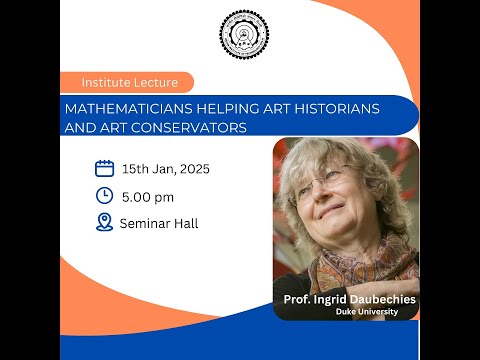
IIT Delhi's Mathematicians Helping Art Historians And Art Conservators By Prof. Ingrid Daubechies: skim's analysis identifies 11 key moments. Mathematician Ingrid Daubechies demonstrates how signal and image processing solve concrete problems in art history and conservation.
Category: Education. Format: Educational. YouTube video analyzed by skim.
skim AI Analysis
Credibility assessment: Primary Research Lecture. Ingrid Daubechies presents firsthand mathematical and art conservation case studies conducted with major museums and academic collaborators, clearly distinguishing what algorithms can compute from the final judgments made by art historians and conservators.
Bias assessment: Interdisciplinary Advocate. The lecture champions applied mathematics and cross-disciplinary collaboration with museums while openly acknowledging algorithmic limitations, failed approaches, and the necessity of keeping human domain experts in the decision loop.
Originality: 90% — Pioneering Case Studies. Rather than surveying standard textbook image processing, the talk details bespoke mathematical solutions to non-standard conservation problems, from reconstructing bombed frescoes and hidden portraits to virtually aging and rejuvenating a 14th-century altarpiece.
Depth: 85% — Applied Mathematical Depth. Tailored for a general academic audience at IIT Delhi, the lecture explains the core mechanisms behind circular harmonics, Fourier thread counting, wavelet feature vectors, Bayesian artifact correction, and crack removal without drowning in formal proofs.
Key Points (11)
1. Circular Harmonics Reconstruct Bombed Frescoes
Timestamp: 00:08:20 to 00:16:29
After World War II bombing reduced the Eremitani Church frescoes in Padua to over 80,000 decorated fragments covering less than 10 percent of the original surface, Massimo Fornasier used circular harmonics to match scanned fragments against pre-war photographs across unknown rotations. Presenting top candidate matches for human conservators to verify proved far more practical and welcome than fully automated placement.
Significance (High): Decomposing images into rotation-predictable basis functions solved a massive combinatorial puzzle on turn-of-the-century workstations while keeping human conservators in control of final decisions.
Sources in support: Ingrid Daubechies (James B. Duke Distinguished Professor of Mathematics and Electrical and Computer Engineering, Duke University)
2. Daubechies on Propagating Color to Church Frescoes
Timestamp: 00:16:35 to 00:19:44
Once fragments of the Eremitani Church frescoes were placed onto life-size prints, conservators gained exact pigment samples for specific areas like pavement, flesh tones, and armor. Massimo Fornasier is now developing a mobile application that computationally propagates those fragment colors across the black-and-white photographs so visitors can view a full-color virtual reconstruction on their phones.
Significance (Medium): Computational color propagation bridges physical conservation and augmented reality, allowing visitors to experience vivid full-color reconstructions without overpainting original surviving fragments.
Sources in support: Ingrid Daubechies (James B. Duke Distinguished Professor of Mathematics and Electrical and Computer Engineering, Duke University)
3. Why Canvas Threads Appear in Painting X-Rays
Timestamp: 00:19:44 to 00:24:36
While preparing a catalogue raisonné, Van Gogh Museum conservators needed thread counts from paintings whose original canvas backings had been covered or removed during relining. Because pre-20th-century factory primers contained lead white that filled the grooves between threads in varying thicknesses, X-rays reveal the weave impression and accordion drying sags left in the primer.
Significance (Medium): Understanding the physical chemistry of lead-white primer explains why X-ray radiographs capture structural canvas weave data even after the original fabric backing has deteriorated.
Sources in support: Ingrid Daubechies (James B. Duke Distinguished Professor of Mathematics and Electrical and Computer Engineering, Duke University)
4. Fourier Thread Counting Authenticates Artworks
Timestamp: 00:24:36 to 00:29:16
To replace tedious manual thread counting under a microscope, Rick Johnson and his Cornell undergraduates applied localized fast Fourier transforms across painting X-rays to map thread frequencies and angular deviations. These color-coded weave maps unexpectedly created canvas fingerprints that matched roll-mate paintings cut from the same bolt of cloth and helped the Prado Museum reattribute a painting to Diego Velázquez.
Significance (High): Automating a routine measurement serendipitously produced a forensic authentication and dating method now used as a standard tool across major museums.
Sources in support: Ingrid Daubechies (James B. Duke Distinguished Professor of Mathematics and Electrical and Computer Engineering, Duke University)
5. Daubechies Uses Wavelets to Compare Brush Styles
Timestamp: 00:29:39 to 00:38:43
At a workshop organized with the Van Gogh Museum, researchers analyzed high-resolution scans using wavelet transforms, which repeatedly blur an image and measure pixel differences across multiple scales and directions. By summarizing patches into feature vectors and measuring distances between point clouds, they separated authentic works from forgeries and peer paintings, though Ingrid Daubechies stresses the method is only one aid for experts.
Significance (High): Multi-scale wavelet feature vectors quantify subtle brushstroke geometry, offering objective stylistic comparisons while respecting the boundary between mathematical tools and curatorial authority.
Sources in support: Ingrid Daubechies (James B. Duke Distinguished Professor of Mathematics and Electrical and Computer Engineering, Duke University)
6. Reconstructing a Hidden Van Gogh Peasant Portrait
Timestamp: 00:39:20 to 00:48:45
Beneath a Paris-period Van Gogh grass study lies an earlier Nuenen-period peasant portrait that materials scientists Joris Dik and Koen Janssens scanned using synchrotron X-ray fluorescence to map elements like antimony and mercury. Ingrid Daubechies' team used Bayesian analysis to fix zigzag scanning synchronization errors, inpainted losses blocked by thick surface impasto, and inferred missing colors from luminance-chrominance regularities in other Nuenen works.
Significance (High): Combining synchrotron elemental mapping with Bayesian de-jittering, inpainting, and cross-painting color statistics recovered a vivid portrait buried six millimeters beneath another artwork.
Sources in support: Ingrid Daubechies (James B. Duke Distinguished Professor of Mathematics and Electrical and Computer Engineering, Duke University)
7. Virtually Aging a Reconstructed 14th-Century Panel
Timestamp: 00:48:51 to 00:56:33
To reunite eight surviving panels of a 14th-century Francescuccio Ghissi altarpiece Depicting St. John the Evangelist, curator David Steel commissioned Charlotte Caspers to paint the missing ninth scene using historical pigments and gold leaf based on the Golden Legend. Because the gleaming new reconstruction would visually clash with the 600-year-old panels, Ingrid Daubechies' team digitally aged a high-resolution scan of the new panel so a print could hang seamlessly in the exhibit.
Significance (High): Virtual aging enabled a museum exhibition to reunite scattered medieval panels with a historically faithful missing scene without distracting viewers with freshly gilded materials.
Sources in support: Ingrid Daubechies (James B. Duke Distinguished Professor of Mathematics and Electrical and Computer Engineering, Duke University)
8. Daubechies on Removing Cracks and 3D Gilding
Timestamp: 00:56:33 to 01:06:01
Reversing the aging mapping allowed the team to virtually rejuvenate the original Ghissi altarpiece panels, beginning with a machine-learning majority-vote crack detection and iterative inpainting method first developed to decipher text in a Belgian oil polyptych. To restore the mirror-like gold leaf background and indented punch marks around the saints' halos, undergraduates modeled the panels in 3D computer graphics so light reflections shifted naturally on screen.
Significance (High): Pairing crack-removal algorithms with 3D reflectance modeling showed museum visitors how medieval gold leaf and tempera pigments originally gleamed, inspiring a Python toolkit for wider museum use.
Sources in support: Ingrid Daubechies (James B. Duke Distinguished Professor of Mathematics and Electrical and Computer Engineering, Duke University)
9. Separating Double-Sided X-Rays and Lattice Cradles
Timestamp: 01:06:40 to 01:13:50
Responding to audience questions about catastrophe damage and subsurface defects, Ingrid Daubechies notes that modern conservators favor reversible or non-invasive virtual restorations and light projections over physical alteration. For subsurface analysis, her group developed image processing methods to separate superimposed X-rays of double-sided polyptych panels and to strip out interfering shadows cast by hardwood lattice cradles glued onto thinned wooden panels.
Significance (Medium): Separating mixed X-ray signals and removing structural cradle artifacts unlocks diagnostic conservation data from historical radiographs without physically disturbing fragile wooden panels.
Sources in support: Ingrid Daubechies (James B. Duke Distinguished Professor of Mathematics and Electrical and Computer Engineering, Duke University)
10. Phase Space Physics to Signal Processing
Timestamp: 01:13:50 to 01:18:15
Asked how she moved from physics to mathematics and art restoration, Ingrid Daubechies explains that her training in mathematical physics focused on quantum-classical correspondence, Fourier transforms, and viewing position and momentum together in phase space. Bringing that joint time-frequency perspective into electrical engineering opened new approaches to signal analysis, while her curiosity about unfamiliar domains led to art and biology collaborations.
Significance (Medium): Viewing time and frequency simultaneously as a phase space bridged quantum mechanics and electrical engineering, laying the conceptual foundation for modern wavelet signal processing.
Sources in support: Ingrid Daubechies (James B. Duke Distinguished Professor of Mathematics and Electrical and Computer Engineering, Duke University)
11. Daubechies on Why AI Needs Deeper Mathematics
Timestamp: 01:18:17 to 01:24:45
Advising students on which branches of mathematics to study, Ingrid Daubechies argues that every mathematical tool eventually proves useful, citing linear algebra, numerical analysis, functional analysis, and differential geometry. Addressing fears that artificial intelligence and machine learning make signal processing obsolete, she contends that mathematicians are needed to explain why black-box AI models work so they can run without massive compute farms and tackle harder problems.
Significance (High): Rather than replacing mathematical signal processing, black-box machine learning creates an urgent theoretical problem: understanding why deep models succeed so they can be made efficient and extended.
Sources in support: Ingrid Daubechies (James B. Duke Distinguished Professor of Mathematics and Electrical and Computer Engineering, Duke University)
This analysis was generated by skim (skim.plus), an AI-powered content analysis platform by Credible AI. Scores and classifications represent the platform's AI-generated assessment and should be considered alongside other sources.