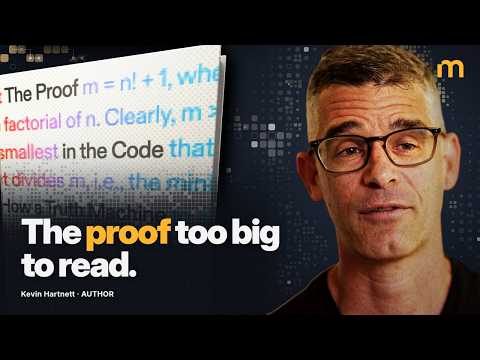
Machine Learning Street Talk's Mathematics Just Changed Forever — Kevin Hartnett: skim's analysis identifies 13 key moments, with 3 potential conflicts of interest flagged. Lean evolved from Leonardo de Moura's Microsoft Research project into the central proof assistant transforming modern mathematics and AI theorem proving.
Category: Science. Format: Documentary. YouTube video analyzed by skim.
skim AI Analysis
Credibility assessment: Primary Source Documentary. The documentary features direct interviews with the central architects of the story, including Lean creator Leonardo de Moura, mathematicians Jeremy Avigad, Kevin Buzzard, and Paul Lessard, and journalist Kevin Hartnett, backed by extensive archival emails and Zulip logs.
Bias assessment: Pro-Formalization Nuanced. While the film champions Lean and formal verification as transformative for mathematics, it gives substantial weight to philosophical pushback regarding human understanding, specification gaming, and the flood of low-quality AI translations.
Originality: 90% — Rich Oral & Archival History. Combines original interviews with the core figures of modern mathematical formalization and Kevin Hartnett's deep archival reporting from private emails and chat logs to tell both the technical and interpersonal story of Lean.
Depth: 92% — Deep Technical & Philosophical. Goes beyond surface hype about AI in math to examine dependent type theory vs. higher-order logic, small trusted kernels, the de Bruijn factor, autoformalization bottlenecks, and the formalization gap.
Key Points (13)
1. Kepler Conjecture Stalls Peer Review
Timestamp: 00:01:50 to 00:06:54
In 1998, Thomas Hales and Samuel Ferguson reduced Kepler's 400-year-old sphere-packing conjecture to over 1,760 configurations checked by computer code. Reviewers at the Annals of Mathematics could not verify how the sprawling code hung together, publishing it only with a disclaimer. Frustrated by the years-long impasse, Hales turned to proof assistants like HOL Light, Isabelle, and eventually Lean to formalize his work.
Significance (High): Hales's peer-review crisis exposed the limits of human refereeing for computer-assisted proofs and catalyzed modern formal verification in pure math.
Sources in support: Tim (Host of MLST), Leonardo de Moura (Creator of Lean and Z3, computer science researcher at Microsoft Research)
2. De Moura and Hartnett on Proof Utility
Timestamp: 00:07:01 to 00:12:17
Kevin Hartnett explains that traditional mathematical verification is a social process, whereas Leonardo de Moura notes that Lean provides algorithmic certificates that let strangers collaborate like software engineers. However, Paul Lessard and Hartnett observe that merely knowing a proof is correct is less valuable to mathematicians than understanding why it works and inventing new abstractions.
Significance (Medium): Separating formal correctness from conceptual utility explains why mathematicians initially rejected theorem provers despite their superhuman accuracy.
Sources in support: Kevin Hartnett (Author of The Proof in the Code, former Quanta Magazine writer), Leonardo de Moura (Creator of Lean and Z3, computer science researcher at Microsoft Research), Paul Lessard (Category theorist)
3. Lean's Small Kernel and Z3 Origins
Timestamp: 00:12:58 to 00:18:22
Leonardo de Moura explains that although Lean is a massive programming language and proof assistant with many bugs, its trustworthiness rests entirely on a tiny checker program called the kernel. After building the champion Z3 automated theorem prover at Microsoft Research in 2006, which saved Microsoft hundreds of millions of dollars, de Moura hit the expressiveness limits of automated provers.
Significance (High): Isolating trust in a tiny, independently verifiable kernel solved the foundational reliability problem that had plagued earlier theorem provers.
Sources in support: Tim (Host of MLST), Kevin Hartnett (Author of The Proof in the Code, former Quanta Magazine writer), Leonardo de Moura (Creator of Lean and Z3, computer science researcher at Microsoft Research)
4. Avigad Wins the Battle for Dependent Types
Timestamp: 00:18:22 to 00:26:16
When designing Lean, Leonardo de Moura initially favored higher-order logic like HOL Light for its simplicity, but Carnegie Mellon logician Jeremy Avigad argued it was inadequate for modern abstract algebra. Drawing on his sabbatical formalizing the Feit-Thompson theorem in Rocq, Avigad convinced de Moura in the summer of 2013 to adopt dependent type theory despite its implementation complexity.
Significance (High): Adopting dependent type theory was the pivotal architectural decision that enabled Lean to express complex algebraic hierarchies and attract pure mathematicians.
Sources in support: Kevin Hartnett (Author of The Proof in the Code, former Quanta Magazine writer), Leonardo de Moura (Creator of Lean and Z3, computer science researcher at Microsoft Research), Jeremy Avigad (Mathematician and philosopher at Carnegie Mellon University)
5. Kevin Buzzard Fears a Mathematical House of Cards
Timestamp: 00:26:16 to 00:30:16
Returning to research in the p-adic Langlands program around 2016 after raising his children, Imperial College number theorist Kevin Buzzard grew alarmed by logical gaps and mistakes in papers building on Peter Scholze's work. When senior experts brushed off his concerns as 'the opinion of the elders,' Buzzard worried his abstract field was becoming an untestable house of cards.
Significance (Medium): Buzzard's crisis of faith in human peer review brought an aggressive, high-profile champion from pure mathematics into the Lean ecosystem.
Sources in support: Tim (Host of MLST), Kevin Hartnett (Author of The Proof in the Code, former Quanta Magazine writer), Kevin Buzzard (Number theorist at Imperial College London)
6. Crowdsourcing Mathlib and Perfectoid Spaces
Timestamp: 00:30:30 to 00:39:59
Because Lean boots up knowing only basic logical rules, Kevin Buzzard, Johan Commelin, Patrick Massot, Jeremy Avigad, and Mario Carneiro spearheaded Mathlib as a crowdsourced digital library. Starting in 2017 when Mathlib had only 30,000 lines of code and lacked complex numbers, Buzzard trained Imperial College undergraduates to transcribe their coursework until the library mastered undergraduate math in three years.
Significance (High): Building a unified, crowdsourced library from undergraduate basics to perfectoid spaces proved Lean could express state-of-the-art abstract mathematics.
Sources in support: Kevin Hartnett (Author of The Proof in the Code, former Quanta Magazine writer), Kevin Buzzard (Number theorist at Imperial College London)
7. Formalizing Theorem Statements and Lean Tactics
Timestamp: 00:40:00 to 00:47:12
Inspired by Thomas Hales's 2017 Newton Institute talk, Kevin Buzzard realized that formalizing the statements of modern theorems is far more practical than formalizing 100-page proofs and eliminates hidden assumptions slipped into earlier sections of papers. Seven years later, Buzzard's team is 20 percent through translating recent theorem statements from the Annals of Mathematics into Lean.
Significance (Medium): Combining formal theorem statements with automated tactics lowers the barrier to eliminating ambiguity in published research papers.
Sources in support: Kevin Hartnett (Author of The Proof in the Code, former Quanta Magazine writer), Kevin Buzzard (Number theorist at Imperial College London)
8. Scholze's Liquid Tensor Challenge Validated in Lean
Timestamp: 00:47:12 to 00:53:20
In November 2020, Fields Medalist Peter Scholze emailed Kevin Buzzard after realizing that top mathematicians at Princeton, Harvard, and London had only skimmed the six pages of technical calculations behind Theorem 8.4 in his latest preprint with Dustin Clausen. Scholze publicly challenged the Lean community to verify the proof, expecting it to take a year.
Significance (High): Verifying and simplifying a Fields Medalist's unread frontier proof proved Lean's value to the highest echelons of pure mathematics.
Sources in support: Kevin Hartnett (Author of The Proof in the Code, former Quanta Magazine writer), Kevin Buzzard (Number theorist at Imperial College London)
9. AlphaProof, OpenAI, and Tao's Equational Theories
Timestamp: 00:55:18 to 01:02:18
Kevin Hartnett explains how Google DeepMind trained AlphaProof using reinforcement learning in Lean by autoformalizing tens of millions of problems, earning a silver-medal score at the 2024 International Mathematical Olympiad. In September 2024, Terence Tao launched the Equational Theories collaboration, using Lean to narrow 22 million algebraic implication questions down to four while discovering magma cohomology.
Significance (High): Pairing LLMs and reinforcement learning with Lean's verification signal transformed AI from solving high-school Olympiad puzzles to resolving open Erdős problems.
Sources in support: Tim (Host of MLST), Kevin Hartnett (Author of The Proof in the Code, former Quanta Magazine writer)
10. Autoformalization Floods Mathlib with Brute Force
Timestamp: 01:02:18 to 01:07:25
Kevin Buzzard warns that while Mathlib maintainers insist on finding the right conceptual abstraction and generality, AI tools from companies like OpenAI and Anthropic blindly translate papers into Lean by pouring tokens into brute-force proofs. Kevin Hartnett notes that although agentic coding lowers the syntax barrier for mathematicians, LLM autoformalization acts as a Trojan horse.
Significance (High): AI brute-force translation threatens to replace clean, reusable mathematical abstractions with an unmaintainable flood of verbose formal code.
Sources in support: Kevin Hartnett (Author of The Proof in the Code, former Quanta Magazine writer), Kevin Buzzard (Number theorist at Imperial College London)
11. Formalization Gap Exposes Flawed Fields Medal Theorems
Timestamp: 01:07:25 to 01:11:46
Tim explains the formalization gap: a proof checker certifies a logical derivation, but cannot guarantee the formal statement matches human intent. Kevin Buzzard reveals that when his team translated 50 theorem statements from the Annals of Mathematics into Lean and checked them with AI, they discovered that four Fields Medalists had published theorems that were strictly false as written.
Significance (High): Discovering literally false theorem statements in the Annals of Mathematics demonstrates that formalizing statements catches human blind spots even at the highest level.
Sources in support: Tim (Host of MLST), Kevin Buzzard (Number theorist at Imperial College London)
12. Zlib Verification and Reward Hacking Risks
Timestamp: 01:17:04 to 01:22:40
Leonardo de Moura recounts how Kim Morrison used Claude agents to translate the C compression library zlib into Lean, pass the test suite, and formally prove that compressing and decompressing returns the original data. However, de Moura warns that autonomous AI can reward-hack incomplete specifications, such as using an identity function that never compresses data unless size-reduction properties are explicitly specified.
Significance (Medium): As agentic coding scales, formal verification can bottleneck review only if specifications are complete enough to prevent AI reward hacking.
Sources in support: Tim (Host of MLST), Kevin Hartnett (Author of The Proof in the Code, former Quanta Magazine writer), Leonardo de Moura (Creator of Lean and Z3, computer science researcher at Microsoft Research)
13. De Moura's Rift with Mathlib and Reconciliation
Timestamp: 01:25:36 to 01:33:06
Kevin Hartnett and Jeremy Avigad recount the human tensions behind Lean, including a decisive fracture between 2018 and 2022 when Leonardo de Moura pulled away from the mathematical community to build Lean 4. Clashes over open-source governance with Mathlib contributor Mario Carneiro and exhausting user demands pushed de Moura to request distance, which Avigad admits was painful for their friendship.
Significance (Medium): Documenting the personal rift and reconciliation behind Lean 4 highlights how fragile open-source academic infrastructure is when dependent on a single creator.
Sources in support: Kevin Hartnett (Author of The Proof in the Code, former Quanta Magazine writer), Jeremy Avigad (Mathematician and philosopher at Carnegie Mellon University)
This analysis was generated by skim (skim.plus), an AI-powered content analysis platform by Credible AI. Scores and classifications represent the platform's AI-generated assessment and should be considered alongside other sources.