Credible AI™ signals
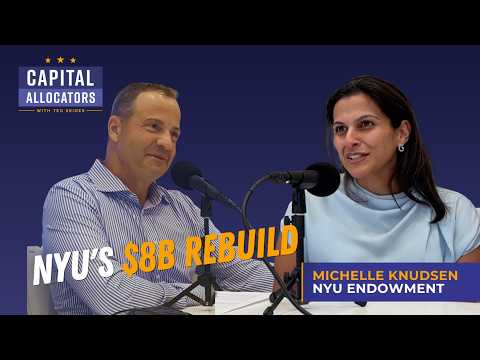
Confidence: Highly Credible. Michelle Knudsen, CIO of NYU, shares extensive experience from Goldman Sachs and Partners Capital. The discussion is detailed, data-driven, and focuses on institutional investment principles, lending significant credibility.
Bias: Slightly Positive. The interview is largely framed around the success and strategic decisions of Michelle Knudsen and NYU's investment office, presenting a generally positive outlook on their strategies and achievements.
Originality (70%): Insightful. While discussing established investment principles, the video offers unique insights into rebuilding an endowment from scratch, specific governance structures, and the practical application of investment philosophies in a large academic institution.
Depth (80%): Deep Dive. The conversation delves into granular details of portfolio construction, asset allocation, manager selection, risk management, and governance, demonstrating a high level of analytical depth.
Key points (20)
- Short (23 min): key points 1, 3, 5, 6, 8, 9, 12, 14, 15 and 17
- Medium (38 min): key points 1, 3, 5, 6, 8, 9, 10, 12, 13, 14, 15, 16, 17, 18, 19 and 20
- Relaxed (49 min): all 20 key points
1. Knudsen: Crisis as a Foundation
Timestamp: 00:01:35 to 00:04:26 (3 min)
Starting a career at Goldman Sachs in 2008 amidst the financial crisis profoundly shaped Michelle Knudsen's approach to investment management, stakeholder communication, and career planning. The experience instilled a deep understanding of the necessity for preparedness for adverse scenarios, emphasizing clear communication and expectation setting, which she applies to managing investment managers and committees.
Impact: High. Why it matters: This foundational crisis experience is presented as the bedrock of her risk-aware investment philosophy and stakeholder management skills.
For: Michelle Knudsen
Neutral: Ted Seides
2. Knudsen: The Power of Network Leverage
Timestamp: 00:04:26 to 00:06:42 (2 min)
Leveraging a broad network of smart individuals across different firm groups was a critical lesson learned at Goldman Sachs during the crisis. This ability to pull together diverse information sources proved invaluable, especially when moving to smaller organizations lacking built-in firm-wide knowledge sharing, highlighting the ongoing importance of cultivating external networks.
Impact: Medium. Why it matters: This lesson directly influenced her strategy for information gathering and decision-making in less resourced environments.
For: Michelle Knudsen
Neutral: Ted Seides
3. Partners Capital: Navigating Diverse Client Needs
Timestamp: 00:06:42 to 00:10:18 (4 min)
At Partners Capital, Michelle Knudsen managed diverse client portfolios, including sophisticated private equity GPs and foundations/endowments. This required tailoring investment strategies to client return expectations, risk tolerance, and liquidity preferences, with a particular emphasis on net-of-tax considerations for private clients and stability for institutional fiduciaries.
Impact: Medium. Why it matters: This experience honed her ability to customize investment approaches based on specific client objectives and constraints.
For: Michelle Knudsen
Neutral: Ted Seides
4. Knudsen: Growth and Opportunity at Partners Capital
Timestamp: 00:10:18 to 00:13:53 (4 min)
During Michelle Knudsen's tenure, Partners Capital grew significantly from $6B to $30B AUM and 60 to 300 employees. Her role evolved from analyst to managing portfolios and an office, driven by her proactive approach to taking on new responsibilities, including developing expertise in underwriting emerging managers due to capacity constraints in existing relationships.
Impact: Medium. Why it matters: This period of organizational growth provided a fertile ground for her professional development and strategic initiatives like opening a New York office.
For: Michelle Knudsen
Neutral: Ted Seides
5. Knudsen: Transition to Single Client Focus at Mellon
Timestamp: 00:14:03 to 00:16:01 (2 min)
Seeking the opportunity to build the 'best portfolio' without client compromises, Michelle Knudsen moved to the Mellon Foundation. This role offered a unique chance to address a specific client need for portfolio transformation, particularly focusing on driving returns from liquid assets as private equity growth showed signs of slowing.
Impact: Medium. Why it matters: This move allowed her to apply her experience in a more focused, strategic capacity, preparing her for the NYU challenge.
For: Michelle Knudsen
Neutral: Ted Seides
6. Knudsen: Rebuilding NYU's Endowment from Scratch
Timestamp: 00:19:19 to 00:23:34 (4 min)
Upon joining NYU, Michelle Knudsen was tasked with building a best-in-class investment office from a $6.5 billion portfolio with a blank sheet of paper. This involved a complete overhaul of governance, asset allocation framework, manager selection criteria, and team structure, shifting from a conservative, volatility-focused approach to one geared for growth.
Impact: High. Why it matters: This initiative aimed to significantly enhance the endowment's growth potential to meet NYU's expanding objectives.
For: Michelle Knudsen
Neutral: Ted Seides
7. Knudsen: Empowering Governance and Teamwork
Timestamp: 00:23:34 to 00:27:02 (3 min)
The new governance structure at NYU empowers the investment committee for oversight on big themes and risk levels, while the investment team handles manager selection up to a 3% allocation threshold. This division leverages expertise, allowing the committee to focus on strategic direction and the team on operational execution, fostering confidence and efficiency.
Impact: High. Why it matters: This structure aims to balance strategic oversight with agile decision-making, enhancing the effectiveness of the investment office.
For: Michelle Knudsen
Neutral: Ted Seides
8. Knudsen: Equity-Centric Asset Allocation
Timestamp: 00:27:08 to 00:30:23 (3 min)
NYU's asset allocation framework balances traditional buckets with a total portfolio approach, prioritizing equity exposure (public and private) at ~65% for long-term growth. An 'absolute return and opportunistic' bucket targets ~25%, with smaller allocations to cash, fixed income, and real assets, all competing against the benchmark of long-term equity market returns.
Impact: High. Why it matters: This strategy is designed to maximize growth potential while preserving purchasing power, aligning with NYU's financial objectives.
For: Michelle Knudsen
Neutral: Ted Seides
9. Trading-Oriented Hedge Funds: A Differentiated Bet
Timestamp: 00:31:02 to 00:32:03 (1 min)
Michelle Knudsen has leaned into underwriting hedge fund strategies that are more trading-oriented, often employing higher leverage and relying on technology or manager skill rather than a single persistent source of return. This approach, which she also utilized at the Mellon Foundation, now constitutes almost all of NYU's absolute return and opportunistic bucket, supported by a team with deep expertise in these strategies.
Impact: High. Why it matters: This strategy diversifies the endowment's risk profile by seeking returns from sources beyond traditional market movements, though it requires sophisticated underwriting to manage inherent risks.
For: Michelle Knudsen
Neutral: Ted Seides
10. Growing Private Markets Amidst Peer Pullback
Timestamp: 00:32:06 to 00:35:48 (4 min)
NYU's endowment has substantially increased its allocation to private markets, including venture capital and buyouts, over the last few years. This growth occurred while many peers were reducing their private market exposure, driven by the team's view that significant long-term value remains in these markets, particularly in the lower mid-market for buyouts to complement the venture portfolio.
Impact: High. Why it matters: By increasing private market allocations when others are pulling back, NYU positions itself to capture potential long-term growth and diversification benefits, though it requires careful manager selection and liquidity management.
For: Michelle Knudsen
Neutral: Ted Seides
11. Managing Contagion Risk in Leveraged Strategies
Timestamp: 00:32:56 to 00:34:06 (1 min)
Knudsen acknowledges the significant risk of contagion and correlations increasing towards one during market stress. NYU models these scenarios, focusing on the risk management of individual managers and understanding 'gap risk' to ensure the total portfolio can withstand severe downside events, a lesson reinforced by the 2008 crisis.
Impact: High. Why it matters: Proactive modeling of extreme market events is crucial for ensuring the endowment's resilience, allowing it to 'live with' severe downturns without jeopardizing its long-term objectives.
For: Michelle Knudsen
Neutral: Ted Seides
12. Navigating Public Markets: Nimble, Size-Constrained Managers
Timestamp: 00:40:01 to 00:41:42 (2 min)
Knudsen sees opportunities in public markets, particularly with asset managers who are nimble and size-constrained. These managers can navigate volatility, trade around short-term movements, and maintain a focus on medium-to-long-term company potential, aligning with NYU's long-term horizon and objective to see through short-term noise.
Impact: High. Why it matters: Focusing on size-constrained managers in public markets allows NYU to capitalize on alpha opportunities that larger, less agile players might miss, while aligning with the endowment's long-term investment philosophy.
For: Michelle Knudsen
Neutral: Ted Seides
13. Manager Selection: Data Meets Forward-Looking Vision
Timestamp: 00:41:45 to 00:44:33 (3 min)
NYU's manager selection is data-driven, using concrete information to support or refute investment cases. This backward-looking data is blended with a forward-looking perspective derived from conversations with managers, ensuring that the articulated vision aligns with historical behavior and provides a cohesive investment story.
Impact: High. Why it matters: This dual approach ensures that investment decisions are grounded in empirical evidence while remaining adaptable to future market dynamics and manager evolution.
For: Michelle Knudsen
Neutral: Ted Seides
14. Portfolio Transformation: From Homogeneous to Diversified
Timestamp: 00:48:48 to 00:50:17 (1 min)
Since Knudsen's arrival, the NYU endowment has undergone a significant transformation, turning over more than a third of its assets and rewriting another third. The portfolio's profile is now markedly different, moving from a homogeneous, bottom-up fundamental approach to incorporating quant, macro, venture capital, and emerging managers, reflecting a strategic diversification.
Impact: High. Why it matters: This strategic overhaul has diversified NYU's investment portfolio, potentially enhancing risk-adjusted returns and positioning it for long-term growth in a dynamic market environment.
For: Michelle Knudsen
Neutral: Ted Seides
15. Stress Testing: Preparing for the Unthinkable
Timestamp: 00:52:58 to 00:54:25 (1 min)
NYU employs rigorous stress testing, projecting future portfolio states and simulating shock events to understand potential impacts, rebalancing needs, and funding capabilities. This process, informed by experience with hedge funds and market crises, ensures the portfolio can remain robust even through multi-year downturns.
Impact: High. Why it matters: Proactive stress testing is essential for building portfolio resilience, enabling the endowment to navigate severe market shocks and maintain its long-term financial health.
For: Michelle Knudsen
Neutral: Ted Seides
16. Building a World-Class Investment Team
Timestamp: 00:54:26 to 00:58:08 (4 min)
Knudsen has successfully rebuilt the NYU investment team, hiring 10 new members in two years across investment and operations. This team, characterized by a commitment to continuous improvement and a 'hustle factor,' integrates diverse expertise from various institutions while forging a unified culture and process.
Impact: High. Why it matters: The strategic expansion and cultural integration of the investment team are critical for executing NYU's ambitious endowment strategy and navigating complex market conditions.
For: Michelle Knudsen
Neutral: Ted Seides
17. Team Synergy: The Power of Deliberate Discussion
Timestamp: 01:02:02 to 01:03:37 (2 min)
Michelle Knudsen emphasizes the critical role of structured team meetings, particularly research-focused sessions, in fostering collaboration and idea generation. By dedicating time for team members to present topics and engage in discussion and debate, the investment office cultivates a culture where diverse information is synthesized, leading to more robust decision-making. This proactive approach to communication and intellectual exchange is vital for a growing team tackling complex challenges.
Impact: High. Why it matters: Fosters a collaborative environment, enhances information synthesis, and improves decision-making quality by encouraging open dialogue and challenging ideas among team members.
For: Michelle Knudsen
Neutral: Ted Seides
18. AI as an Efficiency Engine for Information Overload
Timestamp: 01:03:47 to 01:05:44 (2 min)
Knudsen highlights NYU's proactive adoption of AI tools like Claude, Gemini, Granola, and Whisperflow to manage the deluge of information inherent in endowment management. These tools are instrumental in aggregating raw data, transcribing notes, and analyzing time-series financial data from manager statements, thereby improving efficiency and enabling the team to focus on higher-level strategic tasks. This strategic use of AI is particularly beneficial for a growing team aiming to maximize its output.
Impact: High. Why it matters: Significantly enhances operational efficiency, improves data analysis capabilities, and allows the investment team to focus on strategic initiatives rather than manual data processing.
For: Michelle Knudsen
Neutral: Ted Seides
19. NYU's Endowment: A Two-Year Horizon of Strategic Restructuring
Timestamp: 01:05:47 to 01:07:06 (1 min)
Over the next two years, NYU's endowment strategy will continue to focus on portfolio restructuring, including expanding co-investment opportunities and diversifying public equity strategies. Knudsen aims to move beyond foundational investments to a more dynamic approach, enhancing risk management at the subset level for sleeves like equity and absolute return. This strategic evolution is designed to improve investment management and adapt to market changes.
Impact: High. Why it matters: Positions the endowment for greater diversification and resilience, enabling more nuanced management and adaptation to evolving market conditions.
For: Michelle Knudsen
Neutral: Ted Seides
20. Navigating Private Market Risks and Public Market Underappreciation
Timestamp: 01:07:07 to 01:08:58 (2 min)
Knudsen identifies aggressive fundraising in private markets as a significant risk, driven by FOMO, necessitating robust commitment pacing models. In public markets, the risk lies in underappreciating the long-term impact of private markets and AI, alongside potential mispricing due to market volatility. The strategy involves analyzing factor exposures and enhancing portfolio robustness regardless of market outcomes.
Impact: High. Why it matters: Highlights critical market risks and the need for disciplined investment strategies to mitigate potential downsides and capitalize on evolving market dynamics.
For: Michelle Knudsen
Neutral: Ted Seides
This analysis was generated by skim (skim.plus), an AI-powered content analysis platform by Credible AI. Scores and classifications represent the platform's AI-generated assessment and should be considered alongside other sources.