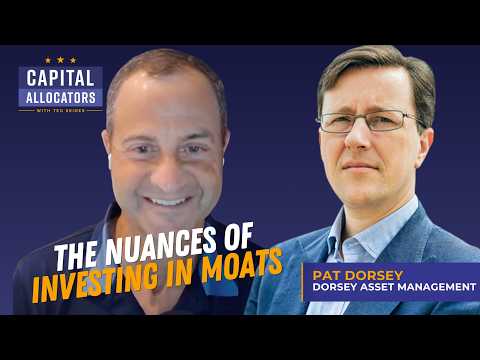
Pat Dorsey: The Nuances of Investing in Moats (Capital Allocators, EP.509)
Capital Allocators with Ted Seides
Summary
Pat Dorsey, founder of Dorsey Asset Management and architect of Morningstar's economic moat framework, joins Ted Seides to examine how moat investing has evolved over two decades. He explains that traditional return-on-invested-capital screens are far less useful today because modern companies create value through expensed software code and brand building rather than capitalized physical assets. Instead, he evaluates qualitative dynamics: how aggressive pricing can erode switching costs at firms like Adobe, why luxury brands like Hermès and rating agencies like Moody's enjoy consensual signaling moats, and why a long reinvestment runway matters more than moat width alone.
Since launching his firm in 2014 to manage a concentrated 10-to-15 stock portfolio, Pat Dorsey has reversed his analytical weighting from 70% moat and 30% management to 70% management and 30% moat. He details how he screens executives for humility, shareholder alignment, and capital allocation discipline, while sharing lessons on cutting broken theses early and favoring mispriced mega-caps over obscure small companies.
How time-sensitive the topic is: Evergreen
By the numbers
15 % returns on capital for >15 years: Threshold Pat Dorsey used on historical data back to the 1960s to build Morningstar's initial moat rubric. (Mentioned at 4:24)
60/70 to 30 % moat vs. management weight (now reversed): How Pat Dorsey's weighting of moat versus management quality has reversed since launching Dorsey Asset Management in 2014. (Mentioned at 17:21)
1,718 companies: Number of equities covered at Morningstar, which prevented deep primary research on every name. (Mentioned at 38:49)
20 % return on capital: Internal return rate Pat Dorsey cites to show why companies with reinvestment runways beat returning cash to shareholders. (Mentioned at 40:51)
30-40 % of portfolio: Historical share of Dorsey Asset Management's portfolio invested outside the United States. (Mentioned at 43:15)
1.5 billion dollars: Approximate assets under management at Dorsey Asset Management cited when discussing liquidity filters for a 12-stock portfolio. (Mentioned at 44:00)
300-400 companies: Approximate number of investable companies globally that pass Dorsey Asset Management's industry, cultural, and liquidity filters. (Mentioned at 44:13)
15 % maximum position size and hurdle rate: Dorsey Asset Management's hard ceiling on a single stock weight and its internal expected return hurdle rate. (Mentioned at 55:25)
9 times EBIT: Valuation low reached by Meta in late 2022, a stock Dorsey Asset Management has held since 2015. (Mentioned at 1:01:43)
3 million dollars: Initial assets under management when Dorsey Asset Management launched in 2014. (Mentioned at 1:05:23)
Questions this video answers
Why is Return on Invested Capital (ROIC) less useful for finding economic moats today?
Pat Dorsey explains that economic value creation has shifted from capitalized physical assets to expensed intangible investments like software code and brand building. Because accounting rules require companies to expense code immediately, businesses with very little physical capital have a tiny denominator and easily show high ROIC even if their competitive position is weak. Investors must therefore rely on qualitative analysis of customer value and pricing power rather than quantitative ROIC screens.
Pat Dorsey, 6:58 to 10:04
From this keypoint: Why ROIC no longer signals a competitive moat
How does Pat Dorsey weigh management quality versus the strength of a business moat?
When Pat Dorsey launched Dorsey Asset Management in 2014, he weighted the business moat at 60% to 70% and management at 30%, but he has since reversed that ratio. Watching poor leaders damage great businesses convinced him that Warren Buffett's adage about buying a business any idiot can run misleads investors. In a 12-stock portfolio, interviewing for executive humility and alignment is essential to avoid catastrophic left-tail outcomes.
Pat Dorsey, 17:00 to 20:55
From this keypoint: Why management humility outweighs moat strength
Why does a company's reinvestment runway matter more than the width of its moat?
A wide moat in a mature market, such as eBay or regional online classifieds, generates excess cash with nowhere to grow, forcing management to make difficult capital allocation choices. By contrast, a company that can reinvest its cash internally at 20% returns compounds shareholder wealth directly while neutralizing the risk that executives will waste money on bad acquisitions or mistimed buybacks.
Pat Dorsey, 38:24 to 42:01
From this keypoint: Reinvestment runways beat stagnant wide moats
How can aggressive pricing power hurt a company with high switching costs like Adobe?
When a company raises prices aggressively without adding proportional value for customers, it enlarges the industry profit pool and attracts competitors. Pat Dorsey points to Adobe as a current example, noting that years of aggressive price hikes may make frustrated customers much more willing to test and switch to emerging AI alternatives.
Pat Dorsey, 10:10 to 13:40
From this keypoint: Abusive pricing power erodes customer switching costs
What is the difference between a consumer brand moat like Coke and a luxury or rating agency moat like Hermès or Moody's?
Consumer packaged goods brands like Coke or Gillette lower search costs, but a shopper can switch to a store brand with zero personal penalty. Luxury brands like Rolex and Hermès, or credit rating agencies like Moody's and S&P, rely on consensual signaling: defecting to an unknown watch loses status signaling, and skipping a Moody's rating costs a bond issuer higher interest rates, making those moats far more durable.
Pat Dorsey, 13:44 to 16:55
From this keypoint: Pat Dorsey contrasts search brands and signaling
Why did Pat Dorsey pass on investing in CoStar despite its strong track record?
Although CoStar succeeded in commercial real estate and apartment data, Pat Dorsey's team worried management would not halt spending if its residential push against Zillow struggled because the company had never experienced failure. Furthermore, the founder CEO had sold down much of his stock over time, meaning outside shareholders bore far more downside risk than he did.
Pat Dorsey, 21:05 to 26:08
From this keypoint: Assessing shareholder alignment and founder myths
Are founder-led companies better investments than businesses run by non-founders?
Pat Dorsey argues that founder-led businesses are no better than non-founder businesses and criticizes Silicon Valley's 'founder mode' hype. Inspiring early employees at a startup requires completely different skills than managing a 5,000-person enterprise, and while founders like Mark Zuckerberg evolved effectively, non-founder CEOs like Larry Culp at GE have delivered historic turnarounds.
Pat Dorsey, 21:05 to 26:08
From this keypoint: Assessing shareholder alignment and founder myths
How should investors evaluate a CEO's capital allocation skills?
Because most CEOs rise through divisional roles and politics rather than capital allocation, investors should assume nothing and verify their track record. Pat Dorsey recommends asking executives directly about their M&A hurdle rates, how often acquisitions miss those targets, and whether share buybacks are executed opportunistically or merely to offset stock-based compensation dilution.
Pat Dorsey, 27:52 to 32:41
From this keypoint: Pat Dorsey on rare CEO capital allocation skills
Why does Pat Dorsey prefer discounted cash flow (DCF) models only as a backup to valuation multiples?
Standard DCF models mathematically assume that a company's returns on capital and valuation multiple fade toward the cost of capital over time. Because moat investing specifically targets companies that beat that fade and sustain high returns, relying strictly on a DCF often undervalues great businesses and causes investors to miss compounding opportunities.
Pat Dorsey, 48:58 to 52:58
From this keypoint: Pat Dorsey's research process and DCF limitations
What advantages do US-listed stocks have over international equities?
Pat Dorsey highlights two structural advantages for US companies: strict oversight by the SEC, which deters accounting frauds like Germany's Wirecard, and stronger managerial capital allocation driven by US executive compensation that can be five times higher than in Europe. Non-US stocks only enter his portfolio when they are irreplaceable global franchises like ASML or Safran.
Pat Dorsey, 42:12 to 48:46
From this keypoint: Filtering 1,700 stocks and US versus non-US edges
How does Dorsey Asset Management size positions in its concentrated portfolio?
The firm holds between 10 and 15 stocks, typically initiating positions at 6% to 7% to retain dry powder for averaging down, or 9% to 10% for higher-conviction ideas. A hard ceiling of 15% is reserved for businesses with A-plus management, a strong moat, a long reinvestment runway, and expected returns well above the firm's 15% hurdle rate.
Pat Dorsey, 52:59 to 59:18
From this keypoint: Managing endowment bias, sizing, and conviction
What was Pat Dorsey's 'weird isn't wonderful' mistake when launching his fund?
When Dorsey Asset Management launched with $3 million in 2014, Pat Dorsey initially sought out obscure, off-the-run small-cap companies to differentiate the portfolio for clients. In early 2016, he wrote an internal memo titled 'Better,' realizing that small companies are often small because they haven't succeeded, and that buying an obvious, mispriced mega-cap is a superior way to generate long-term returns.
Pat Dorsey, 1:01:10 to 1:13:07
From this keypoint: Pat Dorsey's lessons: sell errors, skip weirdness
Credible AI™ signals
Confidence: Seasoned Practitioner Insight. Pat Dorsey draws directly from over two decades of equity research and portfolio management experience, having built Morningstar's moat framework and managed a concentrated global equity portfolio since 2014. He openly discusses past errors and limitations in his own methods rather than presenting an infallible track record.
Bias: Concentrated Quality Equity. The discussion naturally favors concentrated, long-only quality growth investing and US corporate governance standards, reflecting Pat Dorsey's specific mandate at Dorsey Asset Management. However, he consistently acknowledges when alternative approaches work for other investors.
Originality (82%): Candid Framework Evolution. Rather than repeating textbook definitions of competitive advantage, Pat Dorsey deconstructs his own early Morningstar work, explaining why traditional metrics like return on invested capital have lost utility and why Warren Buffett's aphorisms on management can mislead investors.
Depth (88%): Nuanced Structural Analysis. The conversation moves beyond surface-level moat categories to examine second-order dynamics, such as how high switching costs limit customer acquisition, the consensual signaling mechanics of luxury versus consumer brands, and the mathematical flaws of discounted cash flow models for compounding businesses.
Key points (12)
Short (26 min): key points 1, 2, 5, 8 and 12
Medium (43 min): key points 1, 2, 3, 5, 6, 7, 8, 10 and 12
Relaxed (59 min): all 12 key points
1. Pat Dorsey on building Morningstar's moat rubric
Timestamp: 00:03:40 to 00:06:49 (3 min)
Speaker: Pat Dorsey
Pat Dorsey explains that while Michael Porter's Five Forces helped consultants improve existing widget makers, investors needed a rubric to determine if widgets were a good business at all. Analyzing data back to the 1960s on companies sustaining 15% returns on capital for 15 years, his team grouped durable advantages into intangible assets, switching costs, network effects, and cost advantages. Morningstar then adopted moats as its core analytical lens to differentiate its nascent equity research from commodity sell-side reports.
Impact: Medium. Why it matters: Grounding moat categories in empirical multi-decade return data gave individual and institutional investors a repeatable taxonomy for screening business quality.
“We had data back to the '60s, I think, and looked at every company that had done more than 15% returns on capital for more than 15 years.”
In the video: Pat Dorsey, at 4:21
Neutral: Ted Seides
2. Why ROIC no longer signals a competitive moat
Timestamp: 00:06:58 to 00:10:04 (3 min)
Speaker: Pat Dorsey
Return on invested capital has become much less useful for identifying competitive advantages because modern value creation relies on expensed items like software code and brand building rather than capitalized physical assets. Because accounting rules expense software development immediately, companies with almost no invested capital in their denominator easily post high return ratios even if their businesses are weak. Consequently, assessing moats today requires qualitative judgment on pricing power and shared scale economies, such as Costco or Medline, rather than quantitative screens.
Impact: High. Why it matters: Relying on quantitative ROIC screens in an intangible-heavy economy traps investors in low-quality software businesses while missing reinvestors or low-margin compounders.
“Today, I would argue actually return on capital is much less useful as a touchstone for does a company have uh competitive advantage because, frankly, if you don't have any capital, it's pretty and your denominator is nothing, it's pretty easy to generate a high high ratio, right?”
In the video: Pat Dorsey, at 7:14
Neutral: Ted Seides
3. Abusive pricing power erodes customer switching costs
Timestamp: 00:10:10 to 00:13:40 (4 min)
Speaker: Pat Dorsey
High switching costs and network effects contain hidden vulnerabilities: industry-wide switching costs make winning new customers difficult, while network effects can degrade if participants leave. Companies that sustain advantages over time listen to customers and add value alongside price increases, whereas abusing pricing power enlarges the industry profit pool and invites competitors. Pat Dorsey suggests Adobe illustrates this risk, questioning whether its customers would be as eager to test new AI tools had Adobe been less aggressive on pricing.
Impact: High. Why it matters: Extracting price increases without commensurate value turns a defensive switching-cost moat into an incentive for customers to defect when technological disruption arrives.
“And so I think companies that abuse pricing power, they tend to You're seeing this right now with Adobe, frankly. There's a little bit of an AI problem here as well.”
In the video: Pat Dorsey, at 12:48
Neutral: Ted Seides
4. Pat Dorsey contrasts search brands and signaling
Timestamp: 00:13:44 to 00:16:55 (3 min)
Speaker: Pat Dorsey
Pat Dorsey divides brand moats into consumer brands that lower search costs, such as Coke or Gillette, and consensual signaling brands like Rolex, Hermès, Moody's, and S&P. While a shopper can defect from a consumer packaged goods brand at zero personal cost, defecting from a recognized luxury watch or bond rating agency carries a real penalty because outsiders will not recognize the signal or grant lower borrowing rates. This social consensus makes luxury and rating agency moats far more durable than standard consumer brands.
Impact: Medium. Why it matters: Distinguishing zero-cost consumer defection from costly social or financial defection explains why rating agencies and heritage luxury houses preserve pricing power over decades.
“If I defect out of that luxury positioning ecosystem, the cost is nobody nobody gets the signal value. Cuz they've never seen the heard of the watch.”
Over the past decade since launching Dorsey Asset Management in 2014, Pat Dorsey reversed his analytical weighting from roughly 70% moat and 30% management to 70% management and 30% moat. He argues that Warren Buffett's famous line about buying a business any idiot can run has harmed investors by encouraging them to ignore poor governance and destructive leadership. To avoid left-tail blowups, he interviews executives for humility, self-reflection on past do-overs, and clear separation between personal and corporate assets.
Impact: High. Why it matters: Shifting primary weight to managerial humility protects a concentrated portfolio from value-destroying hubris that even a wide economic moat cannot survive.
“I would say when Dorsey Asset launched in 2014, I was probably 60/70 moat and 30 management. So, you want to kind of weight things, and I'm probably the reverse today.”
In the video: Pat Dorsey, at 17:13
Neutral: Ted Seides
6. Assessing shareholder alignment and founder myths
Timestamp: 00:21:05 to 00:26:08 (5 min)
Speaker: Pat Dorsey
Evaluating executive alignment involves listening for 'we' versus 'I' language, scrutinizing headquarters relocations, and checking whether leaders share downside risk with outside shareholders, as illustrated by passing on CoStar before its Zillow push because the founder had sold down stock and never experienced failure. Furthermore, founder-led businesses deserve no automatic pass because inspiring a startup requires different skills than managing a 5,000-person enterprise. While founders like Mark Zuckerberg evolved into strong managers, hired CEOs like Larry Culp at GE prove non-founders can execute historic turnarounds.
Impact: High. Why it matters: Evaluating founders and hired executives on a level playing field prevents investors from excusing reckless spending or poor governance out of deference to Silicon Valley founder mythology.
“The skill set of a founder is very different than the skill set of a manager.”
In the video: Pat Dorsey, at 24:16
Neutral: Ted Seides
7. Pat Dorsey on rare CEO capital allocation skills
Timestamp: 00:27:52 to 00:32:41 (5 min)
Speaker: Pat Dorsey
Pat Dorsey contends that capital allocation skill is rare among major corporate CEOs because executives typically rise through divisional operations and corporate politics rather than investment decision-making. Academic and McKinsey studies suggest most corporate buybacks and infrequent, banker-pitched acquisitions fail to create value, contrasting sharply with iterative acquirers like Danaher, TransDigm, or Constellation. Investors can protect against left-tail capital destruction by questioning management directly on M&A hurdle rates, past write-downs, stock-based compensation dilution, and pro-cyclical share repurchases.
Impact: High. Why it matters: Interrogating executives on explicit M&A hurdle rates and buyback timing exposes whether capital allocation is a disciplined discipline or a value-draining afterthought.
“It's almost kind of weird that you kind of you kind of people rise up through the ranks, get thrown in the CEO seat, and then you're like you're supposed to allocate capital. It's like, well, they've never had to do that.”
In the video: Pat Dorsey, at 28:21
Neutral: Ted Seides
8. Reinvestment runways beat stagnant wide moats
Timestamp: 00:38:24 to 00:42:01 (4 min)
Speaker: Pat Dorsey
After leaving Morningstar in 2012 and launching Dorsey Asset Management in 2014 to run a concentrated, long-only portfolio, Pat Dorsey prioritized B2B companies capable of reinvesting cash directly back into their moats. While investors often fetishize wide network-effect moats like eBay or European online classifieds, a stagnant wide moat leaves management with excess cash and nowhere to grow. A business that can compound capital internally at 20% returns both generates superior wealth and eliminates the risk of value-destroying acquisitions or poorly timed buybacks.
Impact: High. Why it matters: Prioritizing reinvestment runway over sheer moat width solves the capital allocation problem automatically by letting high-return internal projects absorb cash flow.
“If I've got a choice between company A that is constantly giving me back the money and then I need to go reinvest it in a super competitive public equity market or company B, which can just plow it back into a 20% RO return on capital internal project, well, the math is pretty obvious which one I ought to be choosing, right?”
In the video: Pat Dorsey, at 40:59
Neutral: Ted Seides
9. Filtering 1,700 stocks and US versus non-US edges
Timestamp: 00:42:12 to 00:48:46 (7 min)
Speaker: Pat Dorsey
To narrow a 1,700-stock universe down to roughly 300 to 400 investable names for a $1.5 billion portfolio, Pat Dorsey eliminates price-taking industries like airlines, oil and gas, utilities, and life insurance, as well as foreign businesses reliant on local culture or regulation. He argues US-listed companies enjoy two major advantages over foreign peers: rigorous SEC oversight that deters Wirecard-style frauds, and superior managerial capital allocation driven by 5x higher US executive pay. Non-US holdings, which make up 30% to 40% of the portfolio, must be global franchises like ASML or Safran's CFM56 engine partnership, often trading at four to five multiple turns below US peers.
Impact: Medium. Why it matters: Maintaining operational capability to hold local foreign shares lets a concentrated manager capture valuation discounts on global monopolies like ASML without lowering governance standards.
“There are two benefits that US companies enjoy that non-US companies do not. One is called the SEC, which is the nastiest securities regulator on the planet, and which is great for us as investors.”
In the video: Pat Dorsey, at 44:26
Neutral: Ted Seides
10. Pat Dorsey's research process and DCF limitations
Timestamp: 00:48:58 to 00:52:58 (4 min)
Speaker: Pat Dorsey
Research at Dorsey Asset Management progresses from a brief quick idea to a week-long first-pass memo focused on moat trajectory, growth runway, management red flags, and offline Q&A before custom primary research begins. For valuation, Pat Dorsey moved away from Morningstar's academic discounted cash flow reliance toward commercial multiples like EV/EBITDA or free cash flow yield backed up by a three-stage DCF. Because standard DCF math assumes returns fade toward the cost of capital, relying on it alone systematically undervalues businesses built to beat the fade.
Impact: Medium. Why it matters: Pairing market multiples with a three-stage DCF prevents analysts from pricing themselves out of durable compounders due to rigid terminal fade assumptions.
“But if we're looking for moat-y businesses and we're trying to only really own businesses that are likely to, quote unquote, beat the fade and sustainably have high returns on capital, the DCF may not be the best tool cuz it might actually like undervalue the business.”
In the video: Pat Dorsey, at 51:51
Neutral: Ted Seides
11. Managing endowment bias, sizing, and conviction
Timestamp: 00:52:59 to 00:59:18 (6 min)
Speaker: Pat Dorsey
Adding a stock to a 10-to-15 name portfolio requires overcoming endowment bias and evaluating whether the new idea improves expected returns or factor diversification. Positions start around 6% to 7% to leave room to average down and cap out at 15% for A-plus businesses exceeding a 15% return hurdle. Balancing the optimism required to hold concentrated equities against stubbornness relies on a collaborative team environment where debate is framed around truth-seeking rather than winning arguments.
Impact: Medium. Why it matters: Framing internal team debates as truth-seeking and enforcing a hard 15% position cap institutionalizes humility inside a high-conviction portfolio.
“Because the goal is not to be right or wrong, it's to iterate closer to the truth, which is probably unknowable.”
In the video: Pat Dorsey, at 58:49
Neutral: Ted Seides
12. Pat Dorsey's lessons: sell errors, skip weirdness
Timestamp: 01:01:10 to 01:13:07 (12 min)
Speaker: Pat Dorsey
Reflecting on 12 years running Dorsey Asset Management, Pat Dorsey notes that unlike long-term winner Meta, held since 2015, most stock sales result from thesis errors rather than overvaluation. His biggest lessons are never compromising on business or management quality, cutting losses of 12% to 20% quickly when underwriting assumptions break, and abandoning the early mistake that weird, obscure small-caps beat obvious, cheap mega-caps. Finally, he emphasizes that radical transparency via separately managed accounts, refusing to pass operating expenses like Bloomberg terminals to fund clients, and redefining holding periods around thesis validity rather than forever build lasting client trust.
Impact: High. Why it matters: Dropping broken theses quickly and favoring mispriced mega-caps over obscure small-caps prioritizes actual client returns over intellectual vanity.
“And so if you've got kind of the weird off-the-run business that's going to, you know, require some leaps of faith and maybe not offer you great liquidity. And you've got like an amazing mega cap staring you straight in the face at some screamingly cheap valuation. It doesn't matter if everybody's heard of it.”
In the video: Pat Dorsey, at 1:06:20
Neutral: Ted Seides
Conflicts of interest (1)
Dorsey Asset Management Portfolio & Marketing
Commercial conflict, Medium severity
Pat Dorsey is the founder and portfolio manager of Dorsey Asset Management, which manages approximately $1.5 billion to $1.7 billion and holds active positions in discussed companies including ASML and Meta.
Sources: Pat Dorsey, Dorsey Asset Management, ASML, Meta
Significance: Pat Dorsey has a commercial incentive to present his firm's investment process, fee structure, and current holdings like ASML and Meta in a favorable light to prospective institutional allocators listening to the podcast.
Key sources
Ted Seides: Host, Capital Allocators
Pat Dorsey: Founder, Dorsey Asset Management; Former Head of Equity Research, Morningstar
Who's in this
Morningstar
Dorsey Asset Management
Warren Buffett
Michael Porter
Costco
Adobe
CoStar
ASML
Safran
Meta
SEC
Mark Zuckerberg
Larry Culp
Also mentioned
Chicago (First mentioned at 1:56)
Money Masters (First mentioned at 2:45)
Medline (First mentioned at 9:41)
Gillette (First mentioned at 13:56)
Coke (First mentioned at 13:57)
Rolex (First mentioned at 14:44)
Hermès (First mentioned at 15:44)
Moody's (First mentioned at 16:17)
S&P (First mentioned at 16:18)
Wirecard (First mentioned at 18:50)
Zillow (First mentioned at 22:50)
GE (First mentioned at 25:38)
Food and Drug Administration (First mentioned at 0:21)
Forbes (First mentioned at 0:32)
Phil Fisher (First mentioned at 2:44)
John Train (First mentioned at 2:45)
Microsoft (First mentioned at 7:10)
Oracle (First mentioned at 7:11)
Amazon (First mentioned at 8:06)
Western Union (First mentioned at 10:46)
President's Choice Cola (First mentioned at 14:29)
China (First mentioned at 15:38)
Theranos (First mentioned at 18:49)
Enron (First mentioned at 18:57)
Silicon Valley (First mentioned at 23:57)
Brian Chesky (First mentioned at 24:08)
McKinsey (First mentioned at 29:10)
Danaher (First mentioned at 29:19)
TransDigm (First mentioned at 29:20)
Constellation (First mentioned at 29:22)
eBay (First mentioned at 33:36)
Abercrombie & Fitch (First mentioned at 34:21)
BaFin (First mentioned at 45:08)
CFM56 (First mentioned at 47:41)
Triumph of the Optimists (First mentioned at 57:21)
This analysis was generated by skim (skim.plus), an AI-powered content analysis platform by Credible AI. Scores and classifications represent the platform's AI-generated assessment and should be considered alongside other sources.