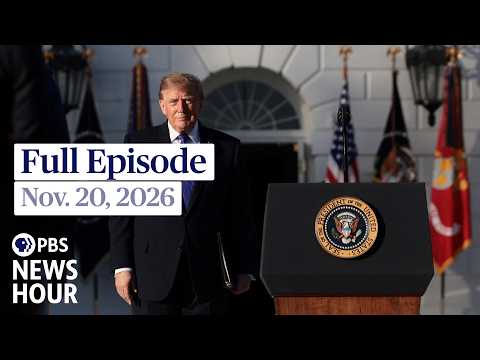
PBS NewsHour's PBS News Hour full episode, Nov. 20, 2026: skim's analysis identifies 12 key moments. PBS News Hour covers President Donald Trump's press conference defending his trilateral summit in China with Vladimir Putin and Xi Jinping, alongside a wave of nationwide tech outages tied to AI-driven software patching.
Category: Current Events. Format: Commentary. YouTube video analyzed by skim.
skim AI Analysis
Credibility assessment: Sourced Broadcast Journalism. The broadcast pairs direct White House briefing coverage with subject-matter interviews, including former CISA director Chris Krebs, Pennsylvania Governor Josh Shapiro, and museum historians. Claims are clearly attributed to named officials, courts, or analysts.
Bias assessment: Establishment Institutionalist. Reporting segments remain neutral, while the interview with Democratic Governor Josh Shapiro and commentary from Jonathan Capehart deliver sharp critiques of President Donald Trump's foreign and domestic policies, balanced partially by David Brooks and administration clips.
Originality: 78% — Primary Interviews & Analysis. Beyond standard daily news summaries, the episode features original interviews with Chris Krebs on AI-driven patching outages, an exclusive sit-down with Governor Josh Shapiro, and on-site reporting at the Sixth Floor Museum in Dallas.
Depth: 80% — Multi-Angle Policy Breakdown. Segments move past headlines to examine underlying mechanisms, such as how frontier AI models accelerate software bug discovery and cause patching outages, alongside historical comparisons between current great-power dynamics and pre-World War I instability.
Key Points (12)
1. Liz Landers on Trump's Summit and AI Policy
Timestamp: 00:02:40 to 00:06:47
Liz Landers reports that President Donald Trump praised his Shenzhen trilateral meeting with Vladimir Putin and Xi Jinping while Secretary argued the three nuclear powers must engage regularly. Trump also threatened a steep tax on companies building AI data centers abroad, imposed export controls on AI chips after Jensen Huang stepped down from Nvidia, and expressed willingness to work with incoming House Speaker Hakeem Jeffries on health care and immigration. The briefing highlights how the White House is balancing great-power diplomacy with aggressive domestic AI industrial policy ahead of a Democratic Congress.
Significance (High): Signals a dual White House push to restrict AI chip exports and penalize offshore data centers while navigating an incoming Democratic Congress.
Sources in support: Liz Landers (White House Correspondent, PBS News Hour), Donald Trump (President of the United States), YouTube: PBS NewsHour (Public Broadcast News Program)
Neutral sources: Amna Nawaz (Anchor, PBS News Hour)
2. AI Market Sell-Off and Court Blocks on Trump
Timestamp: 00:07:00 to 00:09:15
Amna Nawaz reports that Wall Street tumbled on AI sector worries following Nvidia's leadership upheaval and Anthropic's record IPO, pushing the Dow down over 900 points, the Nasdaq down over 5 percent, and the S&P 500 into correction territory. Meanwhile, a second federal judge indefinitely blocked President Donald Trump's 250-foot Memorial Arch near Arlington National Cemetery, and an appeals court blocked the U.S. Army from detonating bomb-making chemicals in Iowa that could spread lead dust 60 miles. Together, these developments show market volatility in the AI sector alongside federal court rulings halting administration and military projects.
Significance (High): Captures a sharp equity correction driven by AI leadership changes alongside judicial injunctions halting federal construction and military chemical disposal.
Sources in support: Amna Nawaz (Anchor, PBS News Hour)
3. Russian Missiles in Poland and U.K.-E.U. Deals
Timestamp: 00:09:22 to 00:13:13
Authorities in Poland say two Russian missiles and a suspected drone landed in Southeastern Poland about 20 miles from European military exercises, prompting Prime Minister Donald Tusk to call the incursion an intentional provocation. In Brussels, the U.K. and European Union agreed to relax agricultural trade restrictions, cut carbon taxes on some exports, and let 100,000 young people live and work across borders, while the BepiColombo probe neared Mercury and Grand Theft Auto VI reached nearly $3.8 billion in first-day sales. The roundup illustrates intensifying security pressure on NATO's eastern flank alongside Britain's economic rapprochement with Europe.
Significance (High): Highlights escalating security risks near NATO exercises in Poland alongside a major post-Brexit trade and mobility thaw between Britain and the E.U.
Sources in support: Amna Nawaz (Anchor, PBS News Hour), Donald Tusk (Prime Minister of Poland)
4. Chris Krebs Links Tech Outages to AI Patching
Timestamp: 00:13:53 to 00:18:16
William Brangham notes that recent outages disrupted Microsoft e-mail, FAA flights, J.P. Morgan Chase transactions, and an internal NSA communications network. Former CISA director Chris Krebs explains that since Anthropic released its Mythos preview model in April 2026, companies like Microsoft, IBM, and Google have used frontier AI to uncover software bugs rapidly, and stacking hasty patches destabilized networks and caused brief outages. Krebs concludes that while the disruptions were benign patching blips rather than cyberattacks, root-cause bug remediation across the Internet could take a year or more.
Significance (High): Reframes nationwide infrastructure outages not as direct cyberattacks, but as collateral instability from an urgent AI-accelerated defensive patching race.
Sources in support: William Brangham (Correspondent, PBS News Hour), Chris Krebs (Founder, The Krebs Group; Former Director of CISA)
5. Offensive AI Frameworks and New Cyber Chief
Timestamp: 00:18:31 to 00:20:35
Chris Krebs warns that adversaries are already deploying agentic offensive frameworks such as ARTEX on top of open-source and Chinese AI models like DeepSeek, Kimi, and GLM to scan corporate networks continuously for vulnerabilities. Following President Donald Trump's removal of National Cyber Director Sean Cairncross and appointment of former Pentagon official Kirsten Davies, Krebs calls Davies a competent technologist who will coordinate with critical infrastructure providers and AI labs. He emphasizes that continuous automated scanning has eliminated the time advantage defenders once held.
Significance (High): Exposes how agentic AI harnesses on open-source models conduct nonstop vulnerability reconnaissance, stripping defenders of their traditional response window.
Sources in support: Chris Krebs (Founder, The Krebs Group; Former Director of CISA)
Neutral sources: William Brangham (Correspondent, PBS News Hour)
6. Josh Shapiro Critiques Trump Foreign Policy
Timestamp: 00:20:48 to 00:27:03
In an interview at the University of Pennsylvania, Governor Josh Shapiro argues that President Donald Trump looked pathetically weak and like a junior partner dominated by Xi Jinping during the trilateral summit with Russia and China. Shapiro urges incoming Democratic majorities in Congress to use a war powers resolution and the power of the purse to end the U.S. war in Iran and reopen the Strait of Hormuz, while supporting an end to long-standing military aid to Israel so long as Israel retains defensive weapons against Hamas, the Houthis, and Iran. Shapiro concludes that repairing the damage to U.S. alliances will require concrete economic and security outcomes rather than rhetoric.
Significance (High): Outlines a potential 2028 Democratic foreign policy platform centered on congressional war powers to halt the Iran conflict and restructuring military aid to Israel.
Sources in support: Josh Shapiro (Democratic Governor of Pennsylvania)
Neutral sources: Amna Nawaz (Anchor, PBS News Hour)
7. Shapiro on $15 Minimum Wage and Measles Outbreak
Timestamp: 00:27:03 to 00:31:30
Following a 22-point reelection victory that established Pennsylvania's first Democratic trifecta in three decades, Governor Josh Shapiro promises that the first bill on his desk in January will raise the state minimum wage from $7.25 to at least $15 an hour. Addressing a measles outbreak that has caused 1,529 cases and eight deaths in Pennsylvania and cost the U.S. its measles elimination status, Shapiro blames Health Secretary Robert F. Kennedy Jr. and President Donald Trump for undermining vaccine confidence. On a potential 2028 presidential run, Shapiro says he will decide soon with his family while continuing to shape the party's direction.
Significance (High): Commitments to a $15 minimum wage in January and sharp attacks on federal health leadership position Shapiro at the forefront of the 2028 Democratic field.
Sources in support: Josh Shapiro (Democratic Governor of Pennsylvania)
Neutral sources: Amna Nawaz (Anchor, PBS News Hour)
8. Brooks and Capehart Debate Trump's China Summit
Timestamp: 00:31:43 to 00:37:26
Citing historian Arne Westad, David Brooks compares today's friction between a rising China and a relatively declining U.S. to pre-World War I instability, arguing that direct talks among Donald Trump, Xi Jinping, and Vladimir Putin at least reduce dangerous miscalculations even as China faces demographic and debt pressures that could tempt action on Taiwan. Jonathan Capehart counters that Trump foolishly views Putin and Xi as friends, achieved zero deliverables despite Russia and China aiding Iran while the U.S. is at war with Iran, and spent his press conference boasting about a used plane from Qatar. Both analysts agree Trump lacks a strategic global vision, even as Brooks values the private communication channel.
Significance (Medium): Contrasts the crisis-management value of direct great-power talks against the strategic cost of holding a summit that yields no concessions on Iran or Ukraine.
Sources in support: David Brooks (Commentator, The Atlantic)
Sources against: Jonathan Capehart (Commentator, MS NOW)
Neutral sources: Amna Nawaz (Anchor, PBS News Hour)
9. Voters Reject AI Data Centers; Musk Drops MAGA
Timestamp: 00:37:26 to 00:42:28
After SSRS midterm exit polls showed 76 percent of Trump voters oppose new data centers in their communities, Jonathan Capehart argues President Donald Trump is ignoring voters' electricity bill and livelihood concerns. David Brooks backs Trump on building data centers, noting they use under 1 percent of U.S. water and represent under 10 percent of increased electricity demand while fueling economic growth. Turning to tech leaders shifting away from Trump, including Elon Musk calling himself foolish for spending nearly half-a-billion dollars on losing Republican midterm campaigns and saying he is not MAGA, Capehart dismisses Musk's pivot while Brooks advises corporate CEOs to remain politically neutral.
Significance (Medium): Highlights a populist split inside the Republican coalition over AI infrastructure costs alongside a rapid political retreat by tech billionaires after midterm losses.
Sources in support: David Brooks (Commentator, The Atlantic)
Sources against: Jonathan Capehart (Commentator, MS NOW)
Neutral sources: Amna Nawaz (Anchor, PBS News Hour), Elon Musk (Tech Executive and Political Donor)
10. JFK Assassination Memory at Sixth Floor Museum
Timestamp: 00:42:43 to 00:46:54
Marking 63 years since President John F. Kennedy was assassinated on November 22, 1963, Jeffrey Brown visits the Sixth Floor Museum at Dealey Plaza in Dallas, where curator Stephen Fagin and CEO Nicola Longford explain that younger visitors often treat the event like a crime scene mystery rather than lived memory. A multimedia exhibition highlights 1963 local reporters including Darwin Payne, who first interviewed Abraham Zapruder, alongside archival reflections from PBS News Hour co-founders Jim Lehrer and Robert MacNeil on encountering Lee Harvey Oswald and Jack Ruby at Dallas police headquarters. The segment shows how eyewitness journalism anchors historical memory as living witnesses fade.
Significance (Medium): Illustrates the generational shift from lived national trauma to forensic curiosity as museums work to preserve primary journalistic records of the 1963 assassination.
Sources in support: Jeffrey Brown (Senior Arts Correspondent, PBS News Hour), Stephen Fagin (Curatorial Head, Sixth Floor Museum at Dealey Plaza), Nicola Longford (CEO, Sixth Floor Museum at Dealey Plaza), Darwin Payne (Former Reporter, Dallas Times Herald), Jim Lehrer (Co-Founder, PBS News Hour; Former Reporter, Dallas Times Herald), Robert MacNeil (Co-Founder, PBS News Hour; Former NBC News Reporter)
11. Conspiracy Culture and Bob Jackson Photo Archive
Timestamp: 00:46:54 to 00:50:25
Outside on Dealey Plaza, Dallas Morning News columnist Robert Wilonsky tells Jeffrey Brown that the JFK assassination defined Dallas and serves as an entry point for modern conspiracy theories where skeptics reject all official institutions. Inside the Sixth Floor Museum, officials showcase a new donation from Pulitzer Prize-winning photojournalist Bob Jackson containing the original negative of Jack Ruby shooting Lee Harvey Oswald along with more than 20,000 images of 1960s and 1970s Dallas. Backed by an Institute of Museum and Library Services grant, the museum plans to digitize the archive and expand to other floors to tell the broader story of Dallas's evolution.
Significance (Medium): Connects Dealey Plaza conspiracy culture to modern institutional distrust while documenting a 20,000-photo archival grant that broadens the museum's civic scope.
Sources in support: Jeffrey Brown (Senior Arts Correspondent, PBS News Hour), Stephen Fagin (Curatorial Head, Sixth Floor Museum at Dealey Plaza), Nicola Longford (CEO, Sixth Floor Museum at Dealey Plaza), Robert Wilonsky (Columnist, The Dallas Morning News)
12. Climate Mitigation Scale and China's Summit Role
Timestamp: 00:51:07 to 00:55:04
In previews of PBS programs Horizons and Compass Points following U.N. climate talks in Turkey, a climate scientist explains to William Brangham that while greenhouse gases mix globally regardless of whether China or the U.S. emits them, technical solutions already exist for almost every emitting sector and must be deployed at national and local scales. In a separate panel on the Shenzhen summit, a foreign policy analyst argues that Xi Jinping uses trilateral meetings to burnish China's image as a symbolic peacemaker without making concrete commitments to pressure Russia, Iran, or North Korea, predicting that intensifying U.S.-China competition over AI export controls will prevent substantive bilateral agreements.
Significance (Medium): Demonstrates why symbolic great-power summits and U.N. climate talks struggle to produce binding commitments amid fierce bilateral technological competition.
Sources in support: YouTube: PBS NewsHour (Public Broadcast News Program)
Neutral sources: William Brangham (Correspondent, PBS News Hour)
This analysis was generated by skim (skim.plus), an AI-powered content analysis platform by Credible AI. Scores and classifications represent the platform's AI-generated assessment and should be considered alongside other sources.