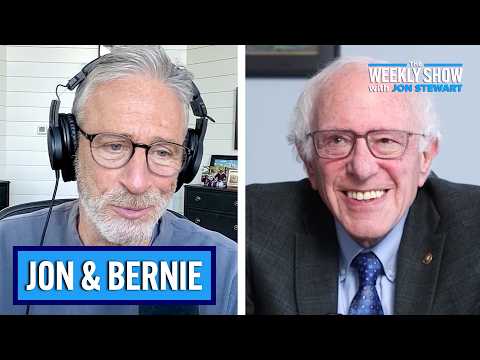
The Weekly Show with Jon Stewart's Sen. Bernie Sanders on Dem Wins, Trump & the Future | The Weekly Show with Jon Stewart: skim's analysis identifies 12 key moments. Jon Stewart interviews Senator Bernie Sanders following congressional election shifts to map out a progressive agenda.
Category: Politics. Format: Interview. YouTube video analyzed by skim.
skim AI Analysis
Credibility assessment: High Sourcing and Firsthand. The interview features a sitting U.S. Senator discussing legislative mechanics, Senate proceedings, and first-person campaign experiences directly. While discussions involve political strategy and partisan viewpoints, the dialogue is grounded in actual legislative processes and verifiable public statements.
Bias assessment: Progressive Left. The dialogue strongly emphasizes progressive policy priorities such as Medicare for All, wealth taxes on billionaires, union labor representation, and systemic reform of corporate influence in American politics.
Originality: 75% — In-Depth Political Analysis. Provides detailed strategic commentary on post-election congressional dynamics, practical legislative paths via reconciliation, and internal Democratic leadership challenges following major political shifts.
Depth: 80% — Structural & Strategic Focus. Explores the mechanics of budget reconciliation, procedural filibuster constraints, institutional challenges to democratic norms, and campaign finance structure with meaningful detail.
Key Points (12)
1. Electoral Shifts in Marginal Congressional Districts
Timestamp: 00:01:22 to 00:06:54
Bernie Sanders highlights how targeting marginal working-class districts during recent campaign tours yielded unexpected victories for progressive candidates. He notes that addressing widespread economic discontent directly was key to shifting these competitive seats. Ultimately, this grassroots strategy helped reverse broader political momentum.
Significance (Medium): Demonstrates a successful electoral model for progressives in traditionally conservative or swing areas.
Sources in support: Bernie Sanders (Independent U.S. Senator from Vermont)
Neutral sources: Jon Stewart (Host)
2. Working-Class Candidates Elevating Real-World Experience
Timestamp: 00:07:15 to 00:11:17
Bernie Sanders and Jon Stewart discuss the impact of nominating candidates with working-class backgrounds, such as waitresses, firefighters, and loggers. Sanders argues that these candidates connect more authentically with voters than career politicians. Their background provides a direct perspective on the economic struggles of average citizens.
Significance (Medium): Reframes candidate recruitment strategy toward non-traditional, working-class backgrounds.
Sources in support: Jon Stewart (Host), Bernie Sanders (Independent U.S. Senator from Vermont)
3. Using Budget Reconciliation to Pass Healthcare Reform
Timestamp: 00:11:37 to 00:18:49
Bernie Sanders argues that Democrats must bypass filibuster gridlock by utilizing the 51-vote budget reconciliation process to expand healthcare. He emphasizes that restoring insurance coverage and advancing Medicare for All should be immediate legislative priorities. This approach avoids standard parliamentary slowdowns.
Significance (High): Identifies the primary legislative mechanism for passing major health reform without 60 Senate votes.
Sources in support: Bernie Sanders (Independent U.S. Senator from Vermont)
Neutral sources: Jon Stewart (Host)
4. Economic Discontent Driving Global Populist Movements
Timestamp: 00:20:24 to 00:23:04
Bernie Sanders explains that working-class economic frustration is driving political volatility across both the United States and Europe. He warns that failing to deliver tangible economic improvements pushes voters toward authoritarian political figures. Delivering real results for working families is framed as essential for protecting democratic institutions.
Significance (High): Connects domestic economic policies directly to the global stability of democratic systems.
Sources in support: Bernie Sanders (Independent U.S. Senator from Vermont)
Neutral sources: Jon Stewart (Host)
5. Funding Social Housing and Education via Wealth Taxes
Timestamp: 00:23:04 to 00:28:02
Bernie Sanders details his proposal for an annual 5% wealth tax on billionaires to generate roughly $400 billion per year. He asserts these funds could finance 7 million affordable housing units, universal childcare, and tuition-free public college. This redistribution model aims to alleviate severe systemic cost pressures on ordinary families.
Significance (High): Outlines a comprehensive tax policy designed to fund major domestic investments and reduce economic inequality.
Sources in support: Bernie Sanders (Independent U.S. Senator from Vermont)
Neutral sources: Jon Stewart (Host)
6. Call for Senate Democratic Leadership Reform
Timestamp: 00:30:44 to 00:36:15
Bernie Sanders states that the Senate Democratic caucus requires fresh, assertive leadership to challenge corporate interests effectively. He expresses support for Senator Chris Van Hollen as a potential replacement for Chuck Schumer. Sanders emphasizes that maintaining status quo legislative tactics will fail to satisfy public demands for urgent change.
Significance (High): Signals progressive backing for structural leadership challenges within the U.S. Senate Democratic caucus.
Sources in support: Bernie Sanders (Independent U.S. Senator from Vermont)
Neutral sources: Jon Stewart (Host)
7. Demanding AI Guardrails and Moratoriums on Data Centers
Timestamp: 00:37:16 to 00:40:07
Bernie Sanders calls for a national moratorium on AI data center construction and a pause on advanced superintelligence development. He argues that tech leaders are deploying transformative technologies without sufficient public scrutiny or societal consent. Sanders stresses the need for congressional oversight to prevent existential and economic risks.
Significance (High): Establishes a legislative stance favoring strict regulatory intervention in artificial intelligence infrastructure.
Sources in support: Bernie Sanders (Independent U.S. Senator from Vermont)
Neutral sources: Jon Stewart (Host)
8. Debating Filibuster Reform and Electoral Mandates
Timestamp: 00:40:07 to 00:43:51
Jon Stewart and Bernie Sanders deliberate on whether the Senate filibuster should be abolished to enable majority rule. Stewart argues that winning coalitions should have the ability to enact their platform and let voters judge results at the ballot box. Sanders acknowledges the strength of this argument while balancing concerns about minority protections.
Significance (Medium): Examines the structural debate surrounding Senate parliamentary rules and legislative productivity.
Sources in support: Jon Stewart (Host)
Neutral sources: Bernie Sanders (Independent U.S. Senator from Vermont)
9. Reforming Campaign Finance and Restricting Dark Money
Timestamp: 00:43:57 to 00:48:21
Bernie Sanders argues that moneyed interests exercise excessive control over U.S. elections due to the Supreme Court's Citizens United ruling. He proposes public financing of elections and internal party rule changes to disincentivize candidate reliance on Super PACs. Sanders asserts these reform steps are critical for restoring electoral fairness.
Significance (High): Outlines policy avenues to counter private wealth and independent expenditure groups in political campaigns.
Sources in support: Bernie Sanders (Independent U.S. Senator from Vermont)
Neutral sources: Jon Stewart (Host)
10. Establishing a Comprehensive and Rational Immigration Framework
Timestamp: 00:48:21 to 00:52:23
Bernie Sanders and Jon Stewart discuss the necessity of structural immigration reform over politicized enforcement tactics. Sanders emphasizes that key economic sectors rely heavily on immigrant labor and calls for earned pathways to citizenship for long-term residents. Both agree that public debate needs to shift toward economic realities.
Significance (Medium): Presents a balanced economic case for structural immigration reform and earned legalization pathways.
Sources in support: Jon Stewart (Host), Bernie Sanders (Independent U.S. Senator from Vermont)
11. Rebuilding Public Sector Trust and Essential Services
Timestamp: 00:54:55 to 00:58:36
Bernie Sanders addresses the erosion of public interest in government service and public school teaching due to ongoing political attacks. He contends that national governance must focus on functional, efficient public service delivery to restore civic trust. Improving public employee support is presented as vital for community quality of life.
Significance (Medium): Highlights institutional challenges facing civil service recruitment and public education quality.
Sources in support: Bernie Sanders (Independent U.S. Senator from Vermont)
Neutral sources: Jon Stewart (Host)
12. Critiquing Defense Leadership and Institutional Accountability
Timestamp: 01:06:37 to 01:10:39
Jon Stewart and his production team critique Defense Secretary nominee Pete Hegseth, questioning his operational experience and focus on cultural rhetoric. Stewart argues that leadership of defense institutions requires managerial competence and clear accountability rather than culture-war grandstanding. He asserts executive leadership should hold appointees accountable for performance.
Significance (Medium): Examines executive appointments and standards of oversight within major federal national security departments.
Sources in support: Jon Stewart (Host)
Neutral sources: YouTube: The Weekly Show with Jon Stewart
This analysis was generated by skim (skim.plus), an AI-powered content analysis platform by Credible AI. Scores and classifications represent the platform's AI-generated assessment and should be considered alongside other sources.