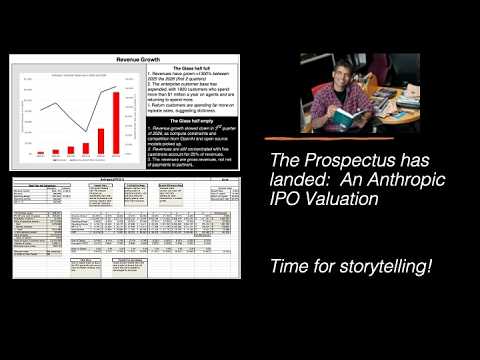
The Prospectus is here: My (but not the) Anthropic IPO Valuation!
Aswath Damodaran
Summary
Analyzing Anthropic's 416-page IPO prospectus, Aswath Damodaran weighs its rapid revenue surge past $16 billion per quarter and 80% gross margins against a third-quarter growth slowdown, 25% revenue concentration in five customers, and over $600 billion in off-balance-sheet compute commitments. Building a 10-year valuation model, he projects $1 trillion in 2036 revenues, a 27.5% regulatory-adjusted operating margin, a 3-to-1 sales-to-capital ratio, a 9.74% initial cost of capital, and a 10% failure probability, while capitalizing $473 billion in contractual compute obligations as debt to reach an equity value of $1.48 trillion ($447 per share).
Beyond the financials, Anthropic's Delaware Public Benefit Corporation status and five-class share structure give seven co-founders 50.1% voting power and allow a Benefit Trust to appoint most directors, stripping public shareholders of control. With the IPO expected to price between $1.5 trillion and $2 trillion, Aswath Damodaran plans to skip the offering and wait for post-IPO volatility to create a steeper discount.
How time-sensitive the topic is: Breaking
By the numbers
416 pages: Length of Anthropic's IPO prospectus filing. (Mentioned at 2:31)
16 billion+ USD: Anthropic's reported revenue in the most recent quarter. (Mentioned at 4:20)
11,900 customers: Total Anthropic customers reported, with about 1,900 spending over $1 million. (Mentioned at 4:42)
25%: Share of Anthropic's revenues accounted for by its top five customers. (Mentioned at 6:12)
600 billion+ USD: Anthropic's collective compute commitments, including over $450 billion in contractual commitments. (Mentioned at 10:30)
114 billion USD: Capital recently raised and held in Anthropic's cash balance prior to the IPO. (Mentioned at 12:54)
1 trillion USD: Aswath Damodaran's 10-year target revenue estimate for Anthropic in 2036. (Mentioned at 23:02)
27.5%: Aswath Damodaran's target operating margin for Anthropic after a 5% deduction for regulatory costs from 32.5%. (Mentioned at 32:17)
473 billion USD: Present value of Anthropic's contractual compute commitments treated as debt in the valuation. (Mentioned at 34:35)
1.48 trillion USD: Aswath Damodaran's baseline intrinsic equity valuation for Anthropic ($447 per share). (Mentioned at 35:17)
Questions this video answers
What is Aswath Damodaran's valuation of the Anthropic IPO?
Aswath Damodaran values Anthropic's equity at $1.48 trillion, or $447 per share. He arrives at this figure by valuing operating assets at $1.7 trillion, adding $220 billion in cash (including expected IPO proceeds), subtracting $473 billion in capitalized compute commitments, and applying a 10% failure probability.
Aswath Damodaran, 32:56 to 38:17
From this keypoint: Aswath Damodaran values Anthropic at $1.48 trillion
Why does Anthropic have over $600 billion in compute commitments and how do they affect its valuation?
Anthropic entered into more than $450 billion in contractual compute commitments ($600 billion+ collectively) with tech firms like Broadcom to secure chip capacity and shift compute from a variable to a fixed cost. In valuation, these contracts act like debt with a present value of $473 billion, creating severe financial risk if revenue growth slows.
Aswath Damodaran, 9:53 to 14:12
From this keypoint: $600B compute commitments act as debt, per Damodaran
How do Anthropic and OpenAI differ in reporting their revenues?
OpenAI reports net revenues, whereas Anthropic reports gross revenues before deducting the 15% to 20% revenue share paid back to big tech distribution partners. Anthropic records those partner payouts as a marketing expense rather than deducting them from top-line revenue.
Aswath Damodaran, 4:00 to 7:09
From this keypoint: Surging Anthropic revenue vs Q3 slowdown risks
How does Anthropic's five-class share structure and Public Benefit Trust work?
Anthropic uses five share classes—including Class F shares giving seven co-founders 50.1% voting power and Class T shares held by a founder-selected Benefit Trust that appoints most board members. Combined with Delaware Public Benefit Corporation status, this structure shields management from shareholder lawsuits and leaves public Class A buyers with no power to force change.
Aswath Damodaran, 38:17 to 43:57
From this keypoint: Five share classes and Benefit Trust strip buyer power
Why did Anthropic report a $72.6 billion convertible expense?
The $72.6 billion expense comes from conversion options kicking in on convertible securities used to raise capital or compensate stakeholders. Aswath Damodaran notes this is a normal accounting consequence of a company's valuation rising rapidly, not evidence of accounting fraud.
Aswath Damodaran, 14:12 to 20:12
From this keypoint: Dismissing AI cabal and accounting fraud theories
What revenue and profit margin does Aswath Damodaran project for Anthropic in 2036?
He forecasts Anthropic reaching $1 trillion in annual revenue by 2036, assuming a $5 trillion to $10 trillion total AI market where Anthropic leads the enterprise premium segment. He models a 32.5% unadjusted operating margin (based on a 75% premium / 25% mass-market mix), reduced to 27.5% after accounting for regulatory compliance costs.
Aswath Damodaran, 20:12 to 24:30
From this keypoint: Projecting $1 trillion in 2036 Anthropic revenue
How does Anthropic's IPO lockup period work for insiders and founders?
Unlike traditional six-month IPO lockups, non-founder insiders can sell up to 10% of their shares on day one, with remaining shares unlocking in tranches up to day 180. Co-founders and key executives are locked up for 365 days before they can trade.
Aswath Damodaran, 43:57 to 47:40
From this keypoint: Staggered IPO lockups and why Damodaran will wait
Will Aswath Damodaran buy Anthropic stock at the IPO?
No, he plans to pass on the IPO because the expected offering price of $1.5 trillion to $2 trillion exceeds his $1.48 trillion valuation, and he dislikes the company's restrictive corporate governance. He intends to monitor the stock post-IPO and buy only if volatility pushes the price significantly below his intrinsic value estimate.
Aswath Damodaran, 43:57 to 47:40
From this keypoint: Staggered IPO lockups and why Damodaran will wait
Credible AI™ signals
Confidence: Transparent Financial Model. Aswath Damodaran anchors his valuation in Anthropic's public 416-page SEC prospectus, explicitly separates reported financial history from his forward-looking assumptions, and shares an open spreadsheet so viewers can audit or override every input.
Bias: Shareholder-Rights Purist. While balanced on operational bulls and bears, Aswath Damodaran holds a strong pro-shareholder governance stance, sharply criticizing multi-class voting shares, Public Benefit Corporation structures, and ESG frameworks.
Originality (92%): Bespoke IPO Valuation. Rather than repeating market commentary, Aswath Damodaran builds a bottom-up intrinsic valuation model for Anthropic from scratch, capitalizing off-balance-sheet compute commitments as debt and providing an interactive framework.
Depth (95%): Rigorous DCF Breakdown. The analysis dissects revenue recognition nuances, fixed versus variable compute cost shifts, capital intensity ratios, cost of capital, failure probabilities, and five-class share governance structures.
Aswath Damodaran examines Anthropic's 416-page IPO prospectus, contrasting modern 400-to-500-page filings from companies like Airbnb and Uber with Apple's 80-page and Microsoft's 66-page prospectuses. He argues that massive risk sections exist primarily as legal protection against lawsuits rather than useful investor guidance. Despite the bloated length, he concludes the filing still contains vital financial data that can be read optimistically or pessimistically.
Impact: Low. Why it matters: Highlights how modern IPO disclosures bury essential unit economics inside hundreds of pages of legal boilerplate.
“The entire risk section in an IPO completely useless but designed to protect companies from getting sued. So the entropic prospect is 416 pages.”
In the video: Aswath Damodaran, at 3:27
2. Surging Anthropic revenue vs Q3 slowdown risks
Timestamp: 00:04:00 to 00:07:09 (3 min)
Speaker: Aswath Damodaran
Anthropic grew revenue by 1,300% to 1,400% year-over-year, exceeding $16 billion in its latest reported quarter across 11,900 customers, including 1,900 spending over $1 million. However, Aswath Damodaran notes that third-quarter growth stalled due to compute constraints and OpenAI pricing pressure, while the top five customers still drive 25% of revenue.
Impact: High. Why it matters: Exposes how gross-versus-net accounting and customer concentration can make hyper-growth appear stronger than underlying net cash flows.
“Open AI is has shifted to net revenues whereas uh Anthropic is reporting gross revenues. What are gross revenues? Some of Anthropic's revenues come from its partnerships with the big tech companies”
In the video: Aswath Damodaran, at 6:31
3. Shifting compute to fixed costs boosts margins
Timestamp: 00:07:09 to 00:09:53 (3 min)
Speaker: Aswath Damodaran
Anthropic reduced compute costs from 250% of revenue six quarters ago to under 50%, turning an operating profit in its most recent reported quarter and posting roughly 80% gross margins. Aswath Damodaran explains that Anthropic achieved this by reclassifying compute from a variable cost to a fixed cost and recording partner revenue shares as marketing expenses. Because fixed costs and stock-based compensation are high, keeping operating profits positive requires relentless revenue growth.
Impact: High. Why it matters: Demonstrates that Anthropic's recent operating profit is a high-operating-leverage bet that reverses quickly if growth slows.
“Compute costs, which used to be 250% of revenue six quarters ago, is now down to less than 50%. That's a major shift.”
In the video: Aswath Damodaran, at 7:24
4. $600B compute commitments act as debt, per Damodaran
Timestamp: 00:09:53 to 00:14:12 (4 min)
Speaker: Aswath Damodaran
Although Anthropic's balance sheet shows minimal capital expenditures, Aswath Damodaran points out over $450 billion in contractual compute commitments and more than $600 billion in collective commitments to tech firms like Broadcom. While locking in chips helps Anthropic catch up to OpenAI, these contracts function as massive fixed obligations.
Impact: High. Why it matters: Reframes off-balance-sheet compute contracts as over $600 billion in debt-like obligations that dictate the company's survival.
“The company's entered into contractual commitments and those commitments the contractual commitments amount to more than 450 billion. The collective commitments are more than 600 billion.”
In the video: Aswath Damodaran, at 10:26
5. Dismissing AI cabal and accounting fraud theories
Timestamp: 00:14:12 to 00:20:12 (6 min)
Speaker: Aswath Damodaran
Summarizing the prospectus as a report card on a precocious kindergartener, Aswath Damodaran warns investors not to fall for AI conspiracy theories alleging a cabal among hyperscalers, Nvidia, OpenAI, and Anthropic. He attributes circular industry revenue to rational self-interest rather than a conspiracy, though he notes it risks double counting.
Impact: Medium. Why it matters: Separates legitimate concerns over circular tech revenues from unfounded claims of accounting fraud over convertible securities.
“one piece of evidence that's offered is this convertible the expense of 72.6 6 billion. That's just a conversion option kicking in, you know, and in fact, that's a feature, not a bug.”
In the video: Aswath Damodaran, at 18:08
6. Projecting $1 trillion in 2036 Anthropic revenue
Timestamp: 00:20:12 to 00:24:30 (4 min)
Speaker: Aswath Damodaran
To project target revenues, Aswath Damodaran estimates the total addressable AI market at $5 trillion to $10 trillion, assuming AI replaces high-paid white-collar roles across multiple industries. Because 80% of Anthropic's revenue comes from enterprise usage rather than subscriptions and the company aims to participate directly in sectors like pharmaceuticals, he casts Anthropic as a premium market leader. Consequently, he forecasts Anthropic reaching $1 trillion in annual revenue by 2036.
Impact: High. Why it matters: Sets an aggressive $1 trillion 10-year revenue baseline, larger than any company today, to anchor the intrinsic valuation.
“Now I you know in my story I'm going to give anthropic revenues of 1 trillion. It's true this is 10 years out and you can't compare to revenues today”
In the video: Aswath Damodaran, at 23:00
7. Estimating 32.5% margins and 3-to-1 capital efficiency
Timestamp: 00:24:30 to 00:28:19 (4 min)
Speaker: Aswath Damodaran
Aswath Damodaran splits the AI market into a commoditized mass market with 10% operating margins and a data-driven premium enterprise segment with 40% margins. Assuming Anthropic's business mix is 75% premium and 25% mass market, he calculates an unadjusted target operating margin of 32.5%. For reinvestment, he assumes data center buildouts will ease the current compute crunch, allowing Anthropic in steady state to generate $3 of incremental revenue for every $1 of capital invested.
Impact: High. Why it matters: Defines the unit economics and capital intensity required to turn massive top-line AI revenue into free cash flow.
“75% premium 25% mass market. I don't think they can entirely avoid ignore the mass market because it'll be a pretty big market in terms of revenues. So that'll give me an unadjusted operating margin of 32.5%.”
In the video: Aswath Damodaran, at 25:33
8. Factoring 9.74% capital cost, failure, and regulation
Timestamp: 00:28:19 to 00:32:56 (5 min)
Speaker: Aswath Damodaran
To account for operating and contractual risk, Aswath Damodaran assigns Anthropic an initial 9.74% cost of capital—near the 9.88% third quartile for US firms in September 2026—and notes its BB+ bond rating. Despite a post-IPO cash buffer near $200 billion, he assigns a 10% probability of failure if growth stalls, which would halve asset value.
Impact: High. Why it matters: Quantifies how regulatory compliance costs and contractual default risks directly reduce intrinsic equity value.
“So in my story, I think the regularatory effects are likely to be mild and lower margins from the 32 1/2% that I originally estimated down to 27 1.5% or reduction of 5%.”
In the video: Aswath Damodaran, at 32:11
9. Aswath Damodaran values Anthropic at $1.48 trillion
Timestamp: 00:32:56 to 00:38:17 (5 min)
Speaker: Aswath Damodaran
Combining his growth, margin, reinvestment, and risk inputs, Aswath Damodaran values Anthropic's operating assets at $1.7 trillion. Adding roughly $220 billion in cash (including $100 billion in expected IPO proceeds), subtracting $473 billion for the present value of compute commitments treated as debt, and adjusting for a 10% failure risk yields an equity value of $1.48 trillion, or $447 per share.
Impact: High. Why it matters: Delivers the concrete $1.48 trillion ($447/share) intrinsic valuation benchmark against which investors can judge the IPO price.
“The bottom line with my assumptions and adjusting for failure risk is a value of the equity of 1.48 48 trillion. It's pretty close to the lower end of the offering price number”
In the video: Aswath Damodaran, at 35:11
10. Five share classes and Benefit Trust strip buyer power
Timestamp: 00:38:17 to 00:43:57 (6 min)
Speaker: Aswath Damodaran
Defining corporate governance as shareholders' power to change management, Aswath Damodaran calls Anthropic a governance quagmire with five share classes: public Class A, employee shares, non-voting Class N shares for Alphabet and Amazon, Class T shares for a Benefit Trust, and Class F shares giving seven co-founders 50.1% voting control.
Impact: High. Why it matters: Reveals that public IPO buyers receive virtually zero governance control or legal recourse if founders prioritize non-shareholder goals.
“and then there's a final class of shares or one share a class F share held by anthropic seven co-founders with 50.1% of the voting rights. This is an in yourrr-face.”
In the video: Aswath Damodaran, at 41:13
11. Staggered IPO lockups and why Damodaran will wait
Timestamp: 00:43:57 to 00:47:40 (4 min)
Speaker: Aswath Damodaran
Anthropic's IPO uses a staged lockup release allowing non-founder insiders to sell up to 10% of their shares on day one, with further tranches unlocking over 180 days and founders unlocking after 365 days. Aswath Damodaran dismisses lockup expiration fears, noting markets price them in ahead of time.
Impact: Medium. Why it matters: Provides a disciplined investment decision rule: pass on an overpriced IPO with weak governance and wait for post-IPO volatility.
“If it's, you know, and I I've given you my estimate of equity value for anthropic with my upbeat story, 1.48 48 trillion. If it's priced well above, which would be my guess as to what it's going to be priced, I'm not buying the shares”
In the video: Aswath Damodaran, at 45:46
Key sources
Aswath Damodaran: Finance Professor at NYU Stern and Investor
Who's in this
Anthropic
OpenAI
Broadcom
Nvidia
Alphabet
Amazon
Facebook
Dario
Tesla
SpaceX
Apple
Microsoft
Also mentioned
Delaware (First mentioned at 41:37)
Airbnb (First mentioned at 2:39)
Uber (First mentioned at 2:39)
Yahoo Finance (First mentioned at 38:28)
The New York Times (First mentioned at 39:29)
Ford (First mentioned at 39:30)
Kim Jong-un (First mentioned at 43:35)
North Korea (First mentioned at 43:37)
This analysis was generated by skim (skim.plus), an AI-powered content analysis platform by Credible AI. Scores and classifications represent the platform's AI-generated assessment and should be considered alongside other sources.