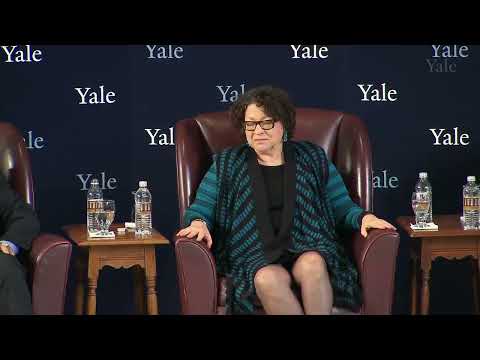
YaleCourses's Three Justices Return to Yale Law School | America's Written Constitution: skim's analysis identifies 14 key moments. Supreme Court Justices Clarence Thomas, Samuel Alito, and Sonia Sotomayor return to Yale Law School to discuss their personal journeys, the internal working culture of the high court, and the qualities required in legal practice.
Category: Education. Format: Panel Discussion. YouTube video analyzed by skim.
skim AI Analysis
Credibility assessment: First-Person Judicial Account. The discussion features three sitting Supreme Court justices detailing their own professional backgrounds, institutional practices, and internal court deliberations in a formal academic setting.
Bias assessment: Bipartisan Collegiality. The panel deliberately avoids partisan rancor, emphasizing mutual respect, shared institutional loyalty to the Supreme Court, and common personal humility despite deep jurisprudential disagreements.
Originality: 90% — Rare Institutional Insight. Rarely do three sitting justices from opposite ends of the ideological spectrum gather to candidly critique court composition, internal memo traditions, and personal career misgivings.
Depth: 88% — Reflective Institutional Look. The panelists contrast district and circuit court adjudicative mechanics, examine how executive leadership prepares jurists for pressure, and critique structural diversity deficits on the federal bench.
Key Points (14)
1. Robert Post Urges Preservation of Civil Legal Dialogue
Timestamp: 00:01:40 to 00:05:02
Democratic society requires institutions where rigorous reasoning and mutual respect can counter public rancor. Yale Law School strives to instill the habit of open, productive conversation among students of starkly different worldviews. Dean Robert Post concluded that judicial courage demands both defending core convictions and listening to opponents.
Significance (Medium): Highlights the essential role academic and judicial bodies play in safeguarding democratic discourse during periods of intense political polarization.
Sources in support: Robert Post (Dean of Yale Law School)
2. Clarence Thomas Exemplified Tenacity at Yale
Timestamp: 00:05:08 to 00:09:36
Overcoming childhood poverty and segregation, Clarence Thomas took on punishing course loads in corporate and commercial law. Dean Post noted that Thomas established deep intellectual connections while remaining willing to stand alone in defense of his jurisprudential beliefs. Post observed that his iconoclastic positions gradually shaped the conservative legal mainstream.
Significance (Medium): Illustrates how perseverance through early hardship established the intellectual independence that came to define conservative high court jurisprudence.
Sources in support: Robert Post (Dean of Yale Law School)
3. Sonia Sotomayor Recounts Early Fascination with Law
Timestamp: 00:20:34 to 00:25:16
Watching Perry Mason as a child revealed that the law offered an endless opportunity to explore diverse human problems and societal sectors. Samuel Alito similarly recalled that his father's legislative redistricting work and high school debate tournaments exposed him to the intellectual rigor of constitutional procedure. Both justices concluded that early curiosity outweighed any formal family legal background.
Significance (Low): Shows that early exposure to civic questions and narrative problem solving can inspire lifelong legal careers without elite lineage.
Sources in support: Sonia Sotomayor (Associate Justice of the Supreme Court of the United States), Samuel Alito (Associate Justice of the Supreme Court of the United States)
4. Clarence Thomas Found Purpose Outside Seminary
Timestamp: 00:25:34 to 00:29:00
Intending originally to become a priest, Clarence Thomas spent four years in the seminary before the social turmoil of 1968 caused him to question his vocation. Redirecting his desire to serve toward community work, he entered legal studies with profound idealism and naivety. Thomas affirmed that four decades later, his dedication to the law remains more idealistic than in his youth.
Significance (Low): Reveals that unexpected career disruptions and spiritual crises can channel civic motivation into impactful legal service.
Sources in support: Clarence Thomas (Associate Justice of the Supreme Court of the United States)
5. Introversion and Focus Aided Judicial Development
Timestamp: 00:29:27 to 00:33:38
Introversion and stubborn persistence allowed Clarence Thomas to quietly master complex tax regulations and work through demanding legal questions. Sonia Sotomayor explained that her intense power of concentration helps absorb voluminous records, even if it can appear combative during oral argument exchanges. Both jurists concluded that self-awareness of one's natural traits is essential to collegial work.
Significance (Medium): Demonstrates that quiet deliberation and intense concentration are critical cognitive assets for handling the complex demands of high court litigation.
Sources in support: Sonia Sotomayor (Associate Justice of the Supreme Court of the United States), Clarence Thomas (Associate Justice of the Supreme Court of the United States)
6. Samuel Alito Recalls Crafting Bold Justice Coffee
Timestamp: 00:35:14 to 00:39:40
While serving on the Third Circuit, Samuel Alito and his law clerks participated in an endurance promotion at an old Newark coffee shop to design their own roast. The resulting high-caffeine blend, named Bold Justice, was formulated specifically to combat afternoon fatigue during arduous opinion drafting. Alito noted that intense legal writing routinely demands practical stamina and strong stimulants.
Significance (Low): Humanizes the rigorous chamber work of appellate judges through humorous traditions that build camaraderie among clerks.
Sources in support: Samuel Alito (Associate Justice of the Supreme Court of the United States)
7. Reading Literature Provides Enduring Fresh Perspective
Timestamp: 00:46:49 to 00:51:22
Stepping away from legal briefs to read classic fiction and non-legal scholarship broadens moral and intellectual insight. Samuel Alito revisits short literary classics, while Sonia Sotomayor turns to scientific narratives like The Immortal Life of Henrietta Lacks to understand the human effects of progress. The panelists agreed that returning to profound works across different life stages yields fresh understanding.
Significance (Medium): Underscores that broad intellectual engagement beyond doctrine is vital for jurists making decisions with sweeping social consequences.
Sources in support: Sonia Sotomayor (Associate Justice of the Supreme Court of the United States), Samuel Alito (Associate Justice of the Supreme Court of the United States), Clarence Thomas (Associate Justice of the Supreme Court of the United States)
8. Law School Humility Spurred Continuous Preparation
Timestamp: 00:55:37 to 01:00:48
Arriving at Yale Law School without family legal connections was an intimidating experience that instilled profound personal humility. Sonia Sotomayor and Clarence Thomas both realized they lacked basic institutional knowledge regarding clerkships and career avenues compared to their peers. Thomas emphasized that acknowledging this knowledge gap motivated him to commit to years of persistent preparation.
Significance (Medium): Encourages students from non-traditional backgrounds to recognize that early unfamiliarity can be overcome through disciplined work and intellectual openness.
Sources in support: Sonia Sotomayor (Associate Justice of the Supreme Court of the United States), Clarence Thomas (Associate Justice of the Supreme Court of the United States)
9. Executive Service Taught Composure Under Criticism
Timestamp: 01:03:06 to 01:07:59
Chairing the Equal Employment Opportunity Commission presented severe administrative turbulence and sustained public controversy. Clarence Thomas explained that weathering those disputes taught him to remain composed, double-check factual premises, and make tough decisions without personal bitterness. Thomas concluded that managing institutional crises provided the ultimate training for judicial independence.
Significance (High): Highlights how executive and administrative leadership builds the emotional fortitude required to withstand intense scrutiny on the high court.
Sources in support: Clarence Thomas (Associate Justice of the Supreme Court of the United States)
10. Sonia Sotomayor Defends Value of Trial Court Insight
Timestamp: 01:08:26 to 01:13:04
Spending five years on the federal district court established an enduring instinct to evaluate how legal rules apply to real-world evidentiary facts. Sonia Sotomayor observed that appellate judges frequently focus entirely on abstract doctrines without understanding how everyday people interact with the justice system. Sotomayor affirmed that trial experience remains the most valuable grounding for her Supreme Court work.
Significance (High): Argues for the vital necessity of practical trial court experience on an appellate bench increasingly dominated by theoretical jurists.
Sources in support: Sonia Sotomayor (Associate Justice of the Supreme Court of the United States)
11. High Court Relies on Paper Memos Over Electronics
Timestamp: 01:13:42 to 01:19:46
Internal deliberations at the Supreme Court remain unexpectedly formal and dependent on circulating hard-copy memoranda rather than internal email. Samuel Alito and Clarence Thomas noted that while technology exists to collaborate digitally, tradition and precedent preserve deliberate, written exchanges. Thomas added that the unexpected warmth and mutual personal respect among colleagues soften this formal isolation.
Significance (High): Reveals the antiquated internal mechanics of the nation's highest court, showing how institutional inertia and written traditions govern deliberation.
Sources in support: Samuel Alito (Associate Justice of the Supreme Court of the United States), Clarence Thomas (Associate Justice of the Supreme Court of the United States)
Neutral sources: Sonia Sotomayor (Associate Justice of the Supreme Court of the United States)
12. Sonia Sotomayor Finds Every Caseload Split Difficult
Timestamp: 01:23:51 to 01:27:22
The public often assumes that Supreme Court decisions are straightforward based on confident majority and dissenting opinions. In reality, because cases primarily arrive via splits among reasonable appellate judges, nearly every dispute involves competing valid legal interpretations. Samuel Alito agreed, noting that even unanimous reversals from the high court can overlook practical economic realities.
Significance (High): Dismantles the public misconception that constitutional disputes are obvious, emphasizing that high court cases represent genuine dilemmas between reasonable positions.
Sources in support: Sonia Sotomayor (Associate Justice of the Supreme Court of the United States), Samuel Alito (Associate Justice of the Supreme Court of the United States)
13. Bench Lacks Geographic and Criminal Defense Range
Timestamp: 01:27:37 to 01:36:14
The contemporary Supreme Court suffers from severe demographic and professional insularity, drawing almost entirely from two elite law schools and large commercial firms. Sonia Sotomayor warned that the absence of justices with criminal defense, small-firm, or regional civil rights experience deprives the bench of critical perspective. Clarence Thomas concurred that the court's heavy northeastern tilt fails to reflect the nation.
Significance (High): Exposes significant blind spots in the federal judiciary, framing professional and geographic homogeneity as a threat to rounded legal judgment.
Sources in support: Sonia Sotomayor (Associate Justice of the Supreme Court of the United States), Clarence Thomas (Associate Justice of the Supreme Court of the United States)
Neutral sources: Samuel Alito (Associate Justice of the Supreme Court of the United States)
14. Samuel Alito Advises Charting Distinct Career Paths
Timestamp: 01:42:24 to 01:50:32
Elite law graduates must resist treating legal careers as competitive tracks that measure human worth solely by prestigious credentials. Samuel Alito urged students to determine what they personally want to accomplish rather than reflexively chasing the next achievement badge. Clarence Thomas concluded by emphasizing that prioritizing mentorship and working for people of genuine integrity matters far more than glamorous titles.
Significance (Medium): Provides career guidance for aspiring attorneys, advocating for ethical groundedness and personal autonomy over institutional conformity.
Sources in support: Samuel Alito (Associate Justice of the Supreme Court of the United States), Clarence Thomas (Associate Justice of the Supreme Court of the United States)
Neutral sources: Sonia Sotomayor (Associate Justice of the Supreme Court of the United States)
This analysis was generated by skim (skim.plus), an AI-powered content analysis platform by Credible AI. Scores and classifications represent the platform's AI-generated assessment and should be considered alongside other sources.