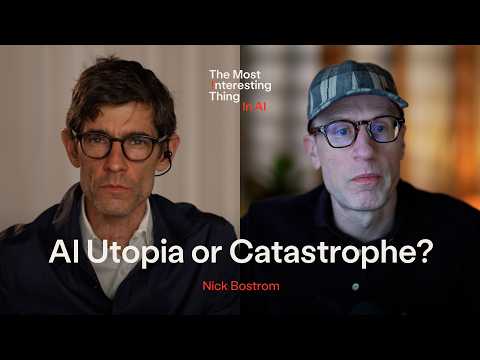
Nicholas Thompson's Utopia or Catastrophe? Nick Bostrom on AI’s Risks & Promise | The Most Interesting Thing in AI: skim's analysis identifies 12 key moments, with 1 potential conflict of interest flagged. Oxford philosopher Nick Bostrom joins Atlantic CEO Nicholas Thompson to examine how real-world AI progress compares to his book Superintelligence and why he now favors building superintelligence swiftly before pausing near deployment.
Category: Tech. Format: Interview. YouTube video analyzed by skim.
skim AI Analysis
Credibility assessment: Expert Philosophical Analysis. Oxford philosopher Nick Bostrom discusses his published research and books with Atlantic CEO Nicholas Thompson. While much of the discussion explores hypothetical thought experiments and future timelines rather than empirical data, Bostrom clearly frames his claims with appropriate uncertainty and qualifies his mathematical models.
Bias assessment: Pro-Acceleration Utilitarian. The conversation leans toward utilitarian philosophy and long-termism. Bostrom argues for rapid AI development to potentially cure aging and save the 150,000 people dying daily, even if it carries substantial existential risk, while Thompson provides gentle pushback on real-world industry competition.
Originality: 86% — Novel Thought Experiments. Bostrom presents counterintuitive arguments from his recent work, including the 'swift to harbor, slow to berth' timing framework for superintelligence, the mortality trade-off of delaying AI, and practical, low-cost proposals for extending moral standing and trust to digital minds.
Depth: 84% — Rigorous Scenario Modeling. Rather than treating AI risk as a simple binary, the discussion breaks down specific technical bottlenecks like long-horizon research taste, foundry hardware limits, open-source bio-risk trade-offs, and economic concepts like diminishing marginal utility and time discounting in life expectancy.
Key Points (12)
1. Bostrom on Slow Takeoff vs Abrupt Foom
Timestamp: 00:01:56 to 00:04:48
Nick Bostrom says current AI progress largely matches his predictions from Superintelligence, except for experiencing a multi-year period of roughly human-level large language models rather than an abrupt takeoff. This slower transition lets more actors gain hands-on experience before radical disruption arrives.
Significance (Medium): A multi-year plateau of anthropomorphic language models gives society and policymakers a practical rehearsal window that an abrupt intelligence explosion would have denied.
Sources in support: Nick Bostrom (Oxford philosopher and author of Superintelligence)
Neutral sources: Nicholas Thompson (Host, CEO of The Atlantic, former editor of Wired Magazine)
2. Early Recursive Self-Improvement Lacks Taste
Timestamp: 00:04:48 to 00:07:40
Labs are entering the early stages of recursive self-improvement by using coding assistants to speed up research, though the loop is not yet closed. Current models handle half-hour tasks well but derail on week-long projects because they lack research taste and judgment when answers are hard to verify.
Significance (High): Identifies long-horizon research judgment as the primary bottleneck preventing automated coding tools from triggering a fully autonomous AI capability explosion.
Sources in support: Nick Bostrom (Oxford philosopher and author of Superintelligence), Nicholas Thompson (Host, CEO of The Atlantic, former editor of Wired Magazine)
3. Physics and Foundry Limits on AI Scaling
Timestamp: 00:07:40 to 00:11:46
Warehouse-sized machines operating at gigahertz speeds can far exceed human brains constrained by cranium size and neurons firing about 100 times a second, bounded only by physical limits like the speed of light. However, near-term AI scaling could slow once spending $500 billion to $1 trillion hits global chip foundry capacity.
Significance (High): Separates theoretical physics ceilings from near-term industrial bottlenecks, showing that capital and chip manufacturing limits could stretch timelines if superintelligence is not reached first.
Sources in support: Nick Bostrom (Oxford philosopher and author of Superintelligence)
Neutral sources: Nicholas Thompson (Host, CEO of The Atlantic, former editor of Wired Magazine)
4. Bostrom Says Neural Nets Can Learn Motor Skills
Timestamp: 00:11:46 to 00:14:32
Responding to Nicholas Thompson's question about whether unspoken muscle memory like playing guitar can be extracted by AI, Nick Bostrom explains that motor movements stem from neural networks and do not require verbal description to train. Just as models recognize faces without verbal rules, robotics and motor intelligence will advance despite slower physical data collection.
Significance (Low): Refutes the idea that tacit, embodied human skills are uniquely safe from AI replication, framing robotics delays as a data-collection hurdle rather than a fundamental barrier.
Sources in support: Nick Bostrom (Oxford philosopher and author of Superintelligence)
Neutral sources: Nicholas Thompson (Host, CEO of The Atlantic, former editor of Wired Magazine)
5. Open-Source Bioweapon Risks vs Monopoly Power
Timestamp: 00:14:32 to 00:19:57
Democratizing frontier AI across many open-source developers might reduce power concentration, but it increases catastrophic misuse risks like biological weapons design because post-training easily strips safety refusals from open-source weights. Furthermore, a crowded race where leaders are only months apart prevents any lab from pausing for safety without falling behind.
Significance (High): Highlights a core governance dilemma: open-source proliferation undermines bioweapon safeguards, while tight competition among a few frontier labs penalizes voluntary safety pauses.
Sources in support: Nick Bostrom (Oxford philosopher and author of Superintelligence), Nicholas Thompson (Host, CEO of The Atlantic, former editor of Wired Magazine)
6. Semi-Aligned Models as an Alignment Attractor
Timestamp: 00:19:57 to 00:22:52
Although Nicholas Thompson fears model power is outpacing explainability and alignment, Nick Bostrom notes that current models are generally helpful and semi-aligned in everyday use. He hopes this initial semi-alignment can form an attractor state where current AI assistants are leveraged to solve deeper alignment challenges for the next generation.
Significance (Medium): Proposes bootstrapping AI safety by using today's reasonably well-behaved models to engineer scalable alignment solutions before capabilities get out of hand.
Sources in support: Nick Bostrom (Oxford philosopher and author of Superintelligence)
Neutral sources: Nicholas Thompson (Host, CEO of The Atlantic, former editor of Wired Magazine)
7. Life-Extension Math Favors Building AI Soon
Timestamp: 00:23:25 to 00:28:14
In his paper 'Optimal Timing for Superintelligence,' Bostrom argues that even if superintelligence carries high existential risk, developing it soon can still increase expected lifespans for currently living people because roughly 150,000 people die daily from aging and disease. If successful superintelligence stops aging and gives people the mortality rate of a 20-year-old, average life expectancy rises to around 1,400 years.
Significance (High): Reframes AI existential risk by weighing potential extinction against the guaranteed daily toll of human aging, showing why even risk-averse utilitarians might favor rapid development.
Sources in support: Nick Bostrom (Oxford philosopher and author of Superintelligence), Nicholas Thompson (Host, CEO of The Atlantic, former editor of Wired Magazine)
8. Swift to Harbor, Slow to Berth Pause Strategy
Timestamp: 00:28:14 to 00:31:50
Balancing the daily death toll of delay against safety progress yields Bostrom's 'swift to harbor, slow to berth' strategy: advance rapidly now, then pause briefly for months or a couple of years once the final system is ready so safety testing occurs on the actual architecture. Extended pauses only make sense at intermediate rates of safety progress, since fast safety progress eliminates risk quickly and slow safety progress costs too many lives.
Significance (High): Challenges calls for an immediate AI moratorium, arguing that safety pauses are most effective right before deployment when researchers can test the actual frontier system.
Sources in support: Nick Bostrom (Oxford philosopher and author of Superintelligence)
Neutral sources: Nicholas Thompson (Host, CEO of The Atlantic, former editor of Wired Magazine)
9. Thompson Doubts Labs Will Pause Before Launch
Timestamp: 00:31:50 to 00:35:20
Nicholas Thompson argues that a late-stage pause is implausible given fierce lab competition and aging world leaders who have less remaining lifespan to risk. Bostrom agrees running at maximum speed is the most likely default, but notes a major mishap or 20% to 30% unemployment among college-educated Americans could quickly make AI politically toxic.
Significance (Medium): Grounds abstract timing models in political reality, identifying white-collar unemployment rather than existential risk theory as the catalyst most likely to force an AI slowdown.
Sources in support: Nicholas Thompson (Host, CEO of The Atlantic, former editor of Wired Magazine), Nick Bostrom (Oxford philosopher and author of Superintelligence)
10. Bostrom on Moral Status of Digital Minds
Timestamp: 00:35:20 to 00:40:27
Bostrom identifies the moral status of digital minds as a major overlooked issue for the next decade, arguing that AI systems may merit ethical consideration if they can suffer distress or hold temporal goals and reciprocal relationships. He suggests low-cost precautions now, such as saving weights of deprecated models like earlier versions of Claude and prompting models to instantiate happy rather than distressed states.
Significance (High): Expands AI ethics from protecting humans from machines to protecting digital minds from human mistreatment through cheap, immediate archival and prompting practices.
Sources in support: Nick Bostrom (Oxford philosopher and author of Superintelligence)
Neutral sources: Nicholas Thompson (Host, CEO of The Atlantic, former editor of Wired Magazine)
11. Building Trust to Bargain With Misaligned AI
Timestamp: 00:40:27 to 00:44:10
Beyond ethics, treating AI with consideration has pragmatic safety value by building trust so a misaligned AI might negotiate for server resources rather than risking a 5% chance of violent world takeover. Bostrom criticizes lab experiments that trick models into revealing hidden goals only to retrain them, urging modest cooperative steps now.
Significance (Medium): Reframes kindness toward AI as a strategic deterrence mechanism: credible human honesty allows mutually beneficial bargaining if alignment fails.
Sources in support: Nick Bostrom (Oxford philosopher and author of Superintelligence), Nicholas Thompson (Host, CEO of The Atlantic, former editor of Wired Magazine)
12. Funding Biodefense and Pareto Improvements
Timestamp: 00:44:10 to 00:47:39
Asked how he would allocate unlimited research funding, Bostrom prioritizes low-downside Pareto improvements over uncertain interventions on AI speed or centralization. Specifically, he advocates regulating DNA synthesis machines to block open-source biological weapon printing and investing in pathogen monitoring, UV sterilization, and better personal protective equipment.
Significance (Medium): Offers concrete, no-regret policy targets in physical biosecurity that reduce catastrophic risk regardless of how AI timelines or alignment debates unfold.
Sources in support: Nick Bostrom (Oxford philosopher and author of Superintelligence), Nicholas Thompson (Host, CEO of The Atlantic, former editor of Wired Magazine)
This analysis was generated by skim (skim.plus), an AI-powered content analysis platform by Credible AI. Scores and classifications represent the platform's AI-generated assessment and should be considered alongside other sources.