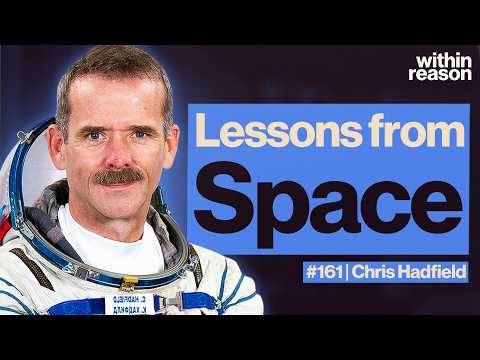
What an Astronaut Learned About Fate, Duty, and Meaning
Alex O'Connor
Summary
Retired astronaut and former International Space Station commander Chris Hadfield joins Alex O'Connor to examine the scientific, psychological, and philosophical realities of spaceflight. Hadfield challenges popular misconceptions that public interest in space has faded since Apollo 11, noting that the recent Artemis 2 mission has sparked global enthusiasm while most later Apollo flights were ignored. He explains how zero-gravity laboratories advance fluid physics, biology, and future Martian settlement, and distinguishes casual suborbital space tourists from professional astronauts trained to handle life-threatening emergencies without ground support.
Turning to psychology and creative work, Hadfield rejects cinematic tropes of lonely, emotionless, or adrenaline-driven astronauts, arguing that operational self-control coexists with deep human awe. He recounts how writing a foreword for Ray Bradbury's The Martian Chronicles led to his bestselling Apollo thriller novels, and concludes that while launching on Space Shuttle Atlantis carried a 1-in-38 chance of death, competence is the ultimate antidote to fear.
How time-sensitive the topic is: Evergreen
By the numbers
1/3 of Earth's population: Estimated share of people on Earth who followed the Apollo 11 moon landing, according to figures Chris Hadfield has heard. (Mentioned at 2:20)
16 orbits per day: Number of times the International Space Station travels around the Earth each day to observe planetary changes. (Mentioned at 10:03)
1957 year: Year the very first human-made object was launched into orbit around the Earth. (Mentioned at 13:33)
21 years: Duration of Chris Hadfield's career serving as an astronaut. (Mentioned at 26:00)
50 dollars/currency units: Approximate licensing fee spent to produce Chris Hadfield's viral music video recorded aboard the International Space Station. (Mentioned at 34:26)
35 languages: Number of languages into which Chris Hadfield's non-fiction book An Astronaut's Guide to Life on Earth has been translated. (Mentioned at 43:36)
15 languages: Number of languages into which Chris Hadfield's debut novel The Apollo Murders has been translated. (Mentioned at 47:21)
1 in 38 odds of dying: Calculated probability of fatal failure during the nearly nine-minute ascent on Chris Hadfield's first Space Shuttle Atlantis launch. (Mentioned at 51:05)
Questions this video answers
What scientific research is actually done on the International Space Station?
By removing gravity, the International Space Station lets researchers study pure fluid dynamics, combustion without heat convection, and microgravity's effects on human bone density, muscles, and balance. Orbiting Earth 16 times daily also makes it an unmatched platform for tracking long-term atmospheric and ocean changes and testing how humans will settle the Moon and Mars.
Chris Hadfield, 8:26 to 11:58
From this keypoint: Zero-G lab tests rules for settling Mars
What is the difference between a commercial space tourist and a professional astronaut?
Hadfield compares buying a suborbital space ticket to flying as a passenger on Ryanair after a 45-second safety briefing. While space tourists pay the price of a luxury car for a short ride, professional astronauts train for years to handle medical emergencies, meteorite strikes, and system failures months away from Earth without ground communication.
Chris Hadfield, 18:57 to 22:35
From this keypoint: Space tourists vs professional astronauts
Why did public interest in the Apollo moon landings fade so quickly?
Hadfield explains that the public often confuses scientific space exploration with entertainment. While roughly a third of the world watched Apollo 11, audiences lost interest by Apollo 12 and 13 because they treated the moon landing like a one-time PR stunt rather than an ongoing research program.
Chris Hadfield, 0:00 to 3:54
From this keypoint: Hadfield equates Artemis 2 buzz to Apollo
Do astronauts experience extreme loneliness and depression in space like in movies?
Hadfield says films like Ad Astra and First Man get astronaut psychology completely wrong by portraying crews as grim and isolated. In reality, carefully selected, non-claustrophobic crews experience spaceflight as a joyful, collaborative triumph shared with teammates.
Chris Hadfield, 23:15 to 26:25
From this keypoint: Hadfield debunks lonely astronaut myth
Are astronauts thrill-seekers who crave adrenaline?
No; Hadfield compares commanding a spacecraft to performing open-heart surgery, where an adrenaline rush would be dangerous. Because adrenaline is an evolutionary fight-or-flight response for escaping predators, astronauts rely on calm, cerebral preparation instead.
Chris Hadfield, 26:54 to 29:29
From this keypoint: Why adrenaline has no place in a cockpit
Does astronaut training make space travelers emotionless?
Hadfield argues that people confuse self-control with a lack of emotion. While flying an F-18 or commanding the space station leaves no room for emotional outbursts, astronauts still need deep artistic and philosophical sensitivity to appreciate the experience, as shown in Mike Collins's book Carrying the Fire.
Chris Hadfield, 30:35 to 33:40
From this keypoint: Self-control is not emotional numbness
How did astronaut Chris Hadfield become a fiction novelist?
Ray Bradbury's family asked Hadfield to write a 3,000-word foreword for a special edition of The Martian Chronicles. After reading that introduction, British publisher John Butler offered Hadfield an advance to write his debut thriller, The Apollo Murders, which became a bestseller in 15 languages.
Chris Hadfield, 43:27 to 47:35
From this keypoint: Ray Bradbury foreword sparked novel career
What does Chris Hadfield consider the biggest risk he has ever taken?
While launching on Space Shuttle Atlantis with a 1-in-38 chance of death was his greatest physical danger, Hadfield says being a parent is the biggest risk he has ever taken. Parents take responsibility for creating human lives who, after age 17, act independently with potentially massive consequences in the world.
Chris Hadfield, 47:57 to 53:09
From this keypoint: Parenting outranks 1-in-38 shuttle launch risk
Credible AI™ signals
Confidence: Direct Astronaut Experience. Chris Hadfield draws on 21 years as a CSA astronaut, combat fighter pilot, test pilot, and ISS commander. Historical claims about Apollo, Artemis 2, and orbital microgravity science align with established spaceflight records, while personal anecdotes about publishing and risk are clearly framed as first-hand testimony.
Bias: Pro-Exploration Humanist. Chris Hadfield strongly champions human spaceflight, framing lunar and orbital missions as a vital continuation of human struggle and planetary settlement. While Alex O'Connor raises common public skepticism about cost and spectacle, the discussion consistently favors the scientific and philosophical value of space exploration.
Originality (78%): First-Hand Space Philosophy. Rather than repeating technical mission logs, the conversation blends orbital science with literary craft and stoic risk management. Hadfield's distinctions between space travelers and professional astronauts, and between danger and fear, offer fresh conceptual framing grounded in lived experience.
Depth (76%): Thoughtful Conceptual Inquiry. Alex O'Connor probes beyond standard biographical questions to test assumptions about public apathy, emotional detachment in high-stakes roles, and the nature of bravery. Hadfield unpacks the physiological, sociological, and psychological layers of spaceflight, though the format remains conversational rather than technical.
Key points (12)
Short (16 min): key points 1, 8, 11 and 12
Medium (29 min): key points 1, 3, 4, 5, 6, 8, 11 and 12
Relaxed (46 min): all 12 key points
1. Hadfield equates Artemis 2 buzz to Apollo
Timestamp: 00:00:00 to 00:03:54 (4 min)
Speaker: Chris Hadfield
Alex O'Connor asks whether modern audiences are less excited by Artemis 2 than people were during the 1969 moon landing. Chris Hadfield counters that most Apollo flights were ignored by the public once the novelty of Apollo 11 wore off, because people confuse space exploration with entertainment. He concludes that Artemis 2 has actually recalibrated public inspiration, evidenced by the massive reception to the crew's world tour.
Impact: Medium. Why it matters: Corrects nostalgic myths about continuous 1960s space enthusiasm, showing that scientific exploration naturally experiences cyclical public attention.
“I think a lot of folks confuse space exploration with space entertainment. They're not the same thing. Sometimes uh exploring the universe is entertaining, but most of the time it's just like any other exploration or any other scientific endeavor.”
In the video: Chris Hadfield, at 2:40
Neutral: Alex O'Connor
2. Lunar missions unlock planetary history
Timestamp: 00:04:26 to 00:07:29 (3 min)
Speaker: Chris Hadfield
When asked why humanity should bother returning to the moon beyond taking pictures, Hadfield explains that holding the orbital high ground enables modern communications, GPS, and planetary physics. Placing laser reflectors on the moon revealed that it retreats at the speed fingernails grow, helping scientists investigate the cataclysmic origins of Earth. Beyond utility, he frames lunar return as the defining human struggle to turn impossible tasks into new capabilities.
Impact: Medium. Why it matters: Connects abstract lunar exploration to everyday satellite infrastructure and fundamental questions about Earth's geological survival.
“we learned uh that the moon is getting further away [clears throat] about the same rate that your fingernails grow. Uh the only way we could ever measure that was by putting laser reflectors or little tiny mirrors on the moon.”
In the video: Chris Hadfield, at 6:06
Neutral: Alex O'Connor
3. Zero-G lab tests rules for settling Mars
Timestamp: 00:08:26 to 00:11:58 (4 min)
Speaker: Chris Hadfield
Hadfield details how removing gravity aboard the International Space Station exposes fundamental rules of fluid dynamics, convection-free combustion, and human bone and cardiovascular adaptation. Orbiting the Earth 16 times a day also provides an unmatched vantage point for monitoring long-term atmospheric and oceanic shifts. Ultimately, he views the station and lunar bases as sociological proving grounds for how humanity will settle Mars without repeating past colonial mistakes.
Impact: High. Why it matters: Reframes the International Space Station from a mere physics lab into a sociological rehearsal for multi-planetary civilization.
“So the space station's a great uh experiment in that and how we settle the moon is is the next step in that leading towards how as our technology continues to improve will eventually settle Mars.”
In the video: Chris Hadfield, at 11:25
For: Alex O'Connor
4. Commercialization globalizes spaceflight
Timestamp: 00:13:15 to 00:16:03 (3 min)
Speaker: Chris Hadfield
Responding to whether space remains a national project, Chris Hadfield notes that all human spaceflight has occurred within his single lifetime since the first orbital launch in 1957. While early access was restricted to superpower states like the United States and the Soviet Union, falling costs now allow private citizens and companies to buy orbital launches and suborbital tickets. He predicts space travel is transitioning into a global commercial network similar to international aviation, requiring a new regulatory framework.
Impact: High. Why it matters: Highlights an urgent governance gap: commercial space access is outpacing the international traffic rules needed to manage it.
“It's no longer only the purview of trillionaires like the Soviet Union and the United States, but now uh a successful individual can buy a ticket and fly in space suborbbitly just go up and fall down again”
In the video: Chris Hadfield, at 14:44
Neutral: Alex O'Connor
5. Space tourists vs professional astronauts
Timestamp: 00:18:57 to 00:22:35 (4 min)
Speaker: Chris Hadfield
Hadfield distinguishes between casual space travelers and professional astronauts by comparing a Ryanair passenger to a commercial airline captain landing on the Hudson River. Anyone with the price of a luxury car can take a brief suborbital flight with minimal briefing, just as William Shatner did. However, operating a lunar spacecraft or space station months away from Earth requires exhaustive medical, psychological, and technical training to survive onboard emergencies without ground communication.
Impact: High. Why it matters: Clarifies labor standards in the emerging space economy by separating passive tourism from mission-critical command roles.
“As the technology gets better so that we can trust it more, the cost will continue to come down so that more and more people will be space travelers just as you can be an air traveler. But that doesn't make you a professional uh pilot or a professional astronaut.”
In the video: Chris Hadfield, at 20:47
Neutral: Alex O'Connor
6. Hadfield debunks lonely astronaut myth
Timestamp: 00:23:15 to 00:26:25 (3 min)
Speaker: Chris Hadfield
Addressing the archetype of the isolated spacefarer, Hadfield insists that spaceflight is a joyful, collaborative triumph rather than the grim ordeal depicted in films like Ad Astra or First Man. Selecting non-claustrophobic, highly competent crews committed to public service prevents psychological breakdown in tight quarters. He adds that thanking military pilots or astronauts for their service literally means thanking them for being willing to die on a stranger's behalf.
Impact: Medium. Why it matters: Dismantles Hollywood tropes of space madness while grounding astronaut selection in competence and sacrificial public duty.
“What they're actually saying is, "Thank you for being willing to die on my behalf even though we've never met." That's what a life of service is.”
In the video: Chris Hadfield, at 25:40
Neutral: Alex O'Connor
7. Why adrenaline has no place in a cockpit
Timestamp: 00:26:54 to 00:29:29 (3 min)
Speaker: Chris Hadfield
O'Connor asks whether astronauts are thrill-seekers chasing an adrenaline rush. Hadfield compares flying a spacecraft to performing open-heart surgery, arguing that no patient wants a thoracic surgeon operating on an adrenaline high. Because adrenaline is an evolutionary fight-or-flight response meant for outrunning predators, spacecraft operations instead demand calm, cerebral preparation.
Impact: Medium. Why it matters: Reframes elite high-risk performance around cognitive discipline rather than emotional arousal.
“In fact, the last thing you want to have happen is is to have adrenaline in your veins. Adrenaline is a is an ancient evolutionary trait that allows you to run faster than the wild animal that's trying to eat you.”
In the video: Chris Hadfield, at 27:53
Neutral: Alex O'Connor
8. Self-control is not emotional numbness
Timestamp: 00:30:35 to 00:33:40 (3 min)
Speaker: Chris Hadfield
After Alex O'Connor cites a scene from The Crown portraying Apollo 11 astronauts as emotionless soldiers, Hadfield counters that fictional shows perpetuate stereotypes and points to Mike Collins's philosophical book Carrying the Fire. Drawing on his own background as a performing musician and bestselling author, Hadfield argues that exercising self-control while flying an F-18 or commanding the ISS does not mean lacking emotion. An astronaut without deep heart and soul would be incomplete and miss the magnificence of the human experience.
Impact: High. Why it matters: Resolves the tension between technical discipline and human awe, showing how operational composure coexists with artistic sensitivity.
Neutral: Alex O'Connor
9. Hadfield uses fiction to capture orbital truth
Timestamp: 00:35:24 to 00:42:55 (8 min)
Speaker: Chris Hadfield
Hadfield explains that writing alternative history thrillers gives him narrative freedom to convey the sensory and emotional reality of spaceflight beyond the limits of non-fiction. By inventing composite characters and flaws, such as a one-eyed protagonist inspired by a friend's fighter jet accident, he can place a skilled aviator into constrained closed-room mysteries. He notes that no astronaut is physically perfect and medical standards evolve as agencies learn which physical traits actually matter.
Impact: Low. Why it matters: Shows how technical insiders use realistic fiction to communicate operational truths that strict historical reporting cannot capture.
“And so by writing alternative history fiction, thriller fiction as I do, it allows me to tell the fundamental story of what happened, but then weave in other characters. So you get other perspectives, you get all the different emotional range”
In the video: Chris Hadfield, at 36:32
For: Alex O'Connor
10. Ray Bradbury foreword sparked novel career
Timestamp: 00:43:27 to 00:47:35 (4 min)
Speaker: Chris Hadfield
Prompted by O'Connor, Hadfield recounts how the family of Ray Bradbury asked him to write a 3,000-word foreword for a Folio Society edition of The Martian Chronicles. Impressed by the imagery in that introduction, British publisher John Butler offered Hadfield an advance and a title to write his first novel. After heavy editing on an oversized draft, The Apollo Murders became a number-one bestseller in 15 languages, launching his four-book thriller series.
Impact: Low. Why it matters: Illustrates how cross-disciplinary skill transfer and taking reputational risks after retirement can open an entirely new creative career.
“And he came to me initially and said, "Did you write that all by yourself?" I said, "Yeah, of course I wrote it all by myself. What are you insinuating?" And he said, "Because I think based on that you could write fiction."”
Hadfield asserts that every worthwhile pursuit carries reputational or physical risk, recalling the anxiety of submitting his first novel manuscript and reading critical reviews. When O'Connor asks him to compare his greatest danger and his biggest risk, Hadfield identifies his first launch aboard Space Shuttle Atlantis, which carried a 1-in-38 chance of death over nearly nine minutes, as his greatest physical danger. Yet he names parenthood as the riskiest thing he has ever done because a parent creates human lives that can significantly impact the world beyond the parent's control.
Impact: High. Why it matters: Separates quantifiable mortal hazard from open-ended moral responsibility, offering a grounded perspective on personal risk.
“a and that would be uh flying space shuttle Atlantis for the first time. The odds of dying that day were one in 38 and not just for a second but for uh almost 9 minutes and one in 38 you know that those are bad odds.”
In the video: Chris Hadfield, at 51:01
Neutral: Alex O'Connor
12. Competence is the antidote to fear
Timestamp: 00:53:09 to 00:56:49 (4 min)
Speaker: Chris Hadfield
Hadfield argues that people falsely equate danger with fear, explaining that danger is an objective condition while fear is a reaction to not knowing how to handle it. Because the greatest antidote to fear is competence, he prepares relentlessly for high-probability emergencies so his fear drops to zero even when the physical danger remains unchanged. Even when facing a 1-in-38 launch risk or unpredictable traffic, mastering controllable decisions maximizes survival odds and shapes one's destiny.
Impact: High. Why it matters: Provides an actionable framework for stress management: treat fear as a diagnostic signal of under-preparation and replace it with targeted skill building.
For: Alex O'Connor
Conflicts of interest (2)
Book Promotion for Final Orbit
Commercial conflict, Medium severity
Chris Hadfield is the author of the novel Final Orbit and the Apollo thriller series, with a direct purchase link featured in the video description.
Sources: Chris Hadfield
Significance: The middle third of the interview focuses heavily on the merits of Hadfield's fiction writing and character design, serving as promotional exposure for his book series.
Host Sponsorship by Huel
Commercial conflict, Low severity
Alex O'Connor receives sponsorship compensation and affiliate commission from Huel via a promotional discount code.
Sources: Alex O'Connor, Huel
Significance: O'Connor delivers a two-minute endorsement of Huel nutrition products mid-episode, though the sponsor has no bearing on the spaceflight discussion.
Key sources
Alex O'Connor: Host, The Within Reason Podcast
Chris Hadfield: Retired Royal Canadian Air Force Colonel, Test Pilot, CSA Astronaut, and Author
Who's in this
International Space Station
Huel
William Shatner
Mike Collins
Association of Space Explorers
Ray Bradbury
John Butler
Also mentioned
Artemis 2 (First mentioned at 0:34)
Apollo 11 (First mentioned at 2:10)
Final Orbit (First mentioned at 12:13)
Kaz Zemeckis (First mentioned at 38:35)
Apollo 8 (First mentioned at 1:40)
Mars (First mentioned at 11:37)
Apollo-Soyuz (First mentioned at 12:20)
United States (First mentioned at 12:56)
Soviet Union (First mentioned at 14:47)
Ryanair (First mentioned at 19:09)
Ad Astra (First mentioned at 24:10)
First Man (First mentioned at 24:10)
The Crown (First mentioned at 29:28)
Prince Philip (First mentioned at 29:31)
F-18 (First mentioned at 31:45)
Carrying the Fire (First mentioned at 32:17)
An Astronaut's Guide to Life on Earth (First mentioned at 43:27)
The Martian Chronicles (First mentioned at 44:31)
The Apollo Murders (First mentioned at 47:18)
Space Shuttle Atlantis (First mentioned at 51:01)
Apollo 12 (First mentioned at 2:26)
Apollo 13 (First mentioned at 2:28)
Ottawa (First mentioned at 3:32)
Europe (First mentioned at 3:36)
iPhone (First mentioned at 4:21)
GPS (First mentioned at 5:28)
Africa (First mentioned at 10:41)
Americas (First mentioned at 10:50)
Antarctica (First mentioned at 11:03)
South Pole (First mentioned at 11:06)
Canada (First mentioned at 12:56)
Navy SEAL (First mentioned at 18:26)
New York (First mentioned at 19:38)
Hudson River (First mentioned at 19:48)
Star Trek (First mentioned at 20:16)
Sean Penn (First mentioned at 24:19)
The First (First mentioned at 24:24)
X-Men (First mentioned at 28:43)
Marvel (First mentioned at 28:43)
Contact (First mentioned at 30:59)
Jodie Foster (First mentioned at 31:01)
This analysis was generated by skim (skim.plus), an AI-powered content analysis platform by Credible AI. Scores and classifications represent the platform's AI-generated assessment and should be considered alongside other sources.